User Acquisition reports and market data
Documents
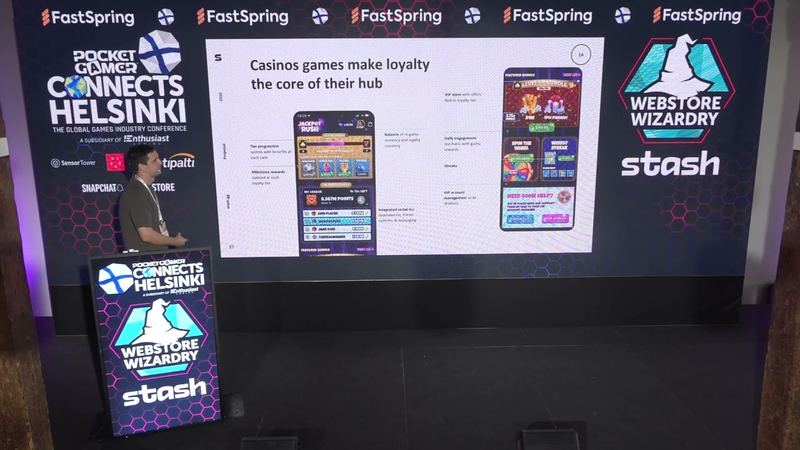
Session: Unlocking D2C Growth: Embedded Payments + Reward-Driven Incentives - Archie Stonehill.
Direct-to-consumer (D2C) growth in the gaming industry is increasingly driven by the strategic integration of embedded payments and reward-based loyalty programs.
- Direct-to-consumer (D2C) loyalty programs are highly effective for channel shifting, allowing studios to remain profitable even when giving away up to 25% of value because of the increased margins captured by bypassing platform fees.
- Android's upcoming regulatory changes in the US are expected to significantly expand alternative distribution and native app payment options, potentially surpassing the current scope of iOS linkout policies.
- Loyalty programs should be designed as a core hub for the D2C experience, utilizing rank-based benefit multipliers that increase rewards as players spend more, thereby incentivizing long-term adoption of the web store.

🎮 The 2 product trends that rule Mobile Games in 2025 by Jakub Remiar
The mobile gaming landscape in 2025 is defined by two dominant product strategies: the sophisticated user acquisition (UA) product funnel and the widespread adoption of game templatization.
- The mobile gaming market is currently dominated by a three-part UA funnel consisting of hyper-casual 'fake' ads, a corresponding 'fake' onboarding experience, and a 'real' core game like 4X or idle strategy.
- Studios such as River Games and Century Games use this multi-stage funnel to lower customer acquisition costs by attracting a broad audience before transitioning them into high-revenue, complex gameplay.
- Game templatization has become a primary strategy for scaling, where studios like Habby and Microfun recycle proven meta-game structures and UI layouts to increase the speed and volume of their product releases.

🏰👠 The Tower GD Masterclass Review: The ultimate Cinderella story
The Tower serves as a compelling case study in the mobile free-to-play market, demonstrating that deep mechanical complexity and community-driven engagement can generate substantial revenue, even in the absence of high-fidelity art or traditional production values.
- The Tower has generated over $50 million in total revenue with daily earnings peaking at $80,000, proving that minimalist, data-heavy interfaces can drive significant financial success.
- The game achieves long-term retention by prioritizing a core loop of macro-management and grinding, eschewing traditional energy-based monetization in favor of deep progression systems.
- A lean team of four full-time employees manages the project, utilizing a hybrid growth strategy where 50% of installs are organic, driven by an active Discord community and a creator code program.

🎮 Habby finally SPEAKS: The template evolves! First-ever Habby Western interview
Habby has evolved from a publisher of simple puzzle games into a powerhouse of midcore, IAP-driven mobile experiences, exemplified by the global success of titles like Survivor.io and Archero.
- Habby has transitioned from simple puzzle games to a midcore, IAP-driven model, leveraging a repeatable development template that balances accessible onboarding with long-tail engagement.
- To combat rising user acquisition costs, Habby is shifting away from the hybrid-casual market and investing in long-term partnerships, such as a $2 million commitment to Mavis Games.
- Successful scaling requires integrating monetization directly into the core game loop, a strategy where Chinese developers currently outperform Western studios that often treat revenue as an afterthought.

🇨🇳 AI trends n Mini-Games: MVP in 2 weeks. 80% of Chinese mini-game developers already use AI
Artificial intelligence has become a foundational element of the Chinese mini-game ecosystem, with approximately 80% of developers currently integrating AI tools into their art, coding, operations, and user acquisition (UA) pipelines.
- Approximately 80% of Chinese mini-game developers have integrated AI into their production pipelines, resulting in an 80% increase in overall development efficiency.
- AI integration has reduced the timeline for developing a minimum viable product (MVP) from two months to just two weeks, significantly lowering production costs to under $40,000 per game.
- Studios are utilizing proprietary LoRA models trained on specific art styles to maintain visual consistency and copyright compliance while avoiding the generic look of standard AI models.

🎮💰 Triumph’s Story: From Brick Breaker to the $100Mil
Triumph has successfully scaled a skill-based gaming platform to over $100 million in total payouts by focusing on a high-velocity, fee-based model.
- Triumph has achieved over $100 million in total player payouts by operating a skill-based real money gaming platform featuring 13 mini-games.
- The platform targets a core demographic of 21–35-year-olds, with users typically making their first cash deposit within five minutes of downloading the app.
- User acquisition strategy relies heavily on 'trust-based' advertising, utilizing celebrity endorsements and influencer livestreams to build credibility for the withdrawal process.

🚨 EMERGENCY EPISODE 🚨 Is EU’s Digital Fairness Act REALLY killing Free-to-Play games?
The European Union’s proposed Digital Fairness Act represents a significant regulatory shift aimed at restructuring the monetization frameworks of free-to-play gaming.
- The EU’s proposed Digital Fairness Act mandates a 14-day refund policy for virtual goods and restricts core free-to-play mechanics like multi-currency systems and dynamic economy balancing.
- These regulations threaten the operational viability of live-service games by dismantling the flexible, inflationary economic models currently used to drive revenue.
- High compliance costs and reduced monetization agility may force developers to exit the European market or shift toward ad-supported models, potentially degrading user experience.

💰 Mini-Games = Mega Revenue: Inside China’s gaming revolution
China’s mini-game sector has emerged as a dominant force in the domestic digital economy, generating $5.6 billion in revenue in 2024 with projections to reach $6.5 billion by 2025.
- China’s mini-game market generated $5.6 billion in 2024 and is projected to reach $6.5 billion by 2025, supported by 600 million monthly active users.
- The sector is shifting from ad-based revenue to in-app purchases, driven by a transition toward complex, high-retention genres like strategy, MMOs, and idle games.
- Mini-games bypass traditional mobile app store fees and the time-consuming ISBN licensing process by operating directly within platforms like WeChat, Douyin, and Alipay.

Min-Maxing Your Steam Launch
Steam serves as a critical marketplace where long-term success is dictated by the efficiency of a store page’s conversion rate during the initial 72-hour launch window.
- Success on Steam is driven by the perception of value conveyed through store pages and trailers, as high-quality games can fail if they do not effectively communicate their appeal to the target audience.
- To identify emerging market trends, analyze the number of releases in a specific genre over 1–2 years; a consistent growth rate of 25% to 50% year-over-year indicates a viable momentum for new projects.
- The 'seed audience'—the initial group of players the Steam algorithm tests your game with—is critical for conversion; if the game is recommended to an incompatible audience, poor early sales data can negatively impact the algorithm's long-term visibility.

📊 Creative Optimization Masterclass: Creative ROI & Scaling Across Networks
The primary objective of modern user acquisition (UA) is to shift focus from vanity metrics, such as install volume and click-through rates, toward creative-level return on investment (ROI) and lifetime value (LTV).
- Shift user acquisition focus from vanity metrics like install volume and click-through rates to creative-level ROI and long-term ROAS.
- Evaluate campaign success based on high-quality user milestones, such as tutorial completion or reaching level 15, rather than cost-per-install (CPI).
- Implement unified dashboards to map creative assets directly to in-app events and revenue data across networks including Facebook, TikTok, Google, AppLovin, and Moloco.

💰 Ad Monetization Trends - Prison games take over by Felix Braberg
The mobile gaming market is currently experiencing a significant shift in simulation and idle arcade genres, characterized by a widespread transition toward prison-themed titles.
- The mobile simulation and idle arcade genres are shifting toward prison-themed titles, replacing the previous market dominance of supermarket-themed simulators.
- Supercent's 'Prison Life' generates an estimated $38 million annual run rate by combining high-frequency rewarded ads with interstitials and a free-to-premium speed-up onboarding funnel.
- Developers are successfully reskinning existing supermarket simulator mechanics to fit prison settings, as seen in titles like 'Prison Escape Journey' and 'Prison Escape Simulator'.

Masters of Publishing 4: One Viral Ad Won’t Save You (Karen Levy, Creative Operations)
Sustainable growth in the hybrid casual gaming sector relies on a sophisticated, data-driven approach to user acquisition that prioritizes long-term retention over short-term traffic spikes.
- Integrating creative teams into the early development process allows for marketability testing that can reduce cost-per-acquisition by 30% to 40%.
- Sustainable growth in hybrid casual gaming requires aligning marketing creative with authentic gameplay to ensure long-term retention and higher lifetime value.
- Successful user acquisition relies on a dual-track methodology that balances high-volume, AI-assisted testing with high-quality production.