VideoTwo & a Half Gamers
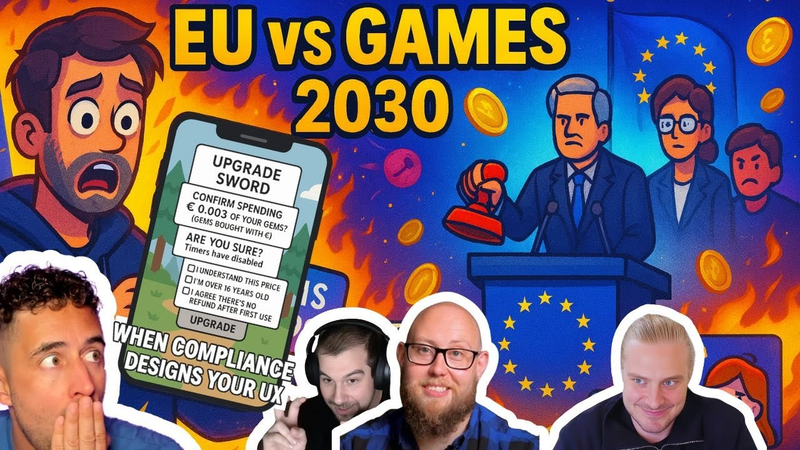
🚨 EMERGENCY EPISODE 🚨 Is EU’s Digital Fairness Act REALLY killing Free-to-Play games?
8 Oct 202541 min video
I guess what you're saying is that the rich companies that have enough money to do this would remain in the EU and the other ones would simply just not target the European Union people, right?
Yeah, it's additional work. It's like a lot of additional work.
What I think will happen, Felix, I actually think that the TAM of Europe will go down because people won't target or do UA and European Union because they're not willing to do the extra work or they want to limit it. So all that happens is budgets increase in the US, Turkey, China, etc. And it's it's us in the EU that basically just lose
and we're rolling the dice with ads making those coins rise up chasing the sky with the two and a half gamers the midnight crew talking u adversar [Music] master eyes on the prize tracking data through the cyerspace skies Felix stacks colors like a wizard in disguise Challenge craft realms lift us to the
highest. Two and a half gamers talking smack. Slow hockey thick got your back. Ads are beautiful. They like the way. Click it fast. Don't delay. Uh-huh. Uh-huh. Uh-huh. 3 2 1. Hello everyone and welcome to an emergency podcast of the Two and a Half Gamers podcast. Today, like we said, it's an emergency episode because we are going to be discussing everything we know about the Digital Fairness Act. I'm Felix Broberg. My
name is Matthew.
I'm Yakubier.
And I'm John Ry.
That's right. And
we
we are Come on, guys.
Doesn't work all the time.
Doesn't work. It's fine. But don't worry. Yeah. Great. Great to have you here, John.
Thank you for coming.
Yeah, good.
Let's discuss this. Let's discuss this whatever
because
unless you've been living under a rock today. There's been a lot of stuff on LinkedIn around
people have jobs. I'm not I don't have time to sit on LinkedIn the whole day and I and you were just bombing us like, "Oh, you're at this." Like, guys, I need to work. So,
that's why we're doing this.
Yeah. This is work. Okay. Fairing our livelihood. This could change everything. You need to be on top of this, man.
That's true. Yeah.
So, basically everything, the reason why we're here, so I'm going to tee this up and I'm going to go through the proposed idea ideation paper, right? But the digital fairness act is essentially proposed by the consumer produ uh protection corporation network in the European Union which is basically a enforcement network of national consumer protection agencies that basically work together on an EU level. So each country has a consumer protection agency and this is like the federated version of that and basically their job is to protect consumers in the EU. That's what
they exist for. That's their whole livelihood, right? And in March, basically they came out with a public consultation paper which looked exactly like this. I'm going to share screen.
And they had to stress this. What was the date, Felix? Again,
21st of March, 2025. So, it's been out for quite a while.
Yeah.
Yeah. So, it's been out for quite a while, right? And in this paper, they're essentially outlining
It's old news.
Yeah. It's old news. But I had no idea. Did you guys know about this? No, of course not lobby because nobody cares.
Okay,
my usual you lobbyist meeting.
Exactly. Right. And that's kind of the issue, right? So they outlined seven principles. I'll just go through them really briefly right now and then we can kind of talk about it. But the first principle that they want to drive through in this proposed legislation, which if approved, which is a big if, would become law in 2030, right? So the first principle that these guys want us to take or as a gaming industry or for
anyone targeting games in the EU, the first one is that price indication should be transparent. So basically when you're buying any in-game asset, you would have to put the realworld price equivalent for gems. So if you're buying something in gems in a game, you basically also need to indicate what the price would be, right?
Need to see 0.0235. 0235 of you know on my on my popup. Can't wait.
All right. Here's probably the one that I think will that the second most I disagree with the most, right? But this one is essentially for bundling, right? So the second practice they want to decouple from games or from consumers in games is that basically you can't bundle things together. You have to sell things virtually separately, right? So no more bundling and no more welcome packs, stuff like that, right?
Special offers. Yeah, exactly. Byebye.
Yeah. Special principle number three is that basically
Oh, wait a second, man. Like, go back. As I see it, this says something
different in my book.
Sorry, it's a third one. So, basically, yeah, obscuring the cost. So, basically, it's not showing what essentially things are worth, right? So, it's mixing multiple virtual currencies in one game, right?
But like mixing multiple virtual currencies, let this sink in. That means like what? Like every single RPG is out because I need multiple currencies.
You can't have multiple currencies, right? because that obsc that basically obscures how much something actually costs, right? And then the third
No, no, like again, read it again. It's not really just multiple currencies. It's just that multiple in-game virtual currencies in one video game because we need those like just imagine how many let's just go through it and then like we can just discuss it, right? So then the next one, the principle three is the bundling part, right? So no bundling. So yeah, you have to actually show what the price is and you can't just do things together, right? Fourth principle, you basically should have before you buy anything, you should be given clear and comprehensible pre-contractual
information. So I guess this would be your warning like uh logo that would come up and basically say this one, principle five, is probably the one I agree with the most, which essentially is that in the EU when you buy something, you have the right to return that product within 14 days. So that's a European rights and basically they say that you should also be able to return anything you buy in the digital sphere right within 14 days.
You buy a special well you buy something you play for 14 days then you get a refund and then you do it again and then you basically play forever for free.
No man special gotcha just just let that gacha sink in. You didn't roll what you wanted.
Yeah.
Come on. Yeah. Yeah. And then principle six is that contractual terms should be fair and written in plain clear language. So this is probably the weirdest one because one of the things they're also suggesting here is that you as a gaming company can't modify the value of in-game virtual currency after you release the game. So basically any
changes to the economy after you release the game wouldn't be allowed which is fantastic weird.
There goes optimization and balancing. Like just this one line is every single terms of agreement of every single game that's on the market. They can do whatever they want at any point unilaterally and shut down the game at any point. That's how it's done. It's every single one.
Right. And then for the final one, which I I can't wait to see Mate's reaction here, right? So basically, it's that game design and gameplay should be respectful to consumers with vulnerabilities. But let me read you this part because it's actually crazy because it kind of says a lot about what these legislators are actually thinking about our industry. Let me read you here. Consumers that are willing to spend an excessive amount of money on and in a video game or so-called whales may be considered vulnerable since they are likely to struggle with impulse control or gambling disorders. So they're saying that essentially anyone
who's spending a lot in a video game most likely is gambling addicted. This is this is basically the the the the point of view of everybody who is talking about games that they are just gambling. It's just gambling. I mean
you're you're a whale. Are you gambling addicted?
Yeah. I I have disorders but not this these types of disorders for sure.
So pretty much two days before this paper came out in March. There's also this thing that came out which is basically the same agency that basically came out United against Star Stable which is a Stockholm studio that's based on how can you describe it Jakob you going to describe
Sweden is the problem
you have a Swedish company we don't talk about Sweden
I think yeah
me and over there uh you know representing Sweden
anyway So these things together
is a very specific developer from Sweden that focuses on children's kind of horse
theme games.
Yeah, basically like it's it's your like my Little Pony fantasy something.
Yes. Slightly different but still like it's just horse game for kids basically.
Yeah. Basically
for girls main. Yeah.
You can choose like a boy gender in the game.
Yeah. So getting into how legislation in the EU works, right? So there's four main stages to passing laws, right? So right now what we have been in and what ends tomorrow on the 9th of October is what's known as public consultation where essentially the suggestees they present a couple of things. So this is one of them. What I just read out before is another position paper which is basically evidence submissions. Then when that closes basically starts the commission draft work which is basically slated for late of this year to mid 2026. And that's essentially when the commission makes internal drafts and they assign a commissioner to basically drive this forward. And this is basically in lobbyism terms when you as
a consumer or someone has the most influence to basically change what actually goes in it because this is when they draft the actual proposal. So then in Q3 in 2026, that's where basically the full legislative text would be submitted and be able to be downloaded by people in the EU. Right? Then in 2027, this would be debated among parliament like parliamentarians. And then that's when you've had amendments, committee reports, and voting. So this is essentially stage three uh 2, three, and four. That's essentially where you have a lot of influence and essentially where lobbyists get to work on basically having their insights. So that's exactly what's going on. But
wait a second, just just to finish the process, it goes to parliament voting floor and it needs to pass.
It might not pass, right? It's in my guess like it still might not pass even after all this
Absolutely.
Yep.
Yeah. So I spoke to a lobbyist for this and basically this is huge business right. So he said like if you want to fight this usually Yeah. Usually what happens is that you get together you
raise 1 to2 million euros you hire the best lobbyists and then they fight on your behalf. Right.
Fight laws.
So it's not a law right it's a proposal.
Yeah. Exactly. It's not the law yet.
Yeah. So what lobbyists do is basically they make papers exactly like this that argue the other side but the lobbyists themselves can't make these position papers because that's not seen as fair right so usually what they do is they work with think tanks so they go to a think tank they pay them
hello can you post something for me please on LinkedIn oh yeah yeah sure you have oh yeah that would be
that basically like not that it needs to be impartial so what you do is you go to a think tank you pay them €100,000 to write a position paper according to your views that then you as a lobbyist can argue in the draft proposal. Right. So you go Exactly. Exactly. Yes. It's essentially Yeah. Excus.
I had a great time on the call finding this out. Right. So now essentially it's when you hire lobbyists to argue this
and basically they pay think tanks to write your positions because they're impartial even though you pay them.
Of course. Yeah. All right.
They're so impartial. Everybody gets their cut along the way. It seems
everybody has an agenda. So anyway,
everyone's earning money, you know, until the end.
So anyway, first takers here guys, do you want to talk about any of these principles before we kind of get into
implications?
Yeah, implications, right?
Let's go one by arm by the boxes. So
one by one.
Yeah. So first one, the cat, let's call it the cat is basically the oldest trick in the freeto play book, which is you always mask the real world value by using like non-real world currencies. It's like it's there, it's out there, we know it, you know it, everybody knows it, it's normal on this basis. I can agree with it that like it's protecting the consumer and da da da da da da like you can do these things of course but the problem is that games don't work that easy in a way that you just obiscate it and suddenly you know like the value of every single item thing whatever you put hard currency on it
changes for instance you have inflationary economies like even Clash Royale has an inflationary economy the value of gold changes within the game during your progression because you have more gold being given to you on arena 10 compared to Arena 2 or whatever. Therefore, even in the shop amounts change, everything changes. So, yeah, you can do these things like that's nice of you, but I can't imagine the amount of bureaucracy being added into just the game designers whatever. There literally would need to be a company that has some kind of SDK in to can just do this. Basically,
basically what would happen here, I guess what you're saying is that the rich companies that have enough money to do this would remain in the EU and the other ones would simply just not target the European Union people, right?
Yeah, it's additional work. It's like a lot of additional work to just
like what I think will happen, Felix. I actually think that the TAM of Europe will go down because people won't target or do UA in European Union because they're not willing to do the extra work
or they want to limit it. All that happens is budgets increase in the US, Turkey, China, etc. And it's it's us in the EU that basically just lose.
And people people do decisions based on even much less intrusive stuff. I remember when I was in Japan before Corona, I was talking to some local producers and they literally told me like, "Oh, we don't want to go to EU because GDPR." Like, really? That's your main hurdle?
Well, now I'm I have a gaming soft launch which also has the same problem. like oh we kind of postponed GLE EU because of the GDPR stuff and then we soft launch again
because GDPR is really kind of easy you know compared to this. Yeah, exactly. Exactly. But it's another it's another hurdle, right? It's a thing that people have to get their head around, have to learn about and you know, and it costs money and sometimes things are not worth the effort, right? Or they don't think they're worth the effort.
Yeah. So here's the second principle, right? So obscuring the cost of in-game digital content and services should be
avoided, right? So it's basically the practices they're outlining here. The second one offering for purchase and mixing different in-game virtual currencies in one video game should be banned. So I guess this is them saying that you need one currency. Maybe the euro, I don't know, like
economies just don't work with one currency, period.
It's just like impossible. You need multiple currencies in order to be able to kind of create different circles of economy and progression that needs to be independent of each other. Otherwise, like economy crumbles basically.
So I guess like what are they saying? Casinos are okay, but then games I guess like Yeah,
because casinos just use money, which is like money is fine. It's okay. Money is okay for blackjack and for roulette.
Basically, basically.
Yeah. I guess this one is the weirdest. Principle three, right? Where basically they say that force customers to purchase unwanted in-game virtual currency should be avoided. So, this is the bundling one, right?
Who's forcing who's forcing anyone to buy stuff? I mean, come on. I think what the guy who was designing it meant that he would literally want to type like, I
want to buy 38 gems and it would give him a price. Like imagine like a grocery store like he goes and like like give me my tomatoes. Like I just want three of them.
Why wouldn't this work? Just steel mounting it. Yakob,
it can work, but we get to the decimal thing, whatever. And and the worst part is that all of these things that you see here from the game designer standpoint, why you do these bundles is because you create anchor. You create an anchor so people can derive value from it. When an offer comes in, then the offer is a bargain compared to these prices which creates the value of the offer and then the discount makes the bargain itself basically. So yeah, it's pretty hard to kind of go against this philosophy in the current setup. But supermarkets do this all the time. They jack up prices and then like oh there's discount even though the price was the same two weeks ago.
Yeah. You know, just make it happen.
Exactly. So yeah, I guess Felix, go please uh Ctrl F or like search and and see if there's any mention of the word
loot box because I'm kind of super surprised that there's no mention of this because I would have thought that like this whole principle if if you scroll up a little bit and like what what it says there that then I should but I think it was even more like unwanted something items or something. That's basically definition of rule books or
I have a I have a theory on this because there was legislation a couple years ago in the EU that got voted down against loot boxes. So I have a feeling they're avoiding that but basically they're using other words right but
but this is even worse to some degree like some of the points that they're like putting into the law here are even worse.
Is it worse for the consumer would you say or is it worse for game developers?
Come on you can you can look at from the consumer. I guess we can go to the like very high level implication later which what this would do in context of like reality check of like you know different markets different developers outside of EU power of develop and stuff like that like
well you can just go now no like we always say let's do it later we never do it so let's just go here like let's
just imagine that like for a consumer it's because as as as John mentioned like some people just will not consider this worth the effort as essentially you have less games for your accessed because like nobody cares now about this like store bloated with regulation that I need to first cut through in order to release the game even on the market. Yeah, bye-bye. Like my game just won't go there. Great consumer protection protected from the from the whole game. That's number one. Number two, the enforcibility of this will be very questionable like how do you enforce this and like how how this whole thing will kind of look like in in practical terms which means that like we have still the giant problem and like elephant in the room that is called fake ads that nobody cares about and like that that's been running a mock all like last I don't know how many years that's okay but but this unacceptable so
and plus like I've been to a supermarket and sometimes basically like shampoo and conditioner They bundle it together and it's cheaper. Likewise in the supermarket, you know what I mean?
Behavioral behavioral economy practices
that's been there out there from like I don't know ' 70s or something. It's
buy one get one free.
It's normal commerce.
Yeah. And I guess also I want to add to your point Jakob that like eventually like if there's less games being played in the EU that's also less jobs eventually for people working in the EU in the gaming sector, right? So
doesn't make sense. But as I said like this just gives more power to the outside competitor countries pretty much like US developers, Asian developers, they just won't care about this, you know, we we just when our own market can shut down away from us. So we'll be just forced to go to their market, our market like we'll be just sitting doing nothing pretty much.
Yeah, this is my major concern guys is the ramifications like people will stop investing into spending money into Europe. You know, European consumers will get less content and less games. job market in Europe for for gaming companies will subside and you know we'll lose x,000 positions out of the 100,000 we have currently within Europe
and then everyone's just trying to you know fight their way out of the EU and and trying to go to greener pastures right we've got teams being airlifted to to US or Southeast Asia or China and the only one who loses is the Europeans and also the consumers themselves because they won't be able to play the games they want and then what do they do VPN in to other countries to get access to the games and IP that they want and then just
like I I think like we don't really need to go far to kind of see the ramifications of this like you've seen what happened in China where like these very massive time constraint regulation were put in which means that it's driving their developers to go out and expand into outside market outside of China which is like makes life harder for us. So this would be basically kind of similar setup where like everybody from Europe would still continue making games but they wouldn't just be focusing on EU markets anymore. or they would be still focusing on US uh whatever Asia and like wherever they can kind of get their uh kind of market share much easier than this basically.
Yeah. How much money do you actually can
get from EU markets in comparison to US or Asia?
Yeah, we can we can check and like see like how how like some of the games to Yeah.
I mean of course it's not
mobile games are not made for like EU. They are made for either west or or east. That that's the usual denominator. But still, you're still talking about 20 25% of a 100 million TAM of mobile as part of a 190 TAM of gaming, right? So, you're still talking uh 20 25 billion, I guess. You know, potential loss.
I guess there's only be going to be ad monetized games then in the EU.
There you go.
Felix is celebrating right now.
All right. Okay. This one provided with clear and comprehensible pre-contractual information. This is the warning screens, right? The warning you're about to make a purchase. Yeah,
I mean seriously I mean I was reading some of these like notes from also Mr. John Ride here is labeled as catastrophic. This is catastrophic for the for the industry. Like come on guys. Like chill the out. Also like this is another IDFA moment in the industry.
Maybe what happened. Yeah. Are we here? Yes. What changed? Literally almost nothing iOS. Come on.
What are you talking about? Like the kaggle of the industry is dramatically lower than what it was preat. We have our trajectory as an industry is nowhere close to what it should have been.
Ad monetization is like not a thing please
temporarily maybe maybe I mean come on
man the power shifted that's the thing power shifted if you cannot do your you know fake fake ads fake onboarding game fake thing funnel you just price out of the market which means again Asia going here and doing what they want and we can't do because people are just not capable pulling that thing off.
Exactly. So but then who whose problem is it is because of it? No, because pro because people are not capable of doing things and adapting which is their problem. That's it.
I know but you know at some point like uh especially with these giant super states kind of economy problems kicks in.
All right. Do we want to talk about the
last like two ones as well or do you want to talk about Ilka's position favor or I guess
those are super important.
Yeah.
The one which one was the previous one go up
this basically right withdrawal. So after 14 days, you have the right to get your money back.
Favorite favorite the endless roll of gacha.
Yes. Exactly. Until I'm satisfied when I get I'm seeing this as something different. I'm saying I'm seeing this as right if I bought some currency for and we held it I held it for 14 days and I didn't use it then I can get a return right which I think is active in most sort of bigger AP games. Anyway,
of course we bought the currency. It's called scrolls or it's called keys or whatever it is called man that you use and throw into the gacha. I want it back. So what now?
Yeah. Okay. Look, GA makes this much more complicated for my thing. It's just buying that currency. I can return it, right? Same as taking back something to the shop.
Katcha just won't work with this. Period. Goodbye. It just won't work at all. So I don't see how the current
market which is I think I would guess top 100 is like 70% having gacha based mechanics. Yeah. There you go.
Yeah. And principle six, contractual terms should be written in fair and plain language. So this is the one that really got me going because basically they're changing like you can change your virtual currency after. Right. Explain why this is right and why you need to be able to rebalance your economy as the game is basically released. I
I don't I don't get this like like at aiming with this like it means that like if I spend money with it, it's considered to be like consumer goods like something as similar to consumer goods. that's like, you know, on the real world market. Like that's what they're saying here. Like, does it also mean that they're forcing you to kind of keep up the game in its original state forever? Like, it just doesn't work at all.
I guess this would be like, hey, if I put it in a real world example, if you're a supermarket, you're not allowed to change the prices of the goods inside the store
during the day.
Yeah. During the day,
like from the point you put it on the shelf for the first time, then it's
price fixed for the for the forever. But you can change the prices like you know every every single month inflation kicks in prices go up. So there's a little bit of nuance I think we're missing here. But still just the terms of agreement of every single gaming company. If you like go into the game it always starts with like we have the right to do whatever we want with the game with its currencies with the thing that you buy with everything. Like it's just every single terms of service is there. So, nobody's buying like a chunk of land or something that's like protected by whatever EU laws like I don't know like this this seems like out of the out out of touch completely like with the reality of like how software development even works.
Yeah. And the final one here, right, which assumes that everyone who spends a lot or a whale, they're all gambling addicted and they have no impulse control. John, how much did you spend on APS last year? Like come on. Like I
dude I I reckon I've spent personally I don't know500 to600 on inapp purchases
in games I like.
Yeah. Just the just the Pokémon cards.
Just I reckon I've spent 600 quid in Pokémon trading cards. How as soon as something drops I spent I'll spit sit there and spend but I have the disposable income to do so. It does not affect my life in any way. And the fact is once I've got what I wanted, I don't go back, you know, like it's not like I'm
Yeah, you're wrong because you're a you're a gambling addict. So you're wrong. Like this is this is like
this is the whole point. Like it's it's just like because somebody said so. It's like who's saving uh you know the poor ladies from their overpriced Louis Vuitton bags? Who's saving them?
Yeah. Look, I I just don't get it, man. I don't see why like a persona like a whale, dolphin, minnow, salmon, all these sort of terms that we've been using for decades, right? not just in gaming but in in other types of industry. I don't know why now people are seeing this as like, oh, this is something super super bad. Like, this is, oh my god, there's a whale. Like, again, we're abusing them. Like, no, it's their choice as a person, as an as
or as an adult. You know, I don't believe we'll talk about the children part of this stuff later, which is a big part of it.
Well, that comes right now, right? If if you're an adult and you choose to to buy something, it doesn't matter if it's an inapp purchase in a game or it's buying a pair of sneakers in Foot Locker or it's going to a restaurant and spending too much on a meal. You uh you are controlling your own decisions by choosing how you spend your money.
Nobody's saving you for excessive alcohol spending or cigarette spending or whatever vice you currently have on the menu like you know.
Yeah. So, here comes the kids part, right? And what's really popular when I spoke to this lobbyist when I prepared for this podcast, right, is that usually when you propose something in the EU, the thing you need to do for your bill or your suggestion, right, or your act is that you need to have a name that no one can disagree with. So digital fairness act, right? Who can disagree with fairness? Then also what you start to do is you have your positions, right? And then you bundle it in with other things. So like I said, right now we're
in the stage right now where it's evidence submission. So these are the principles but it'll also be baked in with this one that came out 2 days before right from the same group which is basically to protect children right so these things like yeah children should be protected and this is the way to do it right and then it's very hard to disagree with it because you can't be against the digital fairness act because it's fair and it's protecting kids so if you're against this act you're against kids
sounds like federal reserve bank
yeah The thing for me is like I mean look the we've got three free fathers on here. Yeah. Right. And I think all of us have got an opinion about like you know how we um you know introduce our kids to games, right? And my my kids play games. They've got a Switch. Um they've got their iPads. But do they have access to the internet? No. Like
did have to go through like an approval process with me. None of the games on my kids iPads have shops or economy. You
can't even do purchases cuz it's disabled. So like
because it's a kids game.
Because it's a kids game. Exactly. It's a kids game. So all of this stuff is prevented. And all we're doing is saying here, right, what we're going to do is we're going to we're going to negatively impact, you know, the entire audience of a game on the basis some kids are playing on their parents' phones, right? And and I don't know, man. I just feel like we should need to be better parents and and like give better education onto like digital safety and this should be much more of something in the school system or something we we control as the parents. I like I don't know I don't think just like blanking brushing this stuff as it's it's protecting kids is the right
what happened is with Star Sable case some parents failed at parenting and now we're suffering all of us. That's what's happening. That's what's happening.
Honestly, I don't I didn't say it. You know, I was being diplomatic. You said
I don't have any problems with the kids stuff like, you know, putting all the kids stuff that you want. But the problem is that the majority of the
spend that we're talking here and this question is targeting it's adults. It's like adults and like, you know, kids are kids and kids are kids because they don't have money. They're kids
and they also they don't understand like where they're just tapping everything. I don't think like they're just normal and like that's that's definitely like I'm all for it. Like should be preventable. There should be like you know have parental controls in the game. have like ease of access all these. Yeah, that's like I don't have any problem with that. The problem is that the legislation never talks about kids and adults as a separate categories or some
it's one they're bundling it.
They shouldn't everybody is an addict kid.
Yeah. Yeah. Exactly. What percentage of people are addicts and kids in this in this thing? That's what I want to see some numbers, you know, like what percentage of gamers are they saying are addicts? Like are all my friends crackheads? Is that what is that like
cracking for gambling addicted right? I don't know maybe someone can like ask Chach for some numbers but like honestly it's not going to be 100% right. Yeah.
Yeah. Yeah. That's that's the piece of
evidence we want and that's if Ch said it it's true% one level behind trust me bro.
No no no no just use just use deep research. Just do and therefore it's fine.
That's it. I think like do we want to take this a step further and also talk about Ilka's letter or do we just want to end it here because I think we kind of talked
we can we can talk a little bit.
Do you have it? I don't have it up here in front of me. Does anyone have
I have it. I have it. Give me give me
again this up. Everybody has an agenda.
Yeah. Everybody has an agenda. Yeah. So for those who don't know why like the link is on fire because there's this giant post by Ilka that got like 2560 likes and 200
reposts. Yeah.
Yeah. I'm guessing those like approaching 300.
Scroll down a little bit. Maybe you'll find one interesting comment. A Yeah. Here. Yes. This is it. This is my
One second. Scroll. Scroll down though. I just wanted to show that picture. Please click on that picture above mate, which is the one that shows you what the
UI will look like because it's my favorite. This is this is what people are going to see basically when you're trying to do a transaction. Fantastic. You know, like Come on. This is this is a big stretch. This is a big stretch and you can you can design it in a way different way. But
I think so it's big session. It's just like it will go one by one. It won't be three three pop-ups in one screen. It will like consequ I don't know like a popup every time is just furious.
I just want the EU to make all our games because you know they're going to be great and fun and force us all to play them and then we'll all be safe as well, right? So yeah. Oh,
it's safe to not play games. That's it. You won't have any. Oh, I know what I'm going to do. I'm going to start playing tic-tac-toe,
you know, with my kids.
Do you want to scroll up and read the letter?
It's never going to end.
Yeah. Yeah. So, there's this kind of,
you know, Ilkas credentials and like what he's doing and what he's saying. There's even video games European game developer association game developer federation quoted which is again
so these are the lobbyism group that would fight this right so basically
those are like our guys fighting like our
lobbyist our lobbyists
yeah so that's there so if we go in there's this uh three-page document uh pretty heavy one I would say where the interesting part is that it never even kind of like quotes the thing that we just went through PDF likely the EU commission one
which is why we wanted to do this episode because there's so much conversation not about
you know what's actually being told here because yeah it's it's more of like already done from the perspective that's like Europe's going to kill another industry I don't think so this going to kill it honestly just going to put the giant as we said bureaucracy dent everybody loses everything goes down but it still lives
another DFA moment
yeah the the you know the premium people are basically just laughing all the way today at at
the comments like it's everything is there everything is there there's gold literally people are
doesn't affect premium games at at like at all basically so anything is doing premium games or even most I guess PC games like they don't really care about this is just like 99% targeted towards mobile
but remember also the the purists out there are the ones who are saying that freeto play is obsessed pit, you know, like
it's cancer. It's cancer.
Of course, of course. The worst worst things since we are literally forget about all the accessibility to games are giving people the ability to play.
It doesn't matter. Some people would never be able to do without it being free to play. Forget all.
Yeah. So, yeah, it goes into like startup ecosystem and stuff like that. just the first sentence like putting Clash of Clans, Candy Crush, Minecraft, and The Witcher in one sentence isn't
really equal here.
Yeah, because like Witcher won't be affected by this at all ever. Never. So Minecraft probably also
if the economy of games in Europe is affected, then certain studios might opt to to relocate or move or
they'll do that and then that which wouldn't be European. But again the question is like do you even need to do you even need to move like if you been from the first place games aren't as I said games aren't made for European people like this is not like physical goods like you made them for the whole as I said the western market and then the Asian market or China specifically because they have lots of regulation to kind of go into their market but that that's there but yeah let's let's continue the case here so he goes into all of these things then there's this like theme park analogy where he says that instead of buying tokens in a theme park once and then like using them all around. You need to go and approve, verify and like you know call your D2C partner and pretty much do whatever you
need to do doing every single attraction buy in where you can go in which adds a lot of friction stuff. That's that's if you saw that like triple scarecreen combo like that's completely verified if if I think it works like it works and then there's just some statistics statistics statistics like uh yeah there's lots of us and like blah blah blah blah blah yada yada yada yada yada and like it's not really good to kind of go forward with this and then the parenting issue like it's basically this this like last part where it says like 18% of families where childrens are allowed to make purchases or in content have parents supervision. So it means like you know people are responsible to begin with. Don't make idiots out of us. And then uh yeah like please include genuine industry engagement I guess because they I don't know like this is the part I'm kind of confused because it was out from March and I'm guessing that people like Supercell knew about this much sooner than we did because they have their
So the call I had with a lobbyist that
explained this to me, right? And he also said that it's kind of funny you're calling the day before it closes because essentially the the public consultation is where you can actually put in evidence that then the commission uses in the draft on the impact assessments. Right? So basically the only way to fight it now is for us to get lobbyists or if you want to basically fight it, you have to get lobbyists. So now it's a bit too late. So yeah, I guess I have no idea. I I've never heard of this before today.
Yeah. And and that that's that's the that's the question here like if if you could fight it before why why not talk about it in March if the stateated in March I'm kind of missing the pointing this are they like it's not like the politicians or the people on the other side are actually sharing this information publicly.
Yeah. How do you find? They're like, "Yeah, yeah, go to the EU's website, click through the horrible website, and then you'll find stuff that they're suggesting, and you're like, what?" Like, yeah,
you're not doing that as like a daily daily news. Like, you go there, refresh. Oh, there's it's there.
This is the best part because they literally have Felix embedded in it. They're also forcing video game companies that rely on optional purchases of in-game content to look at other business model like advertising based revenues which we know undermines the user experience
which we know undermines the user experience. Like what the actual
Because Supercell cannot monetize with ads.
I mean they're doing well on heyday, you know. So come on.
Do they need to? That's the thing. Do they need to? Like
I mean they don't need to, but they are doing it still in one game at least.
Yeah. Like why would you put something like this there? Because everybody has an agenda.
Okay. Anyway,
yeah, I guess we can probably finish there unless anyone else wants to say anything, but essentially if I'll leave the a link in the show notes here, or Mi will, but I'll send it to him and he'll put it in.
Uh, and essentially, you can go read these documents yourself. We we we kind of just thought there was a lot of things flying around today and not that much like from the actual proposed. Yeah. So, we just wanted to set the record straight, but obviously,
personally, I don't agree with many of these points. Uh, the only thing that can be done now is basically to federate and get our own lobbyist if you wanted to fight this. And essentially, the only thing you can do is find a parliamentarian or the commissioner who's going to drive it and email them. But yeah, it's not going to be that effective.
And look, it's not going to come into play even if it does get all voted in for a couple of years anyway. So, by that time, the industry could move on and we could find better solutions.
And this is Yeah, Taco Bell. Very good point.
We're still talking like the
2030.
2030. Yeah.
Yeah. It's five years from now.
Yeah.
Which is not going to happen.
Five years from now, we could be, you know, so far away from the whole free-to-play model, not so far away from mobile phones even that like
What do you mean? In five years, super intelligence is going to be a thing. Exactly. Oh, Skynet's coming, baby. Don't worry. Like, we're having this conversation now, but we don't know what's around the corner. Jesus. Like, who knows?
Yeah. Yeah. All right, this has been another fantastic episode of the Two and
a Half Gamers podcast with a special guest, John Wright, who came on to talk to us. Thank you so much for joining. If you want to talk to us or have any questions, we're in our Slack group. It's right below. You can join it as well. And thank you all for joining us. Have a great weekend. Oh, have a great week. Byebye.
Weekend or weekend as well, maybe. See you next time. See you. Who knows?
Thanks, guys. See you. Bye-bye. Bye-bye. [Music] Heat. Heat. [Music]
Auto-generated captions from YouTube — names and numbers may be misheard.
Distilling the key insights…
The European Union’s proposed Digital Fairness Act represents a significant regulatory shift aimed at restructuring the monetization frameworks of free-to-play gaming. By targeting core mechanics such as multi-currency systems, bundled offers, and dynamic economy balancing, the legislation seeks to impose strict transparency and consumer protection standards. Central to these proposals is a mandatory 14-day refund policy for virtual goods and the prohibition of practices often associated with high-spending user segments. These measures are intended to curb aggressive monetization tactics, yet they simultaneously challenge the operational viability of live-service games that rely on flexible, inflationary economic models.
The industry faces a precarious transition as these regulations threaten to dismantle the established revenue structures of mobile gaming. Analysts suggest that the high compliance costs and the loss of monetization agility will likely force developers to either exit the European market or pivot toward ad-supported models, which may degrade the overall user experience. Furthermore, the integration of these economic restrictions with broader child safety initiatives complicates the industry’s ability to lobby against the act, as opposition risks being misconstrued as a disregard for consumer protection.
Ultimately, the legislation risks undermining the competitiveness of the European gaming sector on a global scale. The bureaucratic burden imposed by these rules could lead to reduced content availability for local consumers and potential job losses within the region. While the act is not expected to immediately terminate the free-to-play sector, it introduces a period of profound uncertainty. The industry’s delayed engagement with the consultation process has left developers with limited influence, setting the stage for a challenging implementation phase that could fundamentally alter the landscape of digital entertainment by 2030.

Two & a Half Gamers · 2026

Two & a Half Gamers · 2026

Two & a Half Gamers · 2026

Two & a Half Gamers · 2026

Two & a Half Gamers · 2026

Two & a Half Gamers · 2026

Two & a Half Gamers · 2026

Two & a Half Gamers · 2026

Two & a Half Gamers · 2026

Two & a Half Gamers · 2026

Two & a Half Gamers · 2026

Two & a Half Gamers · 2026

Deconstructor of Fun · 2026
Two & a Half Gamers · 2026
Two & a Half Gamers · 2026
Two & a Half Gamers · 2026
Two & a Half Gamers · 2026
Deconstructor of Fun · 2026
Two & a Half Gamers · 2026
Two & a Half Gamers · 2026
Two & a Half Gamers · 2026
Two & a Half Gamers · 2026
Two & a Half Gamers · 2025
Two & a Half Gamers · 2025
Comments