USA reports and market data
Documents

Casino Snapshot Report: Market, Features & Updates, Motivations (March 2021)
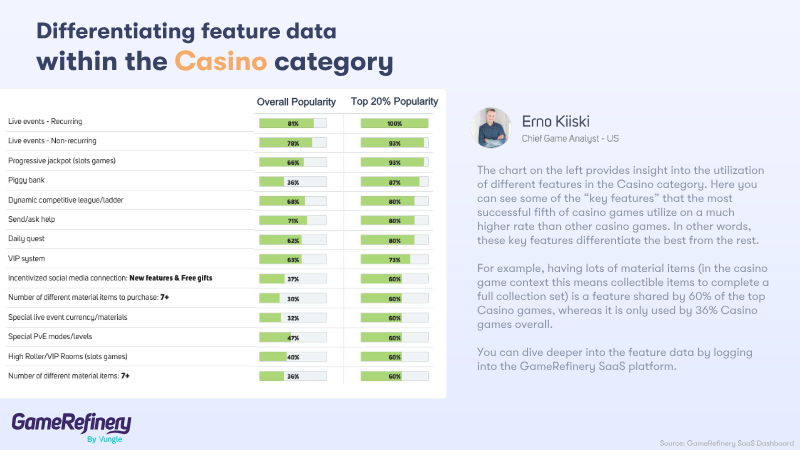
This analysis examines the state of the mobile Casino game category in the United States during the fourth quarter of 2020.
- The mobile Casino category is the second-largest revenue generator on US iOS, capturing 17.2% of total mobile game revenue as of Q4 2020.
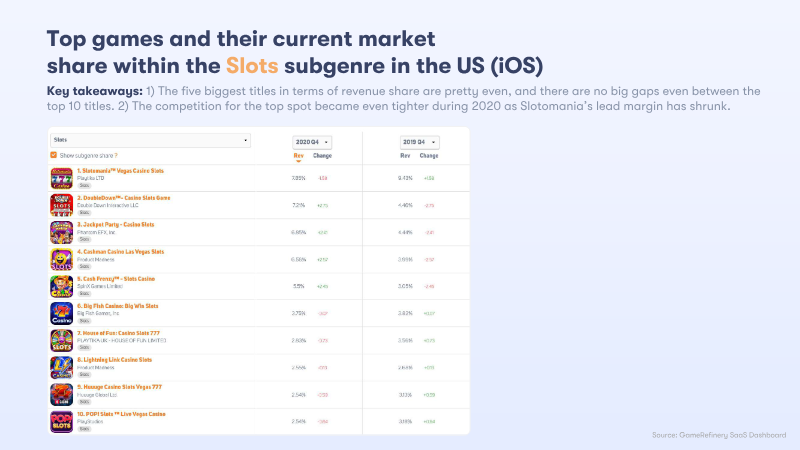
- Slots dominate the category with 80% of total revenue, characterized by a highly competitive landscape where market share is evenly distributed among top titles like Slotomania and DoubleDown Casino.
- In contrast to the fragmented Slots market, the Poker and Bingo subgenres are dominated by single 'king of the hill' titles such as World Series of Poker and Bingo Blitz.

Gaming Spotlight: 2021 Review
The 2021 Gaming Spotlight provides a comprehensive analysis of the global digital gaming landscape, emphasizing the dominance of mobile gaming and the increasing integration of cross-platform experiences.
- Mobile gaming is the primary industry growth driver, with its global lead over home consoles projected to reach 3.1x by the end of 2021.
- Mobile game downloads and consumer spending in Q1 2021 rose by 30% and 40% respectively compared to pre-pandemic levels in late 2019.
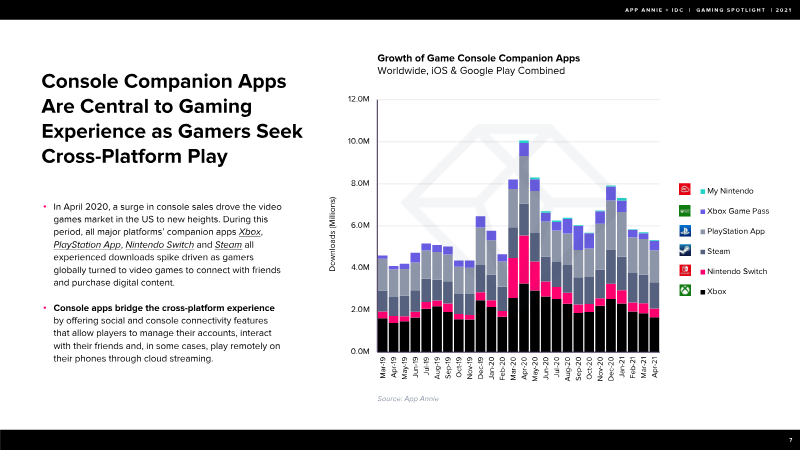
- Cross-platform integration is essential for scale and engagement, as evidenced by the success of titles like Roblox and Genshin Impact across mobile, PC, and console.
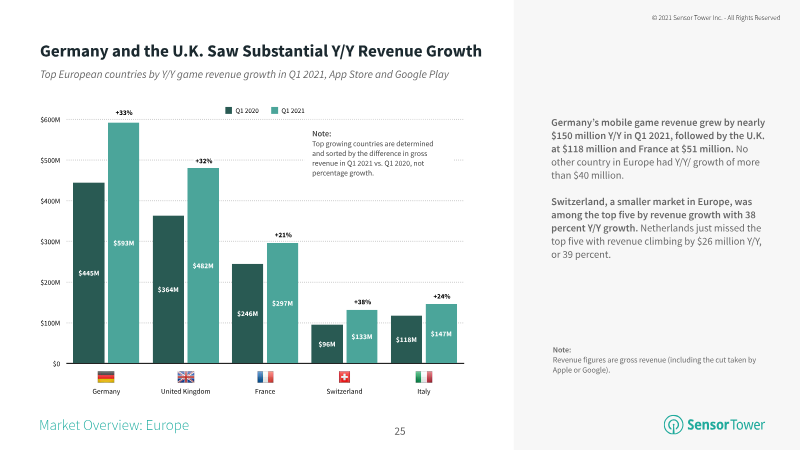
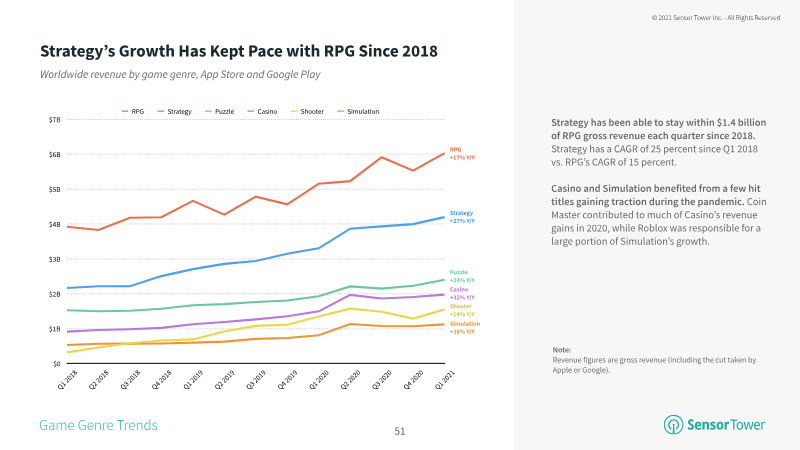
The State of Mobile Gaming 2021: U.S., Europe, and Asia
The global mobile gaming market experienced an unprecedented surge during the 2020–2021 period, fueled by pandemic-related shifts in consumer behavior that accelerated both spending and engagement.
- The global mobile gaming market reached $22 billion in quarterly consumer spending by early 2021, marking a 25% year-over-year increase.
- The industry is projected to reach $117 billion in consumer spending and 67.2 billion annual downloads by 2023.
- Monetization is highly concentrated, with the top five global markets accounting for 77% of total spending and the freemium model generating 99% of App Store revenue.


An Analysis of IPs in U.S. Mobile Gaming
The analysis evaluates the influence of licensed intellectual property (IP) on the U.S. mobile gaming market during 2020, using Sensor Tower’s taxonomy and revenue data from the App Store and Google Play.
- Licensed IP titles represent only 9% of the U.S. mobile market but account for 23% of total player spending and 17% of all installs.
- Video game franchises are the primary drivers of IP revenue, contributing one-third of the total, followed by manga (13%), television (12%), and comics (10%).
- Action, shooter, and role-playing games rely most heavily on licensed IP, with these genres deriving 64%, 45%, and 47% of their respective revenues from such titles.
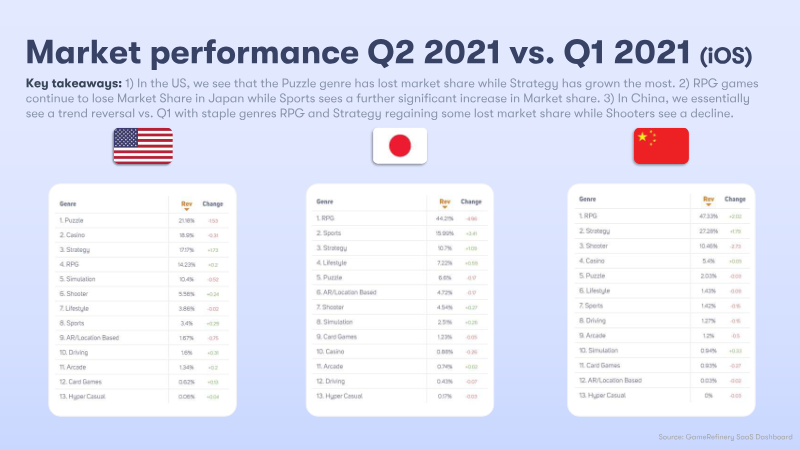


Market Snapshot: Q2 2021 US, China & Japan
The mobile gaming market in the second quarter of 2021 experienced notable shifts in genre performance and publisher dominance across the United States, China, and Japan.
- Live-service feature updates increased by 37% year-over-year, with Strategy games leading the surge at 208% growth.
- Engagement tactics are shifting toward non-recurring live events and limited-time in-app purchase offers, which saw frequency increases of 143% and 122% respectively.
- In the US, the Strategy genre grew while the Puzzle genre declined, with Supercell emerging as a top-performing publisher.
The State of Mobile Game Advertising: An Analysis of U.S. Mobile Game Advertising Trends in 2021
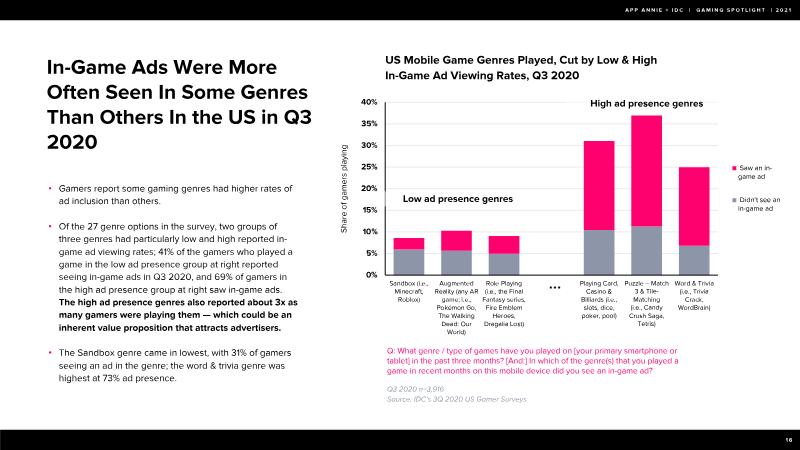
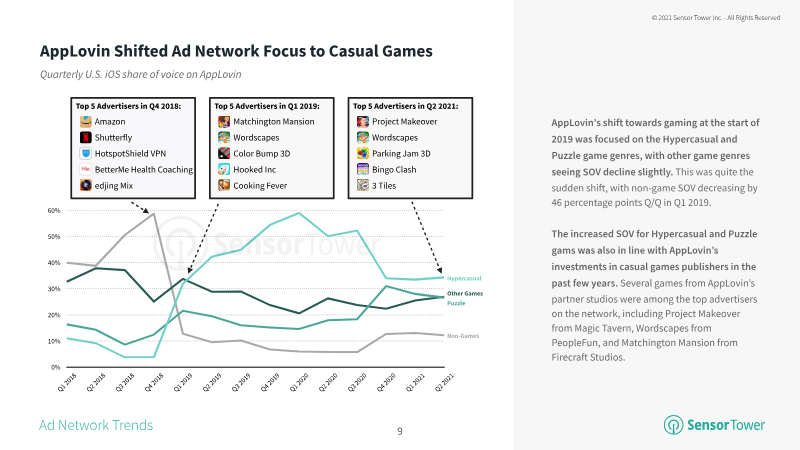
Mobile game advertising in the United States remained resilient through the first half of 2021, showing no immediate negative impact from privacy changes such as the deprecation of IDFA.
- Mobile game advertising in the U.S. remained resilient through H1 2021, showing no immediate negative impact from the deprecation of IDFA.
- Playable ads have become a dominant creative format, accounting for over 40 percent of the gaming share of voice on AppLovin.
- Specialized ad networks like AppLovin, Chartboost, and Vungle maintain a gaming-focused inventory exceeding 90 percent share of voice, while platforms like Facebook, TikTok, and YouTube provide broader audience reach.


Diversity and Inclusion in Gaming: Insights and Opportunities 2021
This analysis examines the state of representation and accessibility within the United States gaming market, challenging the misconception that the gaming audience is primarily composed of young, white males.
- 47% of U.S. gamers avoid titles they perceive as not designed for them, indicating that inclusive character representation is a critical factor for market reach.
- Over half of the gaming audience considers the presence of diverse characters important, with particularly high demand for representation from LGBTQIA+ players and people with disabilities.
- Socioeconomic barriers significantly influence platform choice, as Black and Hispanic/Latinx players are more likely to utilize standard consoles or laptops and subscription services like Xbox Game Pass rather than high-end desktops.

Glassdoor Confessions on Daybreak Studios | Game Dev Unchained Episode 247
The $300 million acquisition of Daybreak Game Company by the Swedish conglomerate Enad Global 7 (EG7) serves as a critical case study in the divergence between internal workplace health and external financial valuation.
- Enad Global 7 (EG7) acquired Daybreak Game Company for $300 million, demonstrating that studios with legacy IP like EverQuest and PlanetSide 2 remain high-value targets for consolidation despite a lack of recent commercial hits.
- The acquisition highlights a growing industry trend where investors prioritize lean balance sheets and consistent revenue streams over the long-term sustainability of creative talent or organizational culture.
- Daybreak’s internal workplace health is characterized by a 17% CEO approval rating and a history of frequent, disruptive layoffs.

How To Start A Game Studio (LEGALLY)
Establishing a game studio as a Limited Liability Company (LLC) serves as a critical step for independent developers to manage legal risks and tax obligations.
- Forming an LLC establishes a corporate veil that protects an owner’s personal assets from business-related lawsuits, including claims of negligence or tort liability.
- LLCs utilize pass-through taxation, which prevents the double taxation typically associated with corporations by taxing profits at the individual owner level.
- Developers can reduce their tax burden by deducting legitimate business expenses, such as game development costs, bug fixing, and operational overhead, from their gross income.
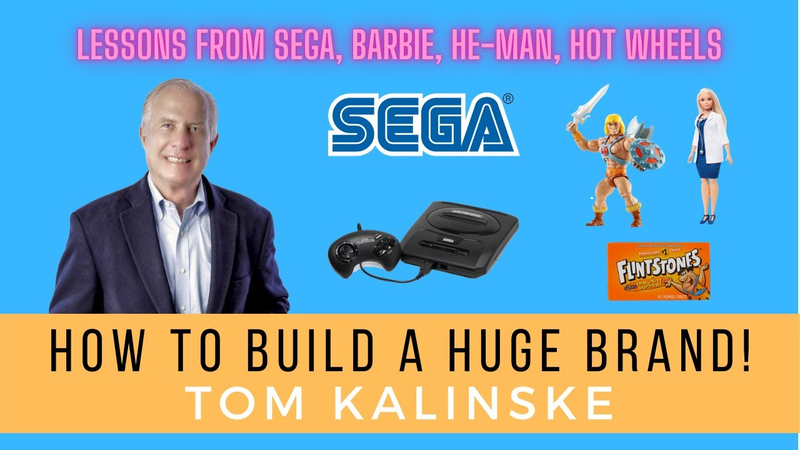
How to Build A Huge Brand | Tom Kalinske (Former CEO SEGA of America)
Brand growth is fundamentally driven by a synthesis of rigorous consumer research and the courage to challenge established industry norms.
- Brand growth is driven by challenging industry norms and identifying untapped market segments rather than simply following existing trends.
- Strategic media integration can drive massive revenue, as demonstrated by the expansion of the He-Man brand from $75 million to $750 million through a syndicated television model.
- Gaining market share against entrenched leaders requires identifying specific technical differentiators, such as the transition to 16-bit technology in the gaming sector.

Riz Virk on US vs. China App Wars, Simulation Hypothesis (Life is a Game!), & Startup Myths
Mobile applications have evolved from simple content delivery tools into critical geopolitical infrastructure, marking a shift from regulating content to controlling the platforms themselves.
- Mobile applications have transitioned from simple content delivery tools into critical geopolitical infrastructure, leading the US, China, and India to treat platforms as matters of national security and data sovereignty.
- The global tech industry must adapt to an era of economic protectionism where foreign-controlled platforms face persistent regulatory scrutiny and complex cross-border ownership requirements.
- The simulation hypothesis suggests that reality functions like a sophisticated video game engine, drawing parallels between quantum physics' observer effect and the information-based structure of the universe.

Painting America's MOST HAUNTED HOUSE (with just a mouse)
Digital art production for game environments relies heavily on establishing a cohesive atmospheric narrative through iterative layering and color logic.
- Effective environmental storytelling relies on disciplined light, shadow, and atmospheric layering rather than hyper-realistic detail to evoke specific emotional responses.
- Atmospheric density, fog, and depth of field are simulated using strategic applications of gradients, motion blurs, and Gaussian blurs.
- Establishing a primary light source early in the creative process is essential for grounding architectural structures through consistent shadows and highlights.