UK reports and market data
Documents

Why Harry Slater's GotY 2015 is Afterpulse
Afterpulse, a third-person mobile shooter developed by Digital Legends and published by Gamevil, stands out as a premier title of 2015 due to its exceptional execution of core gameplay mechanics.
- Digital Legends and publisher Gamevil successfully adapted traditional shooter mechanics for mobile in 2015 by prioritizing intuitive control schemes that mitigate the ergonomic frustrations common in touchscreen gaming.
- The game utilizes a 'Destiny-style' compulsion loop that drives player retention by rewarding combat success with incremental gear upgrades and consistent daily incentives.
- The title demonstrates high player stickiness, with users remaining engaged through at least fifteen levels of progression rather than discarding the game after initial content exhaustion.

How to break into the western markets - PG Connects Bangalore 2015
Expanding into Western gaming markets requires a strategic shift toward professional business operations, legal diligence, and a resilient entrepreneurial mindset.
- Successful expansion into Western markets requires treating a studio as a formal business entity by securing robust shareholder agreements, managing cash flow, and utilizing professional legal counsel.
- Mobile game developers should target the casual sector by focusing on accessible, low-stress mechanics like match-three or hidden-object games rather than high-intensity competition.
- Audience demographics in the Western casual mobile market are predominantly older and female, necessitating the avoidance of gender-based design stereotypes in favor of mechanics that prioritize relaxation and social connection.

Biz Daily: Can Gacha, Fusion and Collection work in the west?
The global mobile gaming industry is currently at a critical juncture, with experts projecting significant growth potential by adopting mechanics that have long defined the Japanese market.
- The global mobile gaming industry could see revenue increase tenfold by adopting Japanese-centric engagement models that prioritize collection, randomization, and fusion over traditional skill-based progression.
- Western mobile development is currently in a state of pre-peak growth, lagging behind the Japanese market's superior revenue per user metrics.
- The core strategy for growth relies on three pillars: Gacha for randomized monetization, collection for inventory depth, and fusion for asset management and power progression.

Biz Daily: Mag Interactive's purchase of Delinquent
The acquisition of the UK-based startup Delinquent by the Swedish developer MAG Interactive serves as a primary indicator of the mobile gaming industry’s transition into a mature phase.
- MAG Interactive’s acquisition of UK-based startup Delinquent signals a shift in the mobile gaming industry toward consolidation, where established developers prioritize buying talent and IP over organic growth.
- The mobile market has reached a mature, saturated phase where high barriers to entry and rising costs make it increasingly difficult for new, independent startups to gain traction.
- MAG Interactive, which has maintained a user base exceeding 50 million downloads since 2012, is using the acquisition to integrate Delinquent’s match-three game, Potion Pop, into its existing ecosystem.

Zombies, Run! CEO on the challenges of smartwatch gaming
The wearable gaming market, specifically regarding smartwatches, presents a significant but challenging frontier for developers.
- Smartwatches should not be treated as smartphone replacements, but rather as niche tools for fitness and movement where sensor accuracy and body positioning provide unique advantages.
- Developers must avoid complex visual interfaces on smartwatches, as forcing users to look at small screens while moving is inherently flawed and unsafe; instead, use extreme simplicity like color-coded notifications.
- The wearable gaming market is currently constrained by high hardware costs, limited battery life, and insufficient consumer demand, making it a secondary platform rather than a mass-market powerhouse.

Patrick O'Luanaigh on nDreams' VR epiphany
Virtual reality represents a transformative shift in the gaming industry, primarily due to its unique ability to generate a sense of presence—the psychological sensation of being physically transported to another location.
- Virtual reality creates a unique sense of presence that amplifies emotional responses like fear and excitement beyond the capabilities of traditional screens.
- Mobile devices serve as the primary entry point for consumer virtual reality, with the Samsung Gear VR currently acting as the industry benchmark for quality and performance.
- Developers must prioritize a consistent 60 frames per second at high resolutions, which requires strict management of draw calls and graphical fidelity.

How to create FPS using audio not graphics
The development of audio-based games represents a shift in interactive entertainment, moving away from visual reliance toward immersive, sound-driven experiences.
- Audio-based games utilize proprietary engines and Head-Related Transfer Function (HRTF) technology to create 3D soundscapes that allow for navigation and interaction without visual reliance.
- Stationary combat mechanics, as seen in titles like Audio Defence, simplify user experience and broaden accessibility by removing complex movement systems.
- Traditional heads-up displays (HUDs) are replaced by auditory cues, such as heartbeats for proximity alerts and distinct weapon sounds for combat feedback.
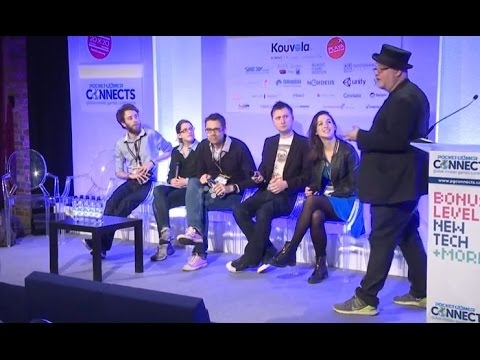
What's the point of the games media anyhow?
The role of games media in the modern digital landscape is defined by a shift from traditional gatekeeping to a diverse ecosystem of cultural analysis, community building, and specialized information sharing.
- Games media has evolved from a traditional gatekeeping role into a diverse ecosystem where professional journalism provides critical depth and authorial context that complements personality-driven influencer content.
- The media landscape is now segmented by audience demographics, with younger users favoring immediate, gameplay-focused video content while older, more engaged audiences prioritize the in-depth industry and cultural analysis found in established outlets.
- A multi-channel communication strategy is now essential for developers, utilizing social media for discovery, YouTube for community engagement, and traditional outlets for authoritative analysis.

Why Nordeus is opening an office in London
Nordeus, the developer behind the successful football management title Top Eleven, has established a new studio in London to expand its global footprint and tap into a broader talent pool.
- Nordeus has established a new, autonomous studio in London to access a broader talent pool and expand its operations beyond its Belgrade headquarters.
- The London studio is tasked with defining its own creative direction and exploring new genres, with a goal to launch at least one new title within the year.
- Nordeus is currently scaling the London office by hiring for key roles, including game designers, developers, and artists.

Why Tag Games is getting into the tools business
Tag Games has transitioned from a mobile game developer into the tools business with the launch of ChilliWorks, a comprehensive technology suite designed for mobile and tablet game development.
- Tag Games has launched ChilliWorks, a technology suite for mobile and tablet development, marking the company's strategic transition from a game developer to a tools provider.
- The company open-sourced its core game engine, ChilliSource, under an MIT license to provide developers with full autonomy to modify and adapt the technology for their specific needs.
- Tag Games aims to democratize the development process by removing engine licensing costs, allowing smaller studios to access technical capabilities previously reserved for larger organizations.

Big numbers from Monument Valley, Crossy Road and Minecraft
The mobile gaming industry began 2015 with a focus on monetization strategies, highlighted by performance data from three prominent titles: Minecraft, Crossy Road, and Monument Valley.
- Monument Valley generated $5.8 million in net earnings against $1.4 million in development costs, resulting in a $4.5 million profit from 2.4 million sales.
- Crossy Road’s two-person development team earned $1 million in revenue by utilizing Unity Ads, demonstrating the financial viability of non-intrusive, incentivized video advertising.
- Minecraft maintains its status as a premium mobile outlier, having reached a total of 30 million downloads.

John Hanke on why location unlocks the next wave of mobile gaming
Location-based mobile gaming represents a significant frontier for digital entertainment, driven by the convergence of advanced mobile hardware, wearable technology, and health-focused applications.
- Location-based gaming is evolving from a niche experiment into a mainstream platform by integrating real-world movement with immersive, narrative-driven gameplay.
- The core value of location-based experiences lies in their ability to foster emergent social behaviors and collaborative community dynamics similar to traditional massively multiplayer online games.
- Global infrastructure is a prerequisite for success, as evidenced by Ingress, which has successfully established a presence across more than 200 countries.