Ukie
Association13 documents
UK's trade body for the interactive entertainment industry. Publishes annual reviews, economic impact reports, and growth strategy papers.
Documents

Report75 pages
Playing for the Planet: Untangling the Carbon Complexities of the Video Gaming Industry
The analysis demonstrates that the video‑gaming sector remains fragmented in its approach to carbon accounting, with only a minority of companies—12 out of 222 surveyed—committed to science‑based targets. This shortfall stems largely from uncertainty around measuring Scope 3 emissions, particularly in categories such as purchased goods and product use. The report underscores a growing industry momentum: the Playing for the Planet Alliance now includes 42 members, and initiatives like the Green Games Guide and Ubisoft’s Climate School illustrate a shift toward embedding climate action within both operations and game content. Concrete progress is evident, for example, the Games Consoles Voluntary Agreement’s 54 TWh energy savings and the documented dominance of Scope 3 categories 1 (purchased goods) and 11 (use of sold products) in studios’ footprints.
Carbon intensity across the supply chain varies markedly by hardware, display technology, and regional electricity mix. Current‑generation consoles draw 150–200 W during gameplay, while PCs can reach 100–300 W; mobile devices consume only a few watts. A high‑end 4K TV can match console power when running HDR, and the carbon intensity of 200 Wh ranges from ≈13 gCO₂e in France to ≈81 gCO₂e in the United States. These disparities highlight opportunities for reducing emissions through hardware efficiency, extended device lifetimes, and the adoption of renewable electricity or green tariffs.
The report calls for consistent, industry‑aligned reporting frameworks—particularly the GHG Protocol Scope 3 categories—and greater granularity by business unit or product. It recommends iterative, data‑quality‑driven methods for estimating Category 1 and 2 emissions, prioritising primary supplier data for high‑spend items while applying spend‑based factors elsewhere. For Category 7 (employee commuting) and Category 11 (use‑phase emissions), detailed calculation examples illustrate the need to account for lifetime usage, regional grid intensity, and potential double‑counting. Real‑time accounting of use‑phase emissions is identified as a critical research gap, with cloud and CDN providers’ inconsistent reporting underscoring the need for standardized data.
Overall, the sector is moving toward greater transparency and actionable climate messaging, yet significant gaps remain in measurement, reporting consistency, and the integration of emerging technologies such as cloud gaming and AI. Addressing these challenges will be essential for credible net‑zero pathways across the global video‑gaming industry.
- Only 12 out of 222 surveyed gaming companies have committed to science-based carbon reduction targets, highlighting a significant industry-wide gap in formal climate accountability.
- Scope 3 emissions—specifically purchased goods (Category 1) and the use of sold products (Category 11)—represent the dominant share of the industry's total carbon footprint.
- Energy consumption during gameplay varies significantly by hardware, with current-generation consoles drawing 150–200W and PCs reaching up to 300W, compared to only a few watts for mobile devices.
- The carbon intensity of gaming is highly dependent on regional electricity grids, with 200Wh of consumption resulting in approximately 13gCO2e in France versus 81gCO2e in the United States.
- The Games Consoles Voluntary Agreement has successfully achieved 54 TWh in energy savings, demonstrating the efficacy of hardware efficiency standards.
Playing for the Planet Alliance

Report45 pages
The Value of Esports in the UK
The study demonstrates that the United Kingdom’s esports industry has experienced robust growth, expanding at an average annual rate of 8.5 % between 2016 and 2019. In 2019 alone, the sector generated approximately £60 million in revenue—about eight per cent of global esports earnings—and contributed £111.5 million to the national Gross Value Added, supporting more than 1,200 full‑time equivalent jobs. These figures underscore the sector’s role as a significant driver of the UK digital creative economy.
Key drivers identified include the proliferation of professional teams, high‑profile tournaments hosted by organisations such as ESL, Gfinity and Epic.LAN, and the rise of streaming platforms that have broadened audience reach. Dedicated venues like Belong Gaming Arenas further stimulate grassroots participation and local economic activity. Modelling of direct, indirect and induced effects reveals a total impact of roughly 216 FTEs and £19.5 million in GVA, while spill‑over benefits from event tourism—estimated at £234 k per 1,000 visitors and nearly five FTEs—highlight additional value for host communities.
The analysis projects that hosting a major global esports event could add 238 full‑time equivalents and £12 million in GVA to the UK economy, signalling substantial upside potential. The findings point to opportunities for further investment, clearer regulatory frameworks and strategic positioning to attract international events, thereby consolidating esports as a pivotal growth sector within the United Kingdom’s broader digital economy.
- In 2019, the UK esports industry generated £60 million in revenue and contributed £111.5 million to the national Gross Value Added (GVA), supporting over 1,200 full-time equivalent (FTE) jobs.
- The sector experienced robust growth between 2016 and 2019, expanding at an average annual rate of 8.5%.
- Hosting a single major global esports event is projected to add £12 million in GVA and 238 FTE jobs to the UK economy.
- Event tourism provides significant spill-over benefits, estimated at £234,000 in economic value and nearly five FTEs per 1,000 visitors.
- Key industry drivers include professional tournament organizers such as ESL, Gfinity, and Epic.LAN, alongside the expansion of streaming platforms and physical infrastructure like Belong Gaming Arenas.
UkieDec 2025

Report46 pages
Esports 2023: Challenges and Opportunities in the UK
The report argues that the United Kingdom’s esports sector has evolved from a fragmented niche into a rapidly professionalised ecosystem, yet it still requires coordinated investment and policy to sustain growth. Key findings show an audience of roughly 55 million adults, with 82.7 % aged 18‑34 and a male dominance of 83 %. While shooters such as Call of Duty, CS:GO and Fortnite command the largest viewership, only 3.8 % of gamers follow competitive play, revealing a small “iceberg” of engaged fans. This gap highlights opportunities for talent development and global brand expansion, especially as the UK lags behind U.S. and Asian markets in producing top‑tier professionals.
Economic data underscore the sector’s momentum: gross value added reaches £111 million and sponsorship revenue exceeds $1.38 billion, with UK events and teams capturing a $1.5 billion share of the global market. Major brands—Intel, Red Bull, Saudi PIF—and tournament operators such as ESL, FACEIT and Gfinity are driving investment, while infrastructure projects by XLHQ, Royal Ravens and Cloud9 create dedicated studios and community hubs. Educational initiatives, including a BTEC programme with Pearson and university leagues like NUEL, demonstrate that esports can boost computing engagement and skill development among 10 000 pupils.
Despite these gains, challenges persist. Mainstream media coverage remains limited, and government support is uneven, constraining broader recognition of esports as a legitimate sport. Diversity and inclusion remain under‑addressed, with female participation at 17 % and a need for stronger links between education, industry and policy to create sustainable career pathways. Emerging monetisation models—Web3, NFTs, metaverse experiences—offer new revenue streams but require regulatory clarity and infrastructure investment. Coordinated action across stakeholders is essential to unlock the UK’s full economic and cultural potential in esports.
- The UK esports sector generates £111 million in gross value added, with UK-based teams and events capturing a $1.5 billion share of the global market.
- While the UK has a potential audience of 55 million adults, only 3.8% of gamers follow competitive play, indicating a significant opportunity for fan base expansion.
- The demographic profile of the UK esports audience is highly concentrated, with 82.7% aged 18–34 and 83% male, highlighting a need for improved diversity and inclusion efforts.
- Major investment is being driven by global brands like Intel, Red Bull, and the Saudi PIF, alongside infrastructure developments from organizations such as XLHQ, Royal Ravens, and Cloud9.
- Educational initiatives, including a Pearson BTEC programme and the NUEL university league, are currently engaging 10,000 pupils in computing and skill development.
+1
British EsportsDec 2025

Report13 pages
Annual Review: 2025
The document outlines Ukie’s first year of its five‑year “Supercharged” strategy, aimed at accelerating the UK video games and interactive entertainment sector. The thesis is that a coordinated policy, industry‑wide campaigns, talent development and trade support can secure the UK’s position as a global leader in games. Key findings show that consumer spending reached £7.6 billion in 2024, a record high, and that Ukie’s advocacy generated three major policy wins: recognition of games as a growth sector, a tailored growth package and £30 million for the UK Games Fund. The organisation also secured £75 million in business wins through global trade activity at GDC and Gamescom, and delivered 19 consultations to government bodies. In talent development, Ukie supported 30 companies via its Growth Programme and ran the largest student game jam with over 200 participants, while Digital Schoolhouse won a national BETT award for best opportunities and experience. The scope covers the UK, with outreach to Scotland, Wales, Northern Ireland and international partners such as Tencent. Methodology includes evidence‑based lobbying, a national pulse survey network, and partnership with academic institutions for skills research. The report concludes that the next year will focus on deepening policy influence, expanding trade missions, and fostering emerging mobile, UGC and external‑engine opportunities to sustain industry growth.
- UK consumer spending on video games and interactive entertainment reached a record high of £7.6 billion in 2024.
- Ukie’s advocacy efforts secured £30 million in funding for the UK Games Fund and official recognition of the sector as a key driver of economic growth.
- Global trade activities at GDC and Gamescom generated £75 million in business wins for the UK games industry.
- The organization delivered 19 formal consultations to government bodies to influence policy and secure a tailored growth package for the sector.
- Talent development initiatives included supporting 30 companies through the Growth Programme and hosting a student game jam with over 200 participants.
+2
UkieDec 2025

Report39 pages
Business Case for an Enhanced Video Games Expenditure Credit: UK
The analysis argues that a targeted increase in the Video Games Expenditure Credit (VGEC) would markedly strengthen the United Kingdom’s competitive position within the global video‑games sector. By raising the nominal rate to 53 % for projects up to £10 million and to 39 % for larger productions, the model predicts an additional £530 million in gross value added (GVA) and roughly 6,000 new full‑time jobs over five years. The return on investment is projected at £2.12 of GVA and tax revenue for every £1 spent, positioning the UK as one of the most attractive jurisdictions for game development.
Key findings highlight a worldwide contraction in employment, with 30 000 layoffs expected between 2023 and 2024, prompting a shift toward freelance and subcontracted talent. Venture‑capital funding has fallen sharply from $9 billion in 2020 to just over $3 billion by early 2024, while indie sales on platforms such as Steam now account for nearly 70 % of full‑game revenue. These trends underscore the need for flexible, cost‑efficient production models and a supportive fiscal environment.
Comparative analysis shows that the current UK VGEC effective rate of 14 % is lower than those in France (20.2 %) and Canada’s Quebec (18.2 %). The proposed tiered scheme would raise the UK rate to 20.6 %, matching or surpassing many international competitors and potentially adding an extra 5,000 full‑time equivalents over five years. Across all scenarios, the cost‑benefit profile remains favorable, with GVA returns of £1.3–£1.4 per £1 invested and tax returns of £0.4–£0.5 per £1.
In sum, the enhanced VGEC package delivers a superior economic return by stimulating export‑driven intellectual property creation and supporting both small studios and multinational operations. The model demonstrates that a carefully calibrated incentive structure can offset macro‑economic pressures, sustain employment growth, and secure the UK’s position as a global leader in video‑game development.
- Increasing the Video Games Expenditure Credit (VGEC) to a tiered rate of 53% for projects under £10 million and 39% for larger productions is projected to generate £530 million in additional gross value added (GVA) and 6,000 new full-time jobs over five years.
- The proposed fiscal enhancement would raise the UK’s effective VGEC rate to 20.6%, surpassing current rates in France (20.2%) and Quebec (18.2%) to improve international competitiveness.
- Every £1 of government investment in the enhanced VGEC is projected to yield a return of £2.12 in combined GVA and tax revenue.
- The global video game industry faces significant contraction, with 30,000 layoffs expected between 2023 and 2024 and venture capital funding dropping from $9 billion in 2020 to roughly $3 billion by early 2024.
- Indie game sales on platforms like Steam now represent nearly 70% of total full-game revenue, highlighting a market shift toward smaller, cost-efficient production models.
+1
UkieDec 2025
Article
Going for Growth: How to Drive Revenue Globally in the Games Industry
The global games industry has evolved into a 500-billion-dollar market, necessitating a multifaceted approach to international expansion that prioritizes cross-platform accessibility and localized monetization strategies. Success in this high-valuation landscape depends on a developer's ability to transition beyond single-platform silos, ensuring that titles are available across mobile, console, and PC environments to capture the widest possible audience. This cross-platform integration serves as the foundation for scaling revenue, as it allows for seamless player engagement regardless of hardware preference or regional infrastructure.
Regional monetization remains a critical pillar for global growth, requiring developers to adapt their financial models to the specific economic realities and consumer behaviors of diverse geographic markets. Rather than applying a universal pricing or purchasing structure, effective scaling involves tailoring in-game economies and payment methods to local standards. This granular approach to revenue generation ensures that games remain competitive and accessible in emerging markets while maximizing lifetime value in established territories.
Beyond technical and financial strategies, the cultivation of robust player communities is essential for long-term sustainability and brand loyalty. Building these communities involves active engagement and the creation of social ecosystems that encourage player retention. By integrating community-building efforts with sophisticated cross-platform and regional strategies, developers can navigate the complexities of the modern gaming economy to drive consistent global revenue growth. This comprehensive framework addresses the technical, economic, and social dimensions required to thrive in an increasingly competitive and lucrative international market.
- The global games industry has reached a valuation of 500 billion dollars, necessitating a multifaceted strategy for international expansion.
- Developers must prioritize cross-platform accessibility across mobile, console, and PC environments to capture the widest possible audience and scale revenue.
- Monetization strategies must be localized to align with the specific economic realities, payment methods, and consumer behaviors of diverse geographic markets.
- Effective revenue scaling requires moving away from universal pricing models in favor of granular, region-specific in-game economies.
- Long-term sustainability and brand loyalty depend on the cultivation of robust player communities and social ecosystems that drive retention.
+1
UkieNov 2025
Article
Press Start to Monetise: Levelling Up with the Right Game Business Model
The video game industry is undergoing a significant transformation where innovation is increasingly defined by commercial strategy rather than just technical fidelity or narrative depth. Success in the modern market requires a sophisticated alignment between game design and monetization frameworks, as the method by which a product reaches its audience is now as critical as the gameplay itself. This shift reflects a broader trend toward diverse business models that cater to evolving consumer behaviors and global distribution challenges.
Current industry dynamics emphasize the necessity of selecting a monetization structure that complements the specific genre and target demographic of a title. While traditional premium sales remain relevant, the rise of free-to-play mechanics, subscription services, and hybrid models has redefined how developers sustain long-term engagement and revenue. These strategies are particularly vital in a landscape where player retention is the primary driver of financial stability, necessitating a move away from one-time transactions toward ongoing service-based relationships.
The scope of these insights covers the global gaming ecosystem, focusing on the strategic intersection of publishing and financial technology. By prioritizing the integration of flexible payment systems and localized market strategies, developers can better navigate the complexities of international scaling. Ultimately, the ability to adapt to shifting economic trends and player expectations regarding value and accessibility determines a studio's capacity to thrive in an increasingly competitive and saturated digital marketplace.
- Commercial strategy and monetization frameworks are now as critical to a game's success as technical fidelity or narrative depth.
- Financial stability in the modern market is primarily driven by player retention rather than one-time transactions.
- Developers must transition from one-time sales models to ongoing service-based relationships to ensure long-term revenue.
- Monetization structures must be specifically aligned with the target demographic and genre of the title to remain competitive.
- International scaling requires the integration of flexible payment systems and localized market strategies to navigate global distribution challenges.
+1
UkieSept 2025
Report2 pages
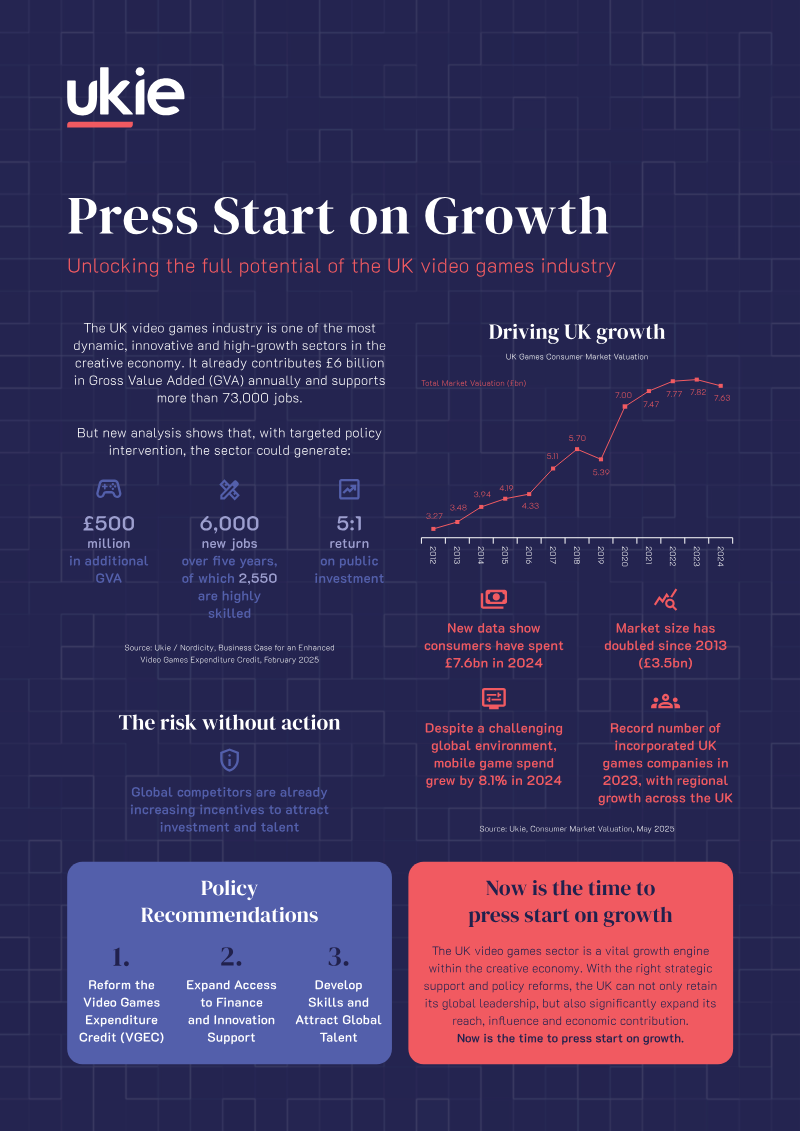
Press Start on Growth: Unlocking the Full Potential of the UK Video Games Industry
The analysis argues that the United Kingdom’s video‑games sector is a high‑growth pillar of the creative economy, already delivering roughly £6 billion in gross value added (GVA) and supporting more than 73 000 jobs, and that strategic policy action could lift its contribution to about £7.6 billion in 2024 and generate an additional £5.7 billion GVA and up to 5.4 million jobs over the next five years. The assessment covers the full UK market from 2022 through 2024, spanning software, hardware, live events, esports, ancillary merchandise and related media, and benchmarks performance against Western‑European averages.
Key findings show a continued erosion of physical boxed software, which fell 34 % year‑on‑year and now accounts for only 4 % of total spend, while mobile games grew 8 %—still below the 13 % regional average. Full‑game digital purchases slipped due to a thin slate of blockbuster releases, yet overall game volume remained stable. Live‑event spending contracted 15 % after pandemic‑related cancellations, whereas esports surged 44 % YoY, driven by a rise in UK‑based tournaments. Subscription revenue rose modestly as price hikes offset a near‑saturation of console subscriber bases. Hardware sales weakened for PS5 disc and Xbox consoles and for the Nintendo Switch, while the PS5 digital edition posted record software sales at a lower price point. Game‑culture engagement declined 13 % across PC and console categories, and related toy and merchandise sales fell 8.5 %.
The conclusions stress that without targeted reforms—particularly in financing, skills development, and talent support—the sector risks losing its global leadership. Conversely, coordinated policy could unlock further growth, broaden international reach, and reinforce the UK’s position as a leading hub for video‑games innovation and cultural influence. Data are drawn from industry sources such as Omdia, Ukie, NielsenIQ/GfK Entertainment, BFI, Comscore and the Official Charts Company, reflecting a comprehensive market‑valuation approach across multiple
- The UK video games industry currently contributes £6 billion in gross value added (GVA) and supports over 73,000 jobs, with the potential to add £5.7 billion in GVA and 5.4 million jobs over the next five years through strategic policy intervention.
- Physical boxed software sales have collapsed, falling 34% year-on-year to represent only 4% of total market spend.
- Esports experienced a significant surge of 44% year-on-year, driven by an increase in UK-based tournaments, contrasting with a 15% contraction in live-event spending.
- Mobile gaming in the UK grew by 8%, though this remains below the 13% regional Western-European average.
- Hardware sales for major consoles, including the PS5 disc edition, Xbox, and Nintendo Switch, weakened, while the PS5 digital edition achieved record software sales at a lower price point.
+1
UkieMay 2025

Report37 pages
Insights into the Japanese Gaming Market: 2025
The Japanese gaming market stands as a uniquely high-value ecosystem, generating 9.1% of global industry revenue despite accounting for only 2.2% of the worldwide player base. This disparity underscores a high average revenue per user driven by a mature demographic that prioritizes quality, depth, and domestic intellectual property. While Nintendo and established local publishers maintain a firm grip on the console sector, the landscape is undergoing a structural shift as PC gaming emerges as a critical growth engine, representing a substantial $2.5 to $3.0 billion opportunity for international entrants.
Success within this region necessitates a nuanced understanding of local consumer behavior, which diverges significantly from Western trends. Japanese players demonstrate a profound preference for narrative-driven, single-player role-playing games and fantasy-themed experiences, often eschewing the open-world, sports, and multiplayer-centric titles that dominate other major markets. This cultural specificity acts as a barrier to entry for many global publishers, who must tailor their content to align with these distinct aesthetic and gameplay expectations to achieve meaningful penetration.
Beyond cultural alignment, international companies must navigate complex macroeconomic conditions, most notably the volatility of the Japanese Yen. While the market remains a lucrative target, the combination of currency headwinds and the entrenched dominance of domestic franchises requires a strategic, long-term approach. By focusing on high-fidelity, story-rich experiences that resonate with the local appetite for solo play, external publishers can effectively capture a share of this high-margin market, provided they remain adaptable to the evolving preferences of the Japanese gaming audience.
- The Japanese gaming market generates 9.1% of global industry revenue despite representing only 2.2% of the worldwide player base, indicating an exceptionally high average revenue per user.
- PC gaming is a critical growth engine in Japan, representing a $2.5 to $3.0 billion opportunity for international publishers.
- Success in Japan requires prioritizing narrative-driven, single-player role-playing games and fantasy themes, which contrast with the multiplayer and sports-centric preferences of Western markets.
- Domestic publishers and Nintendo maintain a firm grip on the console sector, creating a high barrier to entry for international companies.
- International entrants must navigate macroeconomic challenges, specifically the volatility of the Japanese Yen, when planning market entry.
+2
NewzooJan 2025

Report37 pages
Japan Market Report 2025
The Japanese games market represents a unique and highly lucrative landscape, accounting for 9.1% of global games revenue despite containing only 2.2% of the global player base. Average revenue per user is significantly higher in Japan than in Western markets, with Japanese players spending approximately $223 compared to $145 in the United Kingdom. While the market is characterized by a strong preference for domestic franchises and Nintendo’s 70% dominance of console hardware, a substantial $2.5 to $3.0 billion opportunity exists for international stakeholders when excluding mobile and Nintendo platforms.
Demographic and behavioral data indicates that Japan’s PC and console player base is generally older than its Western counterparts. Player motivations also diverge sharply from global trends; Japanese gamers prioritize narrative depth, character design, and solo play, whereas Western players favor open worlds, high-end graphics, and competitive multiplayer. Genre preferences further illustrate this divide, with Japanese console players gravitating toward single-player RPGs and fantasy themes, while PC players increasingly embrace shooters and lower-priced co-op experiences.
The market has seen rapid PC revenue growth over the last seven years, though this trajectory is expected to stabilize through 2027. Conversely, the console segment has faced recent declines attributed to the Nintendo Switch lifecycle and a weaker slate of premium releases. International publishers face specific macroeconomic challenges, notably the weakening Japanese Yen against the U.S. Dollar. Despite these headwinds, titles such as Apex Legends and Genshin Impact have maintained massive free-to-play success, signaling continued potential for well-positioned global titles. This analysis utilizes data from the Newzoo Global Gamer Study, incorporating surveys from over 73,000 gamers across 37 markets to provide a comprehensive view of the 2025 landscape.
- Japan generates 9.1% of global games revenue from only 2.2% of the global player base, with an average revenue per user of $223 compared to $145 in the UK.
- International stakeholders have a $2.5 to $3.0 billion market opportunity when excluding mobile and Nintendo platforms, which currently command 70% of console hardware dominance.
- Japanese gamers prioritize narrative depth, character design, and solo play, contrasting with Western preferences for open worlds, high-end graphics, and competitive multiplayer.
- While PC revenue has experienced rapid growth over the last seven years, this trajectory is projected to stabilize through 2027.
- The console segment is currently facing declines due to the Nintendo Switch lifecycle and a weaker slate of premium releases.
+1
UKIE – UK Interactive EntertainmentJan 2025

Report23 pages
UKIE Annual Review 2024
Ukie’s 2024 annual review presents a comprehensive account of the UK video‑games sector’s performance, strategic direction and advocacy work over the past twelve months. The central thesis is that the industry, now a £6 billion economic engine supporting 76 000 jobs, must be “supercharged” through coordinated efforts to energise businesses, empower talent and elevate games as cultural and educational assets. The review outlines the new five‑year “Supercharged” strategy, which frames Ukie’s campaigning and support programmes for the next decade.
Key findings highlight robust economic contributions: consumer spending on games rose 4 % to £7.82 billion, while a joint analysis with FTI Consulting estimated video‑game technology spill‑overs added up to £760 million to UK GDP and created nearly 10 000 jobs in 2021. International trade activities at Gamescom and GDC generated over £70 million in business wins and attracted more than £150 million of foreign direct investment for 180 UK companies. Policy influence is demonstrated by over 100 engagements with MPs, successful submissions to Ofcom on online safety, and a manifesto that secured inclusion of the sector in major party election platforms. Education initiatives reached 299 470 learners through the Digital Schoolhouse programme, and IP protection actions removed 1.5 million infringing links and prevented £100 million of illicit digital sales.
The review’s scope covers the UK video‑games ecosystem from indie studios to multinational publishers, spanning 2023‑24 and encompassing economic, cultural and regulatory dimensions. Methodologically, the analysis combines internal data on events, memberships and media coverage with external research collaborations, consultation responses and round‑table workshops to produce evidence‑based recommendations. The narrative underscores a commitment to diversity, with a newly approved five‑year EDI strategy and over 20 inclusion‑focused events, positioning the sector for sustained growth and global competitiveness.
- The UK video games sector is a £6 billion economic engine supporting 76,000 jobs, with consumer spending rising 4% to £7.82 billion in the 2023-24 period.
- Video game technology spill-overs contributed £760 million to UK GDP and created nearly 10,000 jobs as of 2021.
- International trade activities at events like Gamescom and GDC generated over £70 million in business wins and attracted more than £150 million in foreign direct investment for 180 UK companies.
- Ukie’s IP protection efforts successfully removed 1.5 million infringing links, preventing an estimated £100 million in illicit digital sales.
- The Digital Schoolhouse education programme reached 299,470 learners, supporting the industry's focus on talent development.
UkieOct 2024

Report11 pages
Supercharged: Powering the Future of the UK Video Game and Interactive Entertainment Industry
The new five‑year strategy and action plan sets out a comprehensive roadmap for the UK video‑games and interactive‑entertainment sector, positioning it as the world’s leading hub for new intellectual property and innovation by 2030. Its core thesis is that sustained growth, enhanced global perception, and a resilient, diverse talent pipeline will secure the industry’s long‑term economic and cultural impact. The plan outlines four strategic priorities—transforming public and media perceptions, building a pro‑games policy agenda, cultivating a highly skilled and inclusive workforce, and strengthening businesses through targeted support.
Key initiatives include three flagship campaigns: energising industry to turn innovative stories into globally successful IPs, empowering talent by nurturing creators and entrepreneurs, and elevating games to showcase British‑made titles as forces for good. The 2024‑25 action schedule launches a coordinated PR strategy, high‑impact partnerships with cultural and digital brands, and an evidence‑led lobbying effort aimed at more competitive tax reliefs, increased investment, and the introduction of a Digital Creativity GCSE. A new research and evidence base will underpin policy advocacy, while a sector‑wide skills network and the refreshed #RaiseTheGame programme will drive diversity, equity, and inclusion across the talent pipeline.
The plan also commits to environmental responsibility through participation in the Playing for the Planet Alliance and internal sustainability measures. Supporting stronger businesses will involve a refreshed membership strategy, expansion of the Ukie Worldwide platform for trade and investment, and the continuation of the Video Games Growth Programme. By inviting industry stakeholders to engage through surveys, working groups, mentorship, and board participation, the strategy seeks broad collaboration to deliver its ambitious objectives across the UK’s mobile, console, core and casual game segments throughout the 2024‑2030 horizon.
- The UK video game industry has launched a five-year strategy aiming to establish the nation as the global leader in intellectual property and innovation by 2030.
- The 2024-25 action plan prioritizes lobbying for more competitive tax reliefs, increased investment, and the introduction of a Digital Creativity GCSE.
- Strategic efforts to strengthen the workforce include the expansion of the #RaiseTheGame diversity, equity, and inclusion programme and the creation of a sector-wide skills network.
- Business growth initiatives include the expansion of the Ukie Worldwide trade platform and the continuation of the Video Games Growth Programme.
- The industry is formalizing its commitment to environmental sustainability through participation in the Playing for the Planet Alliance.
+1
UkieJan 2024