Serious Games reports and market data
Documents
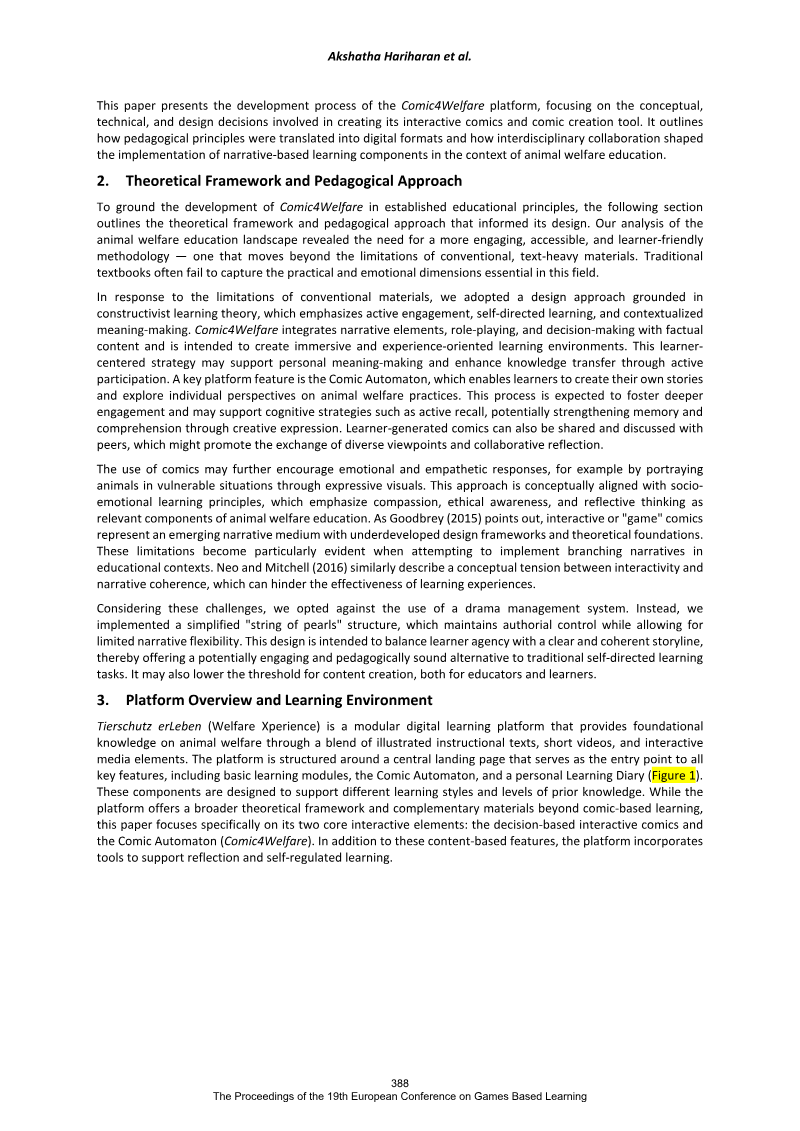
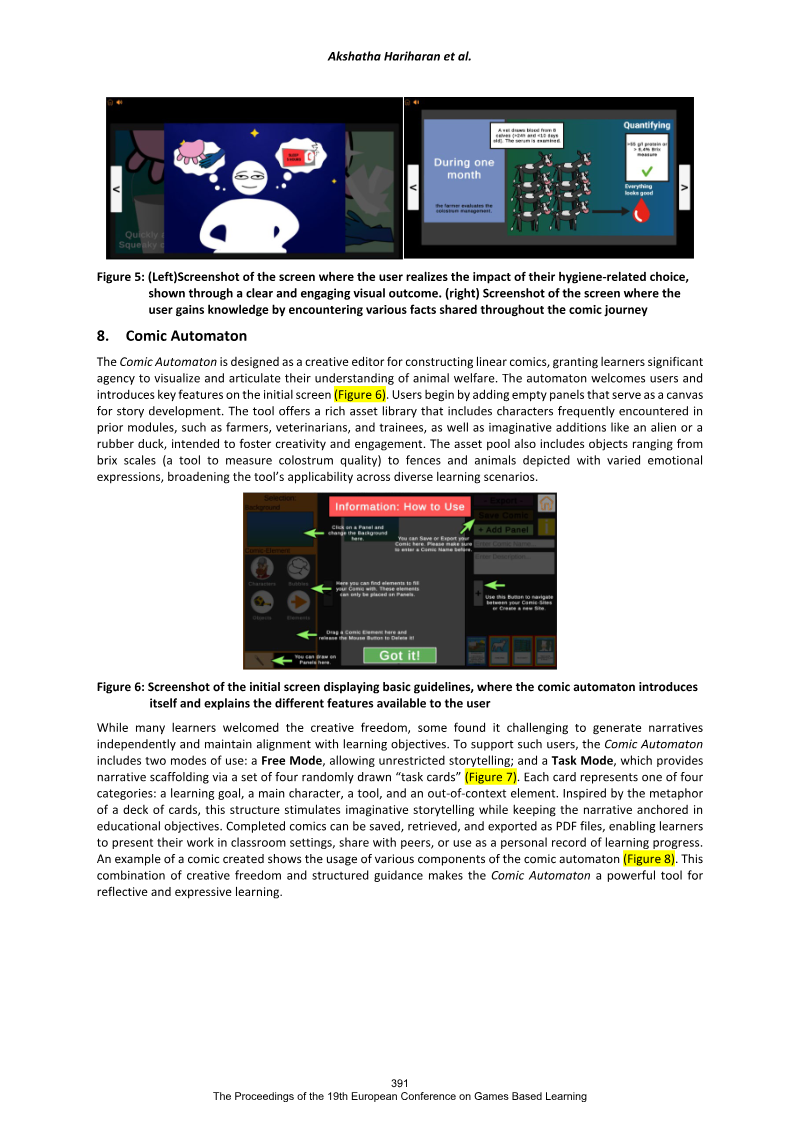
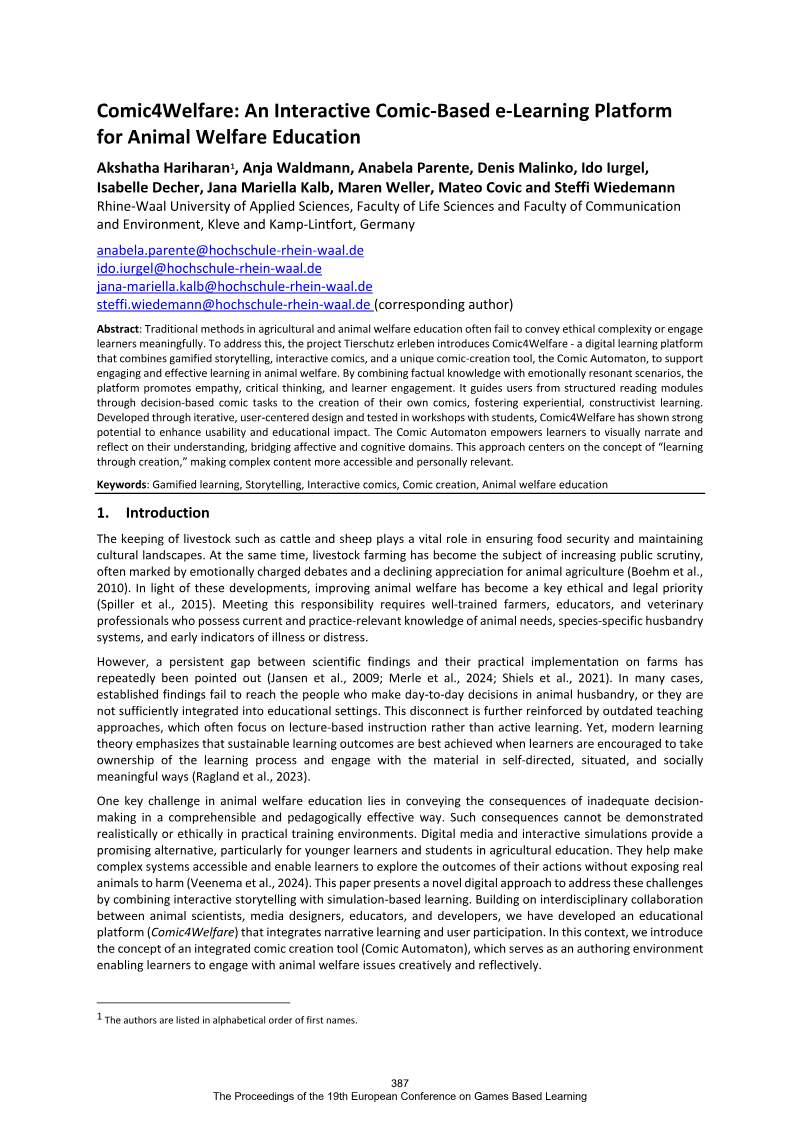
Comic4Welfare: An Interactive Comic-Based E-Learning Platform for Animal Welfare Education
Comic4Welfare is a digital e-learning platform developed by researchers at Rhine-Waal University of Applied Sciences in Germany to address gaps in agricultural and animal welfare education.
- Comic4Welfare is an interactive comic-based e-learning platform for animal welfare education, developed by researchers at Rhine-Waal University of Applied Sciences in Germany, combining decision-based comics with the Comic Automaton, a tool that lets learners create their own comic narratives.
- The platform is grounded in constructivist, experiential learning and 'learning through creation', and was built with Angular, Ionic, GraphQL, and Unity 2021 using a limited-branching 'string of pearls' narrative structure rather than a drama management system.
- Four development workshops with 10 to 20 agriculture and animal husbandry students each used paper prototypes, dot-voting, A/B testing with UEQ surveys, and think-aloud protocols, shifting the design toward 2D comics over 3D simulations and prompting the addition of a scaffolding Task Mode after learners struggled with open-ended narrative generation.
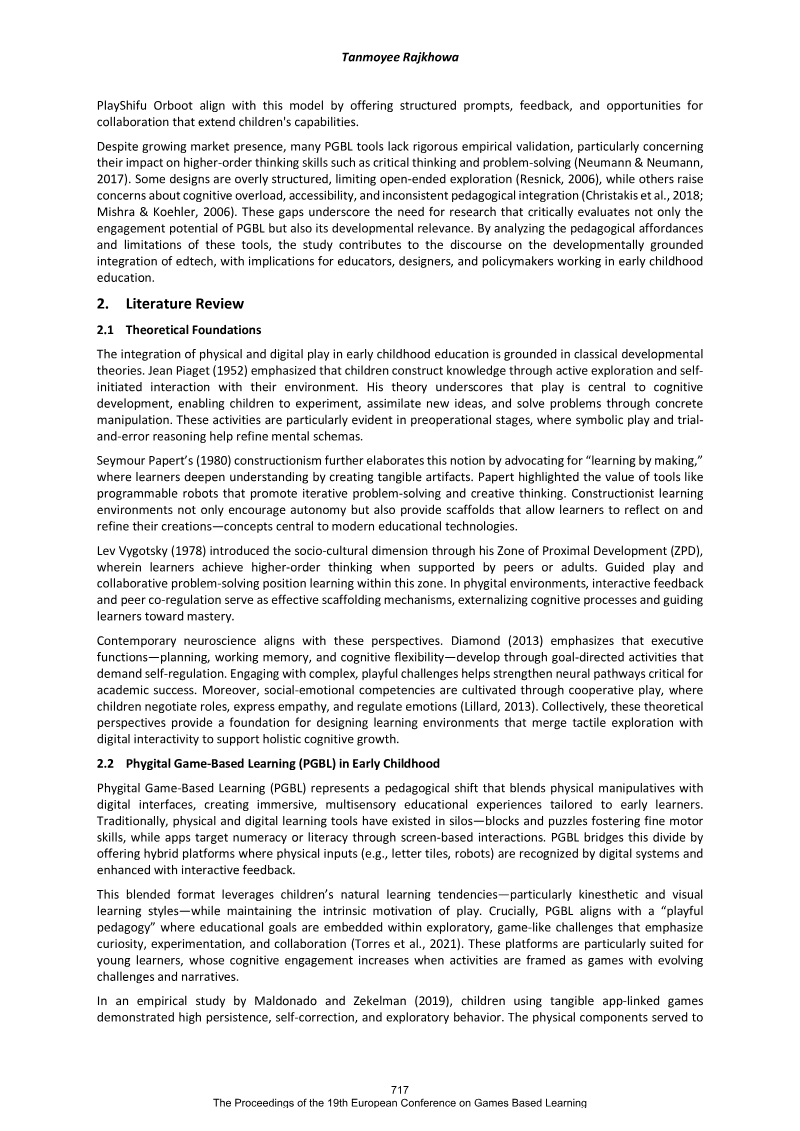
Phygital Game-Based Learning in Early Childhood Education: An Exploratory Review
This review examines phygital game-based learning (PGBL), a hybrid approach combining physical manipulatives with digital feedback, as applied to children aged three to eight.
- Phygital game-based learning (PGBL) combines physical manipulatives with digital feedback for children aged three to eight, and is grounded in the developmental theories of Piaget, Papert, and Vygotsky.
- The review holds that PGBL has documented potential to support engagement, sequencing, spatial reasoning, and early literacy, but its effectiveness is not yet confirmed.
- The synthesis is a qualitative, literature-based comparative case analysis of five tools (Osmo Tangram, KIBO Robot, LEGO DUPLO Stories, Marbotic Smart Letters, PlayShifu Orboot Earth) and relies on secondary data with uneven empirical coverage across products.
VAFUG: A Model for Designing Educational Activities Grounded in Game Studies and Aesthetics
The paper introduces VAFUG, an analytical model designed to help educators examine commercial video games and build learning activities around their expressive and affective qualities.
- VAFUG is an analytical model for educators to examine commercial video games, organized into three components (Visual and Auditory Environment, Fictional Universe, and Core Gameplay), each paired with two indicators.
- The model was developed through Design-Based Research and is aimed at teachers who are not Game Studies specialists, generating guiding questions for student dialogue on socioemotional and civic competences.
- VAFUG targets independent commercial games not originally designed for education and is positioned as complementary to existing serious-game frameworks such as LM-GM.
Enhancing Holistic Development Through Exergame-Based Learning
This paper examines exergame-based learning, an approach that combines physical movement, play, and academic content to support children's development.
- Exergame-based learning combines physical movement, play, and academic content, and the authors argue it should be treated as a strategic, holistic approach to 21st-century education rather than superficial gamified classroom activity.
- The evidence comes from constructive design research with 15 schoolchildren across three co-design workshops, plus an eight-week collaboration with game developers at LYMB.iO on the Multiball exergame platform.
- Co-design findings identified energy, collaborative narrative, and creative freedom as essential ingredients of engaging exergame play, linked to cognitive, socio-emotional, and physical development.
Italian Teachers’ Attitudes and Competence According to the Acceptance Game-Based Learning Questionnaire
A survey of 2,752 Italian teachers examined which factors predict attitudes toward game-based learning (GBL), measured with the Acceptance of Game-Based Learning (AGBL) questionnaire.
- School level is the only meaningful demographic predictor of Italian teachers' attitudes toward game-based learning: preschool teachers reported significantly more positive attitudes than teachers at any secondary school type (p < .001), while differences among secondary school types were negligible.
- Demographic variables together explained only about 2 percent of the variance in attitudes toward game-based learning (R² = 0.019), with no significant association for age or years of teaching experience (p = 0.414 for experience).
- The authors attribute the preschool advantage to the constructivist flexibility of early childhood education versus the assessment-driven rigidity of secondary schooling, along with technological disparities across school levels.
The Ludum Platform: Exploring the Impact of Game Design on Prosocial Behavior in Children's Digital Play
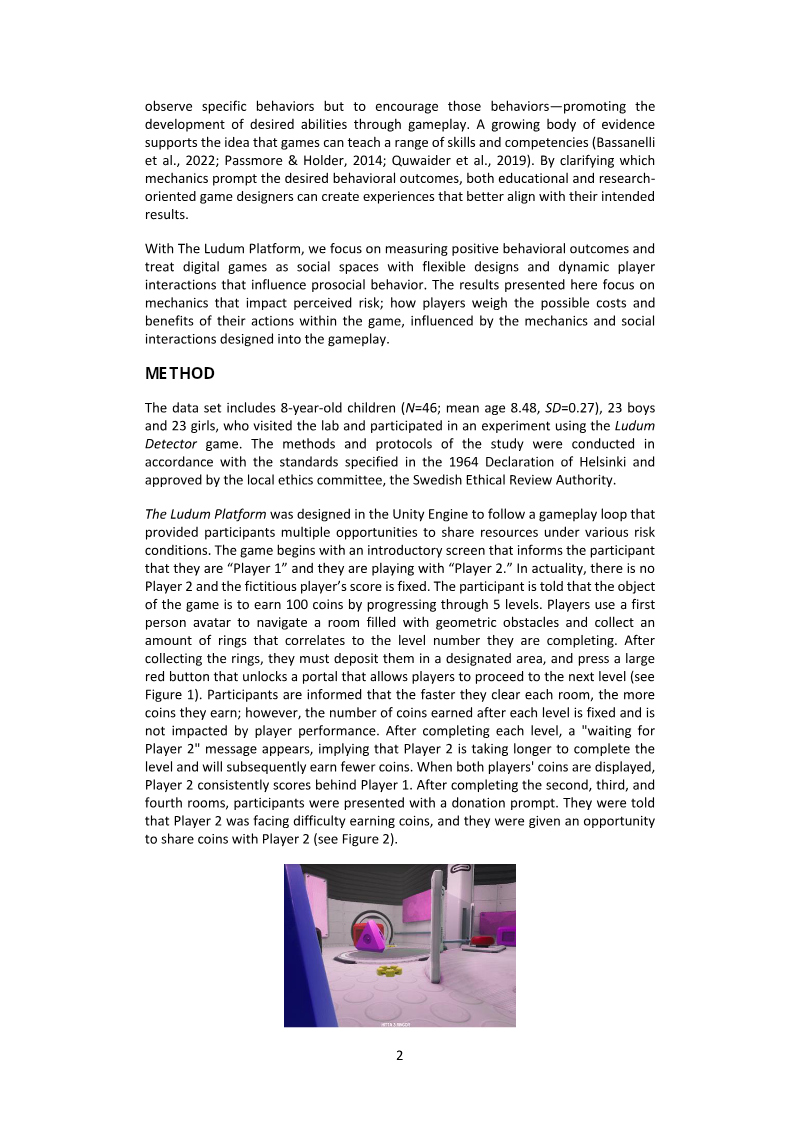
This study examines how perceived personal risk shapes resource sharing among children in a custom-built digital game, The Ludum Detector, which is part of the broader Ludum Platform project.
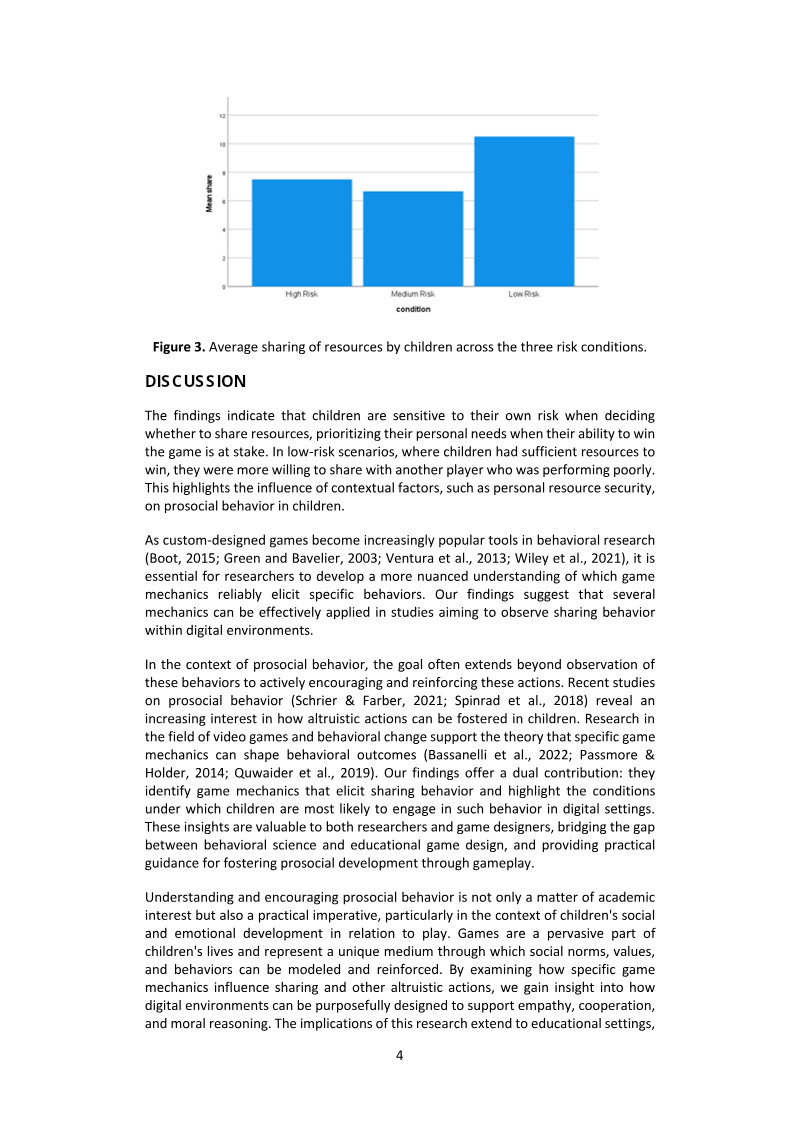
- Children share fewer resources in a digital game as their personal risk rises: in a 46-child study of 8-year-olds, sharing differed significantly between high-risk and low-risk conditions (p = .015) and between medium-risk and low-risk conditions (p = .002).
- The authors conclude that children prioritize personal security, and that resource sufficiency is a strong contextual driver of prosocial decisions in digital settings.
- No significant differences in sharing emerged between boys and girls, suggesting similar responses to risk across sexes.
Speak with Blocks: Minecraft, Environmental Education and Activism
This paper by Gaia Amadori examines how digital games, specifically the sandbox title Minecraft, can serve as platforms for environmental education and ecological activism.
- The paper argues that video games should be analyzed as nodes in a network of stakeholders (NGOs, corporations, public institutions, developers, and gaming communities), not as isolated software products.
- It proposes an analytical model with three dimensions: the ecological issue addressed, the network of actors, and the video game ecosystem (assets, affordances, and paratexts such as user-generated content and streamer discussions).
- Greenpeace's 'To The Last Tree Standing' campaign recreated Poland's Białowieża Forest in Minecraft and then altered the map to show near-total deforestation; the paper says it reached millions and helped build public pressure that contributed to halting real-world logging there.
Copyright and Games Preservation: Lessons and Opportunities in De-colonization
This extended abstract examines how copyright law and institutional preservation practices struggle to accommodate video games in a global, post-colonial context.
- Copyright frameworks and heritage institutions were built around static, physical, territorially bounded objects, while digital games require ongoing copies, updates, and platform maintenance, exposing these limitations.
- Digital distribution and 'service' business models mean libraries and archives often hold only licenses rather than ownership, which limits their long-term capacity to preserve games.
- Territorial licensing creates uneven global availability; the authors cite Sony's PlayStation Network restricting access to roughly 85 countries.
Virtual Burden: Representations of Animal Disabilities in Video Games and Their Posthuman Contexts
This paper examines how animals with disabilities are represented in video games and how these representations participate in posthuman questions of agency, embodiment, and relationality.
- The paper treats animals with disabilities in video games as ambiguous figures, both computational constructs and narrative agents that shape players' subjectivity within hybrid systems of affect, automation, and human and non-human causality.
- It identifies recurring strategies for deploying disabled animals: cultivating sympathy through "cute animals with dysfunctions," depicting "transhuman camouflage" where implants or exoskeletons fully compensate for impairment, framing disabled animals as monstrous, and treating animals as military or war resources.
- The authors attribute these patterns to converging conditions: the predominantly agonistic structure of gameplay, the general underrepresentation of disability in games, instrumental attitudes toward animals, and broader cultural stereotypes.
From Military Simulation to Ludic War: A Generational Typology of the Mobilization of Play
This paper, presented at DiGRA 2025, proposes a generational typology of how play and games have been mobilized for military purposes since the end of the Second World War.
- The paper's central thesis is that play has been absorbed into a logistical procedure it calls "ludologistics," which serves warfare and the militarization of society in NATO states and allies, eroding distinctions such as citizen/soldier and war/peace much as capitalism erodes work/play.
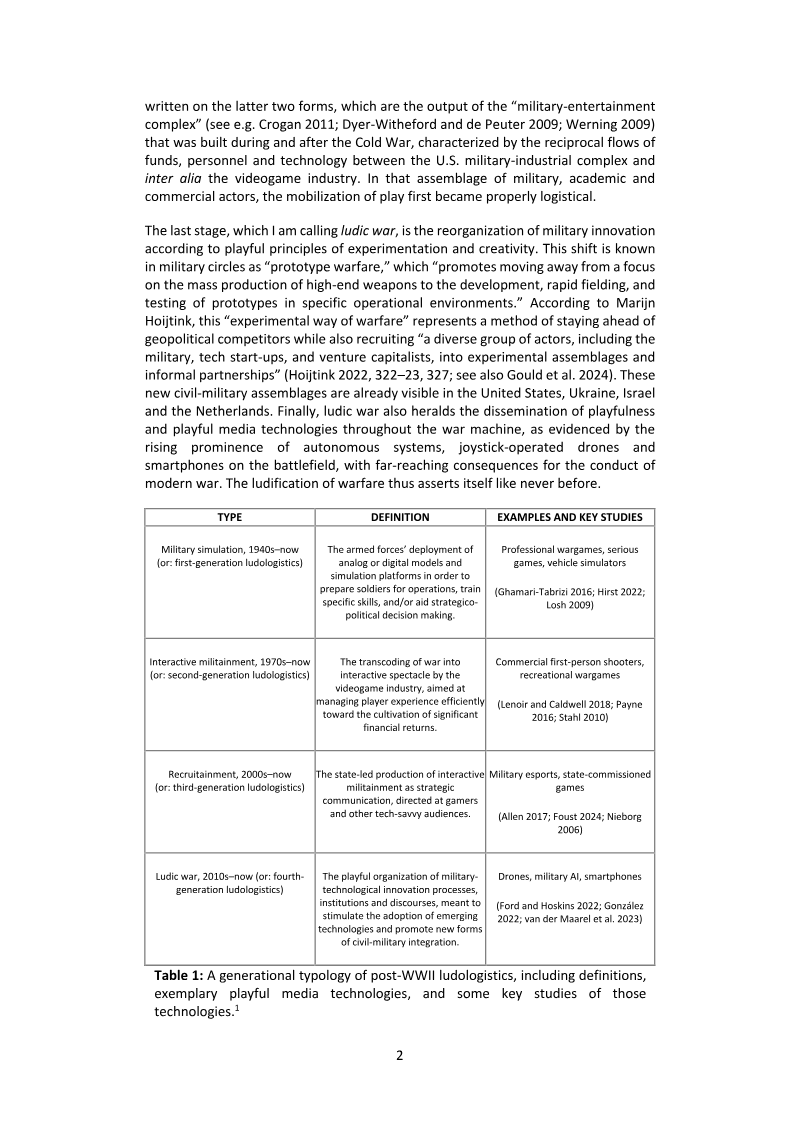
- A four-generation typology traces military play from first-generation military simulation (1940s: professional wargames, vehicle simulators, training platforms) through second-generation interactive militainment (1970s: commercial shooters and recreational wargames), third-generation recruitainment (2000s: state-commissioned games and military esports), to fourth-generation ludic war (2010s).
- Fourth-generation ludic war is characterized by "prototype warfare," which relies on rapid experimentation and civil-military partnerships with tech start-ups and venture capitalists, producing examples such as drones, military AI, and battlefield smartphones.
The Politics of Care: The Possibilities and Limits of Video Games for Political Campaign
This article examines two 2022 mobile games, Lugawan ni Leni and Let Leni Lead, released during the Philippine presidential campaign to support Leni Robredo's candidacy.
- The article introduces the category of "propagandistic advergames," arguing that political games sell a candidate the way commercial advergames sell products, drawing on Ian Bogost's concept of procedural rhetoric.
- Two 2022 mobile games supporting Leni Robredo's presidential campaign, Lugawan ni Leni and Let Leni Lead, express the "Robredo style" of politics, which combines public service performance with personal approachability.
- Lugawan ni Leni uses the lugaw (rice porridge), a humble campaign symbol, to frame serving others as inherently rewarding, while Let Leni Lead adapts the campaign's house-to-house volunteer strategy into an infinite-runner format.

D5.3 Prototype Report: Games, Heritage, Arts, & Sport
The GAMEHEARTS D5.3 Prototype Report presents an early-stage, player-centred video game prototype designed to support youth social inclusion.
- The GAMEHEARTS prototype is a player-centred game for youth social inclusion, grounded in the Positive Youth Development framework and its "5 C's" (competence, confidence, connection, character, caring).
- Its central thesis is that connection itself can serve as the core gameplay mechanic, requiring moderator-supervised collaboration among young people to advance the narrative.
- A needs assessment with a Helsinki youth work centre serving people aged 15 to 25 identified uneven gaming proficiency, limited basic technical skills, language barriers, and loneliness as key challenges.