Serious Games reports and market data
Documents
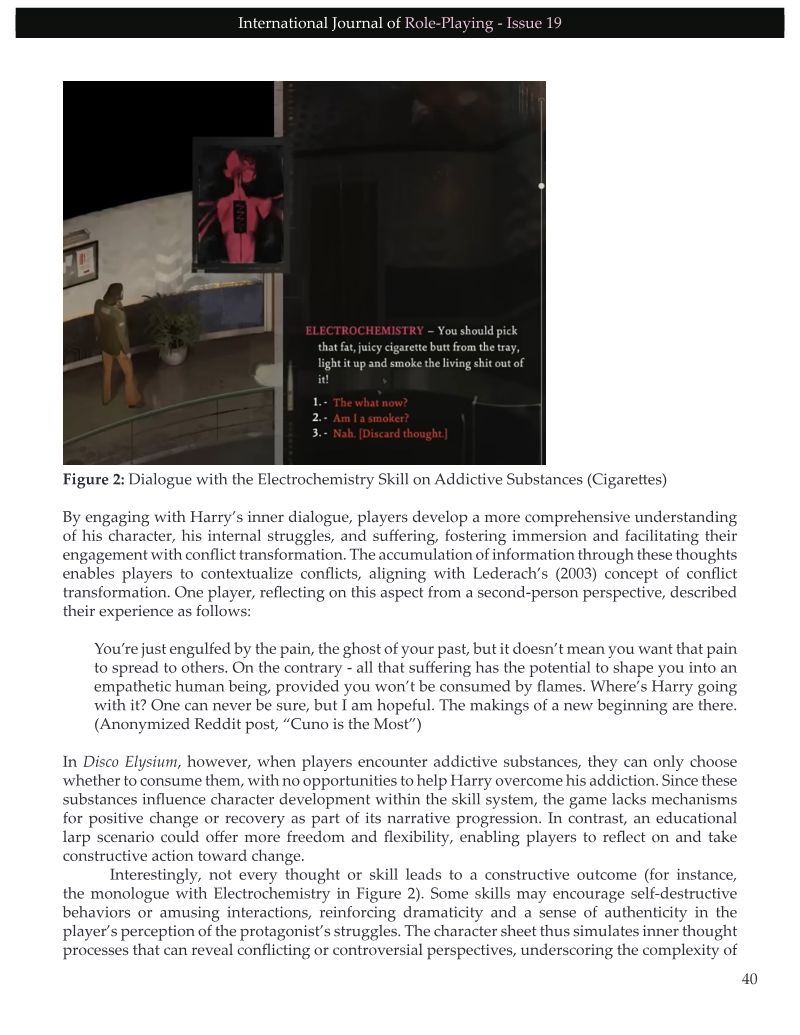
From Digital to Analog: Disco Elysium’s Conflict Transformation Mechanisms for Educational Larps
The integration of digital narrative mechanics into educational live-action role-playing (larp) offers a robust framework for fostering conflict transformation, empathy, and critical self-reflection.
- Educational live-action role-playing (larp) can effectively foster conflict transformation and empathy by adapting internal monologue and skill-based character systems from digital games like Disco Elysium.
- Translating digital narrative mechanics into analog larp environments increases participant agency by shifting the focus from predefined digital outcomes to real-time, active conflict resolution.
- Character development models, such as the trajectory of the character Cuno, can be adapted into educational scenarios to facilitate personal growth and critical self-reflection.
Missing in Action: Professional Wargaming in Game Studies
This paper argues that professional wargaming, the institutionalized use of games by militaries and defence organizations, is a major yet underexamined object of game studies inquiry.
- Professional wargaming, the institutionalized use of games by militaries and defence organizations, is identified as a major yet underexamined object of game studies, which has focused far more on entertainment games and the military-entertainment complex.
- The paper argues that professional wargames do more than represent conflict: they encode assumptions about rationality, technology, identity, and geopolitical order that shape how future conflicts are imagined, prepared for, and managed.
- The paper is an argumentative, agenda-setting intervention rather than an empirical study and presents no new data on any specific military institution.



What Now?: Ecogames after Missed Climate Targets
This conference paper by Conor McKeown argues that ecogames scholarship must shift from a focus on preservation and damage limitation toward engagement with the lived realities of an already-changing climate, now that overshooting the Paris 1.5°C target is effectively acknowledged as inevitable.
- McKeown argues ecogames scholarship must shift from preservation and damage limitation toward engaging with the lived realities of an already-changing climate, since overshooting the Paris 1.5°C target is effectively acknowledged as inevitable.
- He contends that existing ecogames work remains oriented toward hopeful, forward-looking reforms of game design and industry practice and is insufficiently anchored in present climate catastrophe.
- The paper proposes that games addressing livability, citizenship, and practical adaptation should count as ecogames, with climate migration identified as the most pressing concern.
Applied Ethics Techniques for Video Game Ethics
This paper proposes that two families of techniques from analytic applied ethics, case construction and engaging perspectives, can strengthen both the teaching of video game ethics and collaboration among researchers and practitioners.
- The paper argues that game ethics has grown rapidly as a field, but its teaching and research are complicated by the diverse assumptions and evaluative standards found across games scholarship.
- Its central proposal is that two families of techniques from analytic applied ethics, case construction and engaging perspectives, can structure debate, clarify agreement, and pinpoint the true sources of disagreement among researchers and practitioners.
- Case construction includes analogies, which test a target case against a structurally similar one, and simplifying examples, which strip away complicating features to reveal which elements actually drive moral evaluation.



Monstera pocketii: The Botanical Vitality of Pokémon
This paper argues that the Pokémon franchise should be read through plant studies rather than solely as representations of animals.
- The paper argues Pokémon should be read through plant studies rather than solely as animal representations, emphasizing the botanical and 'living surface' qualities of the creatures and franchise, which exceed the category of the animal.
- Author Nikolas Matovinovic (Monash University) builds on ecocritical and critical plant studies frameworks, drawing on Sean Morey and Jason Crider's 'Hyperanimal' concept and theories of plant agency and interspecies communication, including orchid-wasp relations.
- Carnivorous-plant-inspired Pokémon such as Victreebel and Carnivine are presented as the most significant contemporary screen depiction of carnivorous plants, a category the paper says existing plant horror scholarship largely overlooks.
How is Learning in Edu-Larp as a Method Described and Seen by Practitioners?
Educational live-action role-playing functions as a sophisticated pedagogical framework that leverages immersion, agency, and playfulness to foster deep learning.
- The efficacy of educational live-action role-playing (edu-larp) depends on the synthesis of experiential embodiment during play and rigorous post-experience reflection to solidify learning outcomes.
- Edu-larp functions as a constructivist pedagogical framework that utilizes immersion, agency, and social interaction to develop empathy and social competencies alongside academic content.
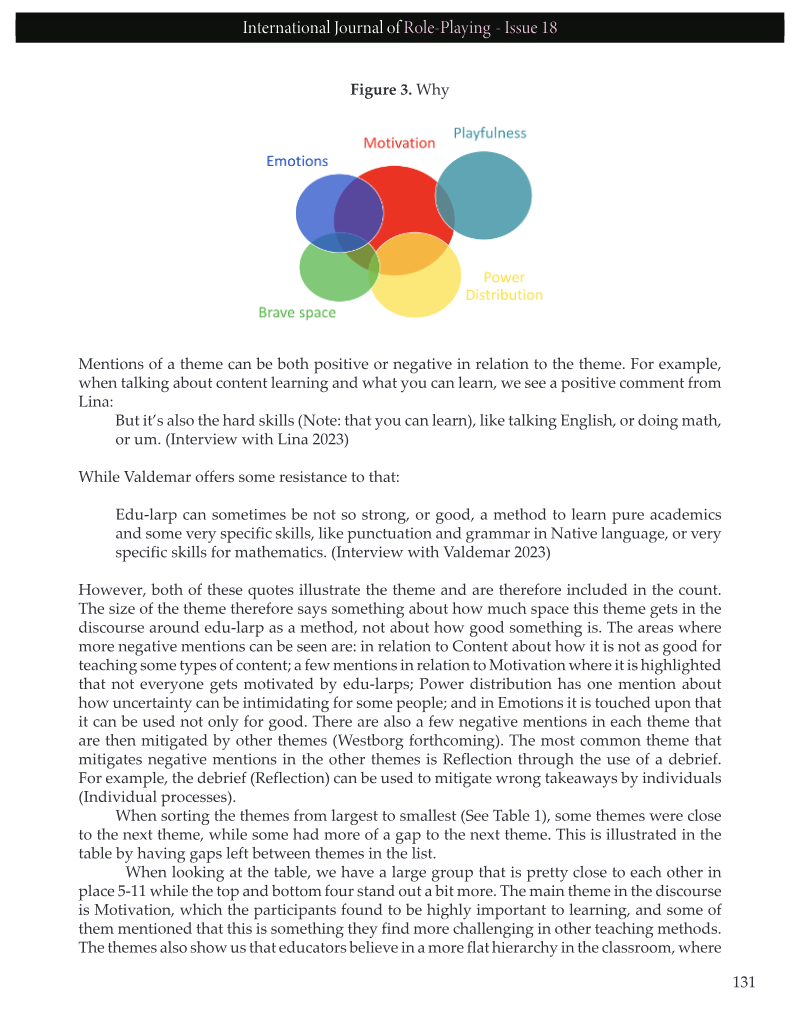
- The creation of a 'brave space'—a safe, immersive environment with distributed power—is identified by practitioners as the primary driver for student motivation.
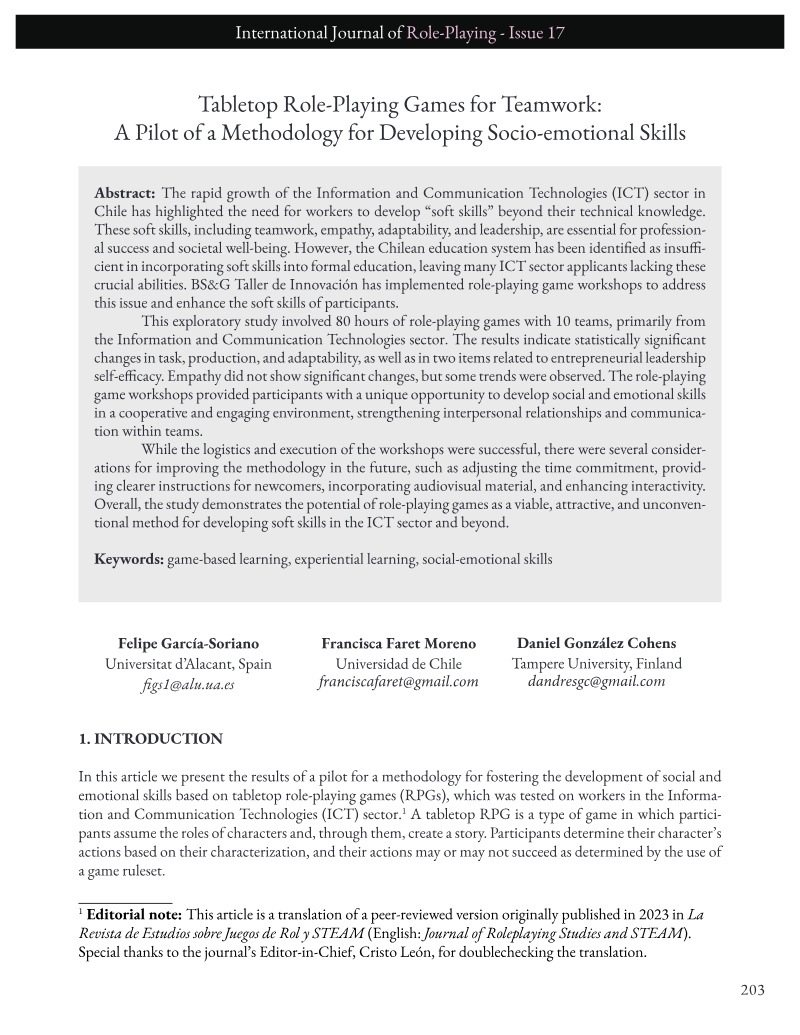
Tabletop Role-Playing Games for Teamwork: A Pilot of a Methodology for Developing Socio-emotional Skills
Tabletop role-playing games serve as a potent experiential learning tool for addressing critical socio-emotional skill gaps within professional environments.
- A pilot study of 49 ICT professionals across ten teams demonstrated that Dungeons & Dragons 5th Edition serves as a viable, cost-effective methodology for improving workplace competencies.
- Participants engaged in 80 hours of online gameplay, which resulted in statistically significant improvements in self-efficacy regarding the creation of innovative work environments.
- Qualitative feedback from the 49 participants highlighted substantial gains in creative problem-solving abilities and the mitigation of workplace stress.
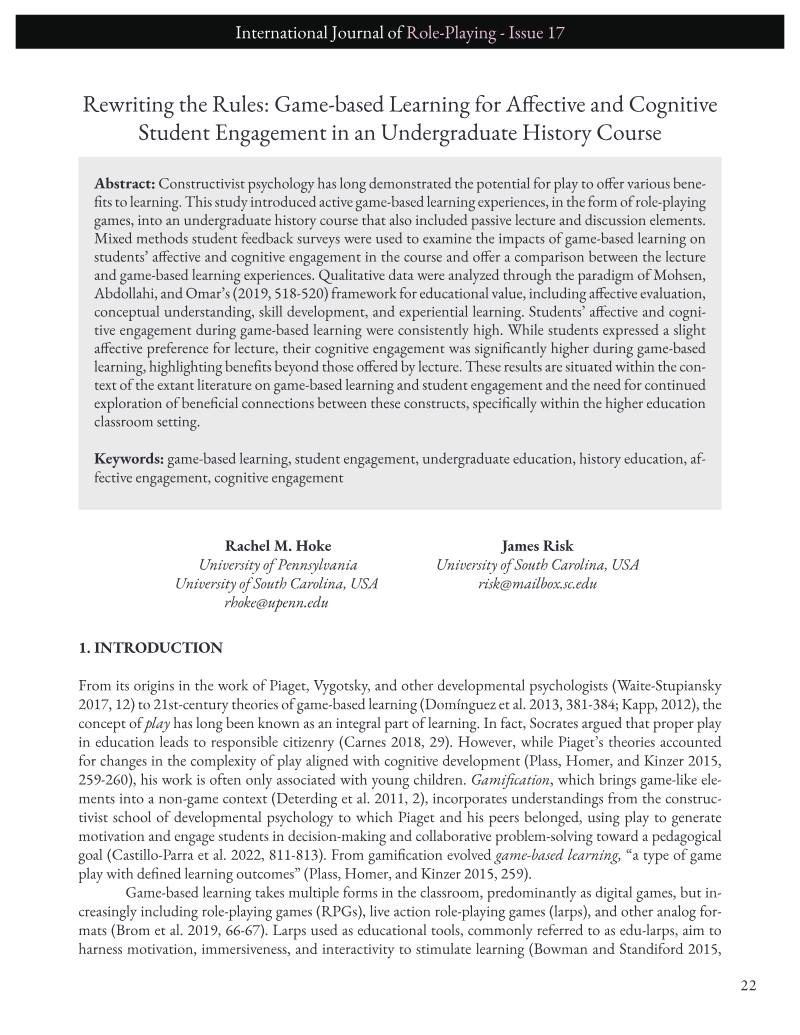
Rewriting the Rules: Game-based Learning for Affective and Cognitive Student Engagement
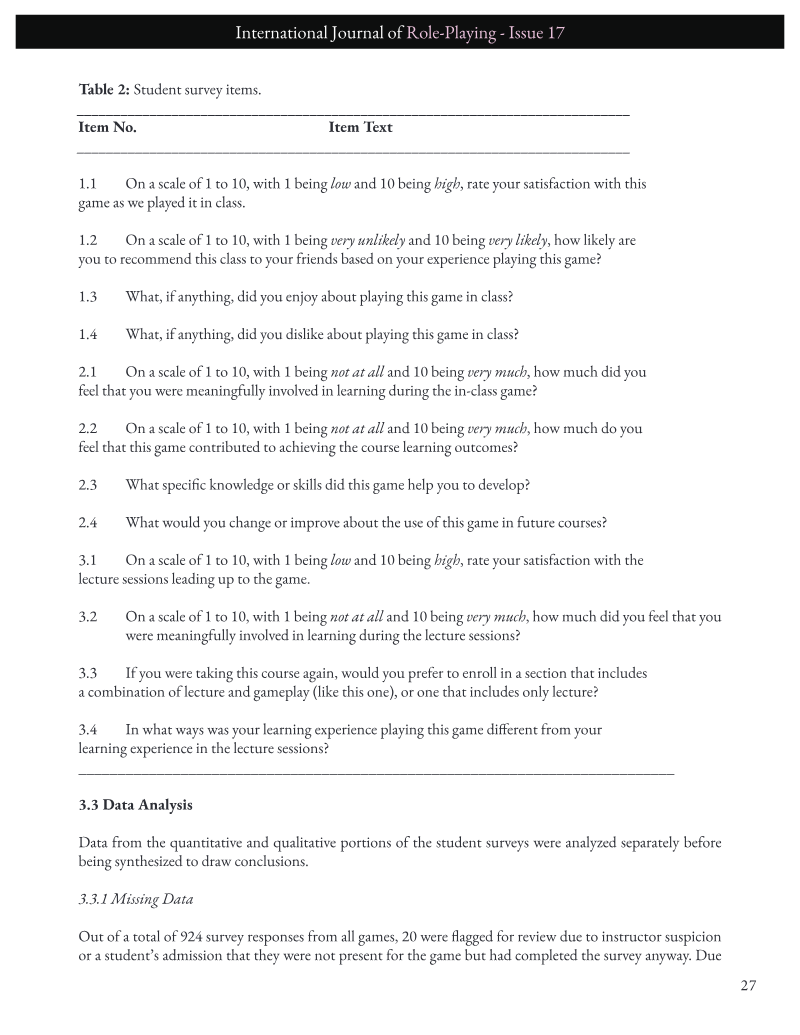
Integrating role-playing games and educational live-action role-playing games into undergraduate history curricula serves as a powerful pedagogical strategy for enhancing student engagement.
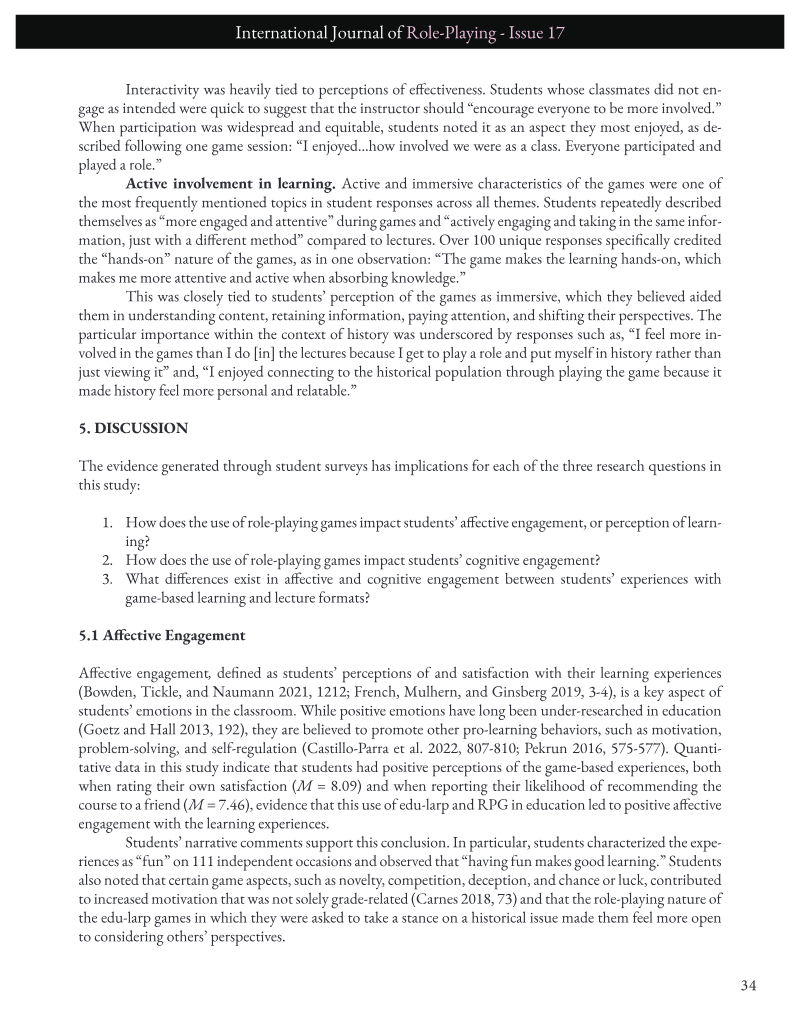
- Game-based learning, including role-playing and live-action simulations, significantly outperforms traditional lectures in fostering cognitive engagement and conceptual understanding among undergraduate history students.
- Data from a survey of 924 students reveals a dichotomy where participants express a preference for the comfort of traditional lectures despite demonstrating higher cognitive performance during game-based sessions.
- Immersive game-based strategies are effective tools for developing critical thinking, collaboration, executive function, and the ability to adopt diverse perspectives on complex historical topics.
From Tradition to Interaction: A Systematic Literature Review of Cultural Heritage Representation in Entertainment Videogames
This systematic literature review examines how cultural heritage is represented in entertainment videogames, analysing 80 publications from 2005 to 2022 identified through a PRISMA-guided Scopus search and ASReview-assisted screening.
- The review analyses 80 publications from 2005 to 2022, identified via a PRISMA-guided Scopus search and ASReview-assisted screening, and applies a tangible/intangible heritage framework adapted from Balela and Mundy.
- Scholarship is heavily skewed toward European heritage (notably Nordic mythology and architecture) and modern American culture as depicted in Grand Theft Auto, while Asian heritage is markedly understudied.
- Research concentrates on Triple-A role-playing and real-time strategy titles on PC and consoles, leaving mobile and indie games largely unexamined.
The Infusion of Virtuality and Reality: Video Games in Exhibition Space and the Flow of Power
This research examines video games in exhibition spaces as ecosystems of human and non-human actors, focusing on how agency and power circulate among institutions, artists, audiences, and machines.
- Video games in exhibition spaces redistribute agency among institutions, artists, audiences, and machines, destabilizing traditional curatorial hierarchies and making exhibition power dynamics more complex and less stable.
- Games tend to attract more diverse visitor types and give audiences greater agency within the exhibition experience.
- Technological labour and machine maintenance function as non-human participants in game-based exhibitions, and are often overlooked because they are treated as mere tools.
Tasks-Interactions-Environment for Simulations and Serious Games (TIE-SSG) Framework: Exploring Practical Applications
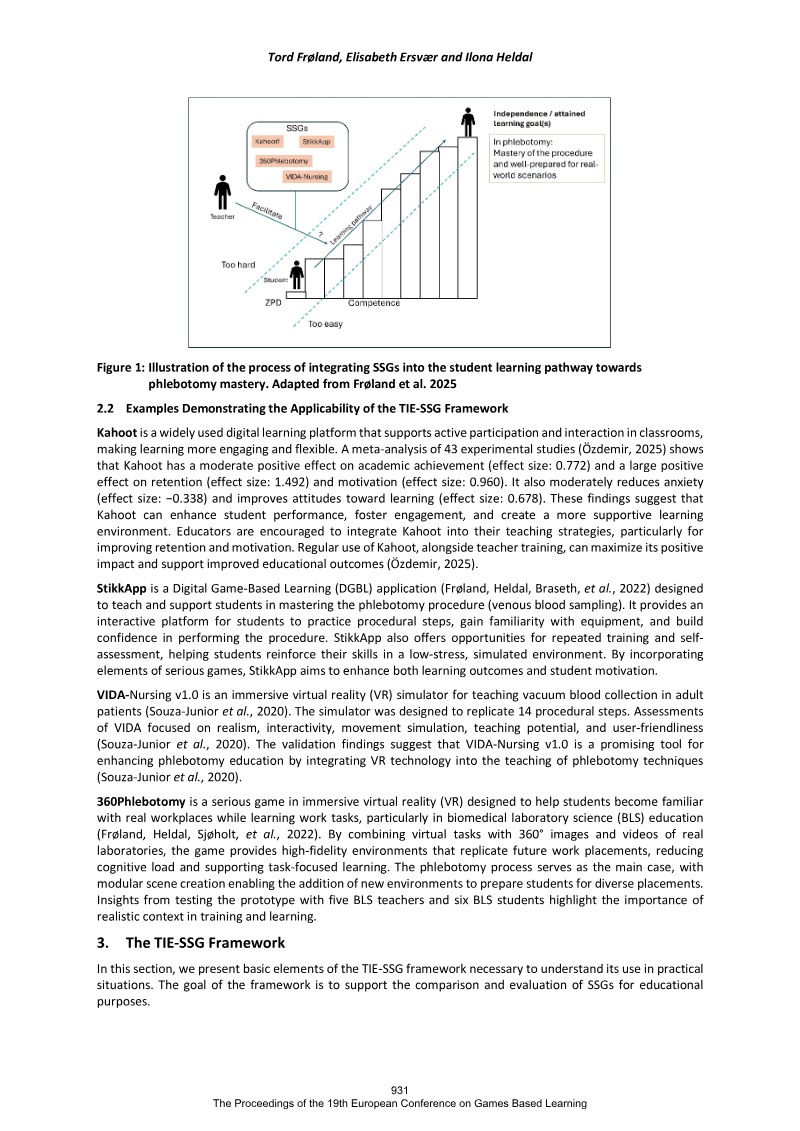
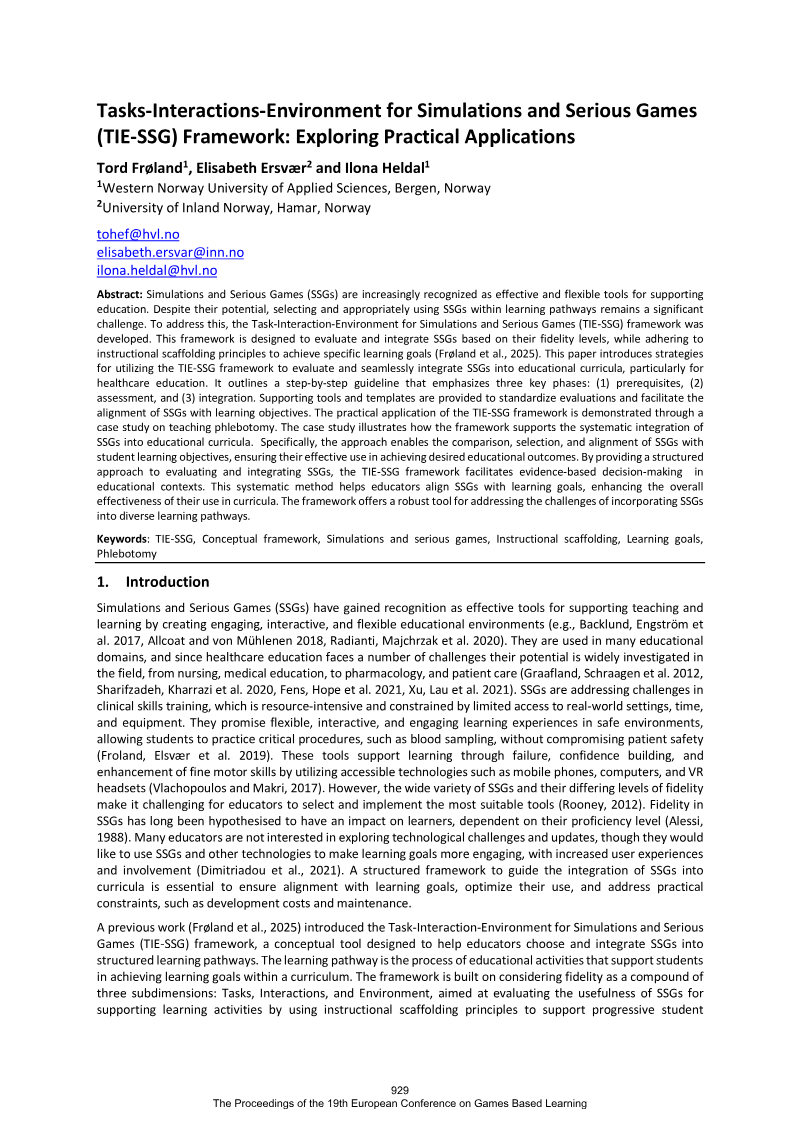
The TIE-SSG framework paper presents a structured, evidence-oriented tool for evaluating and sequencing Simulations and Serious Games (SSGs) in healthcare education.
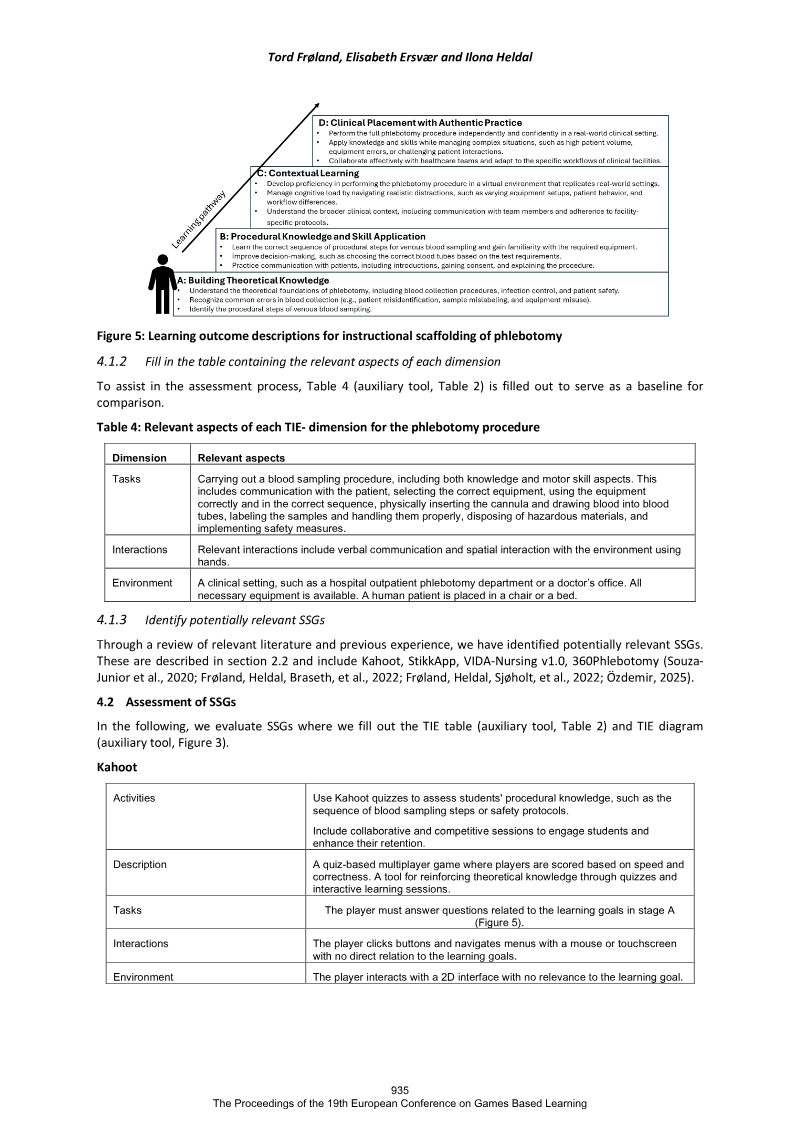
- The TIE-SSG framework argues that an SSG's instructional value depends on its fidelity across three dimensions (Tasks, Interactions, and Environment), and that these ratings should be matched to scaffolding and specific learning goals.
- The framework runs in three phases (prerequisites, assessment, and integration) and is supported by fillable fidelity tables, a fidelity-level guide, and a TIE diagram that visualises each tool's profile.
- In a phlebotomy case study of four serious games, low-fidelity Kahoot was judged suitable for foundational theoretical knowledge, moderate-fidelity StikkApp and VIDA were associated with procedural skill development, and high-fidelity 360Phlebotomy was positioned for contextual learning.
Development of a Serious Game for Practicing Pronouns
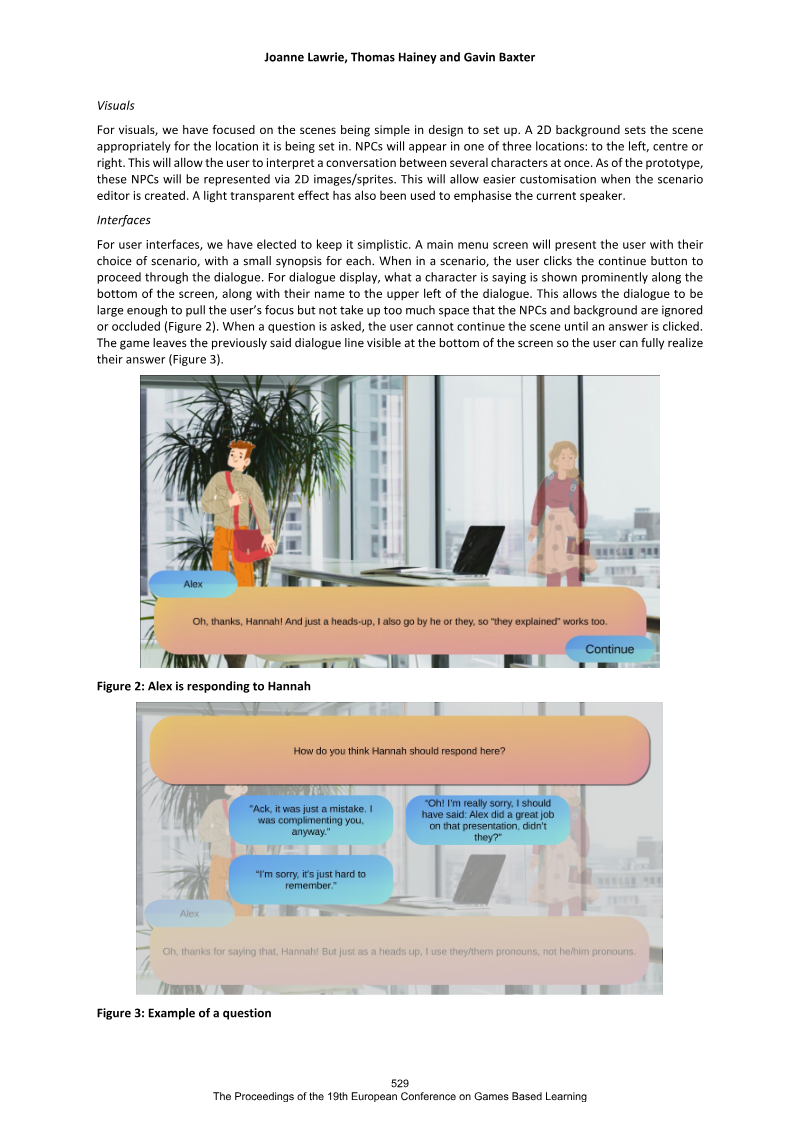
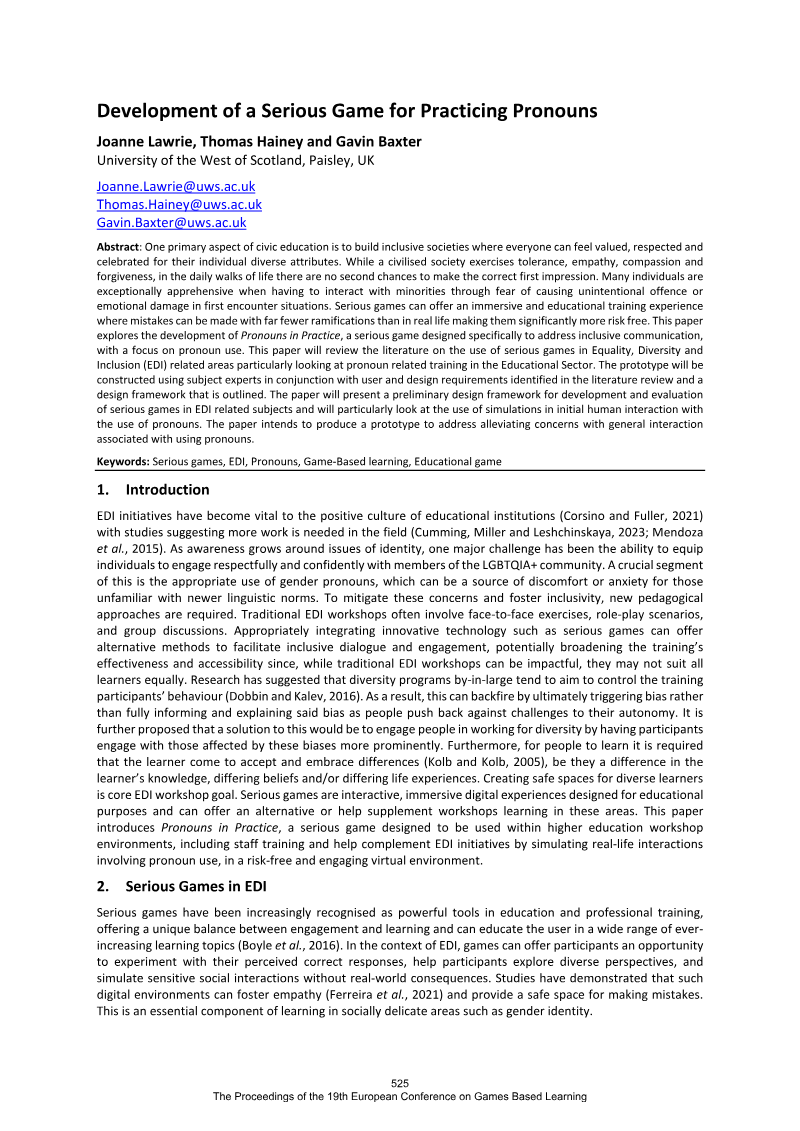
"Development of a Serious Game for Practicing Pronouns" presents the design and development of "Pronouns in Practice," a 2D visual novel serious game built in Unity to help learners practise inclusive pronoun use.
- The authors built "Pronouns in Practice," a 2D visual novel serious game in Unity that lets learners rehearse inclusive pronoun use in a low-stakes setting before real encounters with LGBTQIA+ people.
- The game is a branching narrative in which players navigate workplace scenarios, such as a manager who witnesses or commits misgendering of transgender colleagues, with feedback screens after each choice to prompt reflection.
- The report identifies no existing serious games focused primarily on pronoun use, though adjacent projects provide design precedents such as branching narratives and perspective-switching.