Serious Games reports and market data
Documents
The Integration of the Computer-Mediated Ludic Experience in Multisensory Environments
The document examines how computer-mediated ludic experiences (CMLE) can be integrated into Multisensory Stimulation Environments (MSE), flexible spaces used for therapy, education, and recreation.
- The document argues that computer games, by eliciting emotional states such as flow and happiness, can advance intervention goals in Multisensory Stimulation Environments (MSE), especially for children with intellectual and developmental disabilities.
- The evidence base is limited: MSE efficacy findings are preliminary and largely qualitative, and the link between game-induced emotional states and therapeutic outcomes is not yet well established, so the authors call for more rigorous research.
- The authors propose that computer-mediated ludic experiences (CMLE) can bridge into MSE to support emotional, cognitive, sensory, and motor development.
Workshop: Ethics in Videogames
This workshop proposal, presented at the DiGRA 2009 conference, examines the emerging field of ethics in videogames, arguing that games offer a rich environment for practicing ethical reasoning, moral judgment, and critical thinking.
- Games are framed as both a site of ethical controversy, often blamed for social ills such as youth violence and child obesity, and a potential tool for teaching ethical decision-making.
- The authors define ethics as the practice of enacting choices and moral judgment, arguing that games offer a rich environment for practicing ethical reasoning and critical thinking.
- A 2008 Pew Report cited in the workshop found that 63 percent of teens who play games have witnessed people being mean or overly aggressive, and 49 percent have seen hateful, racist, or sexist behavior.
Evolution and Digital Game Studies
This paper argues that evolutionary psychology can make a valuable contribution to digital game studies, which have largely been shaped by cultural and humanities-based frameworks such as those of Johan Huizinga and cultural relativist approaches to play.
- The paper argues that digital game studies have been dominated by humanities and cultural frameworks (notably Huizinga's view of play as cultural), and that evolutionary psychology can make a valuable complementary contribution.
- It contrasts two lineages of play research: Karl Groos's functionalist view of play as evolutionary preparation for adult life, and Huizinga's cultural-phenomenon account.
- The authors use Tooby and Cosmides' Integrated Causal Model to critique the Standard Social Science Model, which treats the mind as a blank slate and separates culture from biology, and propose examining digital gaming through evolved cognitive modules.

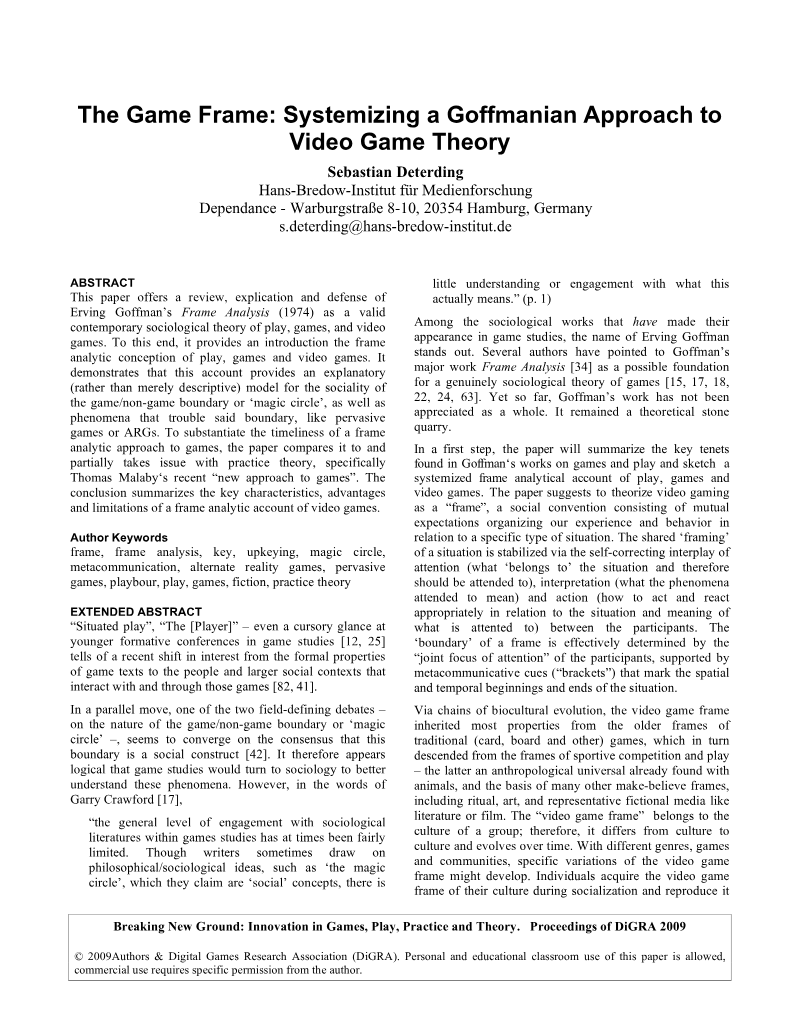
The Game Frame: Systemizing a Goffmanian Approach to Video Game Theory
Sebastian Deterding's paper argues that Erving Goffman's Frame Analysis (1974) offers a valid and underused sociological theory for understanding play, games, and video games.
- Deterding argues that Erving Goffman's Frame Analysis (1974) is a valid but underused sociological framework for understanding play, games, and video games, offered as an extended abstract for DiGRA 2009.
- The paper proposes treating the video game as a social frame: a convention of mutual expectations stabilized through metacommunication, joint attention, interpretation, and action among participants.
- Frame analysis is positioned as an alternative to the long-dominant 'magic circle' metaphor, which many scholars regard as socially constructed but have never explained mechanistically.
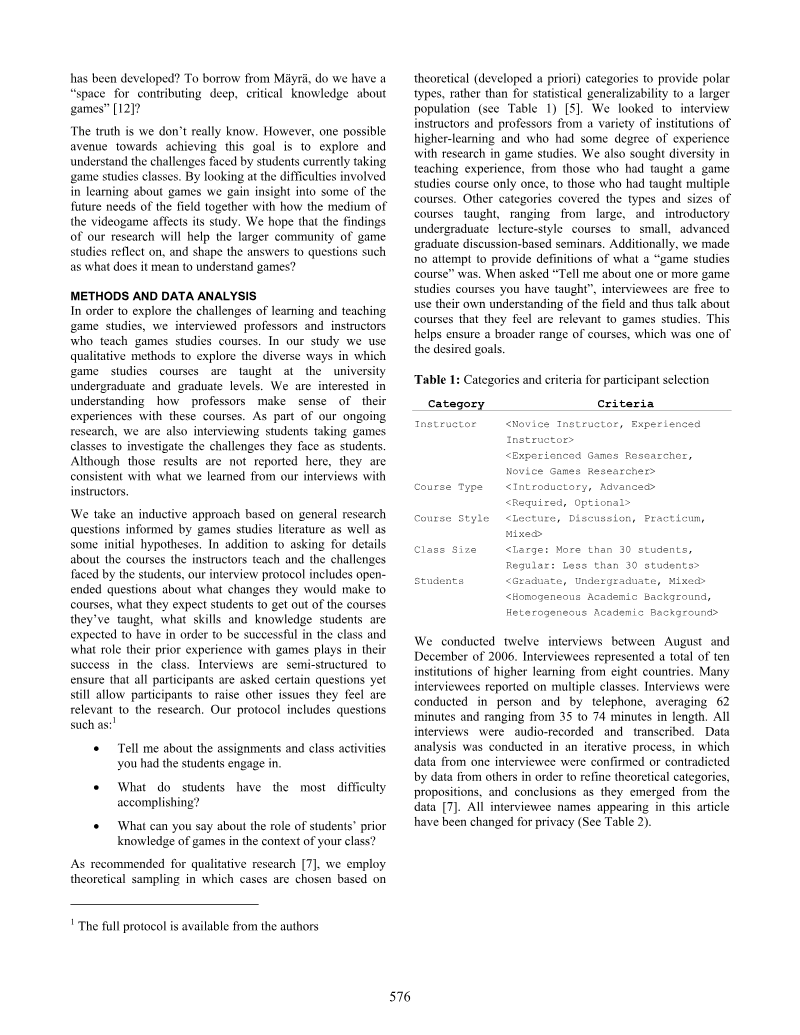
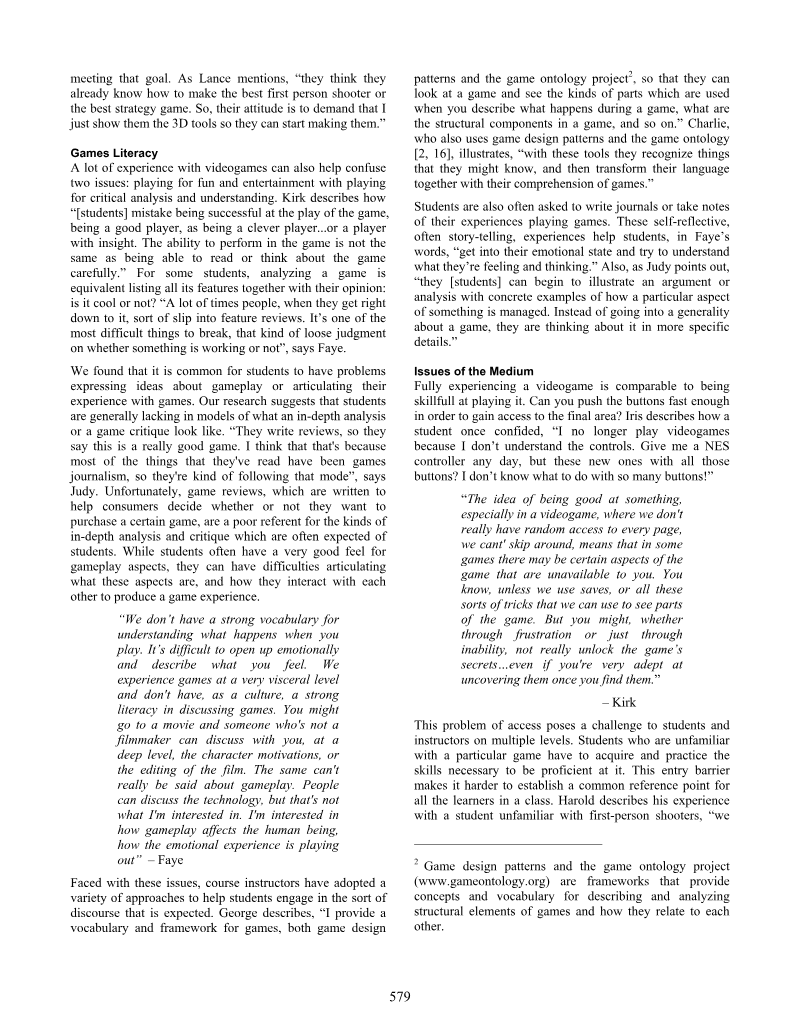
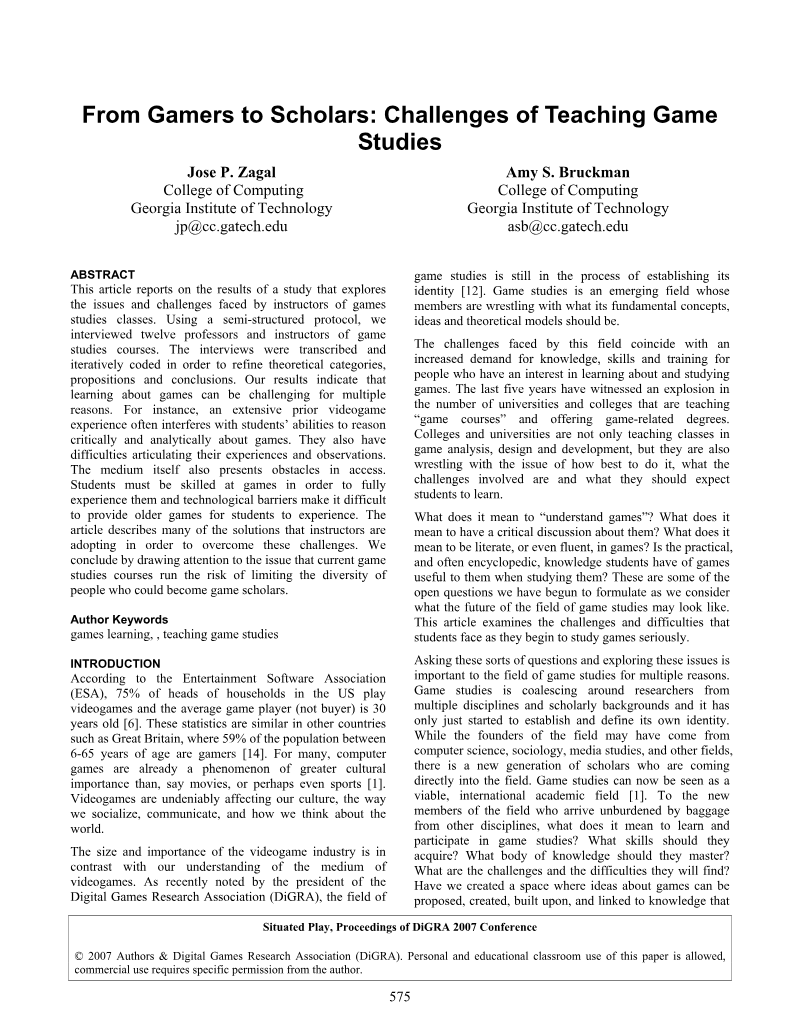
From Gamers to Scholars: Challenges of Teaching Game Studies
Zagal and Bruckman's paper examines the pedagogical difficulties of teaching game studies at the university level, drawing on interviews with twelve instructors in the field.
- Students' deep but narrow gaming backgrounds can boost motivation and supply rich analytical material, yet they often impede critical reasoning, as learners cling to genre-specific assumptions, dismiss older titles, and conflate skilled play with analytical insight.
- Instructors report that students resist perspectives that challenge their identity as "gamers," which makes it harder to foster the detached, critical stance that game studies requires.
- The field's relative youth, lack of an established canon, and practical access problems (platform obsolescence, time demands, uneven prior exposure) structurally compound the difficulty of teaching it.
Playing Through: The Future of Alternative and Critical Game Projects
Patrick Crogan's DiGRA 2005 paper, "Playing Through: the Future of Alternative and Critical Game Projects," examines experimental games that disrupt the usual virtuality of play by making its physical and political stakes visible.
- Patrick Crogan's 2005 DiGRA paper reads experimental games such as Tekken Torture Tournament and the Painstation consoles as 'theatres of cruelty' that use real bodily consequences, like electric shocks and whips, to provoke reflection on the technocultural conditions of gaming.
- Crogan's central critical target is Gonzalo Frasca's claim that simulation is 'the form of the future,' positioned against narrative as the past and drama as the present, which Crogan argues is too rigid a temporal schema.
- Crogan argues that computer simulation grows out of military-industrial technoscience and therefore shares narrative's mnemotechnical, future-directed character rather than standing apart from it.
Games for Learning: Are Schools Ready for What's To Come?
This 2005 pilot study, presented at the DiGRA conference and conducted by researchers at the University of Calgary, examines whether K-12 teachers are ready to integrate digital games into classroom instruction.
- Seventy percent of surveyed K-12 teachers reported using simulations or games in class, and 57 percent used games specifically, mostly for learning.
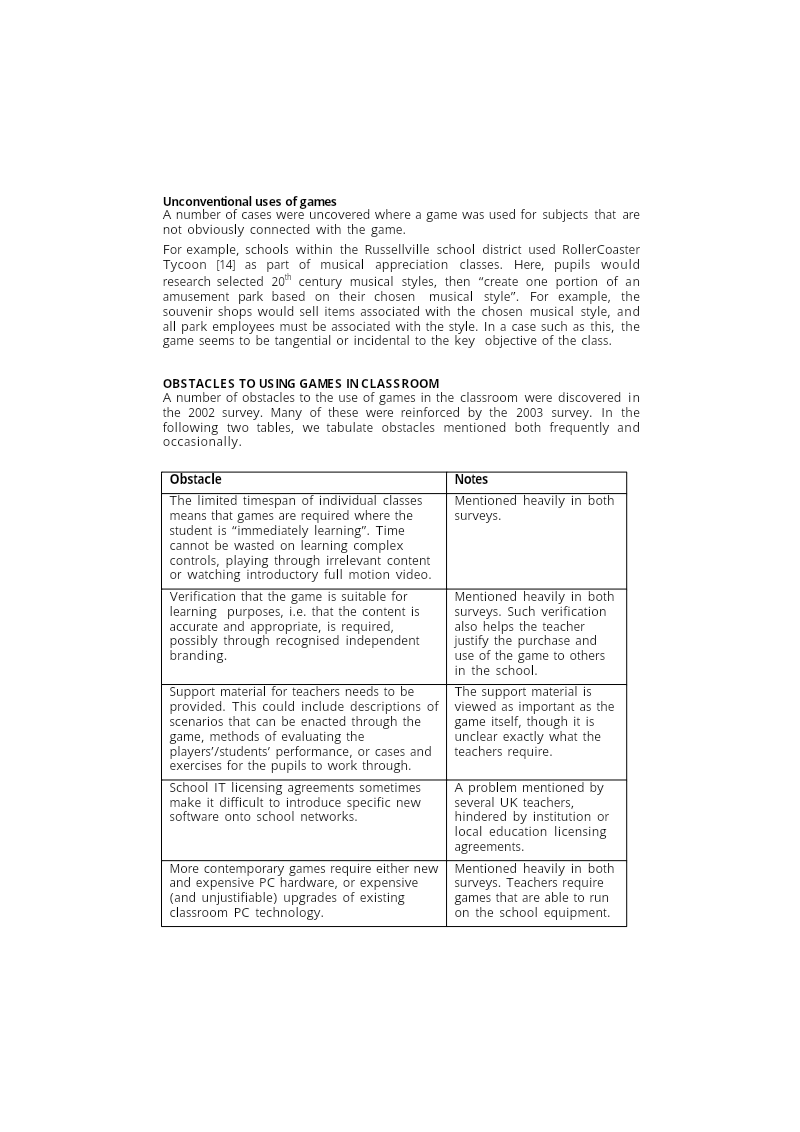
- The main barriers to classroom game use were inadequate hardware and software, insufficient time, and lack of knowledge about integrating games into curricula, rather than resistance to games themselves.
- Willingness to try game-related applications was generally high, with educational downloads and simulations rated most favorably and commercial off-the-shelf games receiving more mixed responses.
Playing Audio-Only Games: A Compendium of Interacting with Virtual, Auditory Worlds
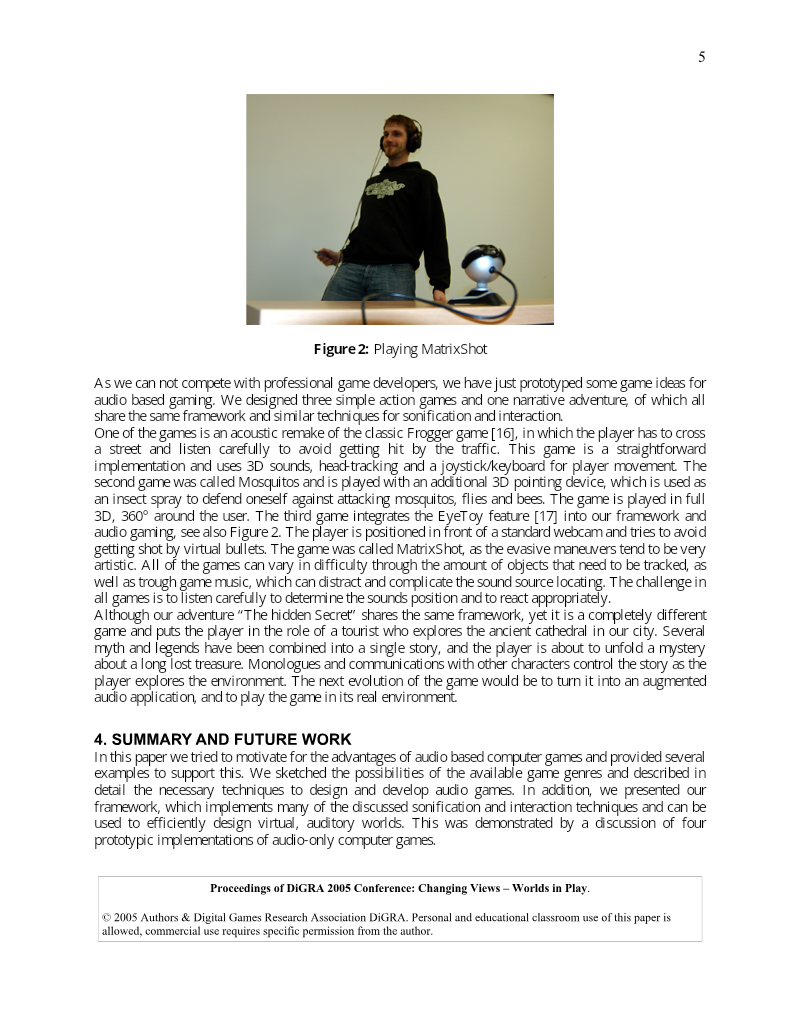
This paper presents an overview of audio-only computer games, games played and perceived entirely through sound and acoustics.
- Audio-only games were originally developed by and for visually impaired players, but the authors argue they offer advantages for gameplay experimentation, mobile gaming, and immersive storytelling that also appeal to hearing players.
- The central design challenge is balancing functional information for orientation and navigation against artistic aesthetics, avoiding both cluttered auditory displays and silent stretches that disorient players.
- Designers can tune difficulty through narration, monologues, the number of sound objects, and background music, which the paper presents as tools for managing this functionality-aesthetics balance.
The Play's the Thing: Practicing Play as Community Foundation and Design Technique
Tracy Fullerton's paper describes the USC Game Design Community, an extracurricular, cross-departmental initiative at the University of Southern California's School of Cinema-Television and Annenberg Center for Communication.
- Tracy Fullerton's paper argues that shared play experiences can give students and researchers from different disciplines a common vocabulary, social bonds, and collaboratively generated design concepts, complementing formal curricula that leave cross-disciplinary teamwork to chance.
- The USC Game Design Community is an extracurricular, cross-departmental initiative run through the School of Cinema-Television and the Annenberg Center for Communication at the University of Southern California.
- The Cooperative Game Play Experiment, drawing on the 1970s New Games Movement and led by Bernie DeKoven, was judged the community's most successful event, with its outdoor, technology-free format and the motto "play hard, play fair, nobody hurt" credited with sustaining discussion.
Use of Computer and Video Games in the Classroom
This paper examines how commercial, entertainment-oriented computer and video games are used within formal classroom instruction, drawing on informal surveys conducted in 2002 and 2003 that were focused primarily on UK schools but extended to the United States, mainland Europe, and Australia to provide comparative context.
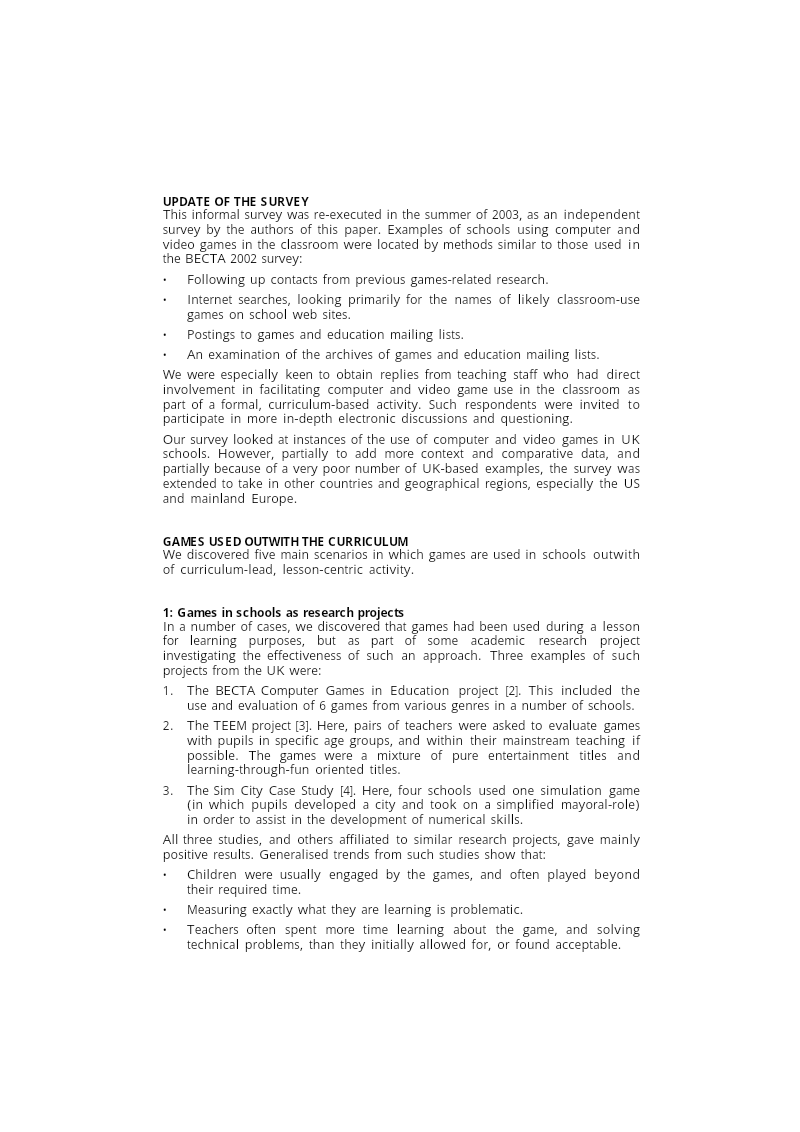
- Games were mostly used outside the core curriculum, in research pilots, competitions, computer clubs, literacy and critique activities, and as behavioural rewards, rather than as part of formal lessons.
- Strategy and simulation titles such as Sim City and RollerCoaster Tycoon were the most common classroom games, valued for their relevance across subjects and their ability to engage students.
- Teachers reported high pupil engagement and sometimes markedly increased group discussion and collaboration when games were used.
Tiny Patches of Peace: Signs of Agency in Digital Games
Cindy Poremba's study examines how player-created modifications function as a form of authorship in digital games, with particular attention to peace-themed works produced after September 11, 2001.
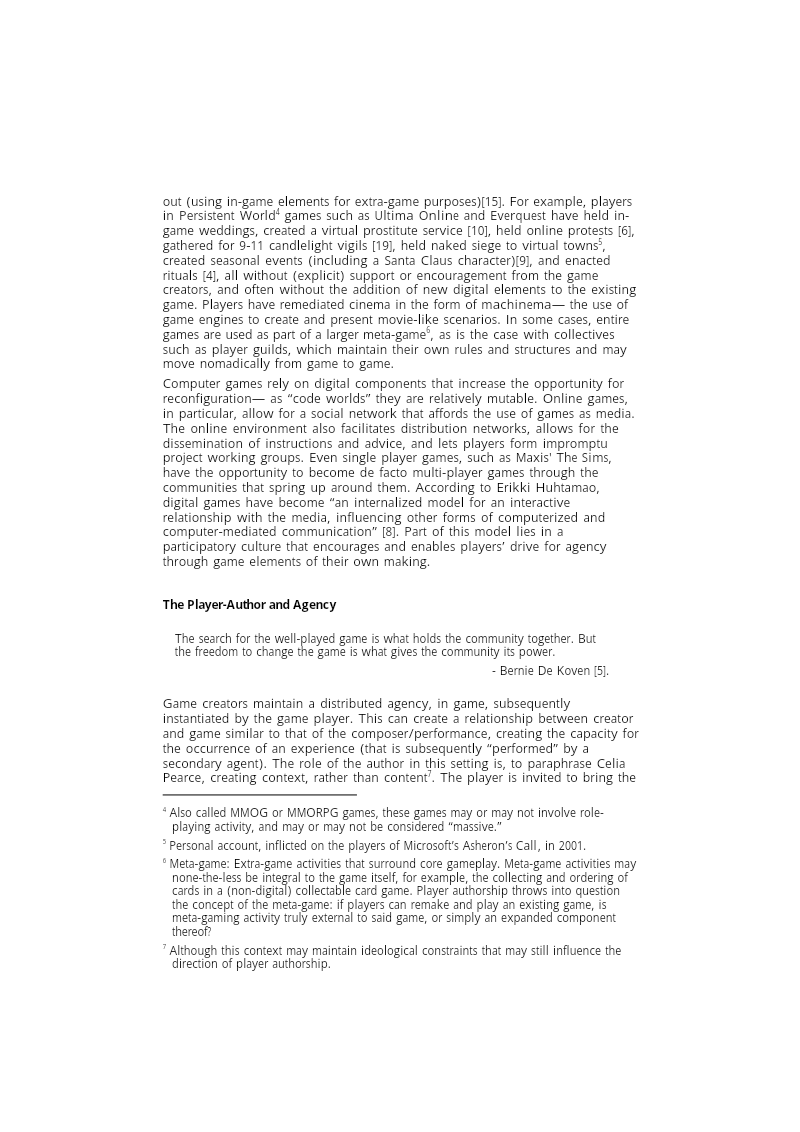
- Player-created modifications are framed as an independent form of authorship that both expresses and reinforces the player's legitimacy as an author, with the study focusing on peace-themed mods made after September 11, 2001.
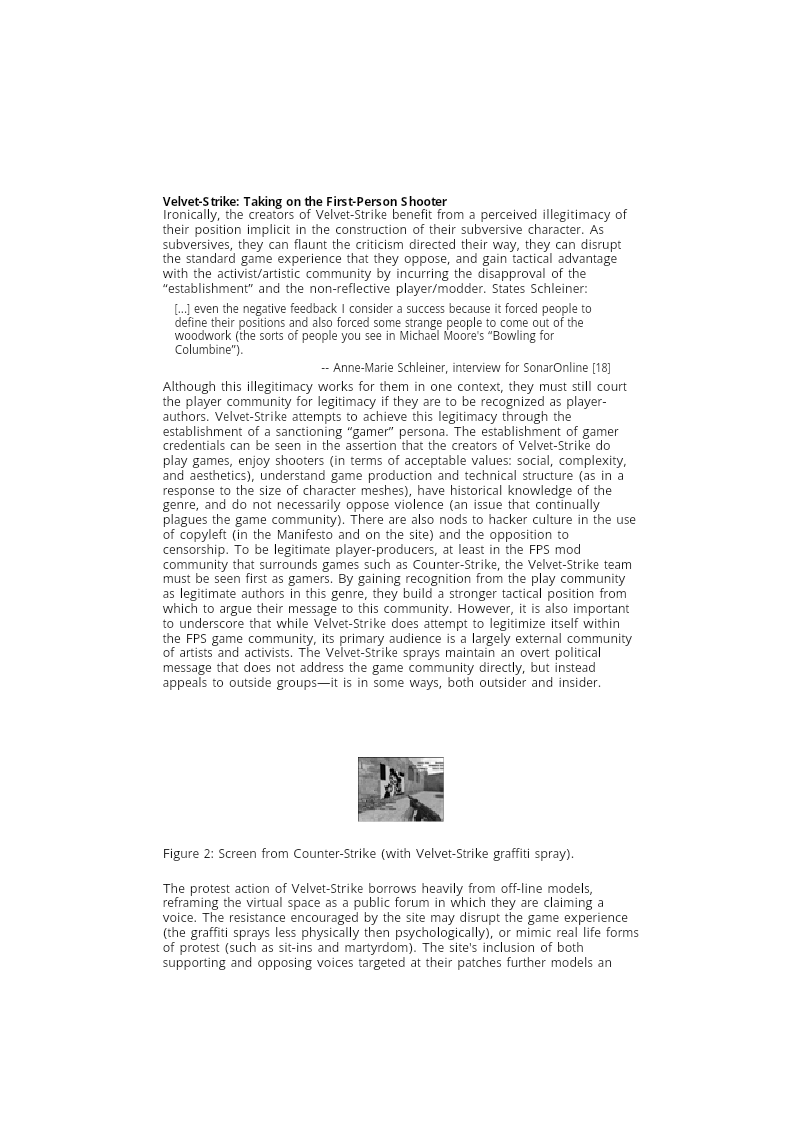
- Cindy Poremba's analysis centers on two cases: the anti-war Counter-Strike modification "Velvet-Strike" and the anti-war posters "Tiny Signs of Hope" created for The Sims.
- Velvet-Strike adopts a "gamer" persona to gain credibility within the combative first-person shooter community while aiming its message at an outside audience of artists and activists.