Regulation reports and market data
17 game industry reports, presentations and talks about regulation from writers such as Video Games Europe and AEVI, newest from 2025. Every document has a summary and key insights with the page they come from.
Key figures
The European video-games sector, valued at €26.8 billion and supporting 116,000 jobs, faces declining global competitiveness due to overlapping and burdensome EU digital regulations.
Video Games Europe, 2025 · Digital Omnibus: Digital Package for Simplification, p. 6
The industry’s self-regulatory PEGI system is a core component of the current framework, currently maintaining approximately 75% consumer awareness regarding age-appropriate ratings.
Video Games Europe, 2023 · Position Paper: Public Consultation for the Fitness Check of EU Consumer Law on Digital Fairness, p. 3
The 2023 position paper leverages data from 2020, noting a 22% growth rate for the sector and highlighting that 54% of the 250 million European players regularly use consoles.
Video Games Europe, 2023 · Video Games Europe: Position on the Green Transition Consumer Directive, p. 6
Documents
Video Games Europe’s Response to the European Commission’s Consultation on the Geo‑Blocking Regulation
Video Games Europe submits a policy position urging the European Commission to retain the existing exemption for electronically supplied non-audiovisual copyright-protected content within the Geo-Blocking Regulation.
- Video Games Europe is lobbying the European Commission to maintain the current Geo-Blocking Regulation exemption for non-audiovisual copyright-protected content to preserve commercial freedom for rights-holders.
- The European video game sector generates €26.8 billion in annual revenue and employs over 116,000 people across the EU.
- Industry analysis indicates that consumer demand for cross-border access to video games is modest, with low interest among the 54% of the European population that engages in gaming.
Video Games Europe: Response on the General Block Exemption Regulation Revision
The European video-games sector, generating €26.8 billion in revenue in 2024 and employing more than 116 000 people, is presented as a distinct hybrid of cultural and technological activity that warrants explicit inclusion in the General Block Exemption Regulation (GBER).
- The European video game sector generated €26.8 billion in revenue in 2024 and employs over 116,000 people.
- Industry advocates are lobbying for the inclusion of video games in the General Block Exemption Regulation (GBER) to classify them as 'experimental development,' which would harmonize state-aid rules and eliminate legal uncertainty across the EU.
- Targeted state aid in Germany has proven effective, generating between €1.60 and €2.00 of additional project spending for every euro of aid while creating 1,725 new jobs.
Digital Omnibus: Digital Package for Simplification
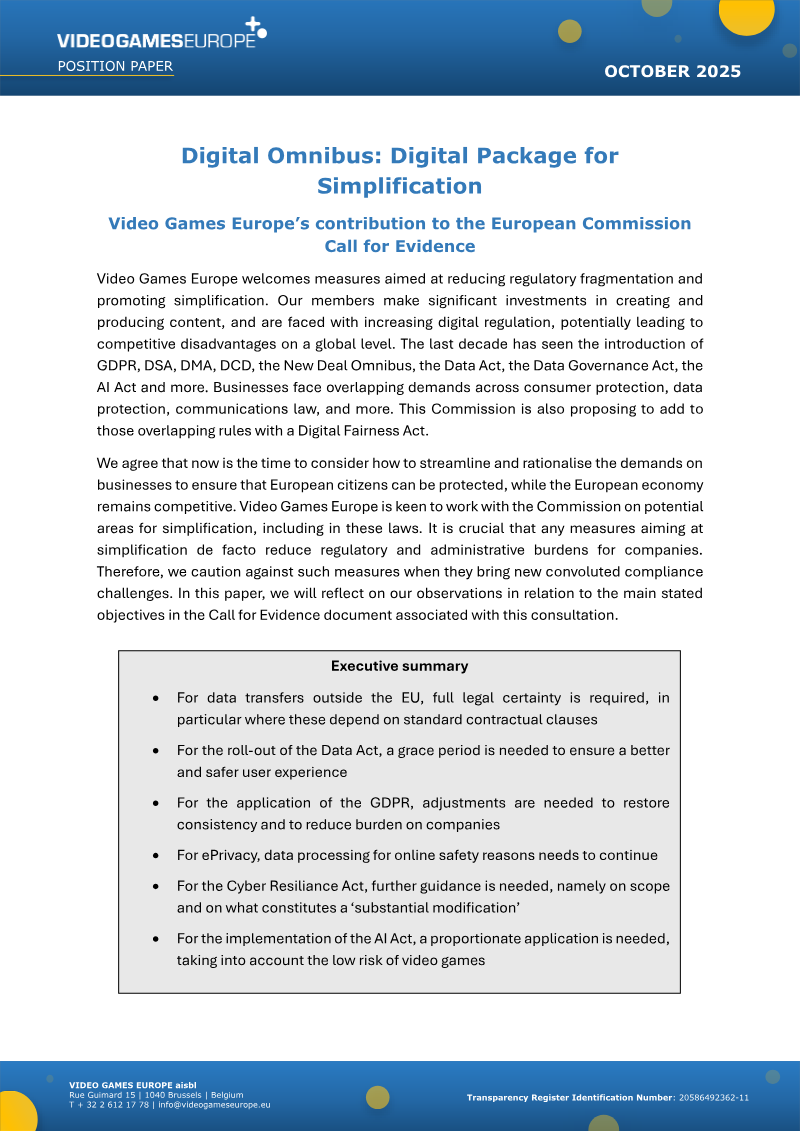
The paper argues that the European Union’s expanding digital regulatory landscape is creating overlapping and burdensome compliance requirements for the video-games sector, threatening its global competitiveness.
- The European video-games sector, valued at €26.8 billion and supporting 116,000 jobs, faces declining global competitiveness due to overlapping and burdensome EU digital regulations.
- OECD research indicates that full data localisation policies could reduce global GDP by 4.5% and decrease exports by 8.5%, highlighting the economic risks of fragmented digital rules.
- The industry is advocating for a 'Digital Omnibus' to streamline compliance, specifically requesting a grace period for the Data Act to account for long console development cycles.
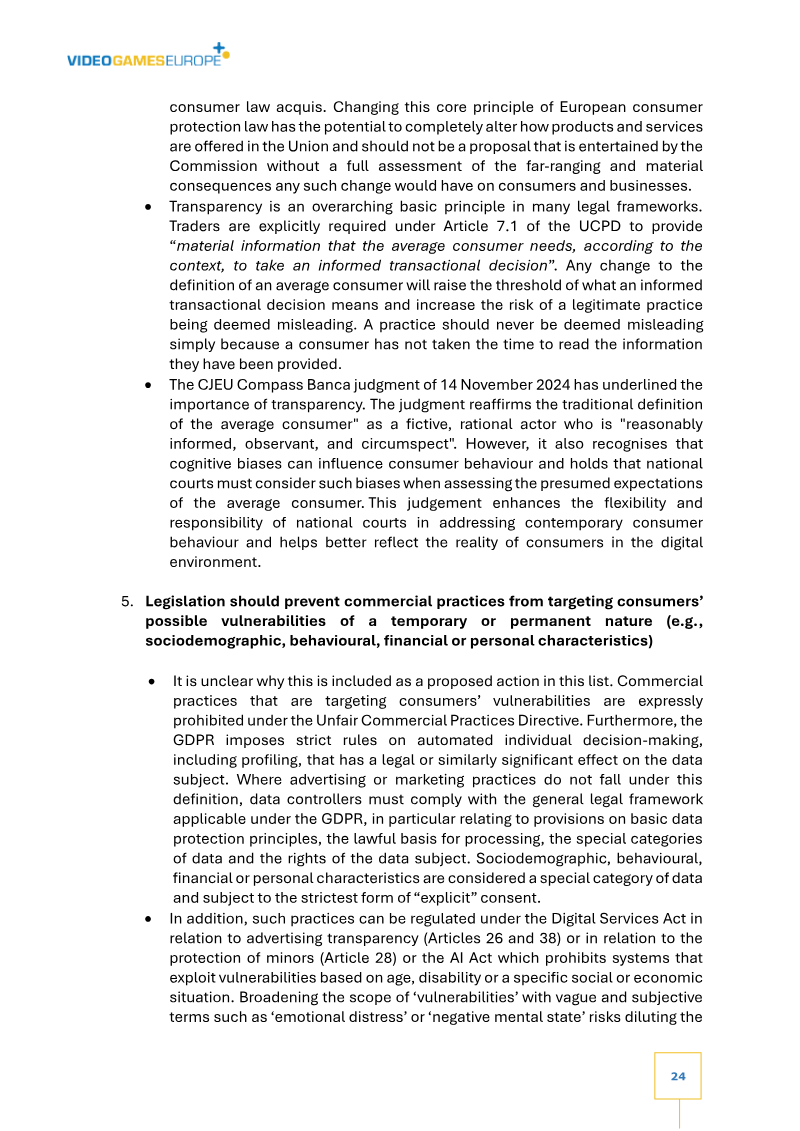
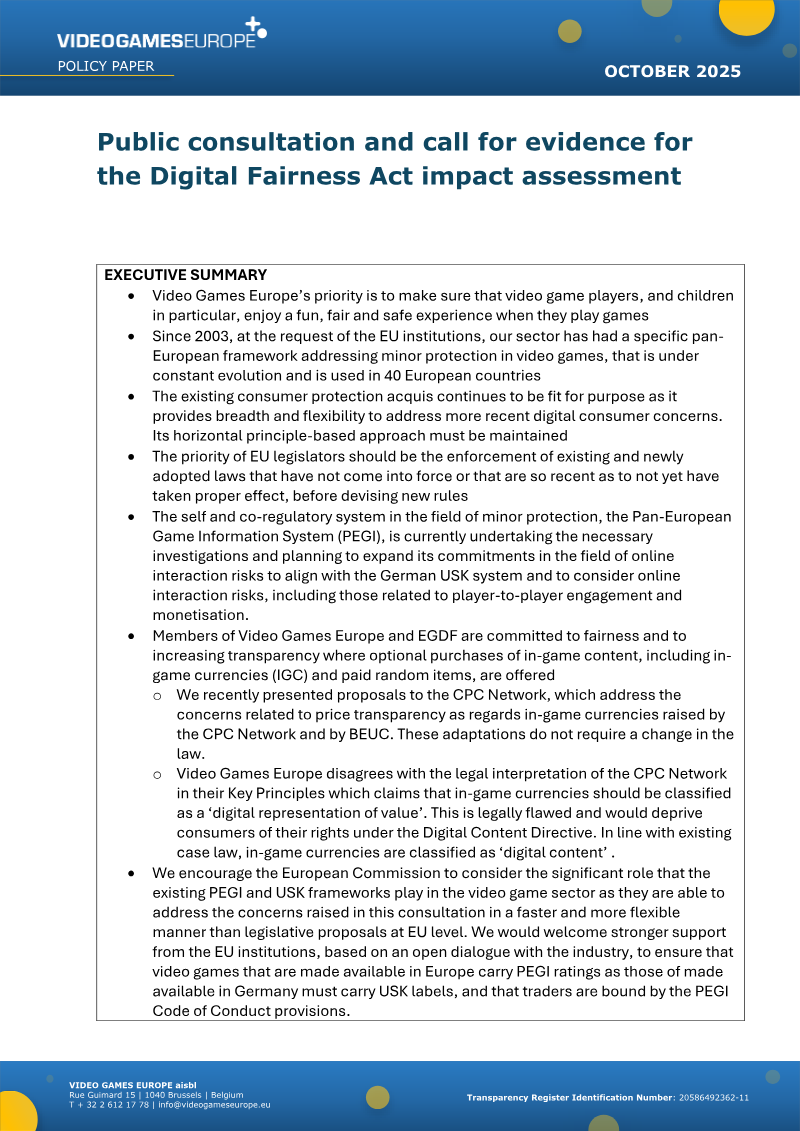
Public Consultation and Call for Evidence for the Digital Fairness Act Impact Assessment
The response to the public consultation on the Digital Fairness Act argues that the European Union’s existing consumer-protection framework, together with the continent-wide PEGI rating system and Germany’s USK scheme, already delivers the breadth, flexibility and enforcement capacity required to safeguard minors and ensure…
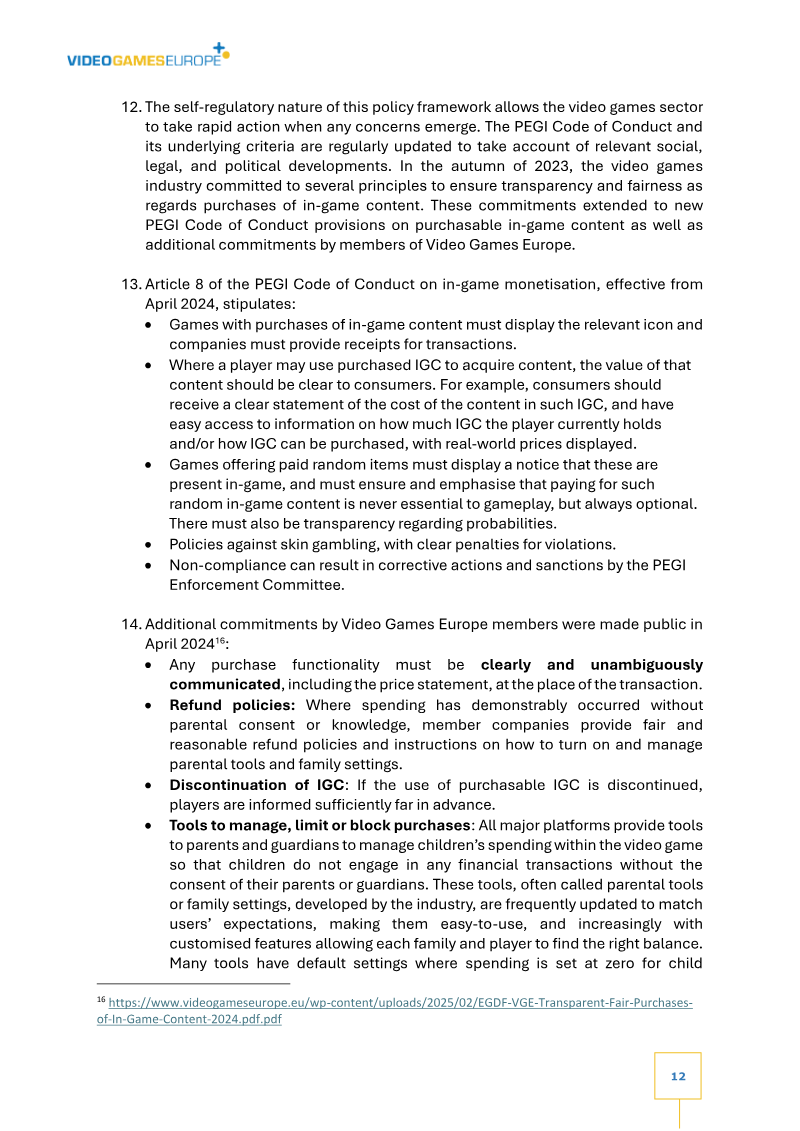
- The European video game industry, which generated €26.4 billion in 2024, argues that existing EU consumer protection frameworks and self-regulatory systems like PEGI and USK are sufficient to address concerns regarding minors and in-game monetization.
- Current industry safeguards show high efficacy, with 79% of parents recognizing PEGI labels, 80% familiar with USK age ratings, and 95% of in-game purchases reportedly supervised by adults.
- Only 18% of children are permitted to make in-game purchases, supported by parental control tools that now allow for the management of data processing, communication limits, and content sharing.
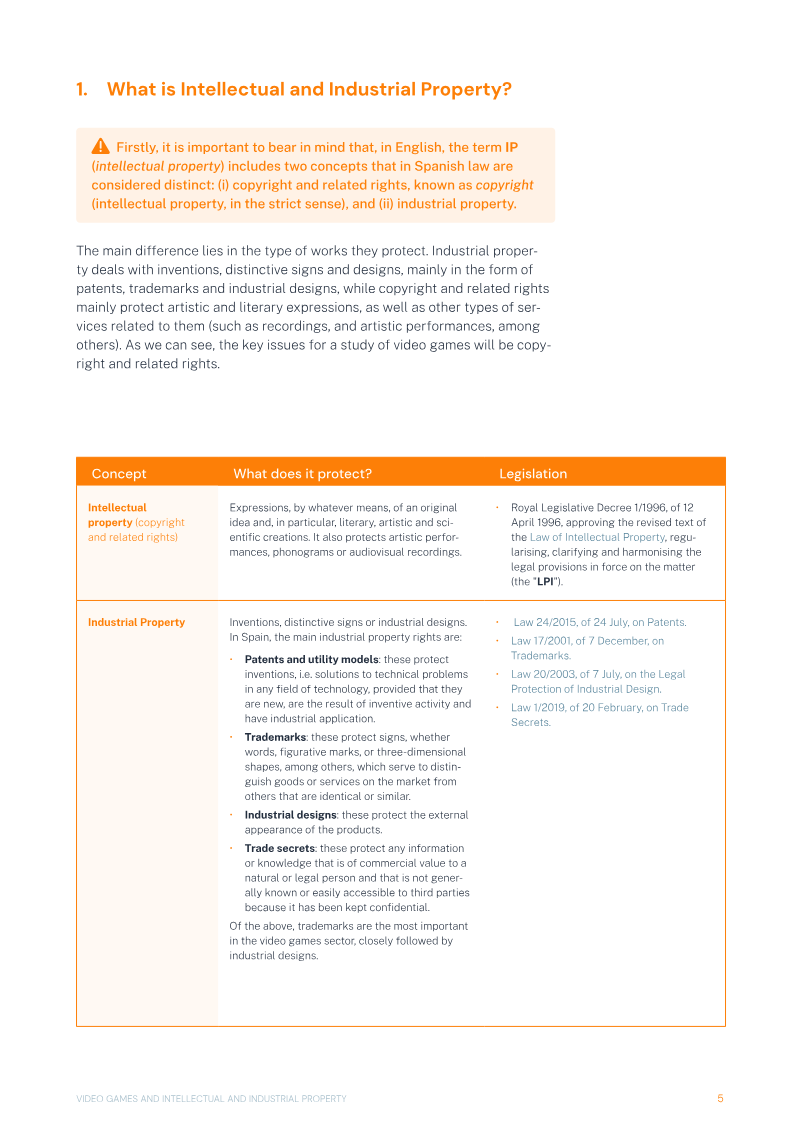

AEVI Guides- Videogames and intellectual and industrial property
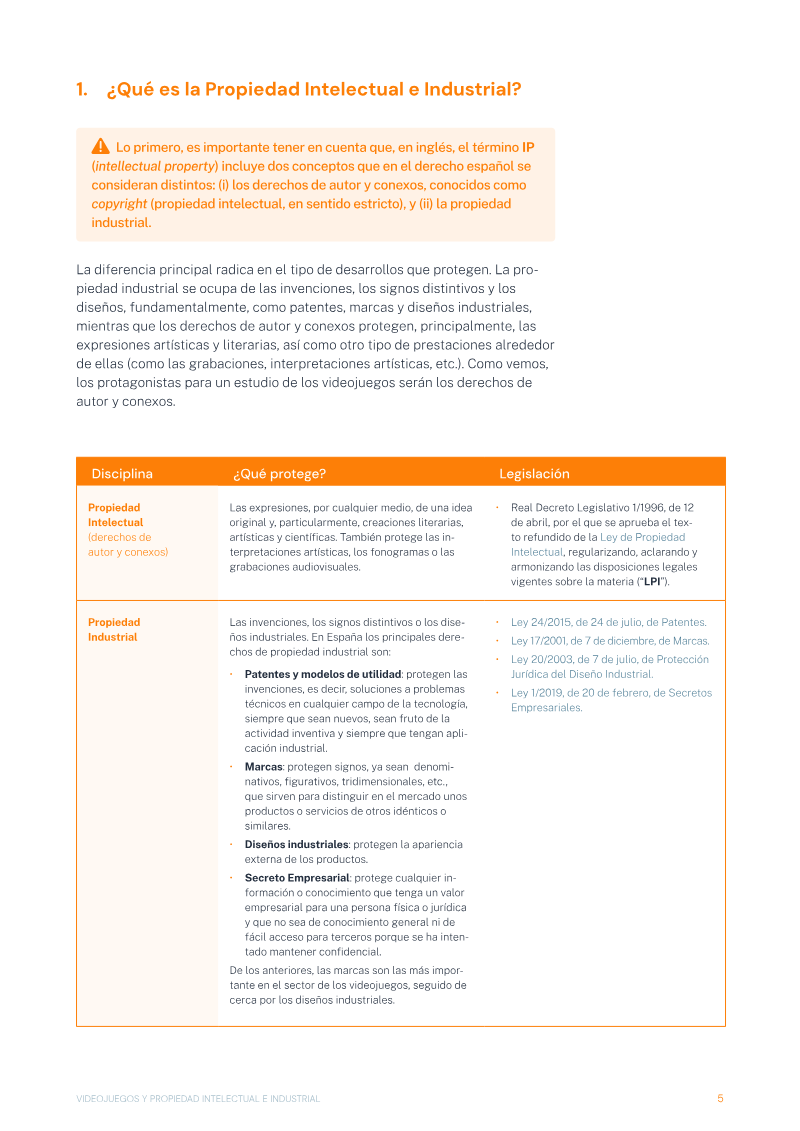
The guide aims to equip video-game developers and publishers with practical knowledge for building a robust intellectual-property (IP) portfolio that safeguards creative assets and minimizes infringement risk.
- Under Spanish law, studios must secure written, exclusive, and worldwide copyright assignments from employees to ensure full exploitation rights, as initial authorship remains with the creator.
- Copyright protection for game components like source code, scripts, and soundtracks arises automatically upon creation and lasts for 70 years after the author's death or 70 years from disclosure for collective works.
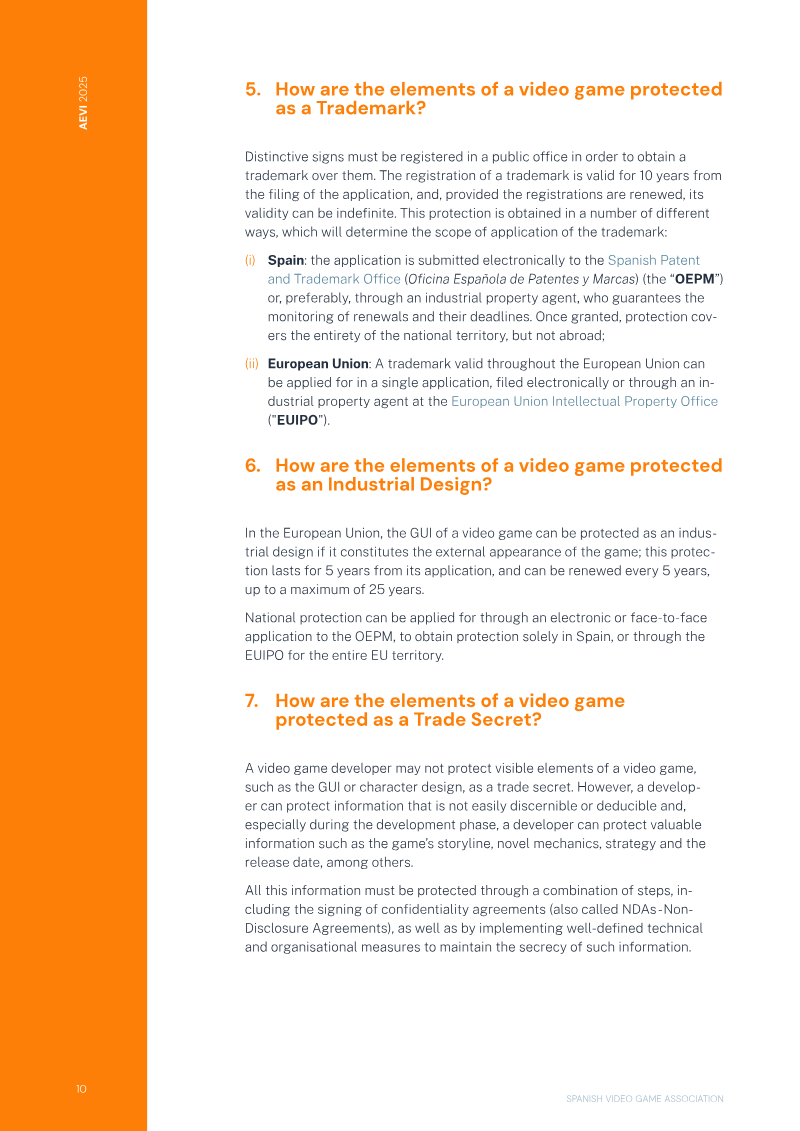
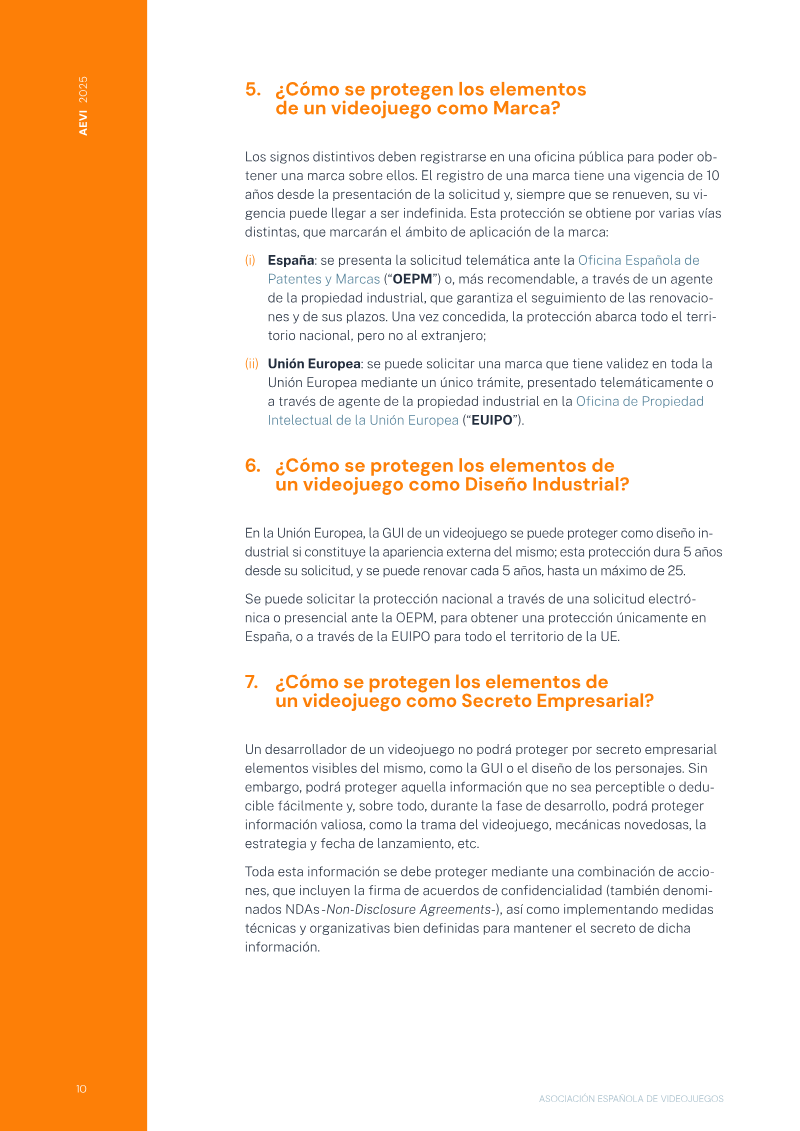
- Trademarks, which require filing with the Spanish Patent and Trademark Office or the EUIPO, provide renewable ten-year protection terms and are critical for securing brand identity.

Guías AEVI: Propiedad intelectual e industrial
The guide aims to equip video-game developers and publishers with a practical framework for safeguarding the creative and technical assets that constitute a game’s intellectual and industrial property.
- Spanish law does not recognize the 'work-for-hire' doctrine, meaning developers must secure explicit written assignments of exploitation rights in all employment and service contracts to ensure legal ownership of creative assets.
- Copyright protection for video game elements arises automatically upon creation and lasts for 70 years after the author's death, or 70 years from disclosure in the case of collective works.
- Trademark protection requires formal registration and provides 10-year terms that are renewable indefinitely, while industrial design protection for GUIs lasts for five-year periods, renewable up to a maximum of 25 years.
Call for Contributions - Competition in ‘Virtual Worlds’ and Generative Artificial Intelligence
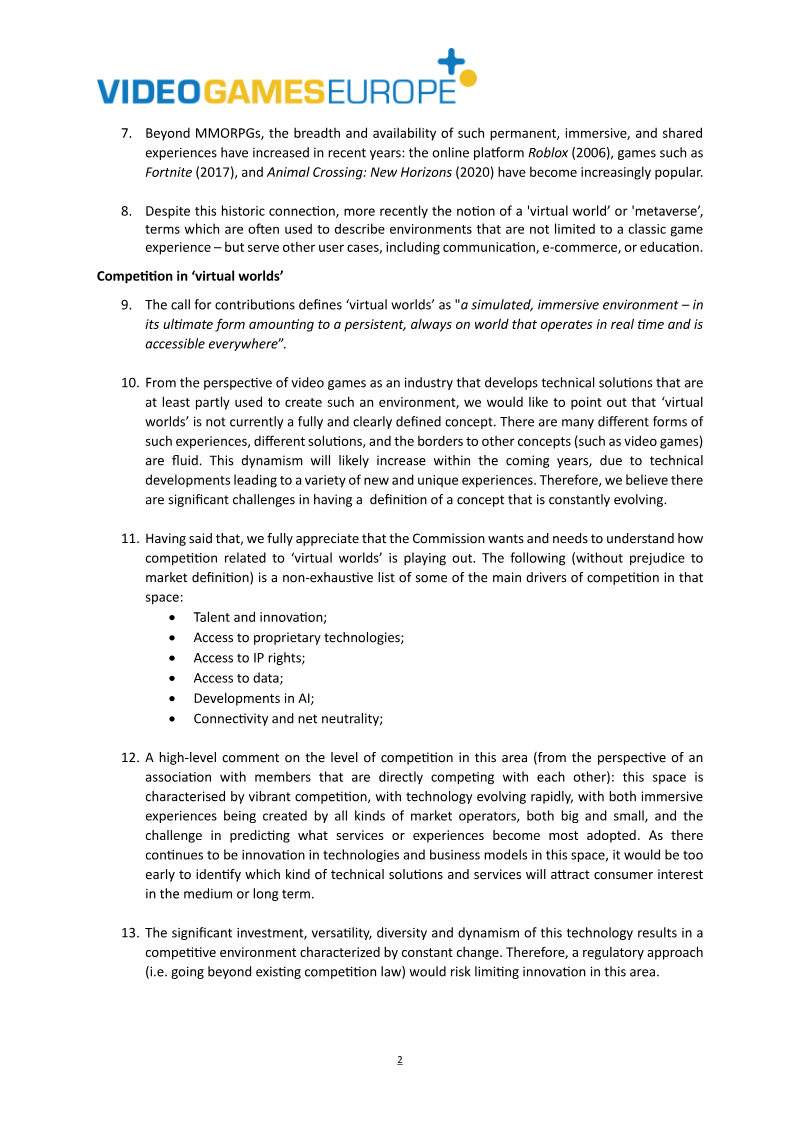
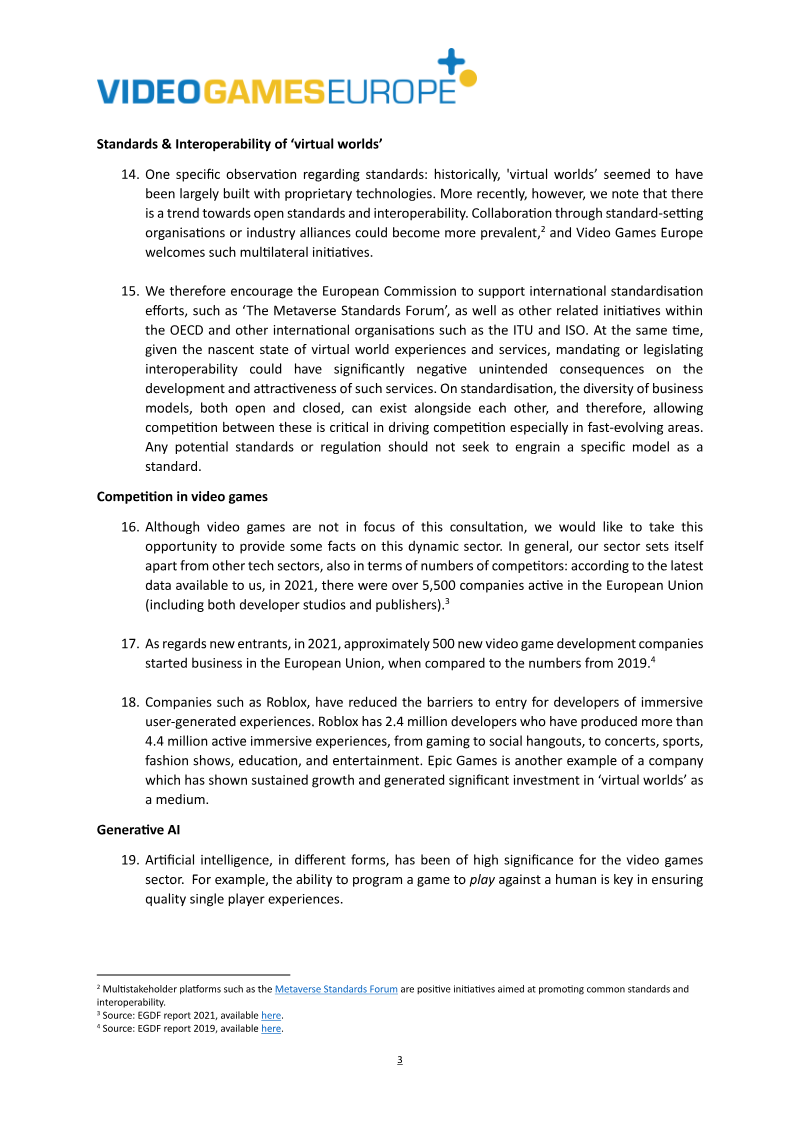
Video Games Europe submits a focused perspective on competition in virtual worlds and generative artificial intelligence, emphasizing that both technologies are central to the European video-games sector’s ongoing innovation and consumer value.
- The EU video game sector remains highly competitive and dynamic, evidenced by over 5,500 active companies in 2021 and the entry of approximately 500 new developers in that year alone.
- Regulatory policy for virtual worlds and generative AI should rely on existing frameworks like the Digital Markets Act (DMA) and the AI Act, avoiding new, overly prescriptive legislation that could stifle innovation.
- While the industry is trending toward open standards and interoperability, mandatory interoperability requirements are discouraged as they risk impeding the development of diverse business models.
Video Games Europe: Position on the Right-to-Repair Directive Proposal
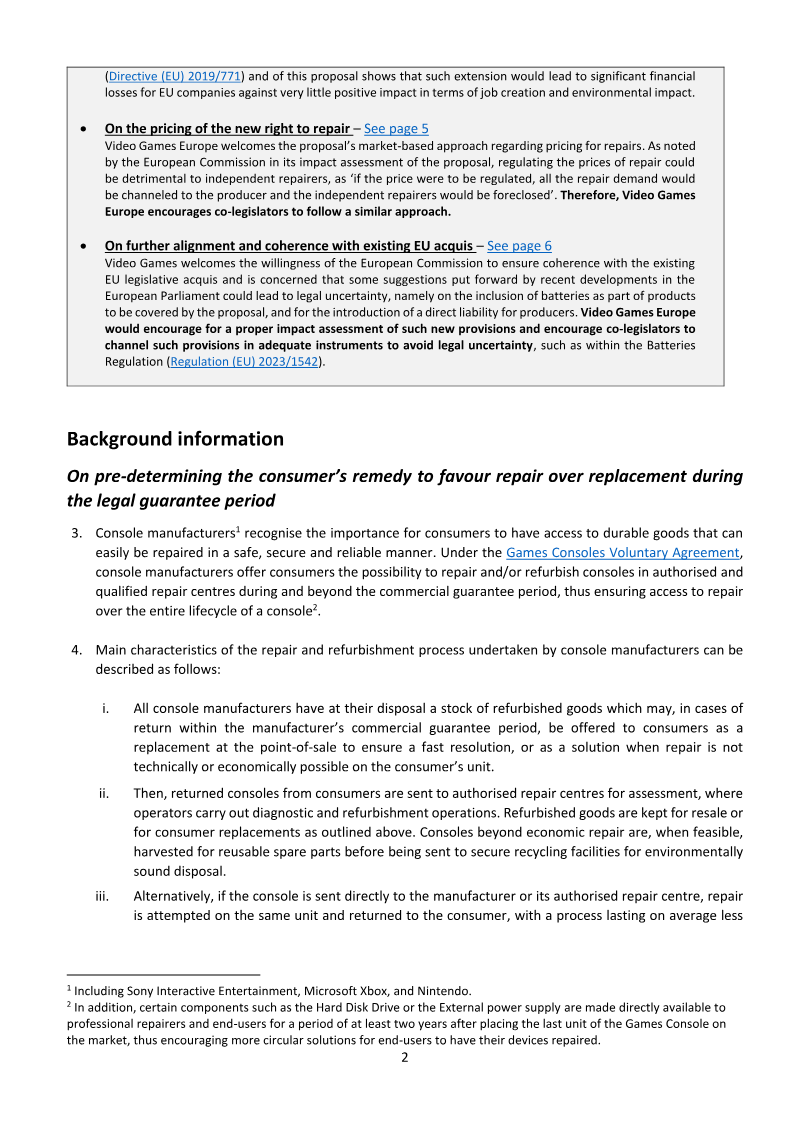
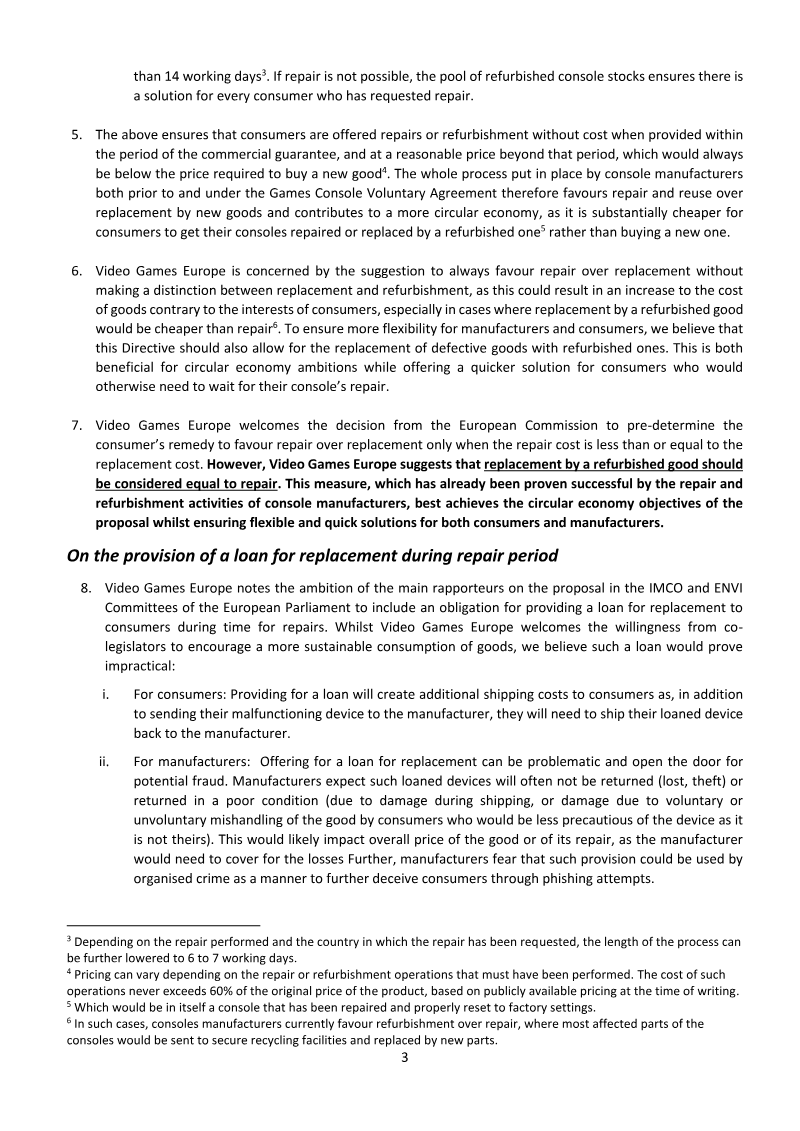
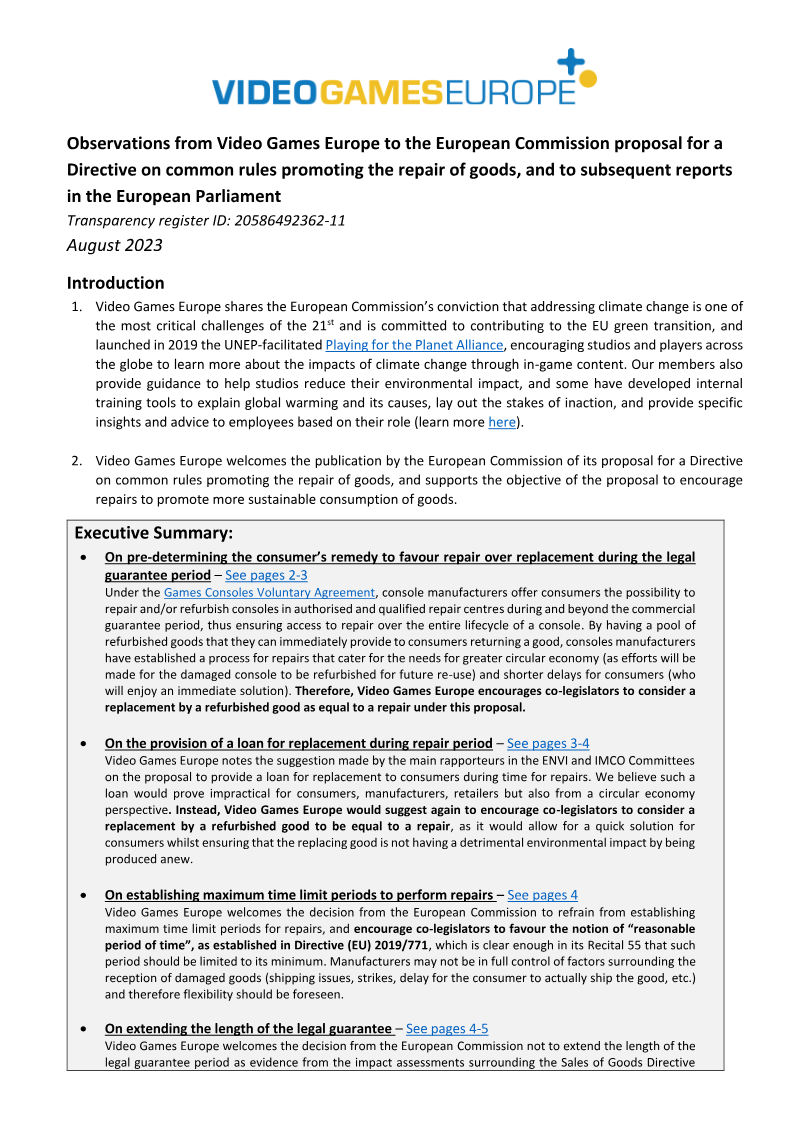
Video Games Europe endorses the European Commission’s draft Directive on common rules promoting the repair of goods, framing the initiative as essential to the EU’s green transition and to more sustainable consumption of electronic products.
- Video Games Europe advocates that replacing a defective console with a refurbished unit should be legally recognized as equivalent to a repair, aligning with existing practices by Sony, Microsoft, and Nintendo.
- The industry currently maintains a repair turnaround time of under 14 working days through authorized centers, which they argue is more efficient than mandatory loaner programs.
- The organization opposes extending the current two-year legal guarantee, citing data that such an extension would yield only 0.3% in CO2 savings and negligible waste reduction over 15 years while increasing firm costs.


Video Games Europe: Contribution on Ecodesign for Sustainable Products
The submission aims to shape the European Commission’s new ecodesign priorities by presenting the video-games sector’s perspective on durability, repairability and the risks of imposing uniform horizontal requirements across ICT products.
- The European video game industry, comprising 5,000 studios and 98,000 employees, generated a €23.3 billion turnover in 2021 while serving over 135 million players.
- The industry argues against uniform horizontal ecodesign regulations, asserting that the functional and technical diversity of ICT devices like consoles, PCs, and smartphones makes a one-size-fits-all approach impractical.
- Existing frameworks, such as the Games Console Voluntary Agreement and the UNEP-facilitated Playing for the Planet Alliance, already address resource efficiency, recyclability, and out-of-warranty repair provisions.
The Future of the Electronic Communications Sector and Its Infrastructure – Video Games Europe Reply
Video Games Europe argues that imposing network fees on high-bandwidth users would harm consumers, the broader Internet ecosystem and the European video-games sector.
- Video Games Europe opposes mandatory network fees for high-bandwidth users, arguing they violate net-neutrality principles and would harm the European video-game sector.
- The European video-games industry comprises approximately 5,100 studios and publishers, generating €12 billion in annual turnover and €23 billion in consumer spending as of 2021.
- Imposing traffic-based fees would create significant financial and technical burdens for publishers, who are already required by the Digital Content Directive to provide frequent security patches and updates.


Initiative on Virtual Worlds: A Head Start Towards the Next Technological Transition
The response aims to shape EU policy on virtual worlds and the emerging metaverse by presenting the video games sector’s perspective, emphasizing that the concept remains fluid and should not be prematurely defined.
- The European video game industry is a significant economic driver, generating over €12 billion in annual turnover, employing approximately 90,000 people, and reaching €23 billion in consumer spending in 2021.
- The sector faces a critical talent shortage, exemplified by a projected shortfall of 25,000 game developers in Sweden alone by 2031, necessitating improved digital-skills education and reduced immigration barriers for global talent.
- Existing EU digital legislation regarding consumer protection, competition, data protection, and cybersecurity is sufficient for virtual environments, and the industry warns that premature legal mandates for interoperability would stifle innovation.


Video Games Europe & EGDF: Position on the Product Liability Directive Review
Video games and their developers argue that the European Commission’s proposal to revise the Product Liability Directive (PLD) would unjustly broaden liability by treating standalone software, including video games, as generic “products.”
- The European video game industry, comprising over 5,100 studios and 90,000 employees, opposes the European Commission’s proposal to classify standalone software as 'products' under the Product Liability Directive (PLD).
- Industry stakeholders argue that the proposed no-fault liability regime for physical goods is ill-suited for complex cultural works like video games, which are already governed by existing frameworks such as the Digital Content Directive and GDPR.
- Public support for extending liability to intangible items like software remains low, with only 48% of respondents in the Commission’s own impact assessment favoring such measures for video games.