Intellectual Property

2 documents·1 publishers

Documents

Page 1
Report15 pages

AEVI Guides- Videogames and intellectual and industrial property

The guide aims to equip video‑game developers and publishers with practical knowledge for building a robust intellectual‑property (IP) portfolio that safeguards creative assets and minimizes infringement risk. It clarifies the legal distinction between copyright‑related rights, which protect artistic and literary expressions, and industrial‑property rights such as patents, trademarks, industrial designs and trade secrets, emphasizing that trademarks and designs are the most relevant instruments for the sector.

Key points outline how each component of a game—script, dialogue, soundtrack, character graphics, user‑interface, source code, middleware and databases—can be protected. Copyright arises automatically upon creation and lasts 70 years after the author’s death (or 70 years from disclosure for collective works); registration at the General Registry of Intellectual Property can serve as evidence of ownership. Trademarks require filing with the Spanish Patent and Trademark Office or the EUIPO, granting ten‑year protection renewable indefinitely, while industrial designs protect the visual appearance of GUIs for five‑year terms, renewable up to 25 years. Trade‑secret protection relies on confidentiality agreements and technical safeguards for non‑public information such as storylines or novel mechanics.

The guide stresses that, under Spanish law, employees retain initial rights to their creations, so studios must secure written assignments—preferably exclusive, worldwide and lasting until the work enters the public domain—to ensure exploitable rights. Collective works, common in game development, confer ownership to the coordinating developer or publisher. For third‑party content, the document outlines limited exceptions—public‑domain use, statutory limits, and narrowly defined descriptive uses of trademarks—while noting that the EU does not recognise a broad “fair‑use” doctrine.

Overall, the document provides a comprehensive, jurisdiction‑specific framework for protecting video‑game assets across Spain and the European Union, guiding stakeholders through registration procedures, contractual safeguards and permissible uses of external material to secure commercial value and legal certainty.

  • Under Spanish law, studios must secure written, exclusive, and worldwide copyright assignments from employees to ensure full exploitation rights, as initial authorship remains with the creator.
  • Copyright protection for game components like source code, scripts, and soundtracks arises automatically upon creation and lasts for 70 years after the author's death or 70 years from disclosure for collective works.
  • Trademarks, which require filing with the Spanish Patent and Trademark Office or the EUIPO, provide renewable ten-year protection terms and are critical for securing brand identity.
  • Industrial design rights protect the visual appearance of user interfaces for an initial five-year term, which can be renewed for up to 25 years.
  • Trade secrets, such as novel game mechanics or unreleased storylines, must be protected through formal confidentiality agreements and technical security measures rather than public registration.
AEVIJan 2025
Page 1
Report15 pages

Guías AEVI: Propiedad intelectual e industrial

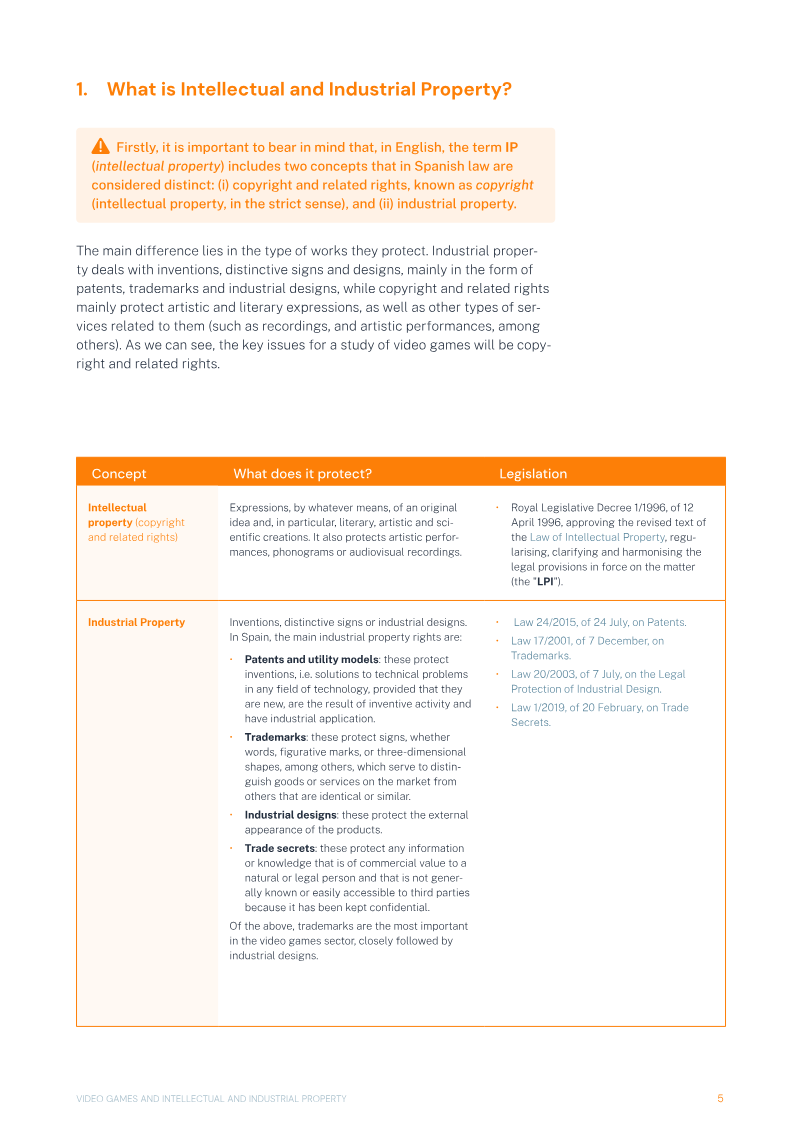
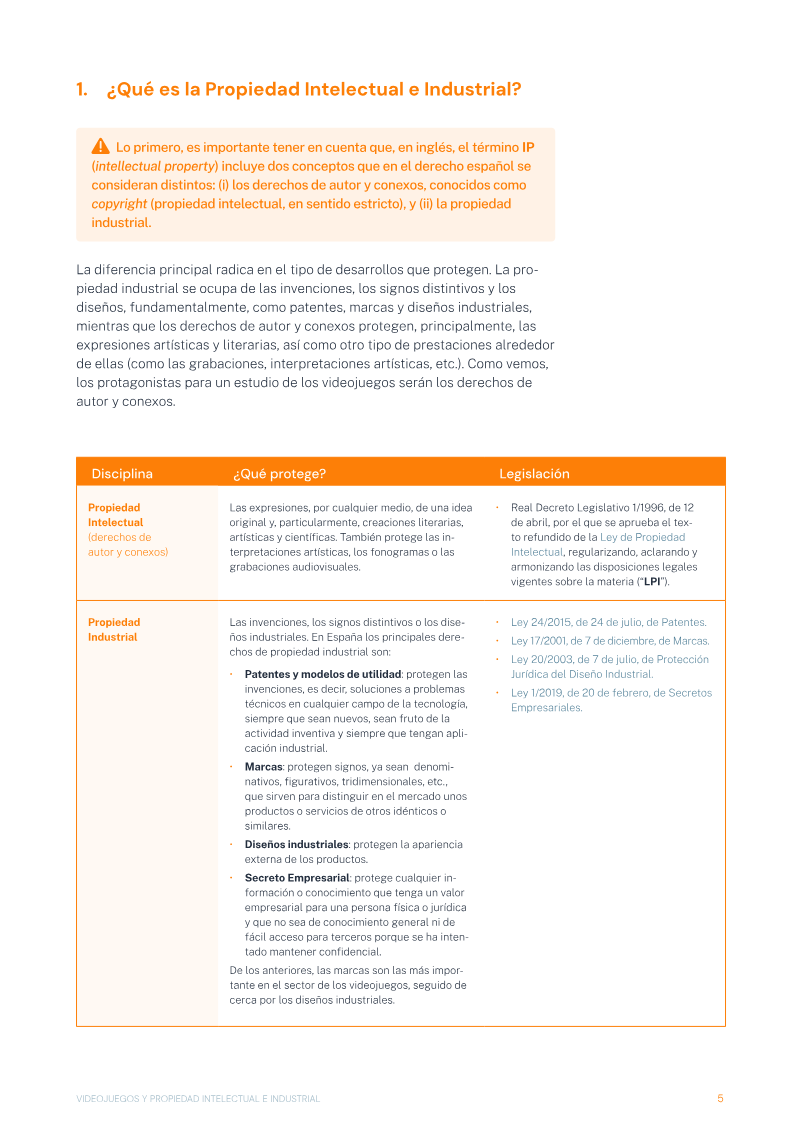
The guide aims to equip video‑game developers and publishers with a practical framework for safeguarding the creative and technical assets that constitute a game’s intellectual and industrial property. It clarifies the dual nature of IP under Spanish law—copyright and related rights on the one hand, and industrial property (patents, trademarks, designs, trade secrets) on the other—explaining which categories protect specific game elements such as scripts, music, graphics, code, user‑interface designs, character names and logos.

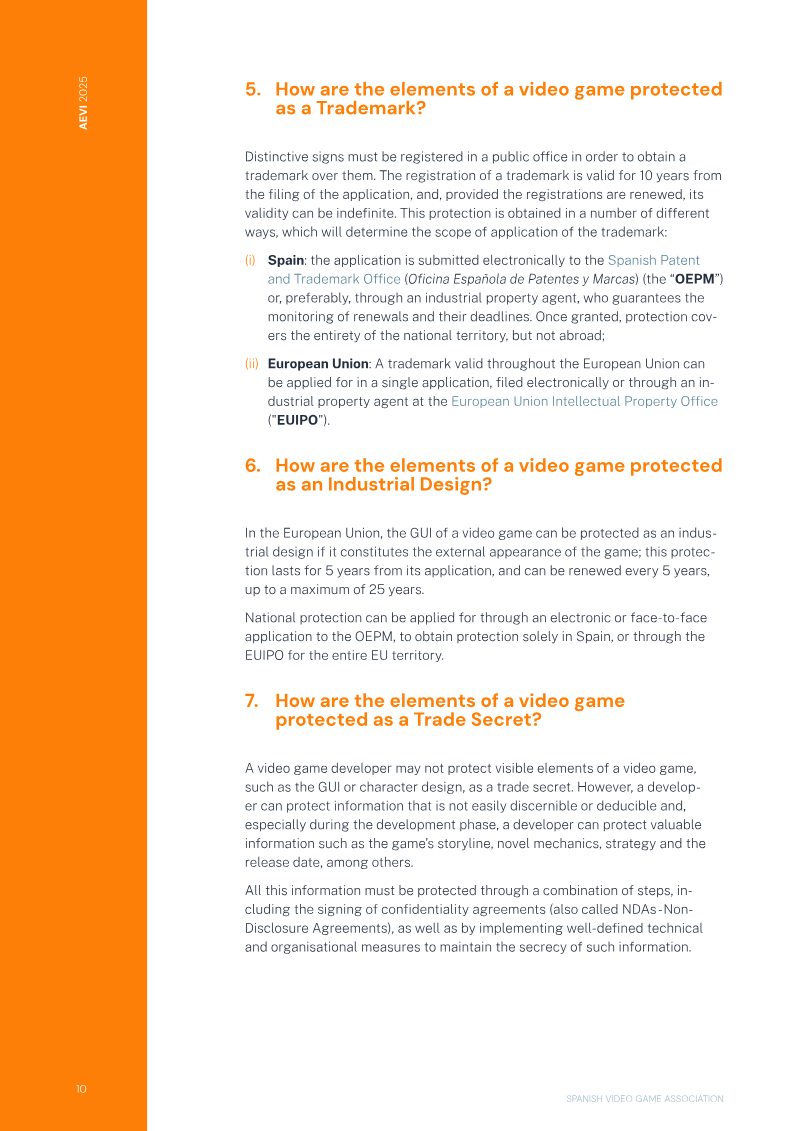
Key conclusions stress that copyright arises automatically upon creation, lasting 70 years after the author’s death (or 70 years from disclosure for collective works), while related rights endure 50 years. Trademark protection requires registration and lasts ten years per filing, renewable indefinitely; design protection covers the external appearance of a GUI for five‑year periods, renewable up to 25 years. Trade‑secret measures rely on confidentiality agreements and technical safeguards rather than formal registration. The guide also outlines the legal regimes governing ownership of works created by employees, freelancers or collaborators, noting that Spanish law lacks a “work‑for‑hire” concept and therefore mandates explicit written assignments of exploitation rights, typically detailed in employment or service contracts.

Practical recommendations include a step‑by‑step checklist for identifying each asset, determining the appropriate protection mechanism, confirming that all contributors have assigned their rights, and implementing NDAs to preserve secrecy during development. The guide further outlines limited exceptions for using third‑party material—public‑domain works, specific statutory limits, and narrowly defined descriptive uses of trademarks—while warning that doctrines such as “fair use” are not recognized in the EU. Overall, the document provides a comprehensive, Spain‑focused roadmap for building a robust IP portfolio that enhances a game’s market value and minimizes infringement risk.

  • Spanish law does not recognize the 'work-for-hire' doctrine, meaning developers must secure explicit written assignments of exploitation rights in all employment and service contracts to ensure legal ownership of creative assets.
  • Copyright protection for video game elements arises automatically upon creation and lasts for 70 years after the author's death, or 70 years from disclosure in the case of collective works.
  • Trademark protection requires formal registration and provides 10-year terms that are renewable indefinitely, while industrial design protection for GUIs lasts for five-year periods, renewable up to a maximum of 25 years.
  • Trade secrets are protected through internal confidentiality agreements and technical safeguards rather than formal registration, making NDAs essential during the development phase.
  • The EU legal framework does not recognize the 'fair use' doctrine, limiting the use of third-party materials to public domain works, specific statutory exceptions, and narrow descriptive trademark uses.
AEVIJan 2025

Publishers

Related Topics

Intellectual Property — Game Industry Reports & Data | Game Industry Library