Player Demographics

177 documents·72 publishers

Documents

Page 1
Report224 pages

Gaming 2025 (Epyllion)

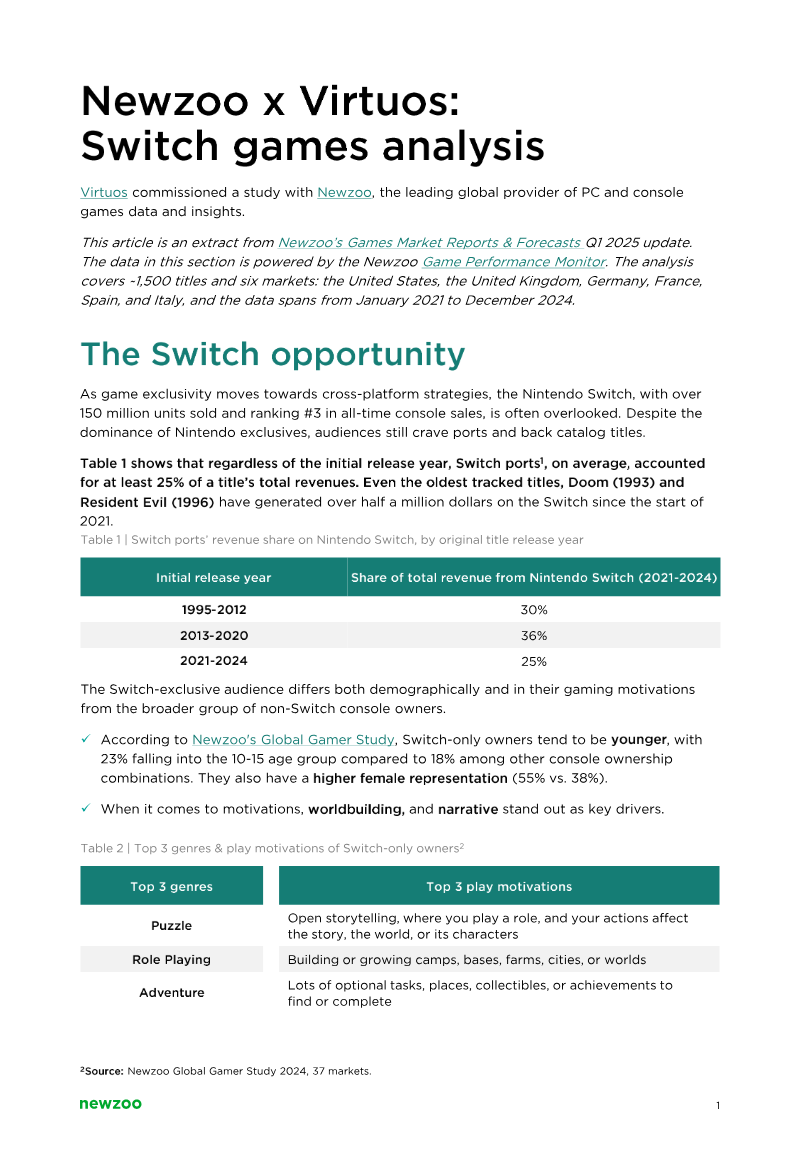
The global video game industry has transitioned from a decade of rapid expansion into a period of contraction and market maturation. Following the 2011–2021 growth wave, the sector now faces a "zero-sum" environment characterized by stagnant player spending, plummeting stock values, and a collapse in venture capital. This downturn has triggered an unprecedented wave of studio closures and mass layoffs as publishers move away from risky new ventures to focus on aggressive multiplatform strategies for established franchises. While the industry maintains a higher net headcount than in 2022, the current climate is defined by an oversupply of content competing for limited consumer hours, with the top ten titles capturing 60% of all sales.

Market dominance is increasingly concentrated in "Black Hole" titles and User-Generated Content (UGC) platforms like Roblox and Fortnite. These ecosystems leverage deep social integration and digital entitlements to create a "lock-in" effect that makes it difficult for new live-service titles to gain traction. While the PC ecosystem is gaining momentum over traditional consoles due to its larger libraries and native social tools like Discord, the handheld market is poised for a shift with the impending launch of the "Switch 2" and Valve’s expansion of SteamOS. Furthermore, the rise of high-quality AAA titles from China and localized media in emerging markets is successfully challenging Western dominance by prioritizing domestic cultural themes and lower hardware specifications.

Future growth is expected to be driven by technological innovation and regulatory shifts rather than traditional software sales. Generative AI is being deployed to create autonomous virtual agents and lower development costs, while major publishers are aggressively pursuing programmatic in-game advertising to offset decades of price deflation. Simultaneously, the deregulation of mobile app stores is expected to improve developer margins by 10–20%, enabling new cloud-native experiences and third-party storefronts. By 2030, nearly one billion mobile devices will be capable of running high-fidelity console-spec games, positioning emerging regional markets as the primary engine for the industry’s next economic cycle.

  • The industry has shifted to a zero-sum environment where the top ten titles now capture 60% of all sales, forcing publishers to prioritize established franchises over new, risky ventures.
  • Market dominance is increasingly concentrated in 'Black Hole' titles and UGC platforms like Roblox and Fortnite, which utilize deep social integration to create high consumer lock-in.
  • Future revenue growth is shifting toward programmatic in-game advertising and the deregulation of mobile app stores, which is projected to improve developer margins by 10–20%.
  • By 2030, nearly one billion mobile devices will support console-spec gaming, positioning emerging regional markets as the primary driver for the industry's next economic cycle.
  • Western market dominance is being challenged by high-quality AAA titles from China that prioritize domestic cultural themes and lower hardware requirements.
+1
EpyllionJan 2025
Page 1
Report37 pages

Starfield: How It Achieved 10M Players

The marketing and commercial performance of Bethesda’s Starfield reflects a strategic evolution in digital promotion, transitioning from traditional trailer-based campaigns to a diversified, multi-channel approach. By prioritizing platforms like TikTok, Twitch, and Instagram during the 2023 pre-order phase, the campaign successfully built massive momentum, culminating in the title reaching the top of Steam’s Wishlist and securing over 300,000 followers prior to launch. A critical component of this success was the integration with Microsoft’s ecosystem, specifically leveraging "Day One on Game Pass" messaging and Bing’s AI search capabilities to maximize visibility and accessibility across the Xbox and PC markets.

Upon release, the title became the largest launch in Bethesda’s history, surpassing 10 million players despite a highly competitive landscape featuring major RPG rivals. This achievement was supported by a substantial $21.2 million advertising investment, which ranked second in the RPG category for the year. A significant portion of this budget—over one-third—was allocated to Over-the-Top (OTT) advertising, signaling a shift toward high-impact streaming services. While the game achieved a favorable critical reception with a Metacritic score of 84, user sentiment remained polarized across Steam and Game Pass, and initial Twitch viewership saw a steady decline following the early-access period.

The broader industry context for these findings is supported by digital marketing intelligence that tracks competitor spending, creative messaging, and regional targeting. By analyzing spend patterns across social and digital platforms, the data illustrates how major publishers are increasingly moving away from centralized video platforms toward fragmented, high-engagement social media and streaming services to capture audience attention in a crowded marketplace. This analysis covers the primary 2021 to 2023 launch window, focusing on the global RPG segment and the shifting dynamics of digital ad distribution.

  • Starfield reached 10 million players at launch, marking the largest release in Bethesda’s history despite a competitive RPG market.
  • The marketing campaign utilized a $21.2 million advertising budget, the second-highest in the RPG category for 2023.
  • Over one-third of the total advertising budget was allocated to Over-the-Top (OTT) streaming services, reflecting a strategic shift toward high-impact digital distribution.
  • Pre-launch momentum was driven by a multi-channel social strategy on TikTok, Twitch, and Instagram, resulting in over 300,000 followers and the top spot on Steam’s Wishlist.
  • Integration with the Microsoft ecosystem, specifically 'Day One on Game Pass' messaging and Bing’s AI search, was critical to maximizing visibility across Xbox and PC.
+2
Sensor TowerJan 2025
Page 1
Report26 pages

Newzoo Puzzle Games Report: Mobile Game Genre Insights

Produced through a partnership between Newzoo and Pangle, this analysis examines the global mobile puzzle game market with a specific focus on the divergent trends between Western and Eastern territories. The study covers major markets including the United States, China, Japan, and South Korea, utilizing 2020 revenue data and 2021 consumer insights. By comparing market dynamics, monetization strategies, and player demographics, the research aims to provide actionable intelligence for developers seeking global expansion.

Findings indicate that the United States is the world’s largest mobile puzzle market, followed by Japan and China. While classic match-3 mechanics remain dominant globally, the genre is evolving through "meta" elements like narrative and decoration. A significant regional distinction exists in monetization: Western titles rely heavily on in-app advertising (IAA) and simple economies, whereas Eastern titles—particularly in Japan—integrate deep character collection, progression, and gacha mechanics, leading to higher in-app purchase (IAP) revenue. Data shows that while Western players demonstrate a higher tolerance for frequent ad breaks, Japanese players prefer longer sessions with fewer interruptions but show a greater willingness to pay for additional functions and aesthetic enhancements.

Demographically, puzzle gamers across all regions skew female and are typically full-time employees with mid-to-high income. However, Eastern players tend to be younger and more highly educated than their Western counterparts. The methodology relies on Newzoo’s proprietary Global Games Market Report and Consumer Insights, supplemented by a case study from Japanese developer Translimit. The analysis concludes that success in the puzzle genre requires localized user acquisition strategies, such as performance-based A/B testing and region-specific ad creative optimization, to navigate the distinct cultural expectations of the global mobile audience.

  • The United States is the world's largest mobile puzzle market, followed by Japan and China.
  • Western puzzle games rely heavily on in-app advertising (IAA) and simple economies, while Eastern titles—especially in Japan—prioritize deep character collection and gacha mechanics to drive higher in-app purchase (IAP) revenue.
  • Western players demonstrate a higher tolerance for frequent ad breaks, whereas Japanese players prefer longer, uninterrupted sessions and show a greater willingness to pay for aesthetic enhancements and additional functions.
  • The global puzzle genre is shifting from classic match-3 mechanics toward the integration of 'meta' elements, such as narrative-driven gameplay and decoration features.
  • While puzzle gamers globally skew female and are typically full-time employees with mid-to-high income, Eastern players are generally younger and more highly educated than their Western counterparts.
+2
NewzooJan 2025
Page 1
Report23 pages

Essential Facts: About the U.S. Video Game Industry 2025

The 2025 Essential Facts report by the Entertainment Software Association provides a comprehensive analysis of the video game industry's footprint in the United States. Based on a February 2025 survey of 5,000 respondents conducted by YouGov, the data reveals that 205.1 million Americans—approximately 64% of the population—play video games for at least one hour per week. The study spans a broad demographic range from ages 5 to 90, highlighting that gaming has become a lifelong pastime; notably, 49% of Boomers and 36% of the Silent Generation engage in weekly play.

The findings emphasize the social and developmental role of gaming within American households. Approximately 82% of gaming parents play with their children, and 67% believe video games offer more potential benefits than social media. Beyond entertainment, 87% of players who engage with sports titles report that these games improve their real-life athletic performance. The industry also serves as a significant cultural discovery engine, with younger generations using games to find new music, movies, and television shows. Accessibility remains a priority, as 21% of adult players report having a disability, and nearly half of that group considers in-game accessibility features to be extremely important.

Economically, the industry continues to show robust growth, with total consumer spending reaching $59.3 billion in 2024. This figure represents a 32% increase since 2019, with the majority of revenue ($51.3 billion) derived from software content. Mobile remains the most popular platform, used by 72% of gaming households, followed by PCs and consoles. The report concludes that video games have transcended their status as a hobby to become a primary driver of the U.S. economy and a central pillar of modern social connection and skill development.

  • The U.S. video game industry generated $59.3 billion in consumer spending in 2024, marking a 32% increase since 2019.
  • Approximately 205.1 million Americans, or 64% of the population, play video games for at least one hour per week.
  • Software content is the primary revenue driver, accounting for $51.3 billion of the total $59.3 billion industry spend in 2024.
  • Mobile gaming is the dominant platform, utilized by 72% of gaming households, followed by PC and console platforms.
  • Gaming has broad demographic appeal, with 49% of Boomers and 36% of the Silent Generation engaging in weekly play.
+1
Entertainment Software AssociationJan 2025
Page 1
Report28 pages

Newzoo Hypercasual Mobile Game Genre Report: Eastern vs Western Markets

Hypercasual mobile games represent a significant and evolving segment of the global gaming industry, accounting for 36 of the top 100 downloaded mobile games in 2021. While the genre is characterized by simple mechanics and high accessibility, it has faced increasing competition, leading to a shift toward hybrid-casual models. These newer titles incorporate meta-features and live operations to improve player retention, which typically falls below 10% by the seventh day for standard hypercasual titles.

The market demonstrates distinct regional variations, with hypercasual games enjoying significantly higher popularity in Western markets like the United States and United Kingdom compared to Japan and South Korea. In 2021, runner and racing subgenres overtook simulation and puzzle titles as the most downloaded categories. Demographically, hypercasual players across key markets skew male, are often full-time employees with mid-to-high incomes, and are younger than the average mobile gamer.

Monetization remains primarily driven by in-game advertising, with interstitial video identified as the most adopted format, followed by rewarded videos and banner ads. However, hybrid monetization is rising, with developers increasingly offering in-app purchases for ad removal or exclusive content. Data from 2021 indicates that the hypercasual sector is highly dynamic; only eight of the top 36 hypercasual titles from 2020 remained in the top rankings the following year. To maintain growth, publishers are leveraging broad targeting strategies that are less affected by privacy changes like IDFA and are utilizing sophisticated retention optimization tools to acquire loyal users.

  • Hypercasual games accounted for 36 of the top 100 most downloaded mobile games in 2021, though the sector is highly volatile with only eight of the top 36 titles from 2020 remaining in the top rankings the following year.
  • Standard hypercasual titles struggle with retention, typically seeing less than 10% of players return by the seventh day, which is driving a strategic shift toward hybrid-casual models that incorporate meta-features and live operations.
  • Runner and racing games became the most downloaded subgenres in 2021, surpassing the previously dominant simulation and puzzle categories.
  • Hypercasual games are significantly more popular in Western markets like the U.S. and U.K. compared to the Japanese and South Korean markets.
  • Monetization is shifting from a reliance on interstitial, rewarded, and banner ads toward hybrid models that integrate in-app purchases for content or ad removal.
+1
NewzooJan 2025
Page 1
Report17 pages

Diversity and Inclusion in Gaming: Newzoo & Intel Report

This research, conducted by Newzoo in collaboration with Intel, examines the state of diversity and inclusion within the United States gaming market. The study challenges the misconception that the gaming population is primarily composed of young, white males, noting that there are approximately 2.7 billion gamers globally. By analyzing a representative sample of 1,824 gamers aged 10–65 via Computer Assisted Web Interviewing in early 2020, the findings identify significant gaps in representation, accessibility, and affordability that impact marginalized communities.

The data reveals that gamers of color, particularly Black and Hispanic/Latinx players, tend to be younger and more engaged than their white counterparts. For instance, roughly 75% of Black PC players are under the age of 35, compared to 50% of white players. Furthermore, Black and Asian PC gaming populations skew more female than other groups. Despite this high engagement, 47% of all U.S. gamers report avoiding titles they feel are not made for them, and over half emphasize the importance of diverse character representation—a sentiment strongest among LGBTQIA+ players and those with disabilities.

Economic factors play a critical role in gaming habits and hardware preferences. Due to historical economic disparities and younger average ages, Black and Hispanic/Latinx gamers are more likely to use laptops rather than expensive high-end desktops and show a higher affinity for game library subscriptions like Xbox Game Pass. These services provide a lower barrier to entry for high-quality content. Additionally, the study finds that players of color are more likely to be "Ultimate Gamers" or "Subscribers" compared to white gamers, who have a higher share of "Lapsed Gamers."

The analysis concludes that the industry must move beyond "sitting on the fence" regarding societal issues. Nearly half of U.S. gamers are more likely to support publishers that take active stances on social justice. By prioritizing affordability, accessibility, and authentic representation, hardware and software providers can better serve an evolving, diverse audience and unlock significant untapped revenue and engagement opportunities.

  • Nearly 50% of U.S. gamers are more likely to support publishers that take active stances on social justice issues, signaling a shift in consumer expectations toward corporate responsibility.
  • 47% of U.S. gamers actively avoid titles they perceive as not being designed for them, highlighting a significant barrier to market penetration for non-inclusive content.
  • Black and Hispanic/Latinx gamers are younger and more engaged than white counterparts, with 75% of Black PC players under the age of 35 compared to 50% of white players.
  • Economic disparities drive hardware preferences, as Black and Hispanic/Latinx gamers favor laptops over high-end desktops and show a higher affinity for subscription services like Xbox Game Pass to lower barriers to entry.
  • Over half of the U.S. gaming population prioritizes diverse character representation, a sentiment that is most pronounced among LGBTQIA+ players and those with disabilities.
+1
NewzooJan 2025
Page 1
Report33 pages

Power of Play: 2025 Global Video Games Report

Across more than twenty national markets, the majority of gamers report that playing video games reduces stress and enhances happiness, with 70‑90 % indicating lower stress levels and 57‑91 % feeling happier. Respondents also cite diminished anxiety and isolation, while parents observe a positive shift in relationships with their children, ranging from roughly one‑third in Sweden to nearly four‑fifths in Nigeria. Mobile devices dominate the landscape, accounting for 60‑96 % of play sessions, and online multiplayer emerges as the most prevalent social mode.

In the United Arab Emirates, United Kingdom and United States, surveys of roughly three thousand gamers reveal consistent benefits: about 70‑80 % experience reduced stress and increased well‑being, and roughly two‑thirds of parents note improved parent‑child interaction. Genre preferences diverge, with UAE players favoring teamwork, collaboration and creativity, whereas UK and US gamers gravitate toward problem‑solving, critical‑thinking and cognitive‑skill development. Approximately half to sixty percent of participants perceive gaming as supportive of career‑related or hobby pursuits, and a similar share report enhancements in professional competencies.

Research spanning multiple sectors demonstrates that video‑game‑based training yields measurable gains in cognition, decision‑making speed and technical performance. Gamers outperform non‑gamers in robotic‑surgery simulations, emergency‑response drills and retail‑seasonal‑sales scenarios, with meta‑analyses confirming statistically significant improvements in perception, attentional control and procedural accuracy. These outcomes translate into higher job performance, reduced error rates and stronger return on investment, prompting organizations such as NASA, the U.S. Air Force and elite sports teams to integrate game‑based platforms into their training pipelines.

  • Video games provide measurable professional benefits, with gamers outperforming non-gamers in robotic surgery, emergency response, and retail simulations due to improved cognition, decision-making speed, and attentional control.
  • Organizations including NASA, the U.S. Air Force, and elite sports teams have integrated game-based platforms into their training pipelines to reduce error rates and improve return on investment.
  • Mobile devices are the primary gaming platform globally, accounting for 60–96% of all play sessions.
  • A majority of gamers across more than twenty national markets report significant mental health benefits, with 70–90% experiencing reduced stress and 57–91% reporting increased happiness.
  • Approximately 50–60% of gamers report that gaming supports their career or hobby pursuits and enhances professional competencies.
+1
Video Games EuropeJan 2025
Page 1
Report32 pages

New Zealand Plays

Video gaming has become a mainstream activity across New Zealand households, with the majority of homes now possessing multiple gaming devices. Seventy‑three percent of residences own two or more consoles or similar hardware, and eighty‑one percent of the population engages in gaming, most of them adults; the average player is 36 years old and eighty percent are aged 18 or older. Parental motivations for allowing children to play centre on enjoyment, educational value and problem‑solving, while a strong majority of parents enforce rules around gameplay. Over three‑quarters of parents set limits, and nearly four‑tenths consider those limits “very much” enforced, with a similar proportion applying them “to some degree.” Adult respondents display solid awareness of New Zealand’s game‑classification system, though familiarity drops for the R13‑R16 categories.

The findings derive from a nationally representative sample of 820 households surveyed in May 2025, encompassing 1,309 individual gamers—including 282 parents—and demographic data on 1,731 persons across the sampled homes. The study achieved a 3.5 percent margin of error and collected detailed information on device ownership, playtime, attitudes and knowledge of classification standards. Results highlight the entrenched role of gaming in everyday life, the prevalence of parental regulation, and a generally high level of consumer understanding of content ratings, albeit with gaps for mid‑range age classifications.

Overall, the research underscores the maturity of the New Zealand gaming market, the integration of gaming into family routines, and the need for clearer communication around specific rating bands to support informed parental decision‑making.

  • Gaming is a mainstream activity in New Zealand, with 81% of the population playing and 73% of households owning two or more gaming devices.
  • The average New Zealand gamer is 36 years old, with 80% of the gaming population aged 18 or older.
  • Over 75% of parents implement gameplay limits for their children, with nearly 40% describing these rules as strictly enforced.
  • Parental support for gaming is primarily driven by the perceived benefits of enjoyment, educational value, and problem-solving skills.
  • While awareness of the New Zealand game-classification system is generally solid among adults, there is a notable decline in familiarity regarding R13–R16 rating categories.
New Zealand Game Developers AssociationJan 2025
Page 1
Report64 pages

Power of Play: Informe Global de Videojuegos 2025

The research surveyed more than 24,000 active gamers from 21 nations on six continents, representing a broad cross‑section of the global gaming population (average age 41, 48 % female). Its central thesis is that video games function as a powerful catalyst for cognitive, social, educational, and mental‑health benefits, extending far beyond entertainment. Across all regions, a majority of players report gaming primarily for fun (56 %), stress relief (55 %) and mental stimulation (46 %). Mobile devices dominate usage (55 % of respondents), followed by PCs/laptops and consoles, while 73 % say gaming reduces feelings of isolation and 81 % view it as mentally stimulating.

Perceived skill development is strong: 77 % associate gaming with enhanced creativity, 74 % with problem‑solving, and substantial portions note improvements in teamwork, resilience and social interaction. The survey highlights a professional impact, with 43 % globally—reaching 76 % in Nigeria and 70 % in India—believing gaming positively shaped their education or career. Mental‑health outcomes are equally pronounced; 70‑90 % report reduced stress, increased happiness and a healthier outlet for daily challenges, with the highest well‑being scores in India, Nigeria and Mexico. Online multiplayer is identified as the primary social connector, cited by up to 96 % of respondents.

Complementary academic research corroborates these findings, showing that digital games boost learning engagement, reading skills and decision‑making, while immersive technologies such as AR/VR enhance performance in high‑stress professional settings, including medical surgery and aerospace training. Collectively, the evidence positions video games as a validated tool for skill development, education, and mental‑health recovery across diverse global markets.

  • Gaming is primarily used for stress relief (55%) and mental stimulation (46%), with 73% of the 24,000 surveyed players reporting that it reduces feelings of isolation.
  • Skill development is a major outcome, as 77% of players associate gaming with enhanced creativity and 74% with improved problem-solving abilities.
  • Mobile devices are the leading platform for 55% of global gamers, followed by PCs/laptops and consoles.
  • 43% of global respondents believe gaming has positively influenced their education or career, with that figure rising to 76% in Nigeria and 70% in India.
  • Online multiplayer serves as the primary social connector for up to 96% of respondents.
+1
AEVIJan 2025
Page 1
Report43 pages

Videojuegos en el Aula: ¿Qué se está haciendo en España? Manual para docentes 2025

Video games have become a central cultural and educational tool in Spain, where more than 22 million people—over half of them women—play an average of 8.2 hours each week. This widespread engagement is leveraged to motivate learning, prompting the development of a coordinated ecosystem that supplies teachers with curated resources, professional training, and ready‑to‑use platforms such as Dok Student, Cokitos, Mundo Primaria, Eutopía and Escapeweb. Publicly funded titles like ABC Dinos, BookyPets and Quijote: Quest for Glory employ RPG, tower‑defense and card mechanics to reinforce early literacy, while historically grounded games such as Dîrok, Plus Ultra Legado and El Enigma de Toledo integrate rigorous research into curricula, supporting both STEM competencies and language development.

A parallel surge in health‑oriented games addresses the mental‑health concerns of Spanish adolescents, with 41 % reporting problems and one‑third never having discussed them. These applications aim to provide preventive support and therapeutic engagement within school settings. Meanwhile, esports and gamified learning are gaining institutional traction; a national competition rewards winning schools with €20 000 in technology, and industry partnerships like GGTech’s site visits illustrate viable career pathways. Complementary initiatives, such as Cruz Roja’s 150‑hour Unity programming course for unemployed youth and the Andalusian “Desafía & Aprende” program, further embed game design skills into broader employment strategies.

Overall, the Spanish educational landscape demonstrates a rapid, multi‑sectoral integration of video games that spans literacy, history, health, and vocational training, reflecting a strategic response to the medium’s pervasive cultural presence and its potential to enhance learning outcomes across the country.

  • Spain’s gaming ecosystem is supported by over 22 million players, with women accounting for more than half of the user base and an average weekly playtime of 8.2 hours.
  • Educational integration is facilitated by a standardized infrastructure of platforms including Dok Student, Cokitos, Mundo Primaria, Eutopía, and Escapeweb.
  • Publicly funded titles like ABC Dinos, BookyPets, and Quijote: Quest for Glory utilize RPG and tower-defense mechanics to improve early literacy, while games like Dîrok and El Enigma de Toledo support STEM and history curricula.
  • To address the 41% of Spanish adolescents reporting mental health concerns, schools are increasingly adopting therapeutic and preventive video game applications.
  • Institutional support for esports and gamification includes a national competition offering €20,000 in technology prizes and industry-led career exposure through partners like GGTech.
+3
AEVIJan 2025
Page 1
Report25 pages

Global Business Strategies for K-Fashion: A Focus on K-Content

The analysis demonstrates that the future competitiveness of Korean fashion hinges on integrating cultural content with advanced technology and participatory fan ecosystems. Influencer campaigns have evolved from reliance on celebrity notoriety to collaborations built on shared values and fan‑aligned storytelling, positioning fan‑generated media as an active co‑marketing partner rather than a peripheral buzz generator. This shift amplifies brand authenticity and deepens consumer loyalty across global markets.

Artificial intelligence is identified as the primary catalyst reshaping product development, marketing, and sustainability. On‑demand production models, exemplified by Desigual’s AI‑driven forecasting, have markedly reduced inventory waste, while hyper‑personalized styling tools and virtual‑try‑on platforms are delivering measurable financial gains. Gentle Monster’s AI‑based recommendation engine lifted revenue by 25 %, and H&M’s deployment of digital twins curtailed refund rates, underscoring the profitability of AI integration. The emergence of agentic commerce, projected to mature by 2026, promises further automation of the purchase journey and deeper data‑driven consumer insights.

Geographically, the findings span a global perspective, encompassing major fashion hubs in North America, Europe, and Asia, and cover the period from the early 2020s through the anticipated developments of 2026. The scope encompasses the apparel, accessories, and eyewear segments, with particular emphasis on digital fashion, AI‑enabled supply chains, and the symbiotic relationship between K‑content and international consumer culture. Collectively, these insights outline a strategic roadmap for Korean fashion brands seeking to leverage cultural capital and technological innovation to secure sustainable growth worldwide.

  • AI integration is a primary driver of profitability, evidenced by Gentle Monster’s 25% revenue increase through recommendation engines and H&M’s reduction in refund rates via digital twins.
  • Korean fashion brands are shifting influencer strategies from celebrity-based notoriety to value-aligned storytelling, treating fan-generated media as a core co-marketing partner to boost authenticity.
  • On-demand production models, such as those utilized by Desigual, are effectively leveraging AI-driven forecasting to minimize inventory waste and improve supply chain sustainability.
  • Agentic commerce is projected to mature by 2026, a development expected to further automate the consumer purchase journey and provide deeper data-driven insights.
  • Future competitiveness for Korean fashion relies on the strategic integration of cultural content, advanced technology, and participatory fan ecosystems across global markets.
KOCCA – Korea Creative Content AgencyJan 2025
Page 1
Report13 pages

Interview with Kim Yoo, License Manager at Bandai Namco Korea

The Japanese character market has evolved from a niche subculture into a mainstream value chain driven by a diverse demographic of high-spending fans. While male consumers maintain a strong presence in the traditional collectible figure segment, women in their 20s and 30s have emerged as a dominant force, shifting market demand toward lifestyle goods, customizable plush toys, and shareable social media content. This transformation is fueled by the global reach of streaming platforms, the normalization of fandom culture through K-pop, and an increasing consumer preference for immersive offline experiences such as pop-up stores and collaboration cafés.

Strategic success in this landscape requires a dual-track approach that balances mass-market accessibility with premium, limited-edition offerings. Current growth is heavily concentrated in cross-category collaborations where character intellectual properties intersect with fashion, digital goods, and the music industry. Navigating this market necessitates a deep understanding of multi-tiered licensing structures and a commitment to protecting the narrative integrity, or worldview, of each IP. Establishing long-term credibility through disciplined execution remains a prerequisite for international partners seeking to enter this competitive ecosystem.

Looking toward 2026, the industry is moving toward a hybrid model that prioritizes experiential content and convergence-driven trends. To remain competitive, businesses must develop the agility to identify these shifts early and execute initiatives swiftly. The integration of character IPs into broader cultural sectors like exhibitions and music suggests that the future of the market lies in creating holistic brand experiences rather than simple product manufacturing. This evolution underscores the necessity for strategic flexibility and rapid response to the changing tastes of a globalized fandom.

  • The Japanese character market has shifted from a niche segment to a mainstream industry driven by high-spending female consumers in their 20s and 30s.
  • Market demand is moving away from traditional collectible figures toward lifestyle goods, customizable plush toys, and content optimized for social media sharing.
  • Strategic success requires a dual-track model that balances mass-market accessibility with premium, limited-edition product offerings.
  • Growth is increasingly concentrated in cross-category collaborations that integrate character intellectual property with fashion, digital goods, and the music industry.
  • The industry is transitioning toward a hybrid model by 2026 that prioritizes experiential, holistic brand experiences like pop-up stores and collaboration cafés over simple product manufacturing.
KOCCA – Korea Creative Content AgencyJan 2025

Publishers

Related Topics