Country & Regional Reports·Updated Mar 17, 2026 by game – Verband der deutschen Games-Branche e. V.
Report · January 1, 2025
Published by game – Verband der deutschen Games-Branche e. V.
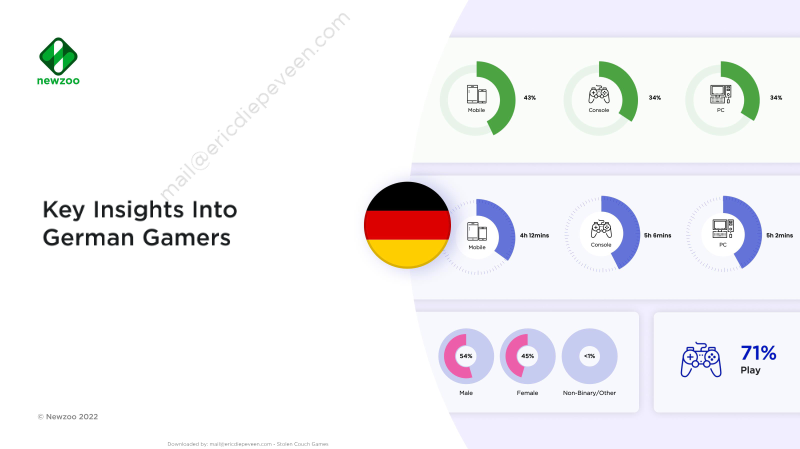
The German games industry navigated a period of significant contraction in 2024, with total market revenue falling 6% to €9.4 billion. This downturn, driven by a decline in mobile revenue and console hardware sales, resulted in the first recorded reduction in the number of active companies and industry employees in recent years. Despite these headwinds, Germany maintains its status as the largest games market in Europe and the fifth largest globally. The domestic player base remains robust and increasingly diverse, encompassing 37.5 million individuals with an average age of 39.5 years, reflecting the deep integration of gaming into the national cultural fabric. Strategic instability during this period stemmed largely from restrictive federal funding guidelines and project application freezes, which disproportionately impacted smaller studios. However, the outlook for 2025 is increasingly positive, anchored by a new coalition agreement that pledges to increase federal funding to €125 million annually by 2026 and introduce competitive tax incentives. These policy shifts aim to bolster Germany’s international standing, which industry leaders currently view as suboptimal despite the nation’s strong infrastructure, academic training programs, and successful startup initiatives like the "Press Start" grant. To secure long-term growth, the industry is prioritizing a hybrid funding model, the establishment of a dedicated "Games University," and the expansion of digital cultural heritage projects, such as the AI-driven archiving of over 40,000 titles. Professionalization efforts continue through the *game* association, which represents over 500 members and manages critical networking platforms like gamescom. By integrating esports development, sustainability commitments, and structured career pathways, the German ecosystem is positioning itself to transition from a period of market correction toward a more resilient and internationally competitive future.
01 Video game players in Germany 8 02 German video games market 14 03 The games industry in Germany 26 .1 Companies and employment figures .2 Games funding .3 The ten demands of the German games industry 04 gamescom and devcom 46 05 German Computer Game Awards 52 06 Entertainment Software 54 Self-Regulation Body (USK) Interview: Sandra Winterberg on the International Computer Game Collection 07 Foundation for Digital 58 Games Culture Interview: Nandita Wegehaupt on the games scholarship Find the digital 08 esports player foundation 62 annual report Interview: Julius Althoff on the Esports Team here! Berlin and Olympic Esport Games Publisher 09 About game – The German 66 game – The German Games Games Industry Association Industry Association Friedrichstraße 165 10117 Berlin Gestaltung 10 Development of the German 74 Bureau Ole Gehling games market since 1995 www.olegehling.de
the Media one year earlier for the promotion of game development were implemented in exciting form: the Press Start: Games Founding Grant, the first programme to provide targeted support to game developers over a period of a year and a half for realisation of their projects. The overwhelming demand demonstrates that there continues to be a huge desire to develop games and take the leap into entrepreneurship in Germany. In the midst of this back and forth on games funding, Germany’s governing coalition of the SPD, Bündnis 90/Die Grünen and FDP also collapsed. The budget for 2025 had not been resolved up to that point. This in particular brought added challenges Dear readers, for games companies. As became apparent From the perspective of the German games shortly before the end of 2024, when funding industry, 2024 can certainly be described as applications could once again be submitted, this bumpy. Although the wave of consolidation in uncertainty gave rise to tight restrictions that the international games sector slowed last year, the practical reality of game development makes projects continued to be cancelled, employees virtually impossible for applicants to comply laid off and studios closed worldwide. These with. As a result, despite the resumption of the developments pose a challenge for the German funding application process at the end of 2024, games industry in particular, which is dominated by many games companies lack the necessary small and medium-sized studios that rely to a large internationally competitive framework conditions. extent on international publishers and partners to Our game industry barometer showed at the start realise their projects.
particular, which is dominated by many games companies lack the necessary small and medium-sized studios that rely to a large internationally competitive framework conditions. extent on international publishers and partners to Our game industry barometer showed at the start realise their projects. This is especially true when, of 2025 just how negatively companies assess as in 2024, an absence of reliable long-term games Germany’s international competitiveness. funding in Germany brings cost disadvantages of The development in the number of employees and 30 per cent compared to relevant international companies in the sector clearly shows the impact locations. of the difficult conditions on Germany as a game However, particularly in the second half of the year, there was also good news. On the occasion of gamescom, the new funding guidelines of the then responsible Ministry for Economic Affairs and Climate Action were announced. While these guidelines in part worsened the situation for many companies, they also clarified the conditions that are to apply when the government resumes acceptance of funding applications. And the 33 million euros made available by the German production location: after years of strong growth in some areas, both figures are now declining. The launch of the Federal funding for video games in 2020 was largely responsible for the subsequent boom in start-ups, which in turn led to a significant increase in the number of employees in the industry.
ction location: after years of strong growth in some areas, both figures are now declining. The launch of the Federal funding for video games in 2020 was largely responsible for the subsequent boom in start-ups, which in turn led to a significant increase in the number of employees in the industry. Meanwhile, the challenging conditions internationally and the unreliable and unpredictable funding situation in Germany have put an end to this development for the time being.
between the CDU, CSU and SPD following the federal election at beginning of 2025 gives cause for hope. The new governing coalition of Christian Democrats and Social Democrats not only recognises the huge cultural, economic and technological potential of the games industry and its role as a pacesetting driver of innovation, but has also announced the introduction of additional tax breaks for game development in Germany. And less than 50 days after taking office, the new federal government, most notably the federal minister responsible for research and games, Dorothee Bär, followed up on the coalition’s pledge to increase support for the industry by designating 88 million euros for games funding in the budget proposal for 2025 and 125 million euros from 2026 onwards. This gives companies significantly greater planning security as well as the breathing space they need until the additional tax breaks announced in the coalition agreement are implemented. cloud gaming – which underscores the perpetual dynamics and innovative strength of the games industry. In combination with new game consoles and blockbuster titles that have already been announced, this promises renewed growth in the near future. Further cause for this positive outlook is delivered by gamescom. The world’s largest games event broke multiple records in 2024, including in the number of exhibitors, the internationality and, above all, international reach. As the annual highlight of the global games industry, gamescom once again took a huge leap forward, underscoring the positive future outlook for games and the global games market.
iple records in 2024, including in the number of exhibitors, the internationality and, above all, international reach. As the annual highlight of the global games industry, gamescom once again took a huge leap forward, underscoring the positive future outlook for games and the global games market. This annual report offers an overview of these and many other developments in the games industry in Germany. I wish you enjoyable reading and interesting insights. Felix Falk The importance of this not only for German games Managing Director of game – The German Games companies, but also for Germany as a business Industry Association location and even for federal revenue as a whole, is demonstrated by a study, conducted by Goldmedia on our behalf, on the leverage effects of tax breaks for games. The results are striking: every euro in funding generates an additional 3.40 euros in tax revenues and social security contributions, 4.80 euros in additional investment and 8.70 euros in additional gross value added. In other words, every euro that goes into games funding multiplies, generating new revenue for Germany.
01 Players in Germany 8 02 German market for computer 14 03 The games industry in Germany 26 .1 Employment figures and companies .3 The ten demands of the games industry 04 Esports 40 05 esports player foundation 42 06 gamescom and devcom 44 07 German Computer Games Awards 48 08 Entertainment Software 50 09 Foundation for Digital Games 52 10 About game –...
Germany stands as Europe’s largest video‑game market and the world’s fifth‑largest, a position reinforced by a robust developer community, flagship events and a policy framework that actively subsidises production. Federal funding of €50 million per year, allocated as non‑repayable grants covering a quarter to half of project costs, is complemented by regional programmes and a business climate that benefits from a sizable domestic audience and a highly skilled workforce. The market generated a record €4.4 billion in 2018, expanding 9 percent year‑on‑year, while the sector’s organisational base grew to roughly 524 game‑related firms that year. These include 368 development studios, 38 pure publishers and a further 118 hybrid entities, employing about 11 000 staff directly in development and nearly 28 000 when ancillary roles are counted. More than 50 higher‑education institutions now deliver dedicated curricula in game design, computer science, art and virtual reality, concentrating talent pipelines in Berlin and Hamburg. Mid‑size studios such as Deep Silver, Kolibri Games and Mimimi have produced internationally recognised titles, and the annual gamescom exhibition in Cologne underscores the industry’s global reach. In 2023 the event attracted 31 300 trade professionals, delivered over 500 000 concurrent viewers for its Opening Night Live broadcast and amassed more than 100 million video hits, prompting the launch of a gamescom Asia edition in Singapore to capture growth in the Asia‑Pacific region. A dense network of over 200 development and publishing firms and more than 150 specialist service providers—spanning localisation, cloud infrastructure, legal counsel, marketing and middleware—covers virtually every German city. This comprehensive, SME‑driven ecosystem, supported by mature ancillary services, positions Germany for sustained expansion and reinforces its role as a central hub for both domestic creation and international distribution of video‑games.
01 Players in Germany 8 02 German market for computer 14 03 The games industry in Germany 24 .1 Employment figures and companies .4 The ten demands of the games industry 04 gamescom 38 05 About game – the German 42 .1 Diversity initiative Hier spielt Vielfalt .2 Environmental and climate protection in the .3 Foundation for Digital Games Culture .5 Entertainment Software Self-Regulation Body 06 D...
01 Gamer in Deutschland 6 02 Markt für Computer- und 12 03 Games-Branche in Deutschland 22 .1 Beschäftigtenzahlen und Unternehmen .4 Die 10 Forderungen der Games-Branche 04 eSports 36 05 gamescom 40 06 Deutscher Computerspielpreis 42 07 Unterhaltungssoftware 44 08 Stiftung Digitale Spielekultur 46 09 Über den game – Verband 48 Herausgeber ...