Player Demographics
Documents
Live Streaming Trend Report: Q1 2025
I’m ready to synthesize the full report, but I only have the beginning of the first section. Could you please provide the remaining section summaries so I can create a complete, cohesive summary?
- Live streaming viewership increased by 8.9% year-over-year in Q1 2025, primarily driven by competitor platforms, as Twitch's viewership decreased by 6.9% from Q1 2024.
- Non-gaming content is the most popular streaming category, growing 25.6% year-over-year, with Kick, Chzzk, and SOOP Korea showing roughly 94% year-over-year increases in non-gaming content.
- Twitch remains the largest platform with 59% of the market share, while Kick experienced strong growth with a 112% year-over-year increase in hours watched, securing an 8.6% share of total viewership.
- YouTube Gaming's market share grew in Q2 2024 following Twitch's shutdown in South Korea, with new Korean platforms like SOOP (AfreecaTV's new platform) and Chzzk seeing streamers prosper after departing Twitch.
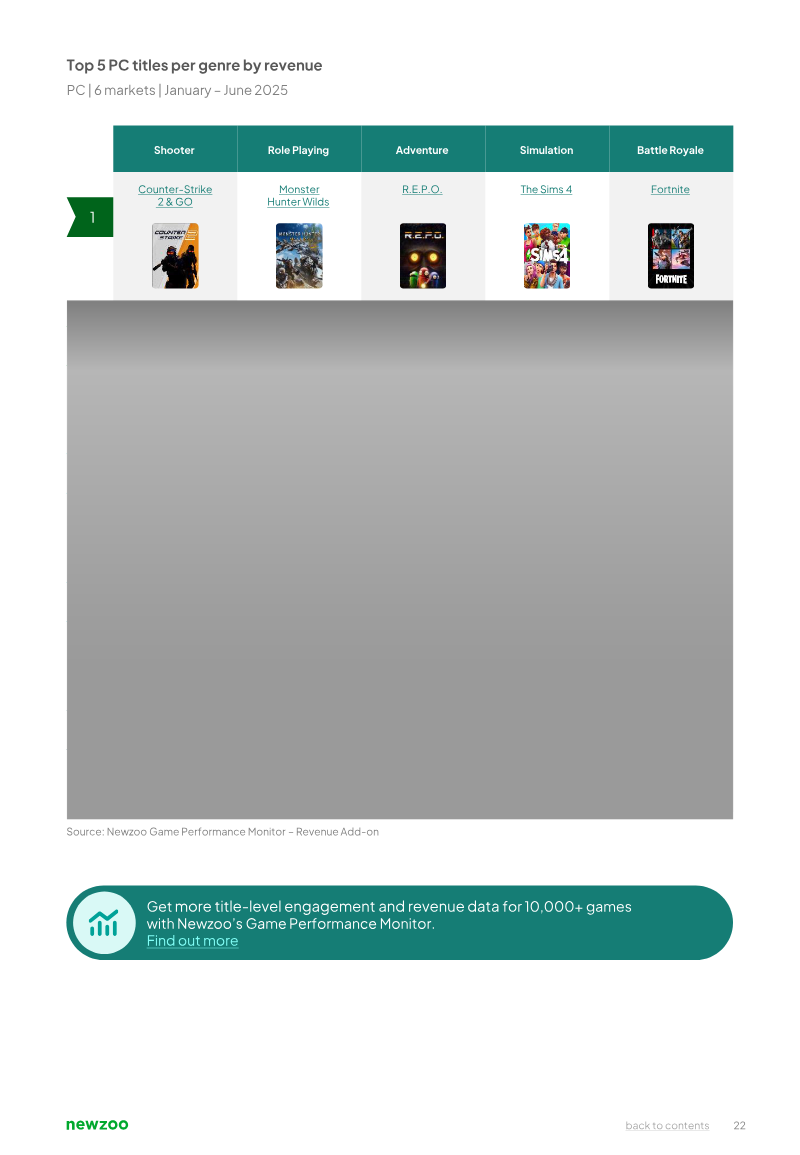
- Counter-Strike boasted the highest growth in Q1 2025, increasing its viewership by 55%, driven by high-profile esports events, while League of Legends, despite remaining #1, saw a 3% quarterly viewership decline.
Bilan du Marché Français 2024
The 2024 French video‑game market delivered €5.7 billion in revenue, representing a 5.8 % contraction from the previous year yet remaining the second‑largest annual total in the sector’s history and the fifth consecutive year above the €5.5 billion threshold. Console sales continued to dominate, contributing roughly 45 % of total turnover (about €2.55 billion), while the remaining revenue was split among mobile, PC and ancillary services. Physical and digital distribution each accounted for approximately one‑third of the market—32 % physical and 31 % digital—indicating a balanced ecosystem in which retail and online channels retain comparable importance.
Consumer awareness of the pan‑European PEGI age‑rating system remained robust, with 62 % of respondents indicating familiarity, underscoring the effectiveness of regulatory communication and its role in shaping purchasing decisions. The data also reveal a nuanced profile of French gamers, whose preferences span a wide range of genres and platforms, reinforcing the market’s resilience despite the modest overall decline.
Strategic governance of the sector is reflected in the composition of the SELL board, which brings together senior executives from the world’s leading publishers—including EA, Bandai Namco, Sony, Microsoft, Nintendo, Ubisoft and Take‑Two. This high‑level representation signals a collaborative approach to addressing industry challenges, fostering innovation, and aligning French market dynamics with global trends.
Overall, the analysis confirms that France remains a pivotal European hub for video‑game activity, with a diversified revenue structure, strong consumer awareness of content ratings, and an industry leadership framework that collectively support continued growth and adaptation in a competitive global environment.
- The French video-game market generated €5.7 billion in 2024, marking a 5.8% contraction from the previous year while maintaining a five-year streak above the €5.5 billion threshold.
- Console sales remain the primary revenue driver, accounting for approximately 45% of total market turnover at roughly €2.55 billion.
- The French market maintains a balanced distribution ecosystem, with physical sales at 32% and digital sales at 31% of the total market share.
- Consumer awareness of the PEGI age-rating system is high, with 62% of respondents reporting familiarity with the regulatory framework.
- The SELL board, which governs the sector, includes senior leadership from major global publishers such as EA, Bandai Namco, Sony, Microsoft, Nintendo, Ubisoft, and Take-Two.
From Data to Personas: The 2025 Guide to US Gaming Audiences
The modern gaming landscape in the United States has evolved into a diverse, cross-generational ecosystem that fundamentally challenges outdated stereotypes of the solitary, young male player. Current data indicates that today’s gaming population is characterized by middle-to-high-income individuals who prioritize quality, convenience, and social connectivity. Far from being sedentary, these consumers frequently integrate digital play with active, outdoor lifestyles, sports participation, and family-oriented activities. This shift reflects a broader demographic reality where gaming serves as a primary form of entertainment across all age groups and socioeconomic backgrounds.
Consumer behavior within this segment extends well beyond the digital realm, as gamers demonstrate significant purchasing power and a strong affinity for premium brands, casual dining, and higher education. Analysis reveals a consistent tendency for these audiences to over-index on online shopping and delivery services, favoring mainstream, value-oriented brands across the retail and fitness sectors. These habits suggest that gaming is not an isolated hobby but a central component of a lifestyle defined by convenience and digital-physical integration.
Segmentation reveals distinct behavioral patterns that allow for more nuanced marketing strategies. For instance, sports-oriented gamers gravitate toward fast-food and convenience-driven brands, whereas those who favor board, puzzle, and trivia games tend to be older, more education-focused, and financially prudent. By moving past monolithic industry tropes, advertisers can leverage these granular insights to execute more precise, data-driven campaigns. Ultimately, the gaming audience represents a highly active, diverse, and economically influential consumer base that requires sophisticated engagement strategies tailored to specific lifestyle personas rather than generalized assumptions.
- The US gaming population is characterized by middle-to-high-income individuals who integrate digital play into active, outdoor, and family-oriented lifestyles rather than operating as a sedentary, isolated demographic.
- Gamers demonstrate significant purchasing power with a strong affinity for premium brands, higher education, and convenience-based services like online shopping and delivery.
- Gaming has evolved into a cross-generational, mainstream form of entertainment that transcends traditional age and socioeconomic stereotypes.
- Consumer behavior within the gaming segment is highly segmented, with sports-oriented gamers favoring fast-food and convenience brands, while puzzle and trivia gamers skew older and more financially prudent.
- Effective marketing in 2025 requires moving away from monolithic industry tropes in favor of granular, data-driven strategies tailored to specific lifestyle personas.
Key Insights into Role-Playing Games (RPGs)
Role-Playing Games (RPGs) represent the highest-revenue genre in the global gaming market as of 2022. The genre is characterized by deep character development, party-based mechanics, and progression systems centered on quests and combat. While RPGs are played across all platforms, they maintain a strong presence on PC and console, where they consistently rank among the top genres for monthly active users.
The demographic profile of the RPG audience is predominantly male, accounting for 58% of players, and skews toward younger age groups, with 59% of the player base falling between the ages of 10 and 30. Engagement patterns reveal that RPG players are highly active, averaging 18.8 sessions per month. The genre also demonstrates significant cross-genre appeal, with high player overlap in the adventure, shooter, and battle royale categories. High magical fantasy remains the most popular thematic element, utilized by 63% of the player base, while skill and talent trees serve as the most prevalent gameplay mechanic.
Monetization within the RPG space is dominated by pay-to-play models, which reach 97% of the player base, followed closely by in-app purchases at 90%. Geographically, the United States and Japan lead in monthly active users on PC and console. The genre also maintains a robust live-streaming presence, generating 205 million hours watched across platforms like Twitch and Facebook Gaming in June 2022. These insights are derived from data covering 37 markets, excluding China and India, and utilize proprietary gamer segmentation to analyze player motivations, viewing habits, and engagement metrics across the broader gaming ecosystem.
- As of 2022, Role-Playing Games (RPGs) rank as the highest-revenue genre in the global gaming market.
- The player base is predominantly male (58%) and young, with 59% of users falling between the ages of 10 and 30.
- Monetization is heavily driven by pay-to-play models used by 97% of the player base, supplemented by in-app purchases at 90%.
- High magical fantasy is the dominant theme, appearing in 63% of RPGs, while skill and talent trees remain the most prevalent gameplay mechanics.
- RPG players exhibit high engagement, averaging 18.8 sessions per month, with significant audience overlap in the adventure, shooter, and battle royale genres.
Annual Report of the German Games Industry 2025
Germany’s video‑game sector generated €5.84 billion in 2024, ranking fifth globally but declining 6 % year‑on‑year. The contraction was most pronounced in game purchases, which fell 17 %, while online gaming and subscription services surged 43 % to €3.26 billion, underscoring a decisive shift toward digital and cloud‑based play. In‑game and in‑app purchases accounted for €4.6 billion, a modest 3 % drop, yet mobile gaming alone grew 63 % since 2019 to €3 billion. Console and PC revenues were €1.9 billion and €1.5 billion, respectively, while hardware sales fell 10 %, with consoles down 26 %. The workforce expanded to 37.5 million players, nearly half women and with an average age of 39.5 years, indicating broader demographic penetration.
Policy analysis reveals that restrictive federal and state funding schemes have limited access for start‑ups, contributing to an 87 % negative perception of Germany’s international competitiveness. The 2025 coalition agreement introduces tax breaks and a €2 750/month “Press Start” grant for new studios, signalling a shift toward a hybrid funding model. A projected €125 million annual increase from 2026, with each tax‑credit euro expected to generate €4.80 in economic spill‑overs, is coupled with calls for university programmes, incubators, and a dedicated “Games University” to supply skilled talent. Without these reforms, Germany risks falling behind global leaders.
The industry’s ecosystem has expanded through high‑profile events such as devcom and gamescom, which attracted record attendance and showcased international diversity. Initiatives like the Press Start: Games Founding Grant, esports talent pipelines, and the Equal Esports Cup demonstrate a coordinated effort to build inclusive professional pathways. The German Games Association, through gamescom and sustainability initiatives such as “Playing for the Planet,” positions Germany as a climate‑friendly, diverse hub. Market data confirm that 60 % of Germans play video games, with mobile gaming dominating at 37.9 %, while over 90 % of households have internet access, underscoring a mature, multi‑platform market poised for continued growth across consoles, PC and mobile channels.
- Germany’s video game sector generated €5.84 billion in 2024, representing a 6% year-on-year decline despite the country maintaining its position as the world's fifth-largest market.
- Consumer spending has decisively shifted toward digital models, with online gaming and subscription services surging 43% to €3.26 billion, while traditional game purchases dropped by 17%.
- Mobile gaming has become a primary market driver, growing 63% since 2019 to reach €3 billion in revenue, while hardware sales contracted by 10% overall, led by a 26% decline in console sales.
- To combat an 87% negative perception of international competitiveness, the 2025 coalition agreement introduces a hybrid funding model featuring tax breaks and a €2,750/month 'Press Start' grant for new studios.
- The government projects a €125 million annual funding increase starting in 2026, with each euro of tax credit expected to generate €4.80 in economic spill-overs.
PC & Console Gaming Report 2025
Global PC and console revenues are expected to grow modestly through 2027, with consoles driving the majority of expansion at an estimated +13 % CAGR while PC revenue rises only in single digits. 2024 saw a plateau for PCs, dominated by free‑to‑play and in‑game monetisation, whereas console sales are set to rebound from 2025 thanks to strong releases such as GTA VI and the launch of Nintendo Switch 2. Player growth remains incremental, with PC players increasing at +2.3 % annually and console players at +3.5 %, driven largely by established franchises rather than breakthrough innovation.
Playtime data confirm that 2024 experienced a 6 % YoY increase, with Pay‑to‑Play titles (e.g., Call of Duty) and free‑to‑play hits (Fortnite, Roblox) accounting for most of the lift. New releases captured only about 9 % of total playtime, underscoring that long‑running series dominate the market. Console audiences remain heavily slate‑dependent: 67 % of new‑release hours come from annual franchises, while PC players show a higher share of non‑annual titles. In the US and Western Europe, non‑annual franchise games contribute a smaller slice of console revenue (≈8–22 %) compared to annual franchises, which drive the bulk of earnings.
Engagement patterns reveal a sharp decline in title diversity on PC and Xbox, with the average number of titles played per player falling 27 % on Steam in the US and up to 34 % in Russia and Brazil. PlayStation, by contrast, shows modest growth in title engagement. Genre preferences are shifting away from Battle Royale toward Adventure and Role‑Playing, reflecting a broader industry trend toward narrative‑rich, long‑form gameplay. Nostalgia and free‑to‑play models continue to sustain short‑term spikes, but long‑term retention hinges on continuous content updates and robust live‑service strategies. New IPs must prioritize originality, polished gameplay loops, and community‑first discovery to overcome the legacy brand advantage and achieve lasting commercial success.
- Console revenue is projected to grow at a 13% CAGR through 2027, significantly outpacing single-digit growth for PC, with major catalysts including the release of GTA VI and the Nintendo Switch 2.
- Market dominance is heavily concentrated in established franchises, as new releases captured only 9% of total playtime in 2024, with annual franchises accounting for 67% of new-release hours on consoles.
- Title diversity is shrinking, evidenced by a 27% decline in the average number of titles played per user on Steam in the US, with drops as high as 34% in markets like Russia and Brazil.
- Player growth remains incremental, with annual increases of 3.5% for console and 2.3% for PC, driven primarily by legacy brands rather than breakthrough innovation.
- Genre preferences are shifting away from Battle Royale toward Adventure and Role-Playing titles, signaling a market trend toward narrative-rich, long-form gameplay.
UK Interactive Entertainment Japan Market Report 2025
The report examines Japan’s interactive entertainment market for 2025, aiming to guide UK game developers and publishers in entering or expanding within a culturally distinct yet lucrative region. Japan accounts for only 2.2 % of the global player base but generates 9.1 % of worldwide game revenue, underscoring high per‑player spend—$223 in Japan versus $145 in the UK. The PC and console segment, excluding mobile and Nintendo platforms, represents a $2.5–3.0 billion opportunity.
Key market dynamics include an older player demographic than the US and Europe, a strong preference for single‑player role‑playing games with deep narratives, and a dominance of domestic publishers—70 % of console hardware sales are controlled by Japanese firms. Nintendo’s presence is particularly pronounced, while sports titles remain marginal. Revenue growth has been robust, with PC revenue rising 16.2 % YoY in 2024 versus a global 4.4 % increase, though the pace is expected to decelerate as the Japanese yen weakens against the dollar.
Methodologically, insights derive from Newzoo’s flagship global gamer study and proprietary market intelligence tools, sampling 73 000 gamers across PC and console platforms. The analysis covers player overlap, retention, and engagement metrics (DAU/MAU), and includes forecasted growth through 2027. The report concludes that strategic localization—emphasizing narrative depth, fantasy and science‑fiction themes, and solo play experiences—will be critical for success in Japan’s competitive landscape.
- Japan generates 9.1% of global game revenue from only 2.2% of the global player base, with an average per-player spend of $223 compared to $145 in the UK.
- The PC and console segment, excluding mobile and Nintendo platforms, represents a $2.5–3.0 billion market opportunity for developers.
- PC gaming revenue in Japan grew 16.2% year-over-year in 2024, significantly outpacing the 4.4% global growth rate, though this momentum faces headwinds from a weakening yen.
- Domestic firms dominate the market, controlling 70% of console hardware sales, with Nintendo maintaining a particularly strong presence.
- Successful market entry requires prioritizing single-player role-playing games featuring deep narratives, fantasy, or science-fiction themes.
Mobile Gamer 2021: Gen Z Edition
The report examines Generation Z (born 1997 and later) as the newest cohort of mobile gamers, highlighting their purchasing power, digital habits, and advertising preferences. Surveying 7,103 U.S. respondents aged 18‑24 on the Tapjoy network in February 2021, it finds that 86 % of Gen Z use mobile devices for gaming, far exceeding console (42 %) and PC (38 %) usage. Nearly one‑quarter first owned a smartphone before age 10, and 49 % replace devices every two to three years. Mobile shopping dominates their retail behavior: 68 % shop on phones one to four times per week, with 60 % ordering food delivery and 57 % making retail purchases. Preferred purchase channels include branded apps, e‑commerce storefronts, rewarded offers in games, and Instagram ads.
Advertising engagement shows a strong preference for rewarded mobile game ads (61 % enjoy offerwalls) and short, creative content such as memes (50.4 %) and humor‑driven brand posts (57 % value humor). Traditional formats—banner ads, non‑skippable videos, and celebrity endorsements—are largely ineffective. Gen Z follows brands that align with their values; 52 % discover new products via social media, and 67 % follow brands for product interest. The methodology involved opt‑in participation with age verification, automatic reward distribution, and a geographically targeted U.S. sample.
Overall, the findings portray Gen Z as highly engaged mobile gamers with significant discretionary spending, a preference for value‑based advertising, and a strong inclination toward brands that reflect their social and environmental values.
- Mobile is the dominant gaming platform for Gen Z, with 86% of 18-24-year-olds playing on mobile devices compared to only 42% on consoles and 38% on PCs.
- Gen Z shows a strong preference for rewarded advertising, with 61% of respondents reporting that they enjoy offerwalls within mobile games.
- Traditional advertising formats like banner ads, non-skippable videos, and celebrity endorsements are largely ineffective with this demographic.
- Gen Z prioritizes humor and creativity in advertising, with 57% valuing humor-driven brand posts and 50.4% favoring meme-based content.
- Mobile shopping is a primary behavior for this cohort, as 68% shop on their phones one to four times per week, with 60% ordering food delivery and 57% making retail purchases.
Newzoo's Generations Report: How Different Generations Engage with Games
The report examines how gaming engagement varies across generational cohorts, drawing on a representative online sample of 72,068 respondents from 33 global markets (North America, EMEA, APAC). Data were collected via Computer Assisted Web Interviewing between January and April 2021. Findings show that younger generations devote a larger share of leisure time to gaming, with Gen Z and Millennials spending 11–12% of their free time on games versus 18% for Baby Boomers. Weekly playtime averages 7 hours and 20 minutes for Gen Z, 6 hours and 30 minutes for Millennials, dropping to just over 2 hours for Baby Boomers. Gaming remains the dominant entertainment medium across all ages, though motivations shift: younger players cite competition, socializing and achievement, while older players prioritize relaxation.
Platform preferences differ markedly; Gen Z spends 77% of gaming spend on mobile, whereas Baby Boomers allocate 73% to PC. Younger gamers also engage more with game‑related content, with 71–67% of Gen Z and Millennials both playing and watching games, compared to 44–51% for older cohorts. Persona segmentation reveals that “Ultimate Gamers” and “Community Gamers” dominate among Gen Z, whereas older groups are more likely to be “Time‑Fillers” or “Bargain Buyers.”
The report highlights the metaverse as a growing trend, with 70% of Gen Z and 63% of Millennials expecting to spend more time in virtual worlds. Overall, the study underscores a generational shift toward immersive, social gaming experiences and signals expanding opportunities for brands to reach diverse gamer audiences.
- Gen Z and Millennials spend significantly more time gaming weekly, averaging 7 hours 20 minutes and 6 hours 30 minutes respectively, compared to just over 2 hours for Baby Boomers.
- Platform spending habits are polarized by generation, with Gen Z allocating 77% of their gaming budget to mobile while Baby Boomers direct 73% of their spend toward PC.
- Engagement with game-related content is higher among younger cohorts, as 67–71% of Gen Z and Millennials both play and watch games, compared to 44–51% for older generations.
- Motivations for gaming diverge by age, with younger players prioritizing competition, socializing, and achievement, while older players primarily seek relaxation.
- The metaverse is a significant growth area, with 70% of Gen Z and 63% of Millennials anticipating increased time spent in virtual worlds.
German Games Industry: 2025
The German games industry navigated a period of significant contraction in 2024, with total market revenue falling 6% to €9.4 billion. This downturn, driven by a decline in mobile revenue and console hardware sales, resulted in the first recorded reduction in the number of active companies and industry employees in recent years. Despite these headwinds, Germany maintains its status as the largest games market in Europe and the fifth largest globally. The domestic player base remains robust and increasingly diverse, encompassing 37.5 million individuals with an average age of 39.5 years, reflecting the deep integration of gaming into the national cultural fabric.
Strategic instability during this period stemmed largely from restrictive federal funding guidelines and project application freezes, which disproportionately impacted smaller studios. However, the outlook for 2025 is increasingly positive, anchored by a new coalition agreement that pledges to increase federal funding to €125 million annually by 2026 and introduce competitive tax incentives. These policy shifts aim to bolster Germany’s international standing, which industry leaders currently view as suboptimal despite the nation’s strong infrastructure, academic training programs, and successful startup initiatives like the "Press Start" grant.
To secure long-term growth, the industry is prioritizing a hybrid funding model, the establishment of a dedicated "Games University," and the expansion of digital cultural heritage projects, such as the AI-driven archiving of over 40,000 titles. Professionalization efforts continue through the game association, which represents over 500 members and manages critical networking platforms like gamescom. By integrating esports development, sustainability commitments, and structured career pathways, the German ecosystem is positioning itself to transition from a period of market correction toward a more resilient and internationally competitive future.
- The German games market contracted by 6% in 2024, resulting in total revenue of €9.4 billion and the first recorded decline in industry employment and active companies.
- Federal funding is set to increase to €125 million annually by 2026, supported by new competitive tax incentives designed to improve Germany's international market standing.
- Germany remains Europe's largest games market and the fifth largest globally, supported by a robust player base of 37.5 million people with an average age of 39.5.
- Market instability in 2024 was primarily driven by a downturn in mobile revenue and console hardware sales, alongside restrictive federal funding guidelines and project application freezes.
- The industry is prioritizing long-term growth through a hybrid funding model, the creation of a dedicated 'Games University,' and the AI-driven archiving of over 40,000 titles.
Games 2025: The Industry Quest for Growth
The global games market reached a record $199.4 billion in 2024, cementing its status as the preeminent force in the entertainment sector. Despite this scale, the industry faces a period of moderated growth, with projections for 2025 hovering at approximately 1%. This deceleration stems from a combination of high-profile release delays, such as the postponement of major titles, and a tightening early-stage funding environment. To navigate this landscape, firms are shifting their focus from aggressive expansion toward operational efficiency, lean development cycles, and the optimization of existing intellectual property.
Strategic growth in 2025 will rely heavily on geographic diversification and demographic expansion. Emerging markets in the Middle East and Southeast Asia represent significant frontiers, while developers are increasingly targeting underserved cohorts, including older gamers and young adult females. Furthermore, the industry is leveraging user-generated content platforms like Roblox to maintain engagement among younger audiences. Hardware cycles, particularly the anticipated launch of the Nintendo Switch 2, remain a critical catalyst for consumer spending, providing a necessary boost to the broader market ecosystem.
To combat the dual pressures of escalating AAA development costs and fragmented consumer attention, publishers are adopting more conservative financial models. This includes a heavy reliance on remakes, remasters, and multi-platform porting to extract maximum value from established assets. Simultaneously, companies are pursuing margin expansion through diversified monetization strategies, such as hybrid mobile models and direct-to-consumer web shops that bypass traditional app store fees. By transitioning toward holistic franchise management that spans licensing, subscription services, and cross-media integration, the industry aims to stabilize revenue streams and ensure long-term sustainability in an increasingly competitive global environment.
- The global games market reached $199.4 billion in 2024, but growth is projected to decelerate to approximately 1% in 2025 due to release delays and reduced early-stage funding.
- Publishers are prioritizing operational efficiency and asset optimization, focusing on remakes, remasters, and multi-platform porting to mitigate the rising costs of AAA development.
- Strategic growth is shifting toward geographic expansion in the Middle East and Southeast Asia, alongside targeting underserved demographics like older gamers and young adult females.
- Companies are pursuing margin expansion by implementing hybrid mobile monetization models and direct-to-consumer web shops to bypass traditional app store fees.
- The industry is leveraging user-generated content platforms like Roblox to maintain engagement among younger audiences while managing fragmented consumer attention.
Mobile Game Genre Report: Comparing and Contrasting Eastern and Western Markets
This analysis explores the hypercasual mobile gaming landscape, comparing market dynamics between Western regions, such as the United States and United Kingdom, and Eastern markets, specifically Japan and South Korea. Utilizing 2021 download data and consumer insights from Newzoo and Pangle, the findings reveal that hypercasual games accounted for 36 of the top 100 most-downloaded mobile games globally. While the genre dominates Western charts—representing nearly half of the top 100 downloads in the U.S. and U.K.—it maintains a smaller footprint in Japan and South Korea, where it comprises approximately 20% of top downloads.
The sector is characterized by rapid evolution and high competition, with only eight of the top 36 hypercasual titles from 2020 remaining in the 2021 rankings. A significant shift in subgenre popularity occurred during this period, as runner and racing mechanics overtook simulation and ASMR themes. Demographically, hypercasual players across all four key markets skew male and are younger than the general mobile gaming population, with an average age below 30. These players often engage with midcore and hardcore genres, such as RPGs and strategy games, making them a valuable audience for cross-genre user acquisition.
To combat historically low retention rates—often falling below 10% by day seven—developers are increasingly adopting "hybrid-casual" strategies. This involves integrating lite meta features, progressive difficulty, and live operations to deepen engagement. Monetization remains heavily reliant on in-game advertising, with interstitial videos being the most prevalent format. However, the rise of hybrid models has introduced new revenue streams, including "remove ad" IAPs and battle passes. Success in Eastern markets specifically requires deep localization, including busier user interfaces and culturally specific live events, to effectively scale and improve lifetime value.
- Hypercasual games represent 36% of the top 100 global mobile downloads, though they command nearly 50% of top charts in the U.S. and U.K. compared to only 20% in Japan and South Korea.
- The hypercasual sector suffers from high volatility, with only eight of the top 36 titles from 2020 maintaining their positions in the 2021 rankings.
- Developers are shifting toward 'hybrid-casual' models—incorporating lite meta features and live operations—to address retention rates that typically drop below 10% by day seven.
- Runner and racing mechanics have overtaken simulation and ASMR themes as the dominant subgenres in the hypercasual market.
- Hypercasual players skew male and under 30 years old, frequently engaging with midcore and hardcore titles like RPGs and strategy games.