Updated Jun 1, 2026 by Deloitte
Report · February 4, 2026
Published by Deloitte
<u>01</u> Esports consumption in Southeast 05 <u>03</u> Appendix 20 Asia (SEA) Glossary 21 Consumer engagement maturity 06 Audience demographics 09 Methodology 22 Engagement and interaction 11 Contacts 23 <u>02</u> Special focus: SEA esports snapshots 14 Country profiles ...
01 Esports consumption in Southeast 05 03 Appendix 20 Asia (SEA) Glossary 21 Consumer engagement maturity 06 Audience demographics 09 Methodology 22 Engagement and interaction 11 Contacts 23 Sports Business Group 24 02 Special focus: SEA esports snapshots 14 Country profiles 15 iN!M
Dear Readers, We welcome you to the latest edition of ‘Let's Play!’, We trust you will find reading this report Deloitte’s esports market report. This report is focused valuable. Representative survey among ~14,000 on Southeast Asia (SEA), one of the most dynamic Sincerely, participants globally, including ~8,000 in and fast-growing esports regions globally. As Europe (age 16-65) esports continues to evolve from a niche interest to a mainstream digital entertainment industry, SEA stands out for its high audience reach, mobile-first 20 global markets, including 6 in Southeast Asia1 ecosystem and deep integration with digital culture. James Focus ofthis report This report unpacks SEA’s unique digital-first Walton consumption habits, its openness to advertising and SEA Sports brand engagement and the ongoing challenge of Business direct consumer monetisation. We also explore how Group esports in the region compares with traditional sports, the role of gaming in shaping the industry, and emerging opportunities for brands, leagues and publishers to drive deeper fan engagement.
engagement and the ongoing challenge of Business direct consumer monetisation. We also explore how Group esports in the region compares with traditional sports, the role of gaming in shaping the industry, and emerging opportunities for brands, leagues and publishers to drive deeper fan engagement. To capture these insights, Deloitte conducted an extensive consumer survey across Southeast Asia, collecting data on how esports is shaping entertainment consumption, digital spending behaviours and community-building across multiple markets. As SEA’s esports industry continues to mature, understanding these evolving trends will be key for companies looking to navigate and capitalise on this high-growth space.
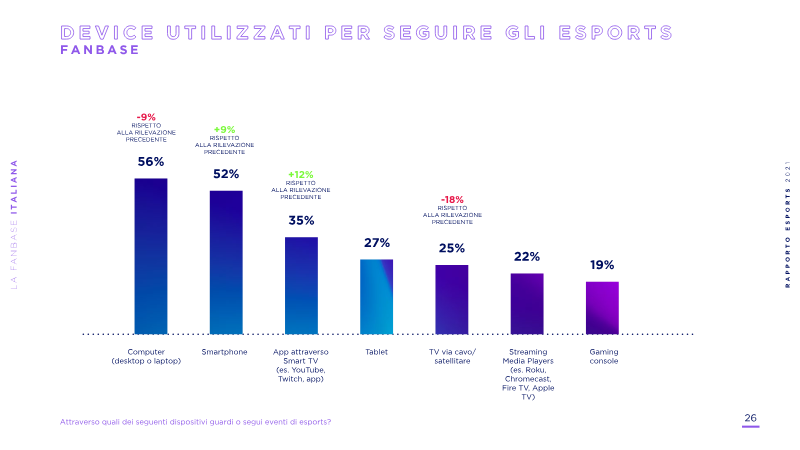
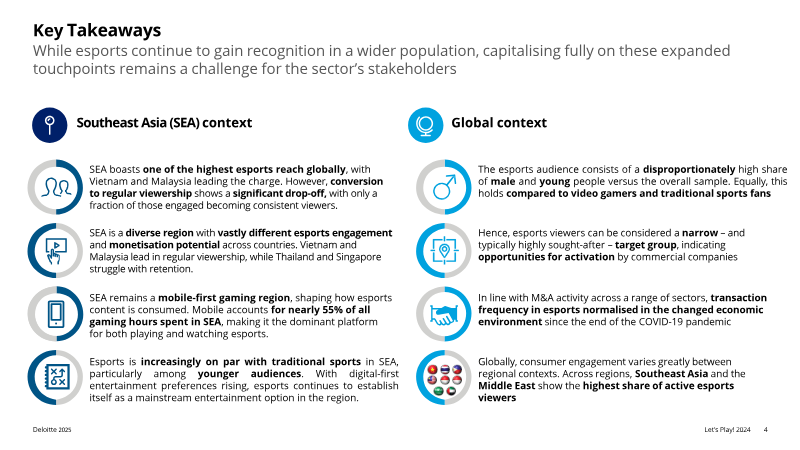
Key While esports continue to gain recognition in a wider population, capitalising fully on these expanded touchpoints remains a challenge for the sector’s stakeholders Southeast Asia (SEA) context Global context SEA boasts one of the highest esports reach globally, with The esports audience consists of a disproportionately high share Vietnam and Malaysia leading the charge. However, conversion of male and young people versus the overall sample. Equally, this to regular viewership shows a significant drop-off, with only a holds compared to video gamers and traditional sports fans fraction of those engaged becoming consistent viewers. SEA is a diverse region with vastly different esports engagement Hence, esports viewers can be considered a narrow – and and monetisation potential across countries. Vietnam and typically highly sought-after – target group, indicating Malaysia lead in regular viewership, while Thailand and Singapore opportunities for activation by commercial companies struggle with retention. SEA remains a mobile-first gaming region, shaping how esports In line with M&A activity across a range of sectors, transaction content is consumed. Mobile accounts for nearly 55% of all frequency in esports normalised in the changed economic gaming hours spent in SEA, making it the dominant platform environment since the end of the COVID-19 pandemic for both playing and watching esports.
ss a range of sectors, transaction content is consumed. Mobile accounts for nearly 55% of all frequency in esports normalised in the changed economic gaming hours spent in SEA, making it the dominant platform environment since the end of the COVID-19 pandemic for both playing and watching esports. Esports is increasingly on par with traditional sports in SEA, Globally, consumer engagement varies greatly between particularly among younger audiences. With digital-first regional contexts. Across regions, Southeast Asia and the entertainment preferences rising, esports continues to establish Middle East show the highest share of active esports itself as a mainstream entertainment option in the region. viewers
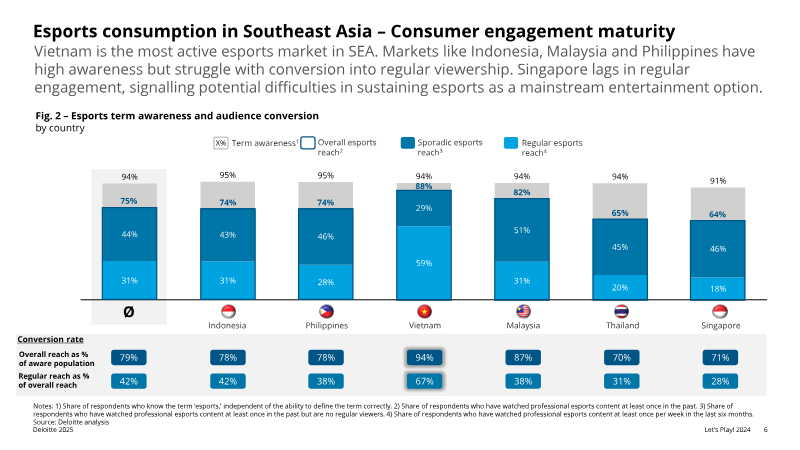
Esports consumption in Southeast Asia – Consumer engagement maturity Vietnam is the most active esports market in SEA. Markets like Indonesia, Malaysia and Philippines have high awareness but struggle with conversion into regular viewership. Singapore lags in regular engagement, signalling potential difficulties in sustaining esports as a mainstream entertainment option. Fig. 2 – Esports term awareness and audience conversion by country X% Term awareness¹ Overall esports Sporadic esports Regular esports reach² reach³ reach⁴ 94% 95% 95% 94% 94% 94% 91% 75% 74% 74% 88% 82% 29% 65% 64% 44% 43% 46% 51% 45% 46% 59% 31% 31% 28% 31% 20% 18% Ø Indonesia Philippines Vietnam Malaysia Thailand Singapore Conversion rate Overall reach as % 79% 78% 78% 94% 87% 70% 71% of aware population 94% Regular reach as % 42% 42% 38% 94% of overall reach 67% 38% 31% 28% 6796 Notes: 1) Share of respondents who know the term ‘esports,’ independent of the ability to define the term correctly. 2) Share of respondents who have watched professional esports content at least once in the past. 3) Share of respondents who have watched professional esports content at least once in the past but are no regular viewers. 4) Share of respondents who have watched professional esports content at least once per week in the last six months. Source: Deloitte analysis
Gamer demographics and preference 3 must-haves to capture growth opportunities 2 Southeast Asia Gaming Consumer Economy WHOLESALE Southeast Asia Gaming Consumer Economy is a co-authored research report by Telekom Malaysia and twimbit.
IN VIETNAM: A NEW TOURWAMENT WHY ESPORTS NOW ? HOW CAN BRANDS 1 A culture of competition 8 BRIDGE THE GAP? 2 A global rising star 10 3 Vietnam’s new favorite pastime 13 1 Ads 44 2 KOL Engagement 54 WHO ARE VIETNAM’S 3 Sponsorship 65 4 Unexplored Alleys 74 ESPORTS FANS? ...
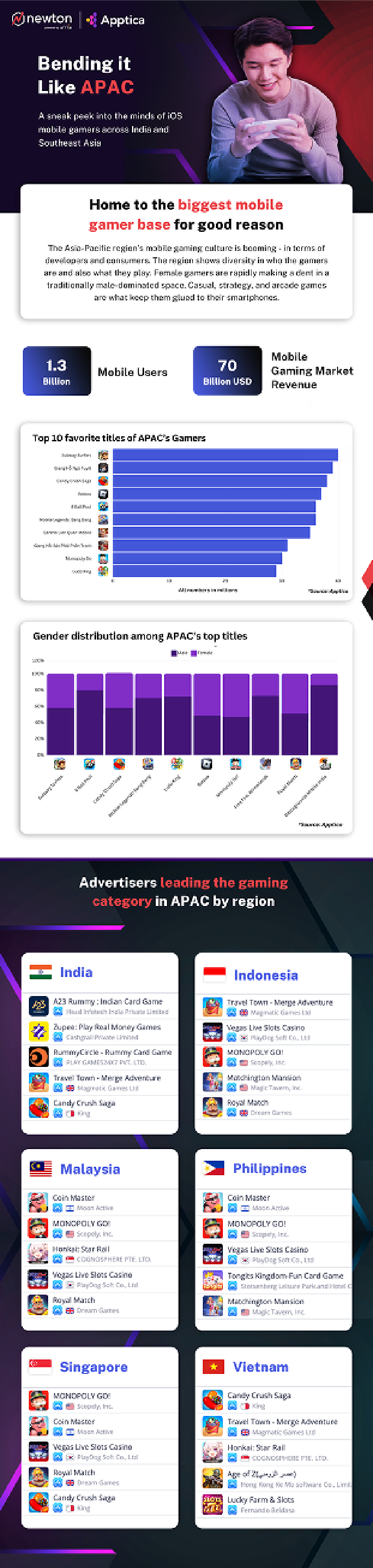
Southeast Asia represents a rapidly accelerating segment of the global esports market, characterized by high growth rates in both viewership and revenue. Between 2019 and 2024, the region is projected to see a compound annual growth rate (CAGR) in audience size that significantly outpaces global averages, with year-over-year increases reaching as high as 18.2%. This expansion is driven by a mobile-first gaming culture where 82% of the online population plays mobile games and 39% of players identify mobile as their primary platform. Key markets fueling this trend include Indonesia, Vietnam, the Philippines, Thailand, Malaysia, and Singapore. The regional ecosystem is heavily influenced by mobile-centric titles, specifically Mobile Legends: Bang Bang, Garena Free Fire, and PUBG Mobile. These three games accounted for roughly half of all global esports hours watched for those titles on Twitch and YouTube Live during the first half of 2021. Revenue streams in the region mirror global trends, with sponsorship serving as the primary contributor, supported by media rights, publisher fees, and digital goods. Government intervention also plays a critical role in market maturation, with initiatives like the Youth Esports Program in the Philippines and the integration of esports into the 30th SEA Games as a medal event. Data for these findings was sourced from Newzoo’s 2021 Global Esports and Live Streaming Market Report and Consumer Insights. The methodology utilized a Major City Approach for most Southeast Asian nations to represent active internet users aged 10-50, while Singapore data covered the general online population within that age bracket. The findings conclude that improved internet infrastructure and the accessibility of mobile devices are the primary catalysts for long-term engagement and the continued attraction of non-endemic brand sponsorships to the region.
What we set out Keep reading to learn... to learn AD Keep reading to learn… The true impact of in-game advertising on The true impact of in-game advertising on With 8o% of under-18s' actively gaming and Gen Z younger audiences.