Player Demographics
Documents
The New Destination to Reach Global Gamers: The 2021 Global Mobile Gamers Whitepaper
Mobile gaming represents the largest and fastest-growing segment of the global entertainment industry, generating $93.2 billion in 2021 with a projected trajectory toward $126.1 billion by 2024. Within this landscape, a distinct synergy has emerged between mobile gaming and social media platforms, particularly TikTok, where nearly half of all mobile gamers are active. These users demonstrate significantly higher value than non-users, installing 50% more games, playing 36% longer, and showing a 66% higher likelihood of making in-game purchases. This demographic functions as a highly social and evangelical audience that consumes an average of seven different genres and responds more favorably to innovative advertising formats like sponsored livestreams and user-generated content.
Global player behavior reveals a consistent preference for realistic art styles and fantasy or mystery settings, though regional nuances remain critical for market penetration. While Southeast Asian markets are dominated by MOBA titles, Japanese and South Korean audiences show a marked preference for immersive RPGs and Puzzle RPGs. Across all regions, the primary motivation for gameplay is relaxation or passing time, yet monetization is driven by progression-based incentives, such as the desire to unlock content or bypass difficult levels. This suggests that while the initial draw of a game is often casual, long-term financial viability depends on structured advancement and consistent content updates.
Retention and re-engagement strategies must address the primary drivers of player churn, which are identified as technical bugs and slow leveling speeds. Conversely, the introduction of new missions, story-driven updates, and technical optimizations are the most effective methods for reclaiming lapsed players. To maximize impact, advertisers and developers should prioritize action-packed, narrative-driven creative content that leverages the social metaverse. By focusing on regional aesthetic preferences—such as "cute" or anime styles in Asia versus cartoonish realism in Western markets—and addressing the specific progression needs of players, stakeholders can better navigate the increasingly competitive global mobile gaming ecosystem.
- The global mobile gaming market generated $93.2 billion in 2021 and is projected to reach $126.1 billion by 2024.
- Mobile gamers active on TikTok install 50% more games, play 36% longer, and are 66% more likely to make in-game purchases than non-users.
- While players primarily game to relax or pass time, long-term monetization is driven by progression-based incentives like unlocking content and bypassing difficult levels.
- Technical bugs and slow leveling speeds are the primary drivers of player churn, while new missions and story-driven updates are the most effective methods for re-engagement.
- Regional preferences vary significantly, with MOBA titles dominating Southeast Asia, while Japan and South Korea favor immersive RPGs and Puzzle RPGs.
Video Games – A Force for Good: Europe's Video Game Industry
This analysis provides a comprehensive overview of the European video games industry as of 2021, detailing its economic impact, demographic reach, and social contributions. Jointly produced by ISFE and EGDF, the findings highlight a sector that remained stable following the pandemic-induced surge of 2020, maintaining a market value of €23.3 billion across key European territories. The industry supports a significant workforce, employing over 98,000 people across Europe, with 74,000 located within the EU. Data is primarily sourced from Ipsos, GameTrack, and GSD, covering major markets including France, Germany, Italy, Spain, and the United Kingdom.
The demographic data reveals that video gaming is a mainstream cultural activity, with 52% of the European population aged 6 to 64 participating. The average player age is 31.3 years, and women represent nearly 48% of the total player base. While engagement remains high, average weekly playtime returned to pre-pandemic levels of nine hours. The digital ecosystem dominates the market, accounting for 81% of total revenue, driven largely by app-based gaming and in-game extras.
A significant portion of the analysis focuses on industry responsibility and social impact. It underscores the effectiveness of the PEGI age rating system and the prevalence of parental control tools, noting a sharp decline in unsupervised in-game spending by minors. Furthermore, the industry is positioned as a driver for digital literacy and mental well-being, with specific initiatives targeting STEM education for girls and climate change through the Green Game Jam. The report concludes that the sector is a vital component of Europe’s digital economy, increasingly recognized for its pedagogical value and commitment to diversity and environmental sustainability.
- The European video game market maintained a stable value of €23.3 billion in 2021, following the initial pandemic-driven surge.
- The industry employs over 98,000 people across Europe, with 74,000 of those roles based within the EU.
- Digital revenue dominates the sector, accounting for 81% of total market value through app-based gaming and in-game purchases.
- Video gaming is a mainstream activity in Europe, engaging 52% of the population aged 6 to 64 with an average player age of 31.3 years.
- Gender representation in gaming is nearly balanced, with women accounting for 48% of the total player base.
A Rising Market: Southeast Asia
Southeast Asia represents a rapidly accelerating segment of the global esports market, characterized by high growth rates in both viewership and revenue. Between 2019 and 2024, the region is projected to see a compound annual growth rate (CAGR) in audience size that significantly outpaces global averages, with year-over-year increases reaching as high as 18.2%. This expansion is driven by a mobile-first gaming culture where 82% of the online population plays mobile games and 39% of players identify mobile as their primary platform. Key markets fueling this trend include Indonesia, Vietnam, the Philippines, Thailand, Malaysia, and Singapore.
The regional ecosystem is heavily influenced by mobile-centric titles, specifically Mobile Legends: Bang Bang, Garena Free Fire, and PUBG Mobile. These three games accounted for roughly half of all global esports hours watched for those titles on Twitch and YouTube Live during the first half of 2021. Revenue streams in the region mirror global trends, with sponsorship serving as the primary contributor, supported by media rights, publisher fees, and digital goods. Government intervention also plays a critical role in market maturation, with initiatives like the Youth Esports Program in the Philippines and the integration of esports into the 30th SEA Games as a medal event.
Data for these findings was sourced from Newzoo’s 2021 Global Esports and Live Streaming Market Report and Consumer Insights. The methodology utilized a Major City Approach for most Southeast Asian nations to represent active internet users aged 10-50, while Singapore data covered the general online population within that age bracket. The findings conclude that improved internet infrastructure and the accessibility of mobile devices are the primary catalysts for long-term engagement and the continued attraction of non-endemic brand sponsorships to the region.
- Southeast Asia's esports audience is experiencing rapid expansion, with year-over-year growth reaching as high as 18.2% between 2019 and 2024.
- The market is defined by a mobile-first culture where 82% of the online population plays mobile games and 39% identify mobile as their primary gaming platform.
- Three mobile titles—Mobile Legends: Bang Bang, Garena Free Fire, and PUBG Mobile—accounted for approximately 50% of all global esports hours watched for those specific games on Twitch and YouTube Live in the first half of 2021.
- Key growth markets in the region include Indonesia, Vietnam, the Philippines, Thailand, Malaysia, and Singapore.
- Revenue generation in the region is primarily driven by sponsorships, supplemented by media rights, publisher fees, and digital goods.
Online Nation 2021 Report
Overview............................................................................................................................ 3 What we have found – in brief ........................................................................................................... 3 1. The online consumer ......................................................................................................
- Adults spent significantly more time online in 2020 compared to 2019, with the 18-24 age group showing the largest increase, particularly during lockdown periods.
- Despite a potential decrease, 6% of UK households (approximately 1.5 million) still lacked internet access in March 2021, though direct comparability with previous years is limited due to methodology changes.
- Social video platforms are actively launching new features to maintain and build engagement, exemplified by Snapchat's 'Spotlight' which gained 100 million users by January 2021 and offers creators a share of $1 million daily.
- TikTok removed 104.5 million videos in the first half of 2020 and 89.1 million in the second half, with 'minor safety' and 'adult nudity/sexual activities' consistently being among the top removal reasons.
- The COVID-19 pandemic led to a significant increase in online education for children, with nearly 90% of parents in Britain homeschooling their children in May-June 2020 and January-February 2021.
Europe's Video Game Industry: Key Facts 2021
The European video game industry serves as a significant economic and social pillar, generating €23.3 billion in annual revenue while supporting a workforce of nearly 100,000 professionals across 4,600 studios. As of 2021, the sector reached a broad audience of 124.8 million players, representing 52 percent of the total European population. This demographic is increasingly diverse, with women accounting for nearly half of all gamers and the 45–64 age bracket emerging as the fastest-growing segment. Beyond its financial contributions, the industry functions as a vital social and mental health resource, fostering connectivity and engagement across age groups.
Commitment to consumer safety and ethical standards remains a core operational priority. The industry maintains rigorous oversight through the PEGI rating system and comprehensive parental controls, ensuring that gameplay environments remain responsible and age-appropriate. These efforts are complemented by a broader push toward social responsibility, including the integration of gaming into educational frameworks and the promotion of diversity initiatives within the workforce.
Environmental sustainability has also become a central strategic objective for the European market. Major industry bodies, including the ISFE and EGDF, are actively coordinating efforts to achieve climate neutrality. This transition is evidenced by the widespread adoption of carbon measurement and offsetting practices, with a substantial majority of companies in key markets like Germany already implementing formal sustainability programs. Supported by a robust network of national trade associations, the industry continues to leverage its collective influence to drive policy development and long-term growth within the European digital ecosystem.
- The European video game industry generated €23.3 billion in annual revenue as of 2021.
- The sector employs nearly 100,000 professionals across 4,600 studios.
- The industry reached 124.8 million players in 2021, accounting for 52 percent of the total European population.
- The player demographic is highly diverse, with women representing nearly 50 percent of gamers and the 45–64 age bracket serving as the fastest-growing segment.
- Industry bodies including the ISFE and EGDF are coordinating efforts to achieve climate neutrality, with most companies in Germany already implementing formal sustainability programs.
Newzoo's Generations Report: How Different Generations Engage with Games 2021
This analysis examines how different generations engage with video games, highlighting the medium’s evolution from a simple pastime into a multifaceted social and entertainment ecosystem. The research, based on a survey of 72,068 respondents across 33 global markets conducted in early 2021, reveals that while gaming is a universal form of entertainment, engagement patterns vary significantly by age. Younger cohorts, specifically Gen Z and Millennials, increasingly view gaming as a primary leisure activity that encompasses not just playing, but also watching content, socializing, and participating in virtual communities.
Key findings indicate that the share of leisure time dedicated to gaming increases with each younger generation. Gen Z and Millennials report spending more time on gaming than on social media or streaming movies and television. While relaxing and unwinding remain the top motivations for playing across all demographics, younger players are uniquely driven by competition, social interaction, and creative achievement. Consequently, these groups favor multiplayer modes and genres that offer sandbox or social elements, such as Fortnite and Roblox. In contrast, older generations, including Gen X and Baby Boomers, primarily utilize games for casual relaxation, often preferring single-player experiences on mobile devices.
The research also identifies a growing trend toward the metaverse, where virtual worlds serve as platforms for non-gaming activities like social gatherings and digital events. Younger consumers show high interest in avatar customization and content creation, signaling a shift toward digital identity and persistent virtual spaces. While older gamers are less likely to engage with gaming-related video content, those who do often prioritize practical information, such as reviews and tutorials, to inform their purchasing decisions. Ultimately, the data suggests that gaming has become a foundational pillar of modern entertainment, offering brands and developers diverse opportunities to reach audiences through increasingly immersive and social digital experiences.

- Gaming has become the primary leisure activity for Gen Z and Millennials, who spend more time playing games than engaging with social media or streaming video content.
- The 2021 survey of 72,068 respondents across 33 global markets confirms that the share of leisure time dedicated to gaming increases progressively with each younger generation.
- Younger players are primarily motivated by competition, social interaction, and creative achievement, driving high engagement with multiplayer, sandbox, and social platforms like Fortnite and Roblox.
- Older demographics, specifically Gen X and Baby Boomers, primarily utilize gaming for casual relaxation and show a distinct preference for single-player mobile experiences.
- Younger consumers are driving the shift toward the metaverse by prioritizing avatar customization and content creation as core components of their digital identity.
Annual Report of the German Games Industry 2021
01 Players in Germany 8 02 German market for computer 14 03 The games industry in Germany 24 .1 Employment figures and companies .4 The ten demands of the games industry 04 gamescom 38 05 About game – the German 42 .1 Diversity initiative Hier spielt Vielfalt .2 Environmental and climate protection in the .3 Foundation for Digital Games Culture .5 Entertainment Software Self-Regulation Body 06 D...
- The German games market experienced significant growth in 2020, with overall sales revenue increasing by over 30% due to the COVID-19 pandemic. Hardware sales, including consoles and gaming PCs, reached a record high, and subscription services saw a 44% increase in sales revenue.
- Germany launched a major EU-notified games funding guideline in late 2020, with several studios receiving over one million euros in funding, marking a significant first for the country's games industry.
- The number of companies in the German games industry increased by 5% for development and publishing companies and 7% for publishing-focused companies in 2021. However, employment in the core market grew by only 8% to 10,906 people, indicating that most new companies are microenterprises.
- gamescom 2020 successfully transitioned to a digital format due to the pandemic, attracting millions of viewers from over 180 countries and featuring 370 partners across five show formats, with gamescom: Opening Night Live being a highlight.
- game – the German Games Industry Association, with approximately 340 members including developers and publishers, advocates for improved industry conditions, youth protection, and diversity, and has been climate-neutral since early 2021.
Mobile Game Genre Report: Comparing & Contrasting Eastern and Western Markets 2021
This report examines the mobile gaming landscape in 2021, focusing on the strategic differences between Eastern and Western markets regarding genre popularity, monetization, and user acquisition. While mobile is the leading gaming platform globally by revenue and player count, market dynamics vary significantly between regions. The United States remains the largest market for puzzle games, followed by Japan and China, though Western markets generally favor casual genres like puzzle and arcade, whereas Eastern markets demonstrate a higher preference for competitive, immersive titles such as Battle Royale and role-playing games.
Key findings indicate that while puzzle games are popular globally, their implementation differs by region. Western titles often emphasize narrative and decoration, while Eastern titles frequently integrate deeper economies, character collection, and gacha mechanics. Monetization strategies also diverge; Western players show a higher tolerance for in-game advertising, leading to an IAA-focused revenue model. Conversely, Japanese players exhibit a greater willingness to engage in in-app purchases, resulting in a more balanced or IAP-heavy approach. Live-ops, including limited-time events and social engagement features, are identified as critical tools for retention in both regions, though the specific content—such as collaborations with anime or manga in Japan—is tailored to local cultural interests.
The analysis relies on industry data and expert insights, including case studies from developers like Translimit. Methodology involves comparing consumer behaviors, demographic profiles, and revenue streams across key markets. The report concludes that successful global expansion requires rigorous localization of marketing creatives and user acquisition strategies. Developers are encouraged to utilize A/B testing and performance-based ad optimization to navigate the distinct preferences of Western and Eastern audiences, ensuring that both gameplay mechanics and monetization models align with regional expectations.
- Western markets prioritize casual genres like puzzle and arcade, while Eastern markets demonstrate a stronger preference for competitive, immersive titles such as Battle Royale and RPGs.
- Monetization strategies differ by region, with Western titles leaning toward in-game advertising (IAA) models, while Japanese players show a higher propensity for in-app purchases (IAP).
- Puzzle games are a global staple, but Western implementations focus on narrative and decoration, whereas Eastern versions prioritize character collection, deep economies, and gacha mechanics.
- Live-ops and social engagement features are essential for player retention globally, though content must be culturally localized, such as using anime or manga collaborations in Japan.
- Successful global expansion requires rigorous localization of marketing creatives and user acquisition strategies, supported by A/B testing and performance-based ad optimization.
State of the Game Industry 2021
The global game industry entered 2021 characterized by a shift toward next-generation hardware and a complex transition to remote work environments. While the PC remains the foundational platform for development and revenue, the PlayStation 5 has established itself as the primary console of interest, capturing 44% of developer attention. Conversely, interest in immersive technologies has cooled, with VR and AR engagement dropping to 38% as the market consolidates around the Oculus Quest. Despite these platform shifts, a significant tension persists regarding digital storefront economics; only 3% of developers believe the traditional 30% revenue cut is justified, signaling a growing demand for more equitable distribution models.
The operational landscape has been profoundly shaped by the COVID-19 pandemic, leading to a notable increase in project delays, which rose from 33% to 44% year-over-year. However, the shift to remote work has proven surprisingly effective, with 66% of professionals reporting stable or increased productivity. This transition has not eliminated long-standing labor issues, as 30% of the workforce still reports "crunch" weeks exceeding 60 hours. Consequently, support for unionization remains high at 51%, driven by a desire for better work-life balance and fair compensation within a workforce where 57% of developers have a decade or less of experience.
Industry growth remains steady, evidenced by 47% of studios expanding their staff, yet demographic and social challenges persist. Although 60% of studios have initiated diversity and inclusion programs, the workforce remains 73% male, and only 31% of developers have implemented specific accessibility measures in their projects. As developers prioritize digital storefront promotion and word-of-mouth for discoverability, the industry continues to balance rapid technological adoption with the need for systemic improvements in labor practices and representation.
- The PlayStation 5 is the primary console of interest for 44% of developers, while interest in VR and AR has cooled to 38% as the market consolidates around the Oculus Quest.
- Remote work has proven effective, with 66% of professionals reporting stable or increased productivity, despite project delays rising from 33% to 44% year-over-year.
- Labor tensions remain high, as 30% of the workforce reports 'crunch' weeks exceeding 60 hours, leading to 51% of developers supporting unionization.
- Only 3% of developers believe the traditional 30% revenue cut taken by digital storefronts is justified, indicating a strong industry push for more equitable distribution models.
- While 60% of studios have launched diversity and inclusion programs, the workforce remains 73% male, and only 31% of developers have implemented specific accessibility measures.
The 2021 Global Mobile Gamers Whitepaper
Mobile gaming has emerged as the primary driver of the global games market, generating $93.2 billion in 2021 and accounting for over half of total industry revenue. This segment is projected to reach $116.1 billion by 2024, fueled by expansion in emerging markets and the integration of social metaverse experiences. Within this landscape, short-video platforms have become essential hubs for player engagement, with nearly half of mobile gamers across thirteen key global markets utilizing these platforms to discover and share content.
Users on these platforms represent a high-value demographic that outperforms the average gamer in nearly every engagement metric. These players install 50% more games, spend 36% more time playing weekly, and engage with a significantly broader variety of genres. Their behavior is characterized by a high propensity for spending, particularly on progression-based purchases and in-game add-ons. This audience acts as a community of evangelists, twice as likely as non-users to discover new titles through social video content and subscription services, making them a critical target for strategy and MOBA developers.
Geographic analysis reveals distinct regional preferences in art styles and mechanics. While realistic aesthetics maintain global dominance, Asian markets show a unique affinity for anime and "cute" art styles, alongside a higher tolerance for randomized reward systems like gacha. Conversely, Western markets in the United States and United Kingdom lean toward puzzle and casual titles with cartoonish aesthetics. Despite these regional differences, fantasy remains the most popular setting worldwide. Across all territories, the consistent introduction of new content and technical stability are the most effective levers for re-engaging lapsed players and maintaining long-term retention.
- Mobile gaming generated $93.2 billion in 2021, accounting for over half of total industry revenue, with projections to reach $116.1 billion by 2024.
- Users who engage with short-video platforms represent a high-value demographic that installs 50% more games and spends 36% more time playing weekly than the average gamer.
- Short-video platform users are twice as likely as non-users to discover new titles through social content and subscription services, making them a primary target for strategy and MOBA developers.
- Regional art style preferences vary significantly, with Asian markets favoring anime and 'cute' aesthetics alongside gacha mechanics, while U.S. and U.K. markets prefer puzzle and casual titles with cartoonish aesthetics.
- Fantasy remains the most popular global game setting, while consistent content updates and technical stability are the primary drivers for re-engaging lapsed players and ensuring long-term retention.
Video Games – a Force for Good (2021)
The 2021 Key Facts report, a joint publication by ISFE and EGDF, provides a comprehensive analysis of the European video game industry’s market performance, player demographics, and social impact. Covering the 2021 calendar year with comparative data from 2020, the report focuses on the European Union and broader European markets, including the United Kingdom. Data is derived from Ipsos, GameTrack, and Games Sales Data (GSD), utilizing surveys and retail tracking across more than 20 European nations.
The findings indicate a stable market valued at €23.3 billion, maintaining the significant revenue gains achieved during the 2020 pandemic lockdowns. While the total number of players grew by 6% to reach 52% of the European population, average weekly playtime decreased to 9 hours, returning to pre-pandemic levels. The digital ecosystem dominates the sector, accounting for 81% of total revenue, driven largely by app-based gaming and in-game extras. Demographically, the average player age is 31.3 years, and women represent nearly 48% of the total player base.
Beyond economic metrics, the report emphasizes the industry’s commitment to social responsibility and sustainability. It highlights the widespread adoption of the PEGI age rating system and the effectiveness of parental control tools, noting a significant decrease in unauthorized in-game spending by minors. The document also outlines industry-wide initiatives to improve workforce diversity, where women currently make up 22% of employees, and details environmental efforts such as the Green Game Jam and the Games Consoles Voluntary Agreement to reduce energy consumption. Finally, the report identifies esports as a high-growth segment, with global revenues surpassing $1 billion in 2021.
- The European video game market maintained a stable valuation of €23.3 billion in 2021, successfully sustaining the revenue gains achieved during the 2020 pandemic.
- Digital sales dominate the industry, accounting for 81% of total revenue, with growth primarily driven by app-based gaming and in-game purchases.
- The European player base grew by 6% in 2021 to encompass 52% of the total population, with an average player age of 31.3 years and a gender split of 48% women.
- Average weekly playtime dropped to 9 hours in 2021, signaling a return to pre-pandemic engagement levels despite the increase in total player count.
- Esports emerged as a high-growth sector, with global revenues exceeding $1 billion during the 2021 calendar year.
Survey on Games and Daily Life: Japan
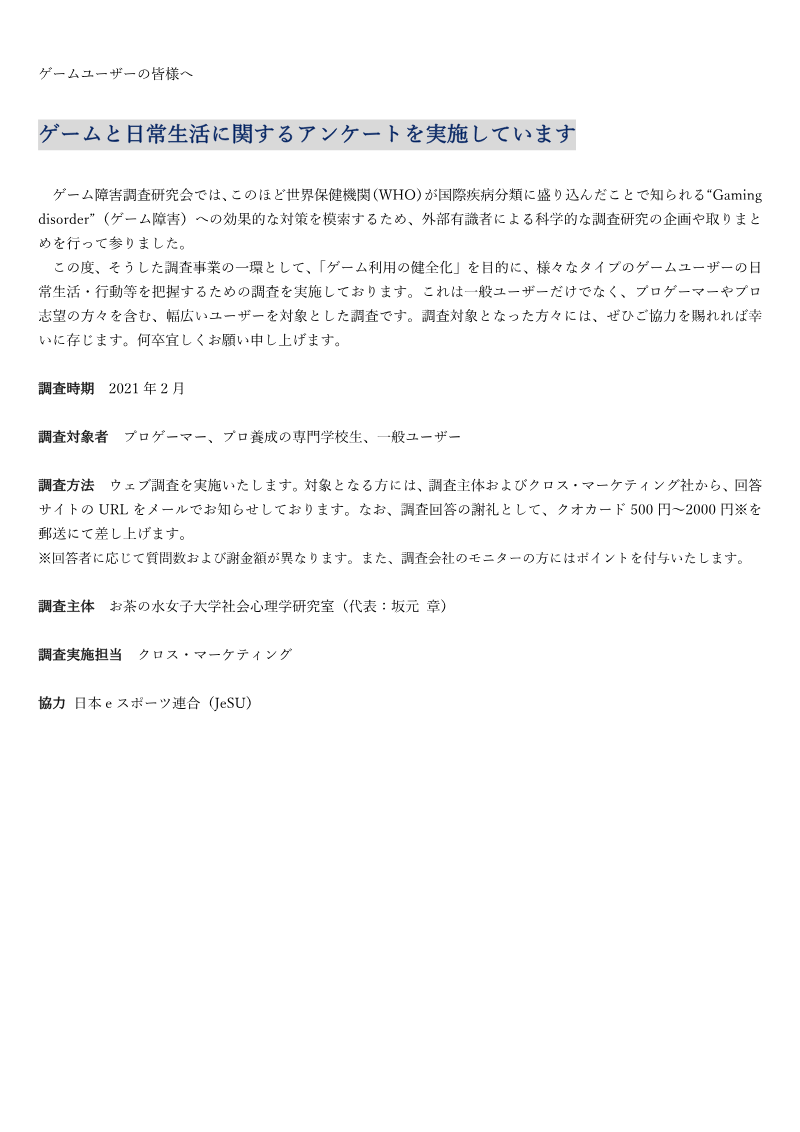
The survey was launched to deepen understanding of how gaming activities intersect with everyday life in Japan and to inform strategies for mitigating “gaming disorder,” a condition recently classified by the World Health Organization. Its overarching aim is to promote healthier gaming habits across a broad spectrum of participants, ranging from casual players to professional gamers and students enrolled in specialized esports training programs.
Fieldwork took place in February 2021 and targeted three distinct groups: active professional gamers, individuals attending dedicated esports academies, and the general gaming public. Data were collected through an online questionnaire distributed via email by the research team and Cross‑Marketing, with respondents directed to a secure response site. To encourage participation, incentives varied from ¥500 to ¥2,000 Quo‑card vouchers, supplemented by point awards for panel members of the survey firm.
The investigation was coordinated by the Social Psychology Laboratory at Ochanomizu University, under the leadership of Professor Akira Sakamoto, with operational support from Cross‑Marketing and endorsement from the Japan eSports Union (JeSU). Although specific results are not disclosed in the excerpt, the study’s design reflects a comprehensive, mixed‑audience approach intended to generate actionable insights for policy makers, health professionals, and the esports industry regarding responsible gaming practices in Japan.
- The study, conducted in February 2021, aimed to analyze the intersection of gaming and daily life to inform strategies for mitigating gaming disorder.
- Research was led by Professor Akira Sakamoto of the Social Psychology Laboratory at Ochanomizu University with endorsement from the Japan eSports Union (JeSU).
- The survey targeted three distinct demographics: active professional gamers, students in specialized esports academies, and the general gaming public.
- Data collection was facilitated through an online questionnaire managed in partnership with the research firm Cross-Marketing.
- Participation was incentivized through a combination of point awards and Quo-card vouchers ranging in value from ¥500 to ¥2,000.