Updated Mar 17, 2026 by game – Verband der deutschen Games-Branche e. V.
Report · January 1, 2021
Published by game – Verband der deutschen Games-Branche e. V.
01 Players in Germany 8 02 German market for computer 14 03 The games industry in Germany 24 .1 Employment figures and companies .4 The ten demands of the games industry 04 gamescom 38 05 About game – the German 42 .1 Diversity initiative Hier spielt Vielfalt .2 Environmental and climate protection in the .3 Foundation for Digital Games Culture .5 Entertainment Software Self-Regulation Body 06 D...
01 Players in Germany 8 02 German market for computer 14 and video games 03 The games industry in Germany 24 .1 Employment figures and companies .2 Games from Germany .3 Games funding .4 The ten demands of the games industry 04 gamescom 38 05 About game – the German 42 Games Industry Association .1 Diversity initiative Hier spielt Vielfalt .2 Environmental and climate protection in the games industry .3 Foundation for Digital Games Culture .4 devcom .5 Entertainment Software Self-Regulation Body .6 esports player foundation 06 Development of the German 48 video games market since 1995 Publisher game – Verband der deutschen Games-Branche e. V. Friedrichstraße 165 10117 Berlin Germany Design Bureau Ole Gehling www.olegehling.de
Last year was an extremely challenging one for all of us – and the games industry was no exception. The Covid-19 pandemic left its mark on many aspects of life in 2020. The highly complex process of game development had to be transitioned to a work-from-home environment, and esports tournaments that previously filled entire stadiums were held without the presence of spectators. The international games industry’s most important events either took place entirely online – like gamescom or the GDC – or had to be cancelled. On the whole, however, the games market was not affected as badly as most other industries. Quite the opposite: within a year, the revenue generated by computer and video games and related hardware actually increased by 32 per cent in Germany – even after setting records the previous year. The more than 8.5 billion euros generated are a new high. Another hallmark of 2020, the year of the pandemic, was the fact that lockdowns and social distancing drove millions of smartphones and other devices to play games or simply to keep in touch with family and friends. It’s hardly surprising, then, that the number of players rose significantly as well. Today, more than 60 per cent of Germans play video games – yet another new record. However, games were more than just a popular form of entertainment in 2020. In this age of remote learning – which in Germany still all too often means downloading and printing out worksheets – serious games had the chance to shine. They provided valuable support to many parents throughout the pandemic.
er, games were more than just a popular form of entertainment in 2020. In this age of remote learning – which in Germany still all too often means downloading and printing out worksheets – serious games had the chance to shine. They provided valuable support to many parents throughout the pandemic. And that’s just one of many examples from last year, in particular, that highlighted the enormous potential games offer for many different areas of society and the economy. Overall, 2020 was an eventful year for the games industry in Germany. On the one hand, this period was characterised by the great interest in games and the corresponding growth in revenue, although 95 per cent of this revenue continued to be generated by games produced in other countries
German studios. On the other hand, effort to improve its competitiveness the Covid-19 pandemic also resulted in this industry. The high demand for in project delays, uncertainty and a games funding demonstrates just how search for new financing possibilities. necessary this move was. For the new The games industry nonetheless looks German federal government, which will toward the future with optimism, be elected in autumn 2021, it will be as game’s industry barometer – an important endeavour to continue compiled for the first time this past to improve the conditions for game year – indicates. Despite a great deal development in Germany in order to of unpredictability, 7 in 10 games leverage the enormous potential of companies have a positive outlook on games as a key technology in promoting the future, with nearly half of them the country as a location for the digital planning new hires. This optimism is economy. obvious in another area as well: many This annual report summarises all the new games companies were founded important developments in the games in 2020. A 50 per cent increase in the industry in Germany. I wish number of games studios underscores you enjoyable reading and the positive outlook. And there is good many interesting insights. reason for this optimism: after the rush for games funding during the Felix Falk pilot phase, the major EU-notified Managing Director of game – funding guideline was finally launched the German Games Industry in late 2020.
ading and the positive outlook. And there is good many interesting insights. reason for this optimism: after the rush for games funding during the Felix Falk pilot phase, the major EU-notified Managing Director of game – funding guideline was finally launched the German Games Industry in late 2020. Just a few months on, Association numerous games studios have received official notification that they have been granted funding – some of them in amounts exceeding one million euros. This is a first for Germany, which, later than many other locations around the
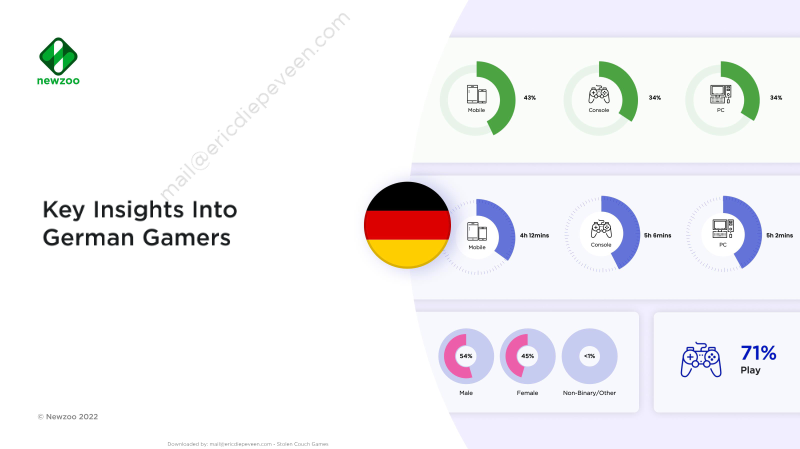
in Germany Germany is a country of video game players: more than half of Germans play computer 48 52 and video games. Overall, 58 per cent of the % % population between the ages of 6 and 69 reach for their PC, console or smartphone to dive into digital worlds. And the genders are essentially equal here: 48 per cent of players are women and 52 per cent are men. Interest in games grew again in Average age 37.5 37.4 Interest in games grew 2020, with the number of players again in 2020, with increasing by approximately the number of players 5 per cent. There are now more increasing by 5 per cent. people playing computer and video games in Germany than 36.1 36.4 ever before! This is partly a result of the contact restrictions during the 35.5 Covid-19 pandemic: particularly during the lockdown phases, games were a source of variety and entertainment for millions 35 of people. They also helped people stay in touch with family and friends and have fun together – even across great distances. The 50- to 59-year-old segment is the largest group of players, in which about 1 in 5 currently plays computer and video games. This group combined with players in the 60–69 age range make up one 2016 2017 2018 2019 2020 2021 third of all German video game players. These ‘silver gamers’ are partly responsible for the continuous increase in the average age of players in Germany over the last several years. At 37.4 years Source: calculations based on the GfK Consumer Panel
01 Players in Germany 8 02 German market for computer 14 03 The games industry in Germany 26 .1 Employment figures and companies .3 The ten demands of the games industry 04 Esports 40 05 esports player foundation 42 06 gamescom and devcom 44 07 German Computer Games Awards 48 08 Entertainment Software 50 09 Foundation for Digital Games 52 10 About game –...
01 Gamer in Deutschland 6 02 Markt für Computer- und 12 03 Games-Branche in Deutschland 22 .1 Beschäftigtenzahlen und Unternehmen .4 Die 10 Forderungen der Games-Branche 04 eSports 36 05 gamescom 40 06 Deutscher Computerspielpreis 42 07 Unterhaltungssoftware 44 08 Stiftung Digitale Spielekultur 46 09 Über den game – Verband 48 Herausgeber ...
The German games industry navigated a period of significant contraction in 2024, with total market revenue falling 6% to €9.4 billion. This downturn, driven by a decline in mobile revenue and console hardware sales, resulted in the first recorded reduction in the number of active companies and industry employees in recent years. Despite these headwinds, Germany maintains its status as the largest games market in Europe and the fifth largest globally. The domestic player base remains robust and increasingly diverse, encompassing 37.5 million individuals with an average age of 39.5 years, reflecting the deep integration of gaming into the national cultural fabric. Strategic instability during this period stemmed largely from restrictive federal funding guidelines and project application freezes, which disproportionately impacted smaller studios. However, the outlook for 2025 is increasingly positive, anchored by a new coalition agreement that pledges to increase federal funding to €125 million annually by 2026 and introduce competitive tax incentives. These policy shifts aim to bolster Germany’s international standing, which industry leaders currently view as suboptimal despite the nation’s strong infrastructure, academic training programs, and successful startup initiatives like the "Press Start" grant. To secure long-term growth, the industry is prioritizing a hybrid funding model, the establishment of a dedicated "Games University," and the expansion of digital cultural heritage projects, such as the AI-driven archiving of over 40,000 titles. Professionalization efforts continue through the *game* association, which represents over 500 members and manages critical networking platforms like gamescom. By integrating esports development, sustainability commitments, and structured career pathways, the German ecosystem is positioning itself to transition from a period of market correction toward a more resilient and internationally competitive future.
01 Gamer in Deutschland 6 02 Markt für Computer- und 12 .2 Umsätze mit virtuellen Gütern und Zusatzinhalten sowie Abonnements .3 Umsätze mit Gebühren für Online-Netzwerke 03 Games-Branche in Deutschland 22 .1 Beschäftigtenzahlen und Unternehmen .4 Die 10 Forderungen der Games-Branche 04 eSports 36 05 gamescom 40 06 Deutscher Computerspielpreis 42 07 Unterhaltungssof...