PC reports and market data
Documents
Let's Be Honest About Indie Game Development — Q&A
This analysis explores the realities of independent game development, focusing on marketing, professional discipline, and the psychological management of creative work.
- Success in a saturated market requires shifting from passive promotion to interactive community engagement, such as crowdsourcing character names or design choices to foster organic growth.
- Relying exclusively on Steam is no longer a viable distribution strategy due to the high volume of annual releases, making platforms like the Nintendo Switch more attractive for discoverability and revenue.
- Developers should decouple their personal identity from their creative output to treat public criticism as a neutral tool for professional growth rather than a personal attack.

Making Games Is Just Like Making Pizza.
The process of independent game development mirrors the complexities of culinary preparation, requiring a balance between individual creative control and the efficiency of collaborative efforts.
- Independent development requires balancing the total autonomy of solo work, which extends timelines, against the faster production cycles and diverse skill sets offered by team-based collaboration.
- Managing multiple concurrent projects, specifically 'Will You Snail', 'Ovus Nova', and an undisclosed university project, creates a high risk of burnout that necessitates a shift toward long-term viability over immediate output.
- The 'Will You Snail' project is the primary focus, utilizing a simplified core design to avoid the market appeal and design issues that hindered the secondary project, 'Ovus Nova'.

2018 Global Games Market Report: Trends, Insights, and Projections Toward 2021
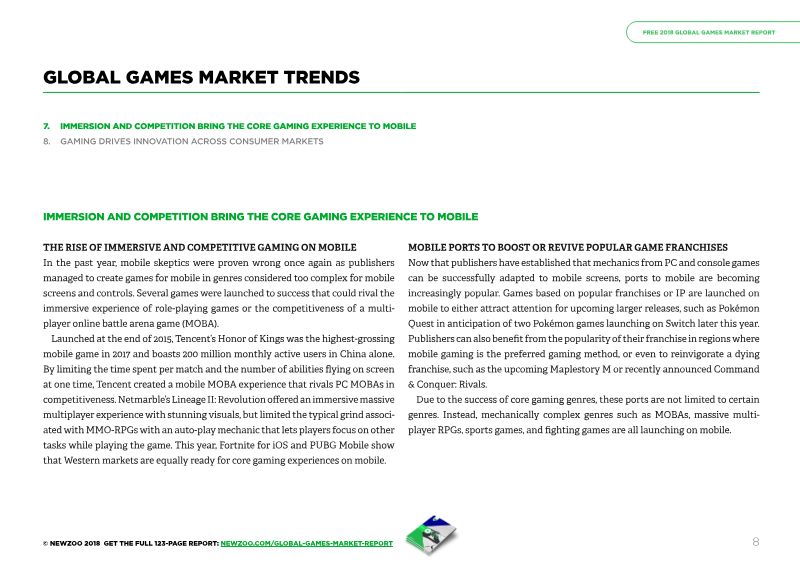
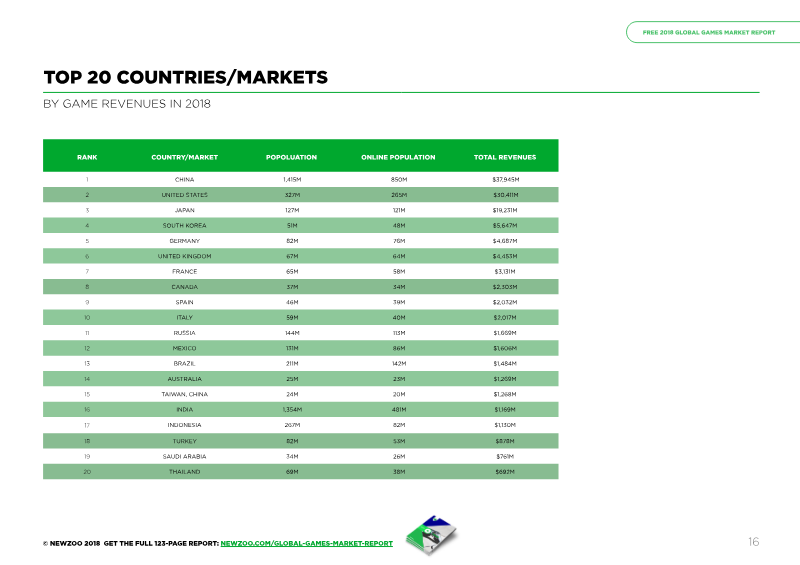
The 2018 Global Games Market Report provides a comprehensive analysis of the gaming industry’s rapid expansion, projecting total global revenues to reach $137.9 billion in 2018.
- The global games market is projected to reach $137.9 billion in 2018, driven by a strategic shift from product-based sales to long-term engagement models.
- Mobile gaming is the industry's dominant segment, generating $70.3 billion and accounting for 51% of total global revenue.
- The Asia-Pacific region remains the largest market, contributing 52% of total global gaming revenue.

Games You Might Not Have Tried - ep 14 - Mechs, Monsters and More! - Extra Credits
This analysis examines a curated selection of video games chosen for their unique design contributions, innovative mechanics, or unconventional approaches to established genres.
- Designers can successfully innovate by prioritizing specific core mechanics—such as moral decision-making in Frostpunk or time-loop puzzles in Minit—over broad market appeal.
- Games like Hunt: Showdown demonstrate that integrating high-stakes permadeath and PvE elements can create unique tension within the established battle royale genre.
- Complex, legacy-style mechanical depth remains viable in modern gaming, as evidenced by the success of the tactical combat in Tower of Time and the systems in BattleTech.
Procedurally Generating History in Caves of Qud
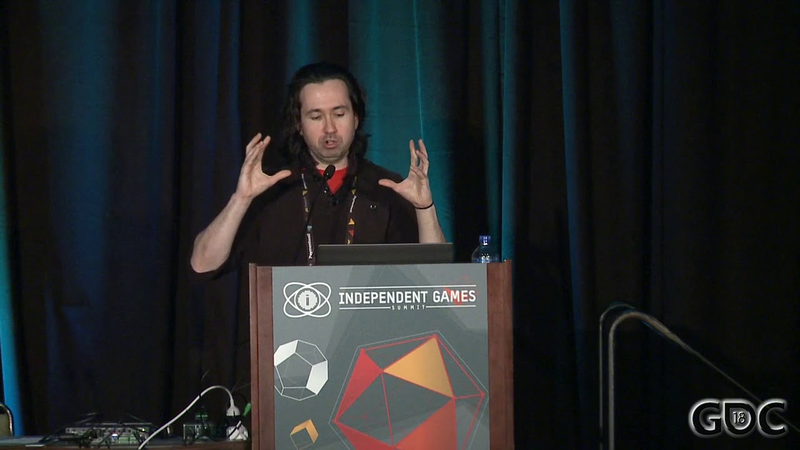
The procedural history system in Caves of Qud prioritizes the creation of evocative, mythic narratives over the implementation of a computationally expensive, bottom-up historical simulation.
- Caves of Qud prioritizes evocative, mythic narrative generation over computationally expensive, bottom-up historical simulations.
- The system focuses on the lives of five ancient Sultans, using their biographies as the foundation for world-building artifacts like shrines and paintings.
- Historical complexity is managed through a constrained set of exactly twelve specific triggers that govern life events and faction relationships.

Move or Die: Why It's Worth It to Chase Your Tail
The success of the multiplayer title Move or Die demonstrates that long-term viability in the independent games market relies on a symbiotic relationship between developers and their community.
- Success for 'Move or Die' was not driven by a single event, but by a continuous stream of updates, community engagement, and strategic marketing over a two-year period that resulted in over 500,000 players.
- Early Access was used as a financial necessity rather than a design choice, with the developer maintaining transparency by explicitly instructing players not to buy the game until it was polished.
- Strategic collaborations, such as integrating Rick and Morty characters, were timed to coincide with external events like the Steam Summer Sale to maximize visibility and press coverage.
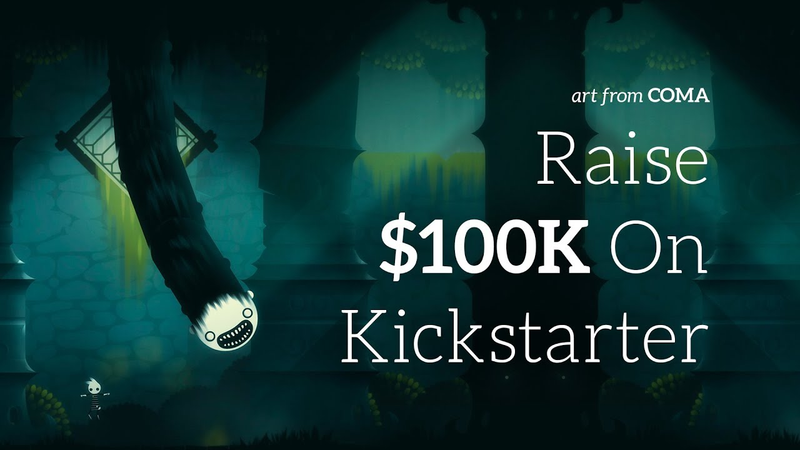
How To Raise $100,000 On Kickstarter
Achieving a six-figure crowdfunding goal for video game development requires a strategic blend of technical preparation, rigorous research, and emotional transparency.
- Successful crowdfunding relies on emotional transparency, where creators build trust by sharing personal struggles and vulnerabilities to foster a community-supported endeavor rather than a simple transaction.
- Campaigns require a two-to-three-month preparation period dedicated to rigorous research and outreach to creators of previously successful projects.
- Developers must produce a highly polished, small-scale prototype before launching to demonstrate technical competency and establish professional credibility.
A Long Dark Road: Blending Player and Authored Story in a Sandbox Survival Game
The development of The Long Dark illustrates the complex tension between authored narrative and emergent, player-driven gameplay within the sandbox survival genre.
- Hinterland Games separated 'The Long Dark' into distinct sandbox and story modes to allow for an Early Access launch without spoiling narrative content, a strategy that resulted in 250,000 players in the first three months and 500,000 within the first year.
- The long-term separation of sandbox and story modes created a dissonance in player expectations, as the sandbox community became accustomed to a non-narrative experience and resisted the shift toward a more linear, authored story.
- Development of a narrative mode in a sandbox game should ideally integrate with existing systems rather than creating a split experience, as seen in titles like 'Subnautica' and 'The Forest' which successfully blended both approaches.
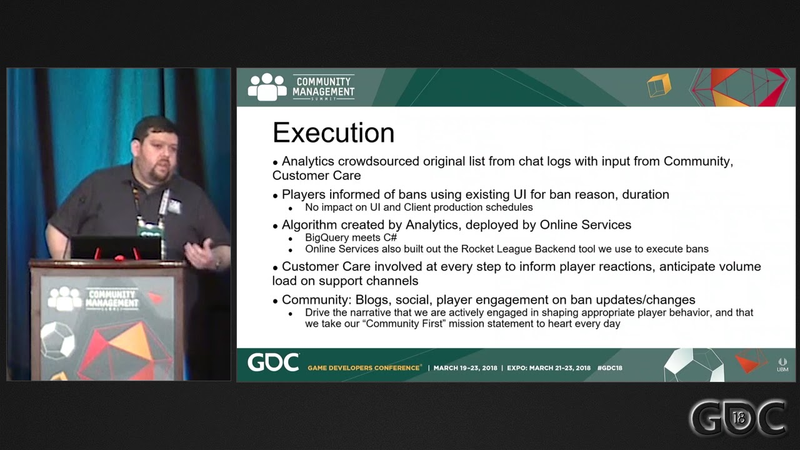
Rocket League: Language Ban System Postmortem
To combat rising toxicity within Rocket League, Psyonix implemented an automated, data-driven moderation framework designed to enforce community standards through tiered, escalating penalties.
- Psyonix implemented an automated language ban system for Rocket League that uses a data-driven 'gram' threshold, where players are escalated through a penalty ladder starting at 24 hours up to two weeks for repeated offenses.
- The system relies on active player reports rather than proactive chat scanning, allowing for context-dependent moderation that avoids penalizing friends who use informal language within private parties.
- To encourage behavior modification, the system includes a de-escalation mechanic where players who maintain good conduct for 30 days see their strike count reduced, preventing long-term accumulation of penalties for one-off incidents.
Tools-Based Rigging in Bungie's Destiny
Bungie’s approach to character rigging for the Destiny franchise centers on a modular, Python-based architecture designed to overcome the limitations of traditional, static animation pipelines.
- Bungie developed a modular rigging system for Destiny using Python and Pymel in Autodesk Maya, utilizing object-oriented programming to manage thousands of animation files efficiently.
- The rigging architecture relies on 'rig components'—independent, reusable Python classes that can be added or removed from a character's rig dynamically without breaking existing animation data.
- To maintain agility during engine development, the team implemented a 'rig template' system that assembles these modular components into complete control rigs for characters, vehicles, and props.
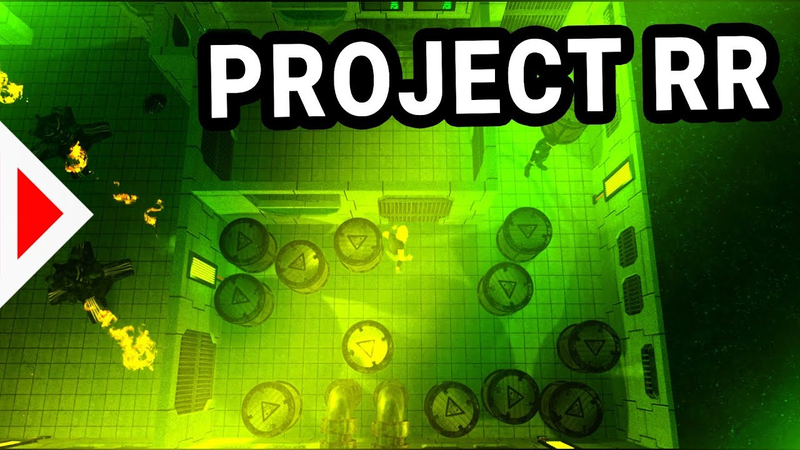
Get Feedback For Your Indie Games!... #010
The primary objective of this analysis is to evaluate the design philosophy of the indie stealth game Project RR, emphasizing the importance of establishing a clear game identity to guide development decisions.
- Developers should prioritize a cohesive game identity over conventional design rules, even if that requires incorporating elements traditionally viewed as frustrating or unfair.
- In Project RR, retaining map progress across restarts transforms the gameplay from a single-run challenge into a puzzle-solving experience based on repeated exploration.
- The developer must balance trial-and-error loops with predictable execution, ensuring that once a player masters a level, success is determined by skill rather than inconsistent AI behavior.

Global Illumination in Tom Clancy's The Division
The Snowdrop engine utilizes a sophisticated, probe-based global illumination system to facilitate dynamic lighting within the expansive, open-world environment of Tom Clancy's The Division.
- Ubisoft Massive utilized a Precomputed Radiance Transfer (PRT) system within the Snowdrop engine to achieve dynamic global illumination, allowing for a full day/night cycle without the need for static light maps or UV unwrapping.
- The system organizes light probes into 2D grid sectors of 64x64 meters, typically containing 300 to 400 probes, with a maximum capacity of 1,000 probes per sector.
- To manage memory and performance, the engine stores sky visibility per probe and uses irradiance bricks to define light influence, resulting in a total lighting data footprint of approximately 1 gigabyte.