Monetization reports and market data
Documents
🚨📢 BREAKING NEWS: GTA 6 Pre-Orders Hit $260M + Tencent & Superplay for $1.5B + PubMatic-Zynga Deal
The gaming industry is currently navigating a period defined by significant capital shifts and balance sheet pressures, with major titles and corporate acquisitions serving as bellwethers for broader market health.
- Grand Theft Auto 6 generated $260 million in global digital pre-orders during the final week of June, with projections estimating 51 million units sold and $3.3 billion to $5.2 billion in revenue by its November launch.
- Analysts warn that if GTA 6 fails to meet performance expectations, the resulting industry-wide valuation decline could negatively impact the broader mobile gaming market.
- Tencent is reportedly in talks to acquire Superplay from Playtika for $1 billion to $1.5 billion to help Playtika manage $2.3 billion in debt maturities due between 2028 and 2029.
TWIG #393: GTA 6's Impossible Attach Rate, Playtika's Earn-Out Disaster, and Unity 7's Big Swing
The gaming industry is currently grappling with a disconnect between aggressive financial projections and historical market realities, particularly regarding the highly anticipated launch of Grand Theft Auto 6.
- Analysts project that GTA 6 would require an unprecedented 60% attach rate to meet expectations of 85 million units sold within two months, a figure that significantly exceeds historical AAA benchmarks.
- The gaming market is highly consolidated, with 94% of total console and PC revenue currently generated by a small group of established franchises.
- Playtika has suspended dividends due to severe balance sheet strain caused by poorly negotiated earn-out obligations following its acquisition of Superplay.
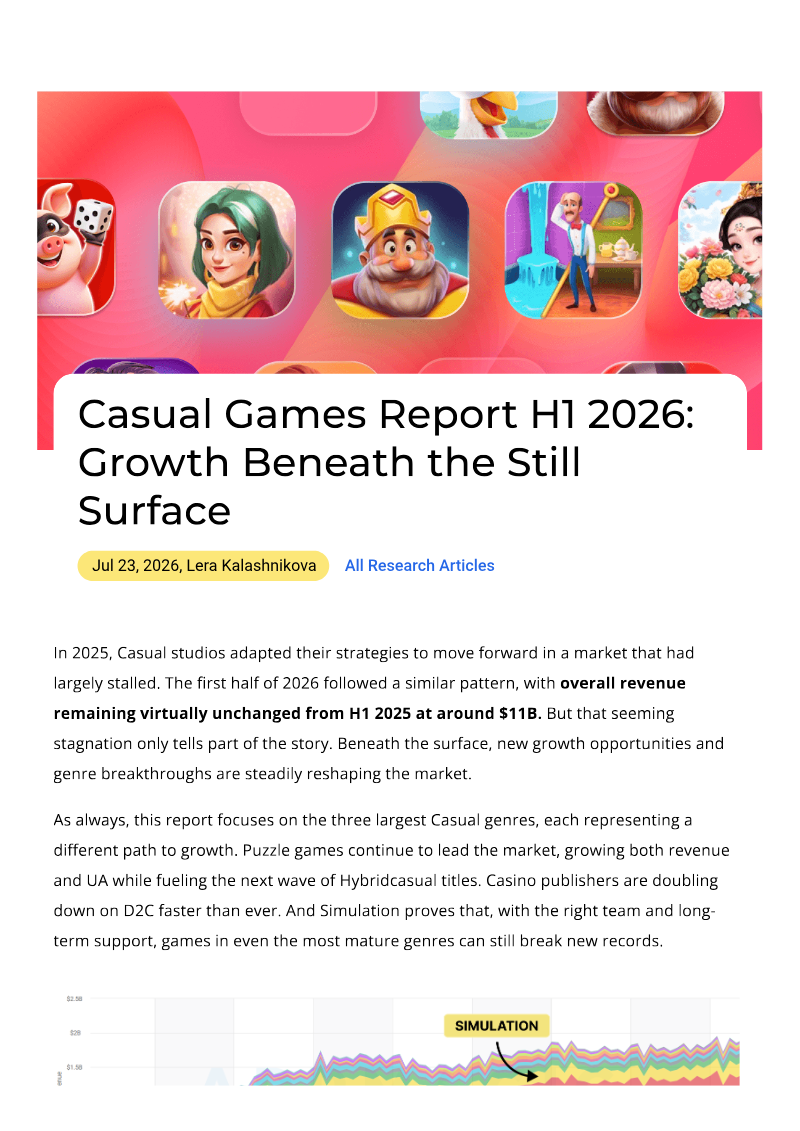
Casual Games Report H1 2026: Growth Beneath the Still Surface
The casual gaming market maintained a stable valuation of $11 billion during the first half of 2026, characterized by a strategic shift from high-volume experimentation toward the refinement of established gameplay loops.
- The casual games market remained stagnant in H1 2026 with $11B in revenue, mirroring H1 2025 performance despite significant shifts in genre-specific growth.
- Merge-2 is the fastest-growing casual genre, nearly doubling its revenue to $1.2B in H1 2026 with a 20% year-over-year increase in downloads.
- Match-3 remains the largest puzzle subgenre at $2.4B, with Dream Games' 'Royal Kingdom' reaching the #3 market spot through a strategy of scaling limited titles and integrating diverse mini-game events.
Tencent, Playtika and SuperPlay shenanigans, further Google Play changes. Monopoly Go, MTG, more
The mobile games industry is currently navigating significant shifts in corporate ownership, platform accessibility, and market performance.
- Google has dropped its requirement for a 'registered app stores' program, allowing third-party app stores like the Epic Games Store to operate directly within the Google Play Store as of late July 2024.
- Tencent is reportedly in talks to acquire Superplay, the developer of Dice Dreams and Domino Dreams, for up to $1.5 billion following the studio's significant performance growth under Playtika.
- MTG reported Q2 group revenue of $306 million with a 24% profit margin, driven by Raid: Shadow Legends, which earned $111 million, while direct-to-consumer revenue grew to 38% of total group income.

Google Play's New Era. Here's Why This is Important...
Google Play has introduced a significant restructuring of its service fee model, effective June 30, 2024, in the US, UK, and Europe, with a phased global rollout continuing through 2027.
- Effective June 30, 2024, Google Play is restructuring service fees for games earning over $1 million annually, charging 20% for new installs and 25% for existing installs.
- Developers can reduce these service fees by 5 percentage points by joining the 'Level Up' program, which requires meeting technical benchmarks like cross-screen support and high-performance rendering.
- Alternative billing methods are now formalized, allowing developers to use external links or web shops at a 20% service fee (15% with Level Up), effectively removing the standard 5% Google Play billing fee.
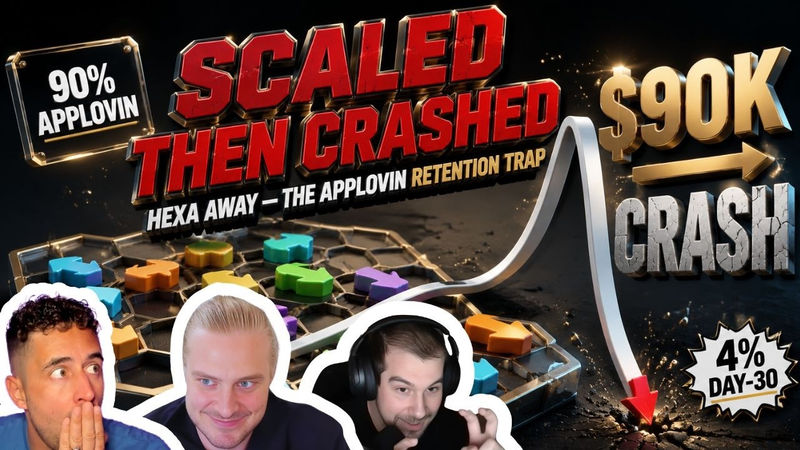
➡️HexaAway Breakdown - The 6th-Biggest sort puzzler you've NEVER heard of
Hexa Away, a hexagonal-grid sort puzzler developed by the studio behind Uma Musume, serves as a significant case study in both successful game design and the risks of aggressive user acquisition (UA).
- Hexa Away achieved a peak of $132,000 in combined daily revenue ($90k IAP, $42k ad) and 500,000 daily active users by utilizing a 3D hexagonal grid to enable more complex, monetization-friendly mechanics.
- The project's long-term viability collapsed due to a poor day-30 retention rate of only 4%, which failed to support the high-volume user acquisition strategy.
- The developer's reliance on AppLovin for 90% of traffic created a single-channel dependency that led to a sharp decline in downloads once return on ad spend (ROAS) targets became unsustainable.
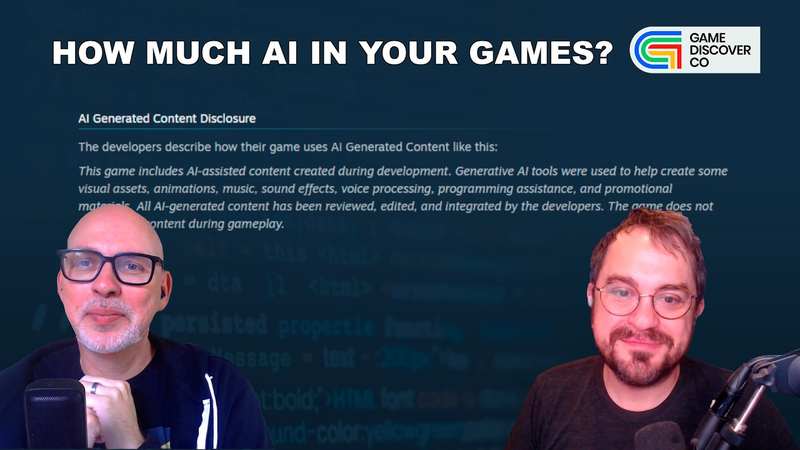
How much AI do players want in their games?
Steam’s refund policy remains a cornerstone of consumer confidence in the PC gaming market, effectively balancing developer risk with player protection despite the volatility inherent in early-access releases.
- A GameDiscoverCo survey indicates that player sentiment toward AI in games is highly divisive, with approximately 43% of respondents expressing openness to AI usage while roughly 31% hold negative views.
- Steam is actively vetting games for AI content, occasionally identifying AI-generated assets in titles where developers were unaware their subcontractors had used such tools.
- Apple Arcade has shifted its strategy to commissioning only 10 to 12 games per year, a significant reduction from its initial launch phase which featured $500 million in 100% commission-based titles.
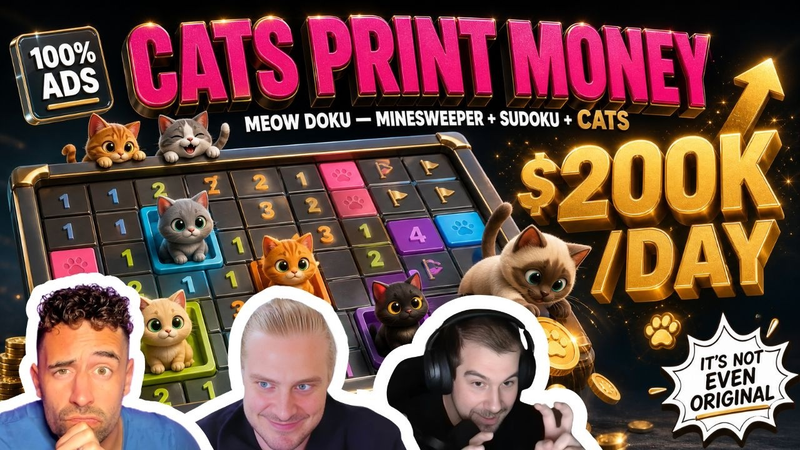
🐱 Meowdoku case study: Minesweeper + Cats + Sudoku. Take a 40-Year-Old Game, Add Cats, Make Millions
Meowdoku serves as a prime example of how established puzzle mechanics can be revitalized through thematic reskinning and aggressive user acquisition strategies.
- Meowdoku generates between $130,000 and $200,000 in daily revenue through a 100% ad-monetization model featuring interstitial ads, rewarded videos, and adaptive cooldowns.
- The game achieves significant scale with 400,000 daily downloads and 2 million daily active users.
- Publisher Beijing Lexing Shen utilizes a high-volume strategy across its portfolio, resulting in over 1 billion cumulative downloads and 70 million monthly active users.
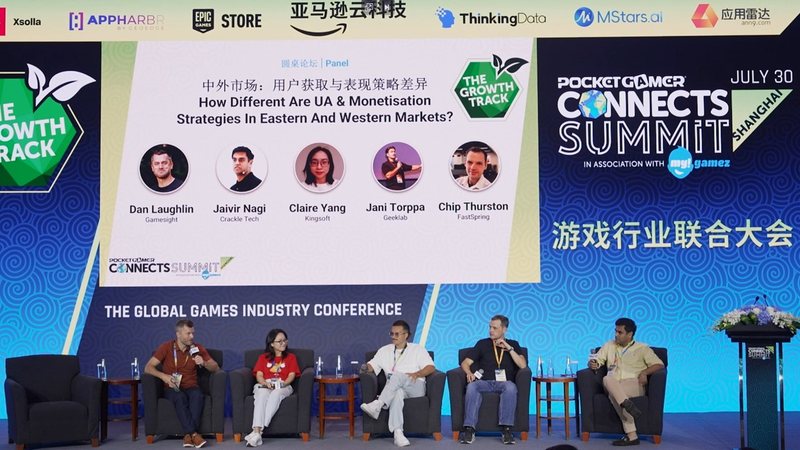
How Different Are UA & Monetisation Strategies In Eastern And Western Markets?
User acquisition and monetization strategies diverge significantly between Eastern and Western markets, driven by distinct platform ecosystems and consumer behaviors.
- The mobile gaming industry is currently dominated by legacy titles, with new game launches struggling to break into the top 10 charts on the App Store and Google Play due to high development costs and market saturation.
- Western user acquisition is heavily concentrated on Meta, Google, and TikTok, creating a 'single basket' risk where publishers struggle to scale or attribute performance due to IDFA and privacy-related data limitations.
- Direct-to-consumer (DTC) web stores are becoming a critical strategy for publishers to increase profitability by bypassing platform fees, despite ongoing legal uncertainty surrounding Apple and Epic Games' court battles.
🚨📢 BREAKING NEWS: Pokémon Go Made MORE Money by Going Free + Xbox Cuts 3,200 + AppLovin Opens Axon
The mobile gaming and technology sectors are currently undergoing a significant shift in monetization, operational efficiency, and trust management.
- Pokémon Go achieved its highest daily revenue in five years, reaching $15.1 million on July 11, after removing ticket paywalls for its 2026 GoFest event.
- Microsoft is restructuring its gaming division with plans to cut approximately 3,200 jobs, representing 20% of the division's workforce, due to profit margins falling below corporate requirements.
- AppLovin’s stock value surged following the decision to open its Axon targeting engine to global self-serve advertisers, though analysts have raised concerns regarding long-term ad ecosystem quality.
TWIG #392: Pokémon’s Gamble, World Cup WHAT & the Monetization Debate
The gaming industry is increasingly relying on nostalgia-driven content to combat the diminishing returns of new releases.
- Developers are increasingly prioritizing nostalgia-driven content, such as League of Legends Classic and Fortnite OG, as a more reliable growth engine than the volatile cycle of new product launches.
- Aggressive or opaque monetization strategies, exemplified by the backlash against EA’s paid progression in College Football 2027, pose significant PR risks that threaten long-term player trust and sustainability.
- The gaming industry has completed an irreversible transition to a digital-first ecosystem, where physical media is largely obsolete and digital distribution is the standard for platform economics.
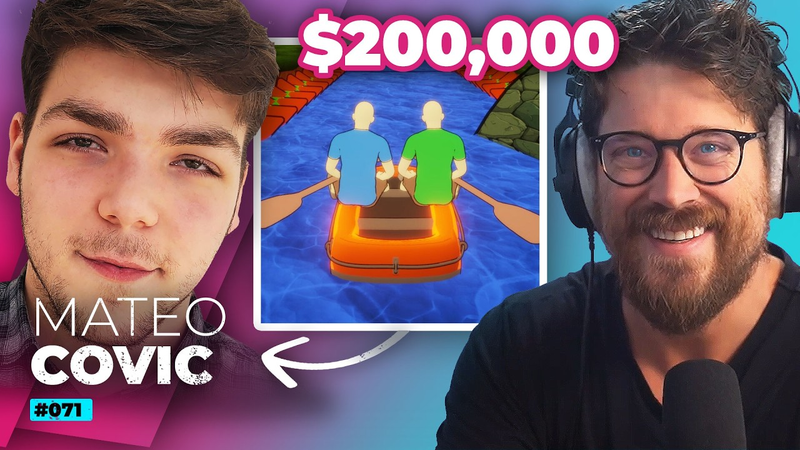
His Dream Game Flopped... And Then Made $200,000+ In 2 Months (w/ Mateo Covic) — Ep 71
The modern indie game landscape increasingly rewards a bifurcated development strategy that balances high-fidelity, ambitious projects with rapid, viral-focused titles.
- Mateo Covic's 'friend slop' game, Paddle Paddle Paddle, generated over $200,000 in revenue within two months, significantly outperforming his previous niche projects.
- Multiplayer 'friend slop' games currently trend well on Steam because they offer casual, accessible fun that appeals to streamers and their audiences, unlike more complex or niche titles.
- Effective marketing for Paddle Paddle Paddle relied on a publisher-led strategy that included professional cover art, targeted influencer outreach, and building a community around a demo prior to launch.