Transcript
Hello and welcome to the Game Discover Co. Show. I am your co-host Chris Plant and I'm joined as always by the brilliant, the inspired, the refreshed Simon Carlos. How are you doing today, Simon?
Howdy. That's that's an intro. Yeah, I'm I'm doing good. Yeah, I got back from holiday. You got back from being a little unwell, so we can continue with with with the podcast. Now,
this is fantastic. Yes, it turns out that laryngitis is um the Achilles heel playing into the hype of the Odyssey right now for a podcaster. But I won't bore people with my medical issues. I want to just dive right into the top of it, which is we always have a few topics before the big main story of the week. And the first one of those is starting out on Steam. Steam's 2hour refund policy. It got called out again. It seems like it gets called out, I don't know, every few months. This time it was
by the dev of Paddle Paddle Paddle who claims to that they have a 21% refund rate and that is majorly boosted by players completing then refunding the game again. familiar with this gripe. Is there something that's different about it this time or are we just kind of going to be in this loop forever?
I think really what happens and I've covered in the game Discover Coletter some of these some of these examples before. Um, and the one I covered maybe two or three years ago was somebody made a horror game, a short horror game who was definitely complaining and definitely had a very high refund rate. But when we looked into it, we discovered the game ended abruptly with like a splash screen like 70 minutes in and not really in a kind of like you were expecting it to end point of view. So for that particular game,
I I think you know there was a reason why why it was quite quite high refund
rate for this game. Uh which is a kind of a fun uh you know a fun kind of kind of co-opy kind of game. Uh, I think you know in the end these sort of slightly sloppy early access games are always going to have a reasonably high refund rate. Like a lot of early access games have a refund rate over 10%. So I think it's understandable that the dev is getting a little bit upset because he sees reviews which are like, "Oh, I finished it then I refunded it. Haha." But I think in general it's agreed that the the refund the easier refund on Steam is net positive because I think and this guy Indie Game Joe wrote a pretty long editorial about it but I think the idea is it makes feel it makes people feel more relaxed to buy things and I think the concept of abuse I was suggesting anecdotally there probably is some abuse here but I'm thinking it's going to be 3 or 4% is sort of my complete guesstimate. I think it this game would have had up to a 15 plus%
refund rate anyway just because it's pretty simple.
Yeah. H Have you heard any possible solutions? Because there is the reality of some games are 30 minutes, right? That that developers have reasons to make very short games and they might have anxiety about this. Has any theory been put through for how the refund policy could be adapted for very short games or is it kind of one of those in trying to fix it, you create a bigger problem for yourself? Yeah, I think I I think one thing is people people refund when they don't enjoy an experience sometimes. And um you know I think I again I did I looked at this and I spoke to some people who'd made short games and in many cases their refund rate was lower than normal because people were like I really enjoyed that. I got my money's worth. That's fine. So, I I think it's really an issue if you have a
game that people are not happy about after 45 minutes or an hour. And arguably that's the reason that the refund um the refund policy exists anyway because it isn't what you expected. So, I think, you know, I I I I think it's fine. Um I you know, I think there's obviously some negatives to allowing obviously consoles do not allow refunds nearly so easily. There's definitely some negatives about making it so easy to click and get a refund, but I would say Steam does have some monitoring for this and they will start warning you and eventually denying refunds if you're just doing this all the time. They have some limits for this.
I I want to talk about this story uh from mobile gamer.biz, which they did some analysis of the top Apple Arcade games of all time. It's based off of Game Discover Co.'s review number charts. And it's very interesting because at the top is Sneaky Sasquatch, which seems to not represent basically the rest of the chart. The chart on by
contrast is very IPheavy. It's very sports license heavy. We're going to talk about that, but first, why is Sneaky Sasquatch at the top of this chart that seems to say a game like Sneaky Sasquatch should not be at the top of that chart?
Yeah, it's interesting. I I guess I'm sort of in the it it makes some sense to me. I mean, one reason is it's been around for such a long time, and this is cumulative reviews. So, so this is obviously had a long time to get reviews. And also, we noted some games incent uh reviews and some don't. So, I know Sneaky Sasquatch does ask you to put a review at some point, but I think most of the games in the top 10 do that at this point, but it has, you know, 254,000 US reviews. This is compared to Hello Kitty Island Adventure is second with 156,000. Uh, and then and then Solitaire by Mobility, 149,000. NBA 2K 23 Arcade Edition, 106,000. The Oregon Trail
93,000 is sort of the uh the top five that that that we see and and we're just sort of manually pulling us US US reviews here. But I I think Sneaky Sascot if people I feel like some people who don't have Apple don't even quite know Sneaky Sneaky Sasquatch, which is interesting. And it's really um you know sort of an openw world uh cartoony art sort of top down kind of game where you're a Sasquatch and you have to explore and steal stuff from picnickers but they've expanded it a lot over the time. So now you can like drive a car and you can go to different locations and there's all kinds of fun mini games and so it's very it's kind of open world. You can mess around shenanigans but it's actually got a fair amount of depth to it. So for me,
yeah,
it makes some sense based on where Apple Arcade's um user base is now.
Yeah, I mean the mobile gamer.biz piece describes that user base uh or at least the target is kids who need an ad and
inapp purchase free option, right? I guess the target base is the kids of the parents who want that that option and that and that's certainly true in my experience. It's very nice to have not just the games that I can trust for my son, but also the ability for him to feel independent and selecting those games from a store experience. I wish it wasn't literally embedded in the main store at times, but but it certainly accomplishes that and all the games that you mentioned fit into that, right? Like the sports games, Oregon Trail. I for us it's the like what the golf, what the car, those sorts of games. Yeah, I mean
Yeah,
sorry. I was just going to say that um you know I think uh it is very kids. Uh it is also I just think family in general. It's casual play casual players I would say. Do do you think that they have Apple in general in terms of like what they are curating
cracked the nut a little bit in terms of what a game subscription service looks like who they want to partner with because you know on the other end of this we can look at Netflix right which I think we are on round eight or nine of their ideas of what games could be for that platform and it seems like Apple Arcade might be sitting into something. Yeah, I think what really happened is when it started there was a belief, a possible belief that Apple Arcade could be a big standalone service and really what's happened is it's got merged into their Apple one subscription. So, so nobody, my understanding is nobody really buys Apple Arcade as Apple Arcade. They they they buy the subscription bundle and they get Apple Arcade. So I think if you think of it in that context, it it is people who want you know additional space or they want music or they want uh you know whatever they want to get the bundle and they get it as part of it. So I think that's
really changed the nature of the service. When they thought it was going to be standalone, I feel like they were very much like we need to make lots of really standout titles, but now they understand it's sort of a compliment. It really changes it really changes the makeup of the script. And something they did which I think was smart which they probably should have done from the start is you know start moving more stuff across from the app store. So in in Apple Arcade you have these sort of plus apps and it's just the same app as in the main app store but without ads or with IOP unlocked or whatever and you know and and and those end up doing pretty well nowadays. So they're probably like twothirds of the content that they're putting up on on Apple Arcade. I think I think what they've done is like I'm sure it's far less exciting for those people who run Apple Arcade now because there's not really a blank canvas here, but I think they've dialed it to what is correct for the you know I'm sure tens of millions of people have access to Apple Arcade. I don't know if all of them actually actually use it. Uh but um you know for those tens of millions of people or even more
uh you know I think it's the right set of games and it is Jet. It's just very familyfriendly
for studios who uh you know might be partnering with them in the future. Do we have any understanding of how it's doing broadly? Because right now Game Pass, a lot of question marks around it, a lot of anxiety around partnering with it. Um and I'm sure that will be figured out in time. But where is Apple Arcade at in in terms of those things? I mean, my understanding is that Apple really only commissions uh like originally 10 to 12 games a year nowadays. So, it's way less than it used to be. And if you look at the beginning of Apple Arcade, there was like $500 million of 100% commission games. So, really, I think they're spending
and I think they will underwrite development a lot of the time. So really they're just they're just paying almost like work for hire for um you know for for these 10 to 12 games to get out and they'll want to make sure it's got the right IP or you know it's a particular thing they're interested in and then
after that they do give you latitude to put the game out on other platforms and you get the money from that. But I think yeah it's it's much closer to sort of like work for hire in a genre that Apple really wants to work in or they see see something with you. I think the opportunity early on was there was a couple of hundred people who sort of got these deals for quite obstruuse indie games. And what we discovered is it didn't really fit that well with with well it it fit okay, but I think people who are subscribing are also interested in recurring revenue. And there's obviously the point that I believe you get paid out on Apple Arcade based on how much people play your game if you're not a working player. And so there is some advantage now to having recurring gameplay. So yeah.
Yeah. I I want to talk about one more story and then we'll get into the main one. And this one is the more we get into the numbers, the more I need your uh guidance through the dark cave in which I have lost myself. But it's nice when we get transparent finan financials around a game's release. Um face punch
launched back in Steam uh back in April. strong launch has has simmered, I would say, and that might be an understatement. Can you tell people a little bit about this game and and what these numbers mean? How you go from again grossing 4.2 million uh since early access, but then dropping down to it looks around like 57K so far in July.
Yeah. So, we're talking about the game Sandbox here. And Sandbox is um a game that was made by the folks who make Rust and Gary's Mod. And they're sort of, you know, Rust has done tremendously well, like hundreds of millions of dollars. And this is really their spiritual sequel to Gary's Mod. And Gary's Mod is a very sandboxy you can make anything in uh in platform kind of make a bunch of weird stuff uh kind of early Steam app.
Yeah. Um, so but but what they decided to do was much more of a, you know, it's quite fully featured really. You can
make your own games in it. And they launched it at $20. And what seems to have happened, I wrote a LinkedIn post about this, is it started out, you know, doing decently certainly, you know, $4 million and it's uh $4 million in in early access is fine. Um, and most of that obviously is the um $20 initial initial fee, although I think there's stuff you can buy in there as well. Uh, but it's really slowed down a bit. And the problem seems to be uh some of the hardcore fan base were really looking for more of a Garry's mods thing which is way more sandboxy. You don't make Hulk games in it. And then the issue which is interesting is the kind of games you make tend to be a little bit kind of random and sloppy because that's sort of how it's easy to make UGC nowadays. And it turns out the people who bought the game for 20 bucks, a lot of them to make the game don't really want to play those games. So it's a real chicken and egg situation I think. Do you think this area is just getting crowded? I mean, it seems like there's just so again, even for me as somebody who pays
relatively close attention, Sandbox was not on my radar, like really much at all. And there it seems just like a a a crowded field uh to be getting back into, I guess, for for the team. Anna now.
Yeah. I mean, I think it was a passion po like most of the stuff that Face Punch does is um more of a passion project. Like a lot of the time they just sort of want to do it and I think they felt like after making Gary's mod they wanted to make something new and interesting. And it is also interesting by the way it uses the Source the Source 2 engine. Valve's game engine. It's like the only game the only non-Valve game released in the last like few years that uses Source 2. So super interesting because because they've had a real uh strong and long relationship with Valve. Uh, but yeah, I think I I think it really is a
um, you know, if if it is $20 to get in and then the kind of games you play are much more kind of like Robloxy sort of
freetoplay sort of fun short things, which they have been so far, then that's a that's a business model mismatch. So arguably you should make it free, but you know, even if you make it free, you you are competing with other platforms that have a ton of users already. So I think they have a discovery a platform discovery problem there beyond the people who wanted to make games in it. That's that's the mismatch and it is it is quite busy to find those millions of new players I think.
Yeah. Well I guess also a mismatch in terms of competition scale right like if you're going up against a Roblox which has infinite money it feels at times you know that that's just competing up on in terms of what you can offer to the player seems very challenging. Uh
yeah, and Roblox is 80 80 or 90% mobile as well, which is where they get a lot of their scale. And this is obviously a PC only thing. So I think it's cool. Like the tech, like the tech is really nice and and the stuff you can make is and stuff people stuff people have made in it is really interesting. It actually reminds me a little bit, it's not quite
so clever technically, but of of of Dreams, which was Media Molecules, uh, you know, game creation engine. And they definitely had the same issue, which is they had a lot of people making really interesting stuff in it, but they had a lot of trouble just building the audience to consume it. And I think I think I think Sandbox has that problem as well.
Yeah, Dreams is sadly not what you want to ever be compared to, which is a brilliant, extremely clever. Unfortunately, some might say too clever for most people. Um, yeah. I I want to talk about the uh the main story of the week and you are going to guide us through this one too. Um, which is what Steam fans think of AI in games. You have some of the first real supporting evidence of of where public and opinion is on this. Do you want to catch us up on it?
Yeah. So, we did a survey um yeah a few maybe three or four weeks ago and we published it a few days ago and it was
really we we do these things where we survey the Steam audience and we do say Steam fan because these people are responding to giveaways so that you know they spot a giveaway of a Steam key or something else and they're like, "Oh, well, I'll I'll give you some information about myself in exchange for getting that." So, we're aware this is going to bias people a little bit because they're the people who are paying attention on the internet. And I think we mentioned before like they have quite a high, for example, Steam Deck attach rate. I think their Steam Deck attach rate is like 15%. So, that's obviously and I think probably Steam Deck as a whole has like a couple of percent attach rate. So, so these are more more committed people, but they do pay attention and I think that's why it's interesting. So we asked them um you know we obviously know people have different views of AI and we asked them just generally for example we asked them uh how much uh you have an issue with a game that shows any kind of AI disclosure on Steam and and we discovered that you know 43% of players have no real issue at all. About 26% are
neutral. They don't really care that much either way. And about 31% view it negatively. And 8% of those 31 said that they just won't buy games that have any AI disclosure.
Yeah. I I'm going to tell you how this hits me and you can let me know if I'm like off base. This seems like a lot of people to me. If I were making a thing, let's say just 8%. If I knew that I was going to lose 8% of my potential customer base on any decision, I would have tremendous anxiety. 8% is nothing. 31% negative uh is nearing a third. And I could be wrong, but it seems like the pendulum is swinging further in AI anxiety as economic trouble happens, as the RAM shortages affect what we can buy. It doesn't seem like this is a number that is like at least in the
short term going to get smaller. Am I off base? I is this a thing that should be concerning developers who are using these tools and putting and specifically putting this into their Steam page? What what's super interesting is that a lot of the mainstream pickup of my story of our of our research uh was someone did a headline about 43% of people being okay with it and then everyone turns up and it's like what is this? No one can be okay with it and they started like quibbling and they were like oh that's not enough people like who are these people they surveyed. So it's so divisive that you could pick either end of that and make and make an argument for it being uh being an issue. I think, you know, it's it's very clear it's divisive. I think, you know, the the 8% saying they absolutely won't is a fairly small percentage, but that percentage that's negative, you know, the 31% or so. Yeah, I I think I think I would be nervous about that. And I think it does depend a lot on what type of disclosure
it is. And and we did ask some questions about that as well because we were interested because there's many types of Steam disclosure. So, we asked people um on the AI disclosure, do people even look at it? And we discovered that 44% of people say they look at it properly, 45% say they glance at it, and 11% don't even bother. It might be the same people who aren't even buying, I guess. So, so there is this issue where you have to like grock what the problem is. But in addition to that,
there's a lot of discussion over AI helpers. And if you ask uh for code specifically, and if you ask people who are making games right now, I'd say the majority of people making games are using AI code helpers in some way. and Steam has sort of said implicitly that that you probably don't have to disclose that although I've seen some mixed messages from their support about that recently and so we asked that question as well and we and we discovered that um you know I think uh 56% of people who we asked explicitly about this said that that should be disclosed uh and only 8%
said that it shouldn't with 37% in neutral so I think the public right now really wants you to disclose absolutely everything but at that point it'll turn even more people off buying your game, I guess.
Yeah. It's also tricky then where I wonder like how useful the box even becomes. If you have if any part of your code is touched by anybody using it, I think we would see so many games that it would become a thing that you would skim. Um because basically every not every I I I can already hear like there are many indie developers who are are being very very outspoken and I think rightly so that they are not using any uh AI support in their coding. But I agree I hear the same thing from so many developers that I speak with of this is part of how we code games. This has long been part of how we do it. And yeah, I I
don't know. I I do wonder if that would actually cause the opposite effect that it would become so prevalent that it would kind of lose its meaning.
And you also on the other side of things, you have folks like Tim Sweeney complaining at Valve because they're making, you know, Valve does not have to do the AI disclosure box, I guess. And and so there was an interesting question. Is the AI disclosure box in itself just making people feel negatively about video games? does not PlayStation and Xbox do not have an an AI disclosure box. So, that's an interesting an interesting question as well.
The the the sweeniness of it all though is is very funny to me because he stands to benefit a lot from uh throwing uh espersions at another company that's trying to run a marketplace. I think also I have to assume he doesn't want to feel the pressure to add it to their own marketplace, right? Like that. I think I think there is a growing anxiety of oh is this the norm and I don't want to
have to do that especially when Epic themselves will be using AI not just on the marketplace but in their engine. Um so I I I think that there's some obvious reasons why he has strong feelings about it to say the least.
I I will also say I think one reason Steam doesn't want to do the code side of things is it's effectively impossible for them to enforce. they'd have to ask for source code from everybody. Whereas we did get a followup from somebody uh about Steam actually looking into this because Steam does vet this stuff and someone said, you know, I I was publishing a game, I submitted it to Steam. They came back and said that some of your art is AI. They didn't know that. They went back to their graphics artist who discovered that a background artist they'd subcontracted had been using AI to make the backgrounds. And and so this was a case where the publisher was unaware of it and Steam actually brought it to their attention. And so that does show I think you know you can argue I think I'd argue that's probably a positive because uh it is it is good to know what's going on and it's
kind of crazy that in that case in that case the uh the publisher didn't know but you know I think I think some degree of checking makes sense but we do have you know some significant skepticism at this point you are disincentivized from saying your game has AI assets in it. there's been quite a number of late uh late additions after after it was pointed out that they didn't have an AI disclosure and we and we actually asked people like like players do you think people are disclosing and um you know I think only 17% of the respondents believe game devs are fully disclosing all the audio visual AI use games like so there's definitely a belief that now you're disincentivized to do it people you know people will just not do it
yeah and we're getting those signals from all over the place, right? Netflix just this past week said, "Oh, actually, we used generative AI in all of these movies." And this this, "Oh, we were going to find out after the the fact." And it has this kind of paternalistic like, "See, actually, you liked it." And
uh I don't I don't know how well that's going to work for people in the long term. Before we before we bounce off this and and get towards the end, do you have a sense of where the mood is heading on on all of this? I think it's pretty coalesed at this point and I think what we tend to see online is a lot of people who are on extreme ends of the spectrum and I think the survey we did I do think is quite realistic of where most people who are paying a lot of attention are at which is to say
you know the the real negative folks are under 10% the real positive folks are under 10% but you sort of get an equal splitish in the middle so I I think there are just going to be people who are who they're not going to be a fan of it. But if the game looks good enough, uh, and and they look at the disclosure, which 45% of people do, and they're kind of like, "Oh, well, it was only, I don't know, it was only these main menu icons that used AI. I'm I that's not going to stop me buying it." Or they say, "Oh, well, all the character models are made
with the with AI. That makes me uncomfortable. I'm not going to buy it." So, I think that's really I think we're the sort of the people who care will'll look at the disclosure and they'll make a decision at that point. And so I think uh you know I think that's probably probably healthy. I think it's probably good. I think ultimately I agree with what Steam's done here. I think
Yeah. Yeah. Same. I guess I guess the anxiety that I would have this is real. I don't make video games. I'm not a CEO. But the anxiety that I would have making something with AI right now is how much money am I saving? And if I know that I I have the potential to lose 10% of whatever I could have made, let's say that the numbers that's not actually how numbers work out, but let's just picture that. And that that number could probably will grow especially around games because I I do think that there will be more anxiety with the RAM shortages. I think when it becomes more
and more exposed to the people who are playing games and they will be very much feeling it that number inflates and I don't know if I if I just look out two years ahead and where I want to place my bets I would have a lot of anxiety that said maybe developers feel like they are saving significantly more than than all of that and it's not an issue for them at least on the financials. I think in the end you're not going to see that many really big really big games using AI to massively generate like backgrounds or or stories and things. I think what's really happening is on the very low end there's a lot of people using AI to fill in the gaps. So I actually think for those people it's less of an issue. I think if you start to see 10, 20, 30 million games using AI extensively, that's where it's going to get really controversial and there'll be some really bad vibes for that because people will be like, "Look at all the layoffs." And now that now they're making this $20 million game for like $10 million less because, and the answer tends to be unfortunately um they're
making the game for less because they're doing a better job of sourcing it to parts of the world with lower cost of living. That's really what's happening. But I think if AI ever ends up t taking over for that change, then we're definitely going to see some real fireworks. And that hasn't happened yet.
Yes, we'll have to talk about um the outsourcing uh another episode because I think that is definitely a piece of this conversation. But in more I would say happy news, I want to head towards the wrap-up and talk about last week, this week in games. What is going on? what is what is blowing up right now?
Yeah. So, uh we always write these up if you're a plus or pro subscriber. We write up the week in uh in the Friday. So, last last Friday was the week that just finished and it was kind of like a reasonably busy week. You know, our view of uh new games coming out is if something gets over a thousand concurrent users, then it's probably going to sell maybe 20,000 copies in week one and then it's probably going to
sell like 50,000 copies in year one, let's say. and um or maybe 50 to 70,000, you know, and that's that's that's pretty good. So, we had like I don't know 15 plus games that were doing that and and and the top ones last week, one that's interesting that was not on my radar is a game called Spirit Veil. And Spirit Veil is a Ragnarok Online inspired uh light MMO. And I find this interesting because I'm not of the I'm not of the vintage that I was uh you know a pre-teen or a teen when Ragnarok Online came out, but quite a lot of Western folks were and that was sort of one of their first MMOs and so that's about 20 years old. And now these people are like in their late 20s or early 30s and they're actually really into this uh game Spirit Veil and it's up at uh well it's got to 20,000 CCU and it's like a $15 game and it doesn't have microtransactions. I think it's just a, you know, you play it and uh it it's a it's yeah, it's a nice kind of light social sort of anime adjacent MMO made
by like a solo depth. So, that's a really interesting uh top title for the last week.
Yeah.
The the game that I'm I'm curious to keep my eye on for a while is Da Attack.
Yes.
Which Yes. which is a kind of Sonic 3D era meets Tony Hawk Pro Skater game. But what I find really fascinating about this game is it has this kind of memey internet friendly squirrel with a gun sort of pitch, which is you are a train in Japan who also does kick flips. But has been getting really, really, really positive reviews. Um, and it seems to be doing both. Both the like, hey, this travels well on social media and it actually is a pretty solid game. How much do those reviews help the like long-term health of a game like that?
Well, it's interesting because this game actually is a classic example of a game that that appears very well in our filter bubble, but we're sort of in a filter bubble. I I specifically called it out in last Friday's news because I knew people would be interested. It's actually right now only number 14 for alltime high CCU of games launched last week on Steam,
which is super interesting. It's It's doing good though, and I looked at it recently. It's also got console versions that are doing reasonably well as well. So, this game it's going to sell, I'm guessing, uh, you know, a couple hundred thousand copies over time, maybe even more than that. And that's just fine. Uh, but I do think it's interesting that it it did have a lot of profile, but I'm just looking at some of the games that did better. There's this game there's this game Pathogenic which is a $10 game uh and that's doing really well. It's like a it's like it's like a bullet hell game set inside a body.
Um
it's exceptional.
Yeah. And and also a great example kind of in contrast of um has some very peculiar full motion video and a really
um grimy and a in the best way art style but uh has really kind of found its audience.
Yeah. And that's a 5800 CCU. I think it's doing really well in China. There's also like a factory game or factory squad that is doing co-op kind of first person factory game that is doing really well. Uh there's also the mound Omen of Cthulhu which hasn't done quite as well as I expected but it's got like 5500 ccu that's like a that's like a co-op kind of horror kind of kind of cthuluy kind of thing. Uh and also the incident at galley house is doing quite well which is which is converted by the root trees are dead folks but it's actually based on a game not made by them and it's a one of those kind of like um almost like cozy narrative kind of retro 2000s kind of kind of thing. So, so yeah, I think it's it was a really good week last week. There was actually very busy there was other than Spirit Veil, nothing got over 10K CCU uh max so far, but there's a lot of games that are going to sell 100,000 copies, 200,000 copies, and for
their for their publisher or for their developer, if they're small, then that's going to be pretty pleasant, right?
Yeah. What do we have coming up this week?
So, this week is Okay, so the top game this week is Dino Blade. Are you aware of Dino Blade? I don't think I know Dino Blade.
So, so Dino Blade is a game where you're a velociraptor with a giant scimitar. That's like the pitch.
Squirrel with a gun. We're back.
Yeah, we were back again. And I don't know how I don't know how good the game is, but it's a really good hook, isn't it? You're a dinosaur with a giant a giant sword. That's the That's the hook. So So that's that's the top that's the top game by by Wishers. I think it's like a solo dev game, so it may be a little janky, but we we'll see. It could be really good. And then there's a bunch of other really interesting stuff. There's a game called Tears of Metal, which is actually quite interesting, which is like a Celtic me co-op melee fighter kind of thing, which is a bit, you know, one of those weapon weaponyy kind of kind of um brawley kind of third person fighters. And that's got over
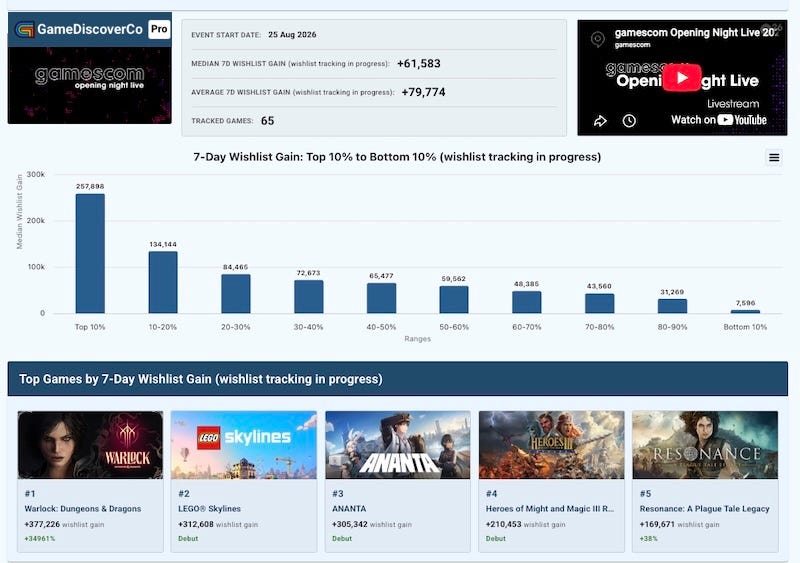
500,000 wishes at this point. There's there's a game called uh Shift at Midnight, which looks pretty interesting, which is a a co-op detective horror game where you have to uh investigate your customers to find out whether they're human or not, which is a popular uh a popular meme nowadays. Uh there's there's also Carnival Hunt, which I think is asynchronous. There's um Dragon Sword Awakening, which is a I think an Asian-made game that is a very uh anime ARPG. So yeah, I mean I mean honestly the sheer amount of games coming out and all of those have at least uh 300,000 wish lists. So uh you know the the sheer amount of games coming out that are interesting like like this week we have 1 2 3 4 5 6 7 have like 15 games coming out with at least 100,000 wish lists. So it's it's it's pretty busy at this time of year.
I I know this one's just a little bit further out, but what should people be expecting around Halo Campaign Evolved? Oh, that's a really interesting question. I mean, I would say Halo games
on PC um don't always do as well as the console versions. I mean, I guess we have this we have it at 720,000 wish lists, which is uh which is pretty good. I guess it's out Yeah, it's out in about uh about about eight days, I guess. So, yeah, I I mean, I I would expect it to do fine on on Steam. Um, but I I because it is a $50 game, so I I I sort of do I sort of do feel like it's a little bit for the throwbacky kind of crowd. So, um, I I would expect it to sell hundreds of thousands of copies, but at a $50 game, I don't think it's going to do like Battlefield 6 style numbers. I think Halo as a franchise is is a little, sorry to say this, Xbox, a little tired at this point because it really was Xbox fans who really cared about Halo and a lot of Xbox fans still play on Xbox in my view.
Yeah. Yeah. Yeah. Well, that wraps up most things except for as always my
question of the week, which is about Mecca Chameleon or sorry, I pronounced it wrong. Meta Chameleon.
Oh, is it?
Um, meta, which means like in Japanese it's like ooh very chameleon. Uh, like it's it's a bit more [clears throat] of like an enthusiastic. It is not like a mech.
Um, but this game uh it is this discover. It's co-op. Sorry, it's not co. I guess it's a multiplayer game where uh a player goes and hides and they blend into the environment like a chameleon. There's a very cute painting mechanic and then you spot them and very fun first person. And there are already so many clones up around this game. And I guess what I'm wondering about this game is are we seeing a little bit of what is happening on Roblox starting to happen just across general storefronts? Because this game in its
design, even though I know a lot of time went into it, looks and even feels in some ways like something I might have expected to see on Roblox. and the cloning of it absolutely feels like something I would expect to have happen on Roblox or is this just, you know, more of the same of what has always been happening on Steam? Um, you know, I think it is interesting. It was originally prototyped in for, you know, it's Unreal Engine. It was made certainly in Fortnite. And I know the Fortnite folks were sort of saying, "Oh, it was prototyped in UF UFN." So, uh, that's interesting. Obviously, one thing about it is it some of it like the paint program is a little bit complicated to actually do in UEFN, which is one of the reasons they released it standalone, I think.
Um, yeah, I mean, it is the kind of thing where you're seeing a sort of a a short high hook idea really resonating with people. And I think all of all of Friendop is sort of and this is a friend slop adjacent game. It's all this space where I was saying
um you know there's a game called Dear Passengers that I just uh wrote something on that that got you know 1.4 million wish lists in a very short period of time. And it sort of is the kind of I'm willing to pay 10 bucks every few weeks to play a game with my friends. And obviously the way it works on Roblox is you just switch between games and maybe you'll buy some stuff, you know, in in the game, you're right, and you're effectively paying $10 because you've bought Avatar accessories or whatever. And the way it works outside of Roblox is you just pay 10 bucks and you download the game. But I think it's it's quite similar um similar sort of pricing, not pricing, spending. Uh you know, the spending is similar. I can see a lot of a lot of paying customers on Roblox spending, you know, 10 bucks a month on something kind of random. And and I think what we're saying for a lot of this friends adjacent stuff is a lot of these titles are $7 to $10 and you'll just play it uh pay for it, play it for a few weeks and then move on to the next thing. So that's where I see Mega Chameleon in the
sort of um you know the sort of uh priority list for people. It's another of those games they can rotate through with their buddies and have a lot of fun.
Yeah. Before we wrap up, where should people go? What should people be looking forward to on Game Discover Co this week?
Uh that that is a good question. In you mean you mean in terms of the uh you mean in terms of the newsletters?
Yeah.
Uh yeah. Uh well okay. So the one we're putting out today is all about longtail. So um uh uh sorry we're putting it out tomorrow. It's all about it's it's all about longtail. And uh it's interesting because we're talking about if you have a week one revenue, you're a dev, you have a week one revenue of X uh X dollars, how much will you make by the end of year one and how much will you make by the end of year two? We've done these before, but people are asking for updated data. So we've done a whole bunch of crunching of data on that. The other thing we're working on which is going to be interesting, I don't know when it's coming out, is we're getting an interview with the folks who made a
game slash uh sort of framework called Beam BeamNG Drive. Do you do you know you know this framework?
Yeah. Yeah. Yeah. Yeah.
Yeah. So, I've been spotting I guess ever since 2020 when someone came out with a multiplayer mod for it. Um it's been going kind of crazy. It's it's made I think our our reference is we think it's made over $150 million on Steam and it rarely gets discussed. So we did manage to get hold of the um of the uh of the devs and it's a really interesting case you know this this and it's a vehicle it's it's open world vehicle kind of make your own vehicle thing but it's been around for like 15 years and um you know I think it's super interesting. So, we're planning to have a chat with them because I think a lot of regular devs or other people are not aware that this game has grossed so much money at this point.
Where did you find the devs? Was it on a goldplated yacht or a military helicopter?
Uh very nice.
I know. It must be nice. No, it's it's just some lovely lovely German people
that I'm emailing.
It always is, you know, that's I mean, it makes me happy that whenever it's like massive success, you're like, "Oh, you're just nice people just still doing." And the other interest thing about those people that we'll get into is they actually sell a sort of an enterprise level version of it for like autonomous car companies and like I think the military even and because it's true like you want really good vehicle modeling for all kinds of real world practical examples. So, I'm super interested and I'm asking them about like, you know, how much does your, you know, how much do your features you need for like your autonomous vehicle clients feed into what you're putting on Steam for people to make lots of like weird rallying sims with or whatever you do with with this this framework. So, yeah, it's it's super interesting.
That's fantastic. Well, I look forward to it. Well, that has been another episode of the Game Discover Co show. You can hear us every week, which is why you should make sure to subscribe. you are listening right now. Maybe you're watching the video version on the newsletter, but here's a trick. Go to your favorite podcast app and subscribe
there, too. Maybe subscribe to the newsletter if you're listening to us first.
That would be a little peculiar right now, but like if if it's happening, great. You should go do that. And thank you so much for listening, Simon. Thank you as always for being here, my wonderful co-host.
Yeah, thanks. It's been awesome. Let's see everyone next time.
We'll see you then.
Auto-generated captions from YouTube — names and numbers may be misheard.
Key insights
7 takeaways · ~3 min read- 01A GameDiscoverCo survey indicates that player sentiment toward AI in games is highly divisive, with approximately 43% of respondents expressing openness to AI usage while roughly 31% hold negative views.
- 02Steam is actively vetting games for AI content, occasionally identifying AI-generated assets in titles where developers were unaware their subcontractors had used such tools.
- 03Apple Arcade has shifted its strategy to commissioning only 10 to 12 games per year, a significant reduction from its initial launch phase which featured $500 million in 100% commission-based titles.
- 04The game 'Meccha Chameleon' highlights a trend of rapid cloning on Steam storefronts, mirroring the high-turnover environment typically seen on platforms like Roblox.
- 05Steam's two-hour refund policy remains a point of contention for developers of short games, though data suggests that high-quality short experiences often maintain lower-than-average refund rates.
- 06The 'Spirit Veil' MMO, a title inspired by the 20-year-old 'Ragnarok Online', recently reached 20,000 concurrent users (CCU) as a $15 premium game without microtransactions.
- 07User-Generated Content (UGC) platforms face a recurring 'chicken and egg' challenge where the audience purchasing the creation tools is often not interested in playing the resulting user-made games.
Ask AI about this video
Cite this video
Citation
Generating citation…














Comments