Monetization reports and market data
Documents

Google's Tobias Knoke: The Era of Growth at All Costs is Over
The mobile gaming and application industry has reached a growth plateau, signaling the end of the era defined by growth at all costs.
- The mobile gaming and app industry has reached a growth plateau, signaling the end of the 'growth at all costs' era and a shift toward predictive lifetime value (LTV) and long-term user retention.
- With approximately 700,000 new apps and games entering the Google Play Store monthly, developers must prioritize unique value propositions and high-quality user experiences to avoid being ignored by users.
- While AI is a powerful tool for rapid prototyping and eliminating repetitive development tasks, user research indicates that players across all generations demand authentic, human-designed experiences that AI cannot replicate.
The $12B+ Mobile Ad Market: Sensor Tower's First-Ever Deep Dive
The mobile advertising market is projected to reach a valuation of at least $12 billion by 2025 across 19 key global territories.
- The global mobile advertising market is projected to reach at least $12 billion by 2025 across 19 key territories.
- Market consolidation is high, with AppLovin and Google collectively controlling approximately 65% of the total market share.
- Gaming accounts for 72% of ad demand, while non-gaming sectors—led by e-commerce giants like Temu and Shein—now capture 28% of total revenue.

🐜 Colony Flow Breakdown: The Ant Puzzler getting sued & already taken DOWN from Android!
Colony Flow, a mobile puzzle game developed by ABI Games, represents a significant case study in the high-stakes, high-volume landscape of the casual gaming market.
- ABI Games' title Colony Flow was removed from the Android marketplace following a lawsuit from Famfinity, which alleges the game is a direct clone of its title, Food Hunt Pixel Puzzle.
- Colony Flow achieved rapid scale after its June launch, reaching 150,000 daily installs within two months.
- The game generated approximately $150,000 in daily in-app purchase revenue, supplemented by additional income from advertisements.
🚨📢 BREAKING NEWS: Google's Antitrust Blow, AppLovin's Hidden Strength & Smash Fest's Copycat Army
The mobile gaming industry is currently navigating a period of significant regulatory and competitive shifts, characterized by the ongoing erosion of the 30% app store commission model and the rapid proliferation of copycat development strategies.
- The European Commission has fined Google €890 million for Digital Markets Act violations, mandating that developers be allowed to promote alternative payment methods outside the Google Play Store.
- Google faces a 60-day compliance window to reform its payment policies, with potential ongoing penalties reaching up to 5% of its total worldwide turnover.
- AppLovin maintains a structural advantage in mobile app discovery and monetization through its AppLovin Max mediation platform, despite recent stock volatility and market pressure.

TWIG #394: Playtika's Solitaire Meltdown, the AppLovin-AdMob Duopoly and Why Nobody Wants New Games
The mobile gaming industry is currently navigating a period of significant contraction and structural instability, characterized by a shift in consumer preference toward established titles over new releases.
- AppLovin and Google’s AdMob now control 65% of global gaming ad revenue, creating a market duopoly that contributes to rising user acquisition costs and CPI inflation.
- Global mobile game downloads have declined by 12% as consumer preference shifts away from new releases toward established, high-retention titles.
- Playtika’s portfolio is experiencing a 35% year-over-year revenue decline, exacerbated by internal cannibalization from the launch of Disney Solitaire and ongoing legal challenges.

🧊 Cube Land: How RotateLab went from idea to $300K/Day in Just 6 Months
RotateLab has achieved significant commercial success with the 3D voxel blast puzzler Cube Land, scaling the title to approximately $300,000 in daily revenue within six months of its early 2026 launch.
- RotateLab scaled Cube Land to $300,000 in daily revenue within six months of its early 2026 launch.
- The studio achieved this success by testing approximately 20 prototypes before identifying the viable hit, validating a high-volume, iterative development philosophy.
- RotateLab allocates 90% to 95% of its advertising budget to AppLovin, citing a lack of necessary attribution infrastructure on alternative platforms like Meta for their hybrid monetization model.

2026's top games so far, Raid's new rival plus nuggets from Google, Ubisoft, Stillfront and more
The mobile gaming industry in the first half of 2026 reflects a landscape defined by the dominance of Chinese-developed titles, significant regulatory pressure on platform holders, and the emergence of community-driven development models.
- The European Commission has fined Google $1 billion for antitrust violations, specifically for hindering developers from steering users to external web stores and prioritizing its own search products.
- In the first half of 2026, the top three grossing mobile games were Honor of Kings ($1 billion), Whiteout Survival ($723 million), and Last War: Survival, all of which are Chinese-produced titles.
- Skillz won a legal battle against rival competitive gaming firm Papaya Gaming, resulting in a court-ordered damage award that increased from $420 million to $719 million.

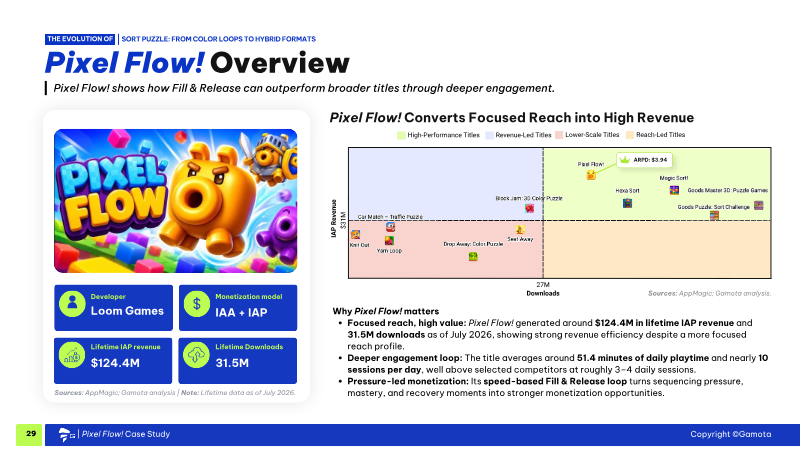
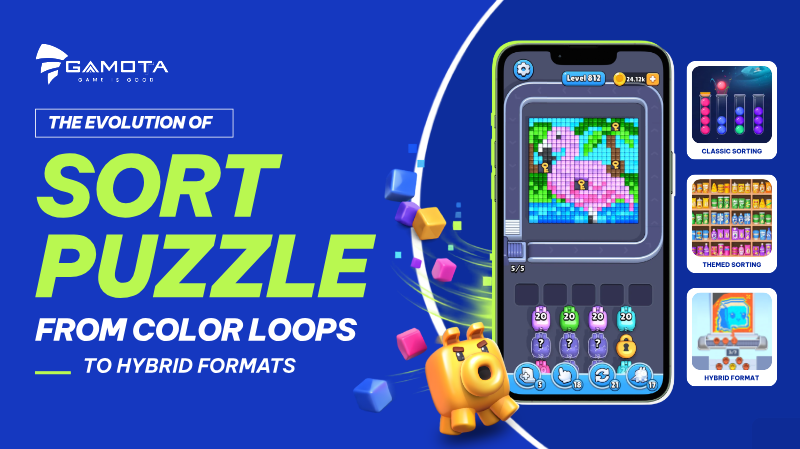
The Evolution of Sort Puzzle: From Color Loops to Hybrid Formats
The sort puzzle genre has transitioned from rudimentary color-matching loops into a sophisticated, high-growth category that generated $279 million in in-app purchase revenue and 992 million downloads by 2025.
- The sort puzzle genre reached a scale of $279 million in in-app purchase revenue and 992 million downloads by 2025.
- Despite high download volume, the genre currently underperforms in monetization efficiency compared to mature puzzle category leaders.
- Developers are shifting from simple color-matching loops to hybrid-casual mechanics and complex progression systems to improve long-term retention.

The ex-Riot producer betting mini-games will be China's next big export
The Chinese gaming industry is undergoing a significant shift, characterized by increased confidence and a strategic focus on global expansion.
- The mini-game market is a significant emerging export for China, with global revenue projected to reach $9 billion in 2025, up from $7.6 billion in 2024.
- Major Western platforms including YouTube, Discord, Telegram, and LinkedIn are already integrating mini-game ecosystems, signaling a global shift toward this format.
- Chinese developers are increasingly successful because they integrate monetization strategies—such as hybrid IAP/IAA models and reward structures—early in the product design phase rather than treating them as post-development additions.

🎯 The Mobile Games Ecosystem Explained by Felix Braberg
The mobile games ecosystem is a massive, high-stakes industry that facilitated over $1.4 trillion in spending in 2025, with mobile gaming alone accounting for $52.5 billion in in-app purchase revenue.
- Mobile gaming generated $52.5 billion in in-app purchase revenue in 2025, contributing to a broader mobile ecosystem that facilitated over $1.4 trillion in total spending.
- Creative strategy is now the primary driver of user acquisition, with top-performing companies scaling from 100 to over 10,000 creative assets per month to maintain visibility.
- Developers are increasingly adopting direct-to-consumer payment solutions like FastSpring to bypass the traditional 30% platform fees charged by Apple and Google, significantly reducing transaction costs.

Google's €890m EU fine and why Netflix's gaming figures mean nothing | Week in Mobile Games podcast
The European Commission has imposed an €890 million fine on Google for violating the Digital Markets Act, specifically targeting anti-steering practices and self-preferencing within the Google Play Store.
- The European Commission has fined Google €890 million for Digital Markets Act breaches, consisting of €460 million for self-preferencing its own services and €430 million for restricting developers from directing users to alternative, cheaper purchase channels.
- Tencent is reportedly in talks to acquire the mobile game developer SuperPlay from Playtika in a deal valued at up to $1.5 billion.
- Netflix’s claim of a 600% increase in mobile game engagement is considered a 'vanity metric' by industry analysts because the company fails to provide standard health metrics like Daily Active Users (DAU) or Monthly Active Users (MAU).

Puzzle Monthly #5: The Secret Behind Toon Blast's Success
Toon Blast maintains its market dominance by fundamentally evolving the clicker sub-genre, moving away from the deterministic, high-friction gameplay that characterized earlier titles like Pet Rescue Saga.
- Toon Blast achieved market dominance by replacing deterministic, high-friction gameplay models found in titles like Pet Rescue Saga with a more accessible, luck-based experience.
- The integration of the 'Super Light Ball' mechanic served as a critical driver for increasing both player retention and revenue by enhancing the core board-clearing loop.
- The game successfully transitioned from short, isolated events to overlapping, long-term engagement structures, effectively revitalizing performance among a mature user base.