This performance mirrors H1 2025.
Market Valuation. The casual games market remained stagnant in H1 2026 with $11B in revenue.
This genre also saw a 20% year-over-year increase in downloads.
Fastest Growth. Merge-2 is the fastest-growing casual genre, nearly doubling its revenue to $1.2B in H1 2026.
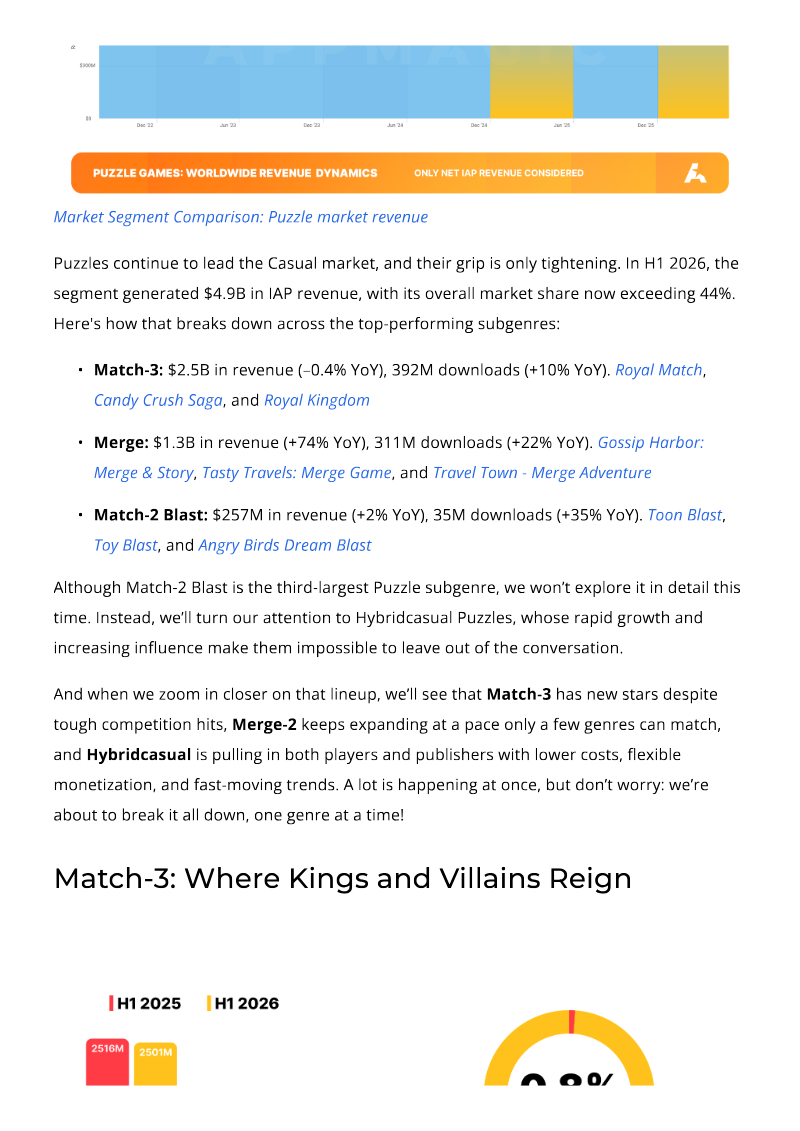
Dream Games' 'Royal Kingdom' reached the #3 market spot by scaling limited titles and integrating diverse mini-game events.
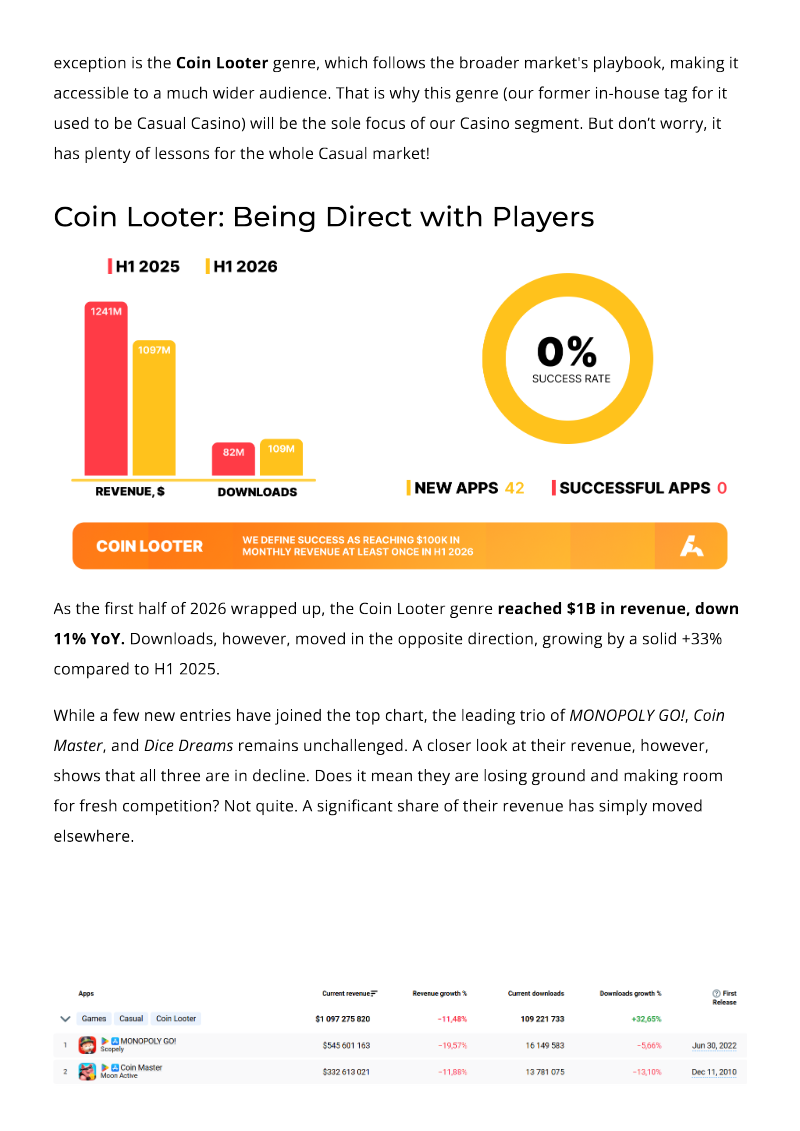
Major titles like 'MONOPOLY GO!' and 'Coin Master' experienced revenue drops.
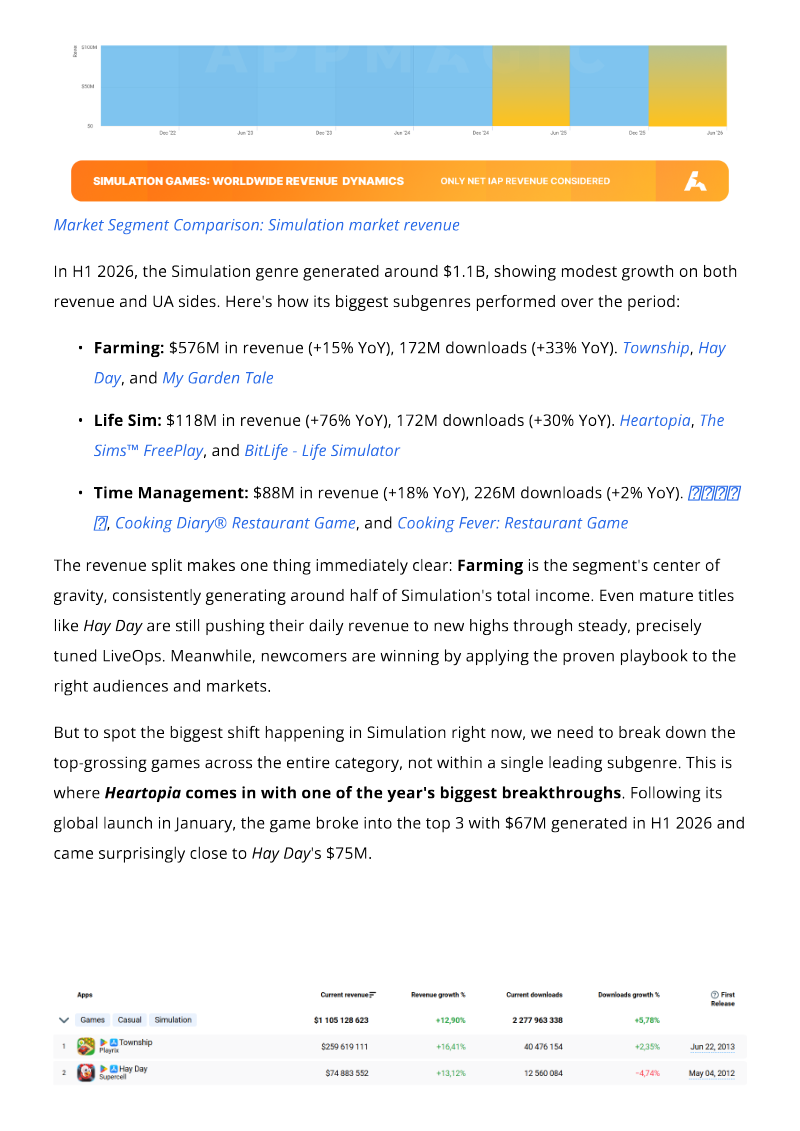
'Heartopia' generated $67 million in H1 2026 following its January launch.
The casual gaming market maintained a stable valuation of $11 billion during the first half of 2026, characterized by a strategic shift from high-volume experimentation toward the refinement of established gameplay loops. While traditional pillars like Match-3 remain dominant with a 44% market share, growth is increasingly concentrated in high-performing subgenres. The Merge-2 segment has emerged as a primary driver of expansion, nearly doubling its revenue to $1.2 billion, while the Simulation genre reached a similar $1.1 billion valuation, bolstered by the disciplined execution of LiveOps in long-standing titles.
Industry success is currently defined by the ability of experienced studios to scale proven formulas and maximize player lifetime value. Hybridcasual puzzles, specifically within the sort, screw, and block categories, have successfully bridged the gap between hypercasual accessibility and deep in-app purchase monetization. Conversely, segments such as the Coin Looter casino genre are facing significant headwinds, evidenced by an 11% decline in in-app purchase revenue despite a surge in downloads. This disparity has prompted leading publishers to explore direct-to-consumer channels to mitigate platform fees and preserve margins.
Geographically and strategically, the industry is prioritizing precision over radical innovation. The Farming simulation sector, in particular, has benefited from an East-first approach to regional targeting, demonstrating the importance of localized execution. As barriers to entry rise for legacy genres, the market is consolidating around studios that can effectively leverage portfolio scaling and sophisticated monetization strategies. Ultimately, the casual gaming landscape in 2026 reflects a mature ecosystem where sustained growth is achieved through the optimization of existing assets and the strategic diversification of distribution channels rather than reliance on new, unproven mechanics.