ReportGamota
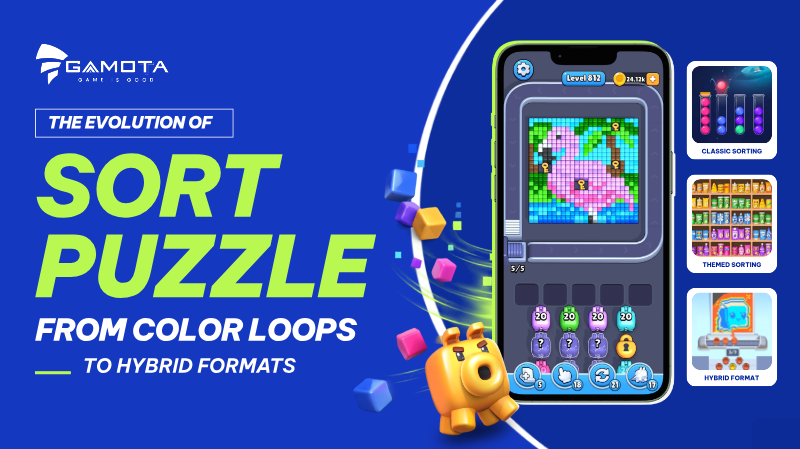
The Evolution of Sort Puzzle: From Color Loops to Hybrid Formats
30 Jul 202645 pages~27 min full read
The genre generated $279 million in in-app purchase revenue.
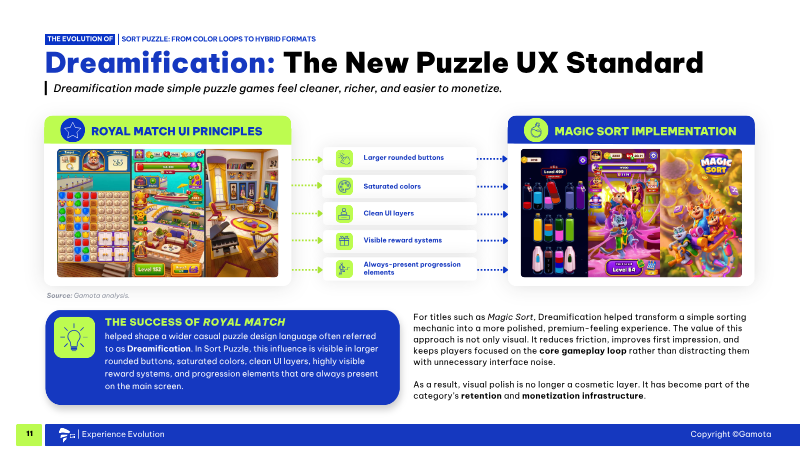
Page 5 of the reportThe sort puzzle genre has transitioned from rudimentary color-matching loops into a sophisticated, high-growth category that generated $279 million in in-app purchase revenue and 992 million downloads by 2025. Despite this massive scale, the genre currently underperforms compared to mature puzzle leaders in monetization efficiency. To bridge this gap, the industry is shifting away from simple accessibility toward deeper retention strategies, complex progression systems, and hybrid-casual mechanics. Future market viability depends on adopting high-fidelity UI standards, often referred to as dreamification, alongside robust live operations to sustain long-term player engagement.
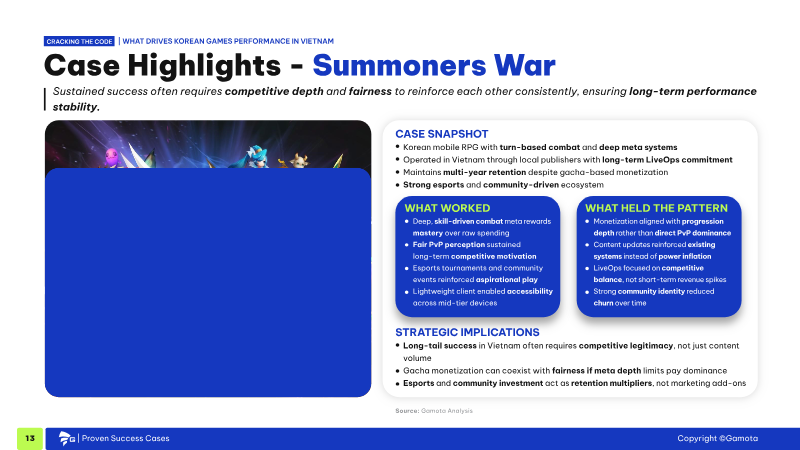
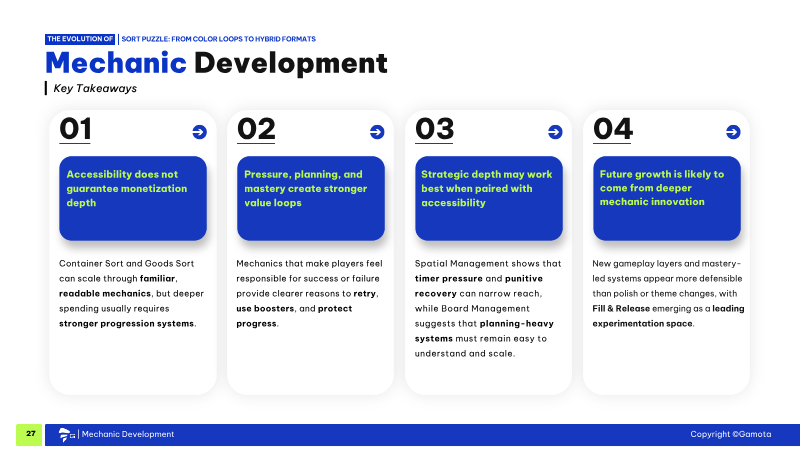
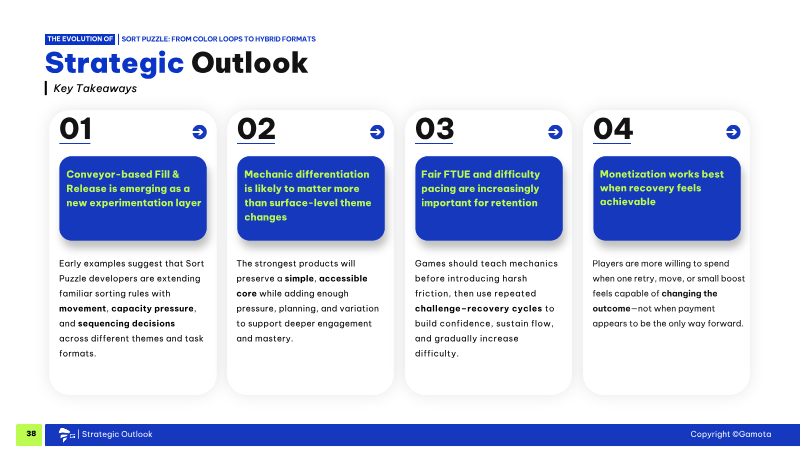
The evolution of the genre is defined by a move toward strategic depth and mastery. Modern titles are increasingly incorporating high-pressure environments, conveyor-based movement, and intricate sequencing to challenge players. By replacing random level generation with fair, skill-based design, developers are successfully driving higher revenue and deeper engagement. This shift reflects a broader trend of integrating hybrid formats that reward tactical decision-making rather than relying solely on repetitive, low-stakes sorting inputs.
To maximize these gains, developers are adopting a challenge-recovery pacing model. This approach prioritizes teaching mechanics before escalating difficulty, ensuring that in-app purchases function as strategic recovery tools rather than perceived barriers to progress. By balancing mechanical complexity with a player-centric difficulty curve, the genre is moving toward a more sustainable model that values long-term retention over short-term conversion. This strategic pivot marks the maturation of the category, positioning sort puzzles as a core pillar of the contemporary mobile gaming landscape.

SocialPeta · 2026

Gamota · 2026


Gamota · 2026


Gamota · 2026

Gamota · 2026

Gamota · 2026
Gamota · 2026

Gamota · 2026

Two & a Half Gamers · 2026

Two & a Half Gamers · 2026
Deconstructor of Fun · 2024

Two & a Half Gamers · 2026

Deconstructor of Fun · 2026

Two & a Half Gamers · 2026

Two & a Half Gamers · 2026

Two & a Half Gamers · 2026

Deconstructor of Fun · 2026

Two & a Half Gamers · 2026

Deconstructor of Fun · 2026

Two & a Half Gamers · 2026
Comments