VideoTwo & a Half Gamers
🎯 The Mobile Games Ecosystem Explained by Felix Braberg
29 Jul 202620 min video
Transcript
So, that's why companies run quite a lot of creatives. And this is one of the things that we've seen lately. Usually, you could run maybe 100 new creatives a month on a big game, but now these days you need to run like 10,000 to get any scale, and those are the companies that are winning the most. So, back to my original question.
[music] [music] [music] [music] [music] [music] [music]
Real talk before we start. This episode is brought to you by Potensic. And if you're a mobile game publisher tired of leaving money on the table, then listen up. Potensic is a premium ad network built by people who have actually been on both sides of this industry, game publishers, agencies, successful exits. So, they get it. Here's the thing. Potensic has direct deals with Amazon, Apple, Coca-Cola, Vodafone. It's not programmatic. It's direct. Those budgets land in your game at premium CPMs, no middleman tax. And they handle everything with their in-house team in terms of the creatives. Plus, they've partnered with playable maker, wink wink. So, they will take brands' YouTube videos or static images and actually turn them into playable ads or even video. Proper interactive format built
for gaming inventory. Brands getting a gaming native creative, publishers are getting a higher CPMs. Everyone wins. Head to Potensic.com to get started or check their creative portfolio in the link in the show notes. Thank you very much Potensic for sponsoring this episode.
Hello and good morning and welcome to another special episode of the Two and a Half Gamers Podcast. Today, it's just me doing a solo episode and I want to do a special solo episode on an overview of the mobile ecosystem and the aim of this video is basically as an introduction to anyone who's starting in our industry and basically so you can get a head start. The kind of thoughts behind this is eight or nine years ago when I first joined the industry, it's very hard to understand exactly how everything works. I remember getting a interview question when I was interviewing at Mopub Twitter which asked me, "What is the difference between a DSP and an ad network?" And I wasn't able to answer that question. I didn't get the job. Yeah, I don't think
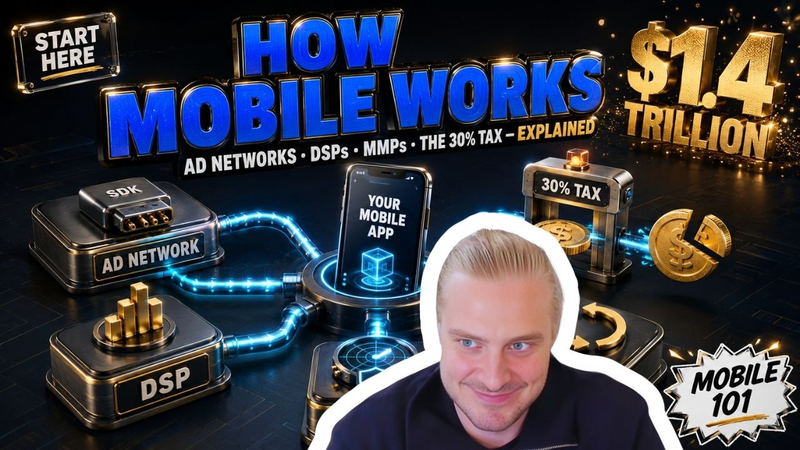
there's any actual data on this or any really discussion that you only can kind of have to do to learn it in the mobile ecosystem is kind of just learning on the job. So, yeah. Here is 15-20 minutes on how most of the most important companies and industries in mobile work and the problems that we're actually solving. So, this is for you who's starting the mobile industry, who's either interviewing for an entry-level job, who has just started an entry-level job and is kind of looking to get up to speed and understanding how everything works. So, let's start at the very, very easy start here and let's start with what is the mobile ecosystem. So, Apple recently said that the mobile ecosystem has reached over 1.4 trillion in 2025. So, that means that it has facilitated over one and a half, nearly one and a half trillion dollars of spending. All right, so the first thing to realize here is that mobile is a very, very big
business and there's a lot of money being earned inside of the mobile app stores on either Google Play or on the Apple App Store. So, for example, here in 2025, Apple reported that gaming alone in the App Store has reached 52 and a half billion in-app purchase spending, right? So, the first thing to know about mobile is that it's an extremely large and lucrative market where there's a lot of players and if you know what you're doing, you can make a lot of money from either games or applications. What the biggest problem is of the mobile space is pretty much shown here, right? So, there's 52 billion dollars being earned in 2025 from gaming, but and you know, over 1.4 trillion in payments across all the apps. But, the biggest issue is here, right? There is two and a half million apps on the Google Play Store currently and two and a half million apps on the Apple App Store, right? And the biggest
issue here is that the discoverability on the App Stores is absolutely terrible. And this is kind of the same issue that's been around since the dawn of the App Stores in the early 2010s. And you can see here, this is what the Google Play Store looks like and this is what the Apple App Store looks like, but the issue here is that discoverability for these two and a half million apps on both App Stores is absolutely atrocious. So, you have a lot of money being earned by games and applications, but it's really hard to get users' attention, right? How How you actually get users to download your applications? So, in the early stages of the app stores, how this was solved was essentially with human curation. So, Google and Apple had human teams where they basically put yeah, recommended for you or trending apps.
And essentially, that's how you got to the top of the app store, and that's how you got a lot of downloads because this is what people see when they get into the app store. This was great, but very very like trollable, right? So, in the early stage of the app store, you had people just paying to buy fraud traffic to get download numbers up to get a lot of organic rankings. And this kind of developed quickly into a industry, right? So, the yeah, the biggest issue here you can see on the Apple App Store as well as how do you actually discover new games and new applications? I remember reading somewhere that everyone on average on their phone has between 70 to 85 applications, but how do you actually find the right application that you want to download? So, it used to be discoverable in the app store, but now with 2.5 million apps on the app store, it's impossible to find new apps. So, here in Sensor Tower, you can see that in the last 30 days, the top apps have earned a lot of money. So, ChatGPT in the last 30 days has earned a quarter
of a billion, YouTube 200 million, Honor of Kings 150 million, TikTok Shopping has earned 114 million. So, it's a lot of money that's being passed through here. So, basically, how people started discovering more apps was that inside of apps, if you had a lot inside of games or apps, if you had a lot of inventory, a lot of users, what started to happen was they started to form a bunch of ad networks, basically. And this is an example of one ad network. And what an ad network is essentially is a SDK that's plugged in inside of your mobile application or mobile game. And then what you do is inside of your app, you start showing ads basically to other applications. So, then if I have one of the 2.5 million apps that I want to advertise it to get more users because I can't rely on only organic downloads, what then happens is that
you can go to these companies and you can buy inventory. So, basically you show either video ads, banner ads, and then basically these show up in the games or applications and users see them, and then you're basically redirected to download these apps directly in the App Store. How this usually works is that companies on the supply side, they sell impressions on an eCPM basis, right? So, what that works is they basically group together 1,000 impressions and you get paid for that. So, usually you get maybe couple of percent of people that actually click on the ads, but if you sell them as a thousand, that actually means you can run an arbitrage. So, basically you spend a thousand dollars to earn maybe $1,200, right? How ad networks work is essentially they plug into mobile games or mobile applications and they basically buy the inventory directly there, right? So, that basically started to solve the discoverability issue on the App Stores, but it wasn't very good
in the early days and there was a lot of fraud because basically how do you actually police what type of applications you're seeing on the mobile space. There was so much fraud, so basically a couple of companies that are called MMPs started popping up. MMP stands for mobile measurement partner, and these companies are essentially attribution providers. So, the two biggest companies in our industry is AppsFlyer, which is independently owned, and then you have Adjust, which is owned by AppLovin, and there's a couple of other players as well. But, what these companies sell is essentially that they track and basically are the impartial arbitrators of installs. So, if you're running paid marketing uh to your mobile application, you need to work with a mobile MMP basically to keep track of where your spending and where you're getting installs from. So, basically you pay these companies on a install basis and they keep an eye on
the let's say if you're spending and where the installs if they came from Meta, Google, or if they came from Mintgral or AppLovin or whatever. And basically it's inside of these companies that you set up the tracking. How the tracking actually works is that you can optimize your track your campaigns on different tracking events that you set up in your application. So, when you start working with an MMP like AppsFlyer or Adjust or anyone else, what happens is that you set up tracking events. So, basically as you get a new user from a campaign that you're running let's say with AppLovin, basically they track that user using an IDFA or Google ID, which is a code that's used for advertising and tracking of users across the mobile advertising ecosystem. So, basically all this does is let's say you have a game, it tracks that a user called XYZ basically downloaded the game from a campaign that was run by Mintgral. This user has come inside of your game and they have played to level 33 and that's where you have a tracking event that shows that that user has played to that
level. Certain things you track as well as stuff like has this user made a purchase, yes or no. Has he made a subscription, yes or no. And from the back of that you can basically find out who's running profitable campaigns. There's a couple of caveats here. Most of the large networks self-attribute. So, essentially you plug into example for Facebook and they tell you exactly what the campaigns are actually doing. So, they're self-attributing networks. So, yeah, it's a bit more complicated than that, but essentially MMPs are where you track everything. You can keep an eye on all your mobile campaigns. So, that brings us back to the App Store. So, if you go back here, basically the main money earners in the App Store is either mobile games or mobile applications, and they monetize in very different ways. But, you got to remember that the main facilitator on the main App Stores that basically is run is run by Google and Apple. And they essentially take a 30%
cut of any subscription or any IAP that is made from a game on their App Stores. And this is the thing that's kind of been in the news quite a lot lately because there's a lot of lawsuits flying around right now about them taking 30% and that being extremely aggressive. But, this is very big business for both Google and Apple. And I think it's about like 12% of Apple's top line revenue and probably a big chunk of their profits. And Google, I think it's about 9% if I remember it correctly. So, these companies earn a lot by facilitating the transfers here. So, if you compare this to, for example, a credit card purchase where you basically get charged 1 2 3%. These guys charge 30. That brings me also to the different types of monetization mechanisms that you actually have on mobile. So, if we go back here to checking the top charts in the last 30 days here on Sensor Tower, you can essentially see here these are the top, yeah, what is it? Top 30 or 25 apps that have earned the most from in-app purchases.
So, how it actually works on mobile is usually you have different monetization structures, which either is I monetize 100% from subscriptions, I monetize 100% from in-app purchases, or I monetize with ads 100%, or basically combination of all of these factors. How you monetize pretty much determines, like what type of business model you have. And yeah, it's a quite dynamic. I could make a video on like IAP monetization and subscription monetization all on its own. But yeah, saving for another day. But all you need to know is basically that those are the main monetization mechanisms. And if we go back to the ad network, so here's another example of an ad network that's grown a lot lately, which is AppLovin. So, AppLovin is currently one of the largest networks on iOS and also one of the largest networks on Android. So, you if you want to advertise your apps, you go to AppLovin and you say, "Hey, I want to buy user acquisition campaigns uh for my application that either monetizes with subscriptions, IAPs, or ads."
So, when you go to them, you can basically run user acquisition campaigns that are tailored towards those monetization strategies. So, you are able to run either IAP-tailored campaigns, which is you trying to buy users that's tailored for IAP purchases to try to get them to your app, or you can buy users that are tailored for yeah, uh subscription purchases, or ads, or basically users that watch ads and basically convert only with ads. And then you can also run blended campaigns that are kind of our combination of both. To run these campaigns, you need to basically make your own creatives. So, before there was a lot of skill involved in user acquisition and running campaigns, a lot of that's getting automated. But where these companies are actually competing right now is on the creative side. So, user or basically companies are running a lot of creatives. They're using AI to build a boatload of creatives and basically seeing what converts really,
really well. The biggest companies that there's a couple companies that people work with like Playable Maker, where you can actually make playables. So, the main types of advertising that you do on mobile usually is video or playables. So, video is like a 30-second ad that you're shown inside of apps, or a 15-second interstitial ad. But the main thing that actually monetizes usually on AppLovin and So, companies need to make these to run them. How it works is that you can run a type of creative usually for a fixed amount of days before you basically burn through all the users who care about that creative, which means that you need to make a lot of creatives and a lot of creatives quite often depending on your scale. So, that's why companies run quite a lot of creatives. And this is one of the things that we've seen lately. Usually, you could run maybe 100 new creatives a month on a big game, but now these days you need to run like 10,000 to get any scale, and those are the companies that are winning the most. So, back to my original question where I started this video at was basically there's ad networks, and the biggest difference of an ad network is
essentially they have the SDK connection with the end application where you're showing the ads. That's what the definition of an ad network is. They run and own their own inventory. There's also another place you can go for user acquisition, and that's a DSP. DSP is a demand-side platform, and the key difference here is that they don't own the end relationship with the apps where they show their ads in. They buy them on the open market. So, these ad networks, they connect to applications, and basically through the applications, they also sell part of their inventory to companies like DSPs to basically earn more money. So, DSPs, the probably the biggest two examples in our industry is Liftoff and Moloco. They've basically gotten so big that they also started running now with an SDK to cut their margins or basically to have better like margins. But that's what a DSP is. So, there's on the one hand what we've been talking about now is yeah, DSPs and ad networks for running user acquisition campaigns. There's also companies that
focus on something called retargeting. So, what is retargeting? So, retargeting is essentially downstream from when you run user acquisition. So, basically this is to target users that have already downloaded your application or game, and basically to try to push them to a purchase or basically get them back in the application or game to purchase more. Here's an example of one of the largest DSPs for retargeting. It's called Addict-Mobile. They're a French company, but that's all retargeting is. So basically they try to get back the high-value users and basically get them to purchase, but only after they have appeared inside of your application. So this is to push them more down the funnel and usually the biggest spenders here tends to be mobile games with high LTV. Applications like e-commerce, basically to get you back to purchase more. And also then what we have is that's probably one of the most interesting industries as well currently is the mobile payment space right now. So remember back when I told you in the
start of this video that Google and Apple earn a lot of money from this 30% take rate that they take on applications and apps or games inside the mobile ecosystem. So this is up right now for a lot of litigations. So what's happened is that there's been a group of very large payment companies that are getting into the mobile space that are offering basically payment solutions to evade the 30% charge that are being charged by Apple and Google. And this is kind of what's been in the courts lately. An example of this is FastSpring. How this works is that either you put it inside of your application or you basically redirect users to make their payment on mobile web instead, thus saving knocking down basically the 30% down to a couple percent and thus making you more money. So I'm going to wrap up now cuz I've talked for exactly 18 minutes about how the mobile ecosystem works. I think this is a really good introduction video for anyone who's doing an interview in the ecosystem or who's
starting to work in it because essentially no one really explains how this actually works when you first start. So best of luck. Let us know if you want us to dive deeper on any of these topics. Thank you for stopping by. I'm Felix Broberg and this has been Two and a Half Gamers.
Auto-generated captions from YouTube — names and numbers may be misheard.
















Comments