Monetization reports and market data
Documents
Mobile Gaming Market Review 1H2024 | AppMagic Data Analysis
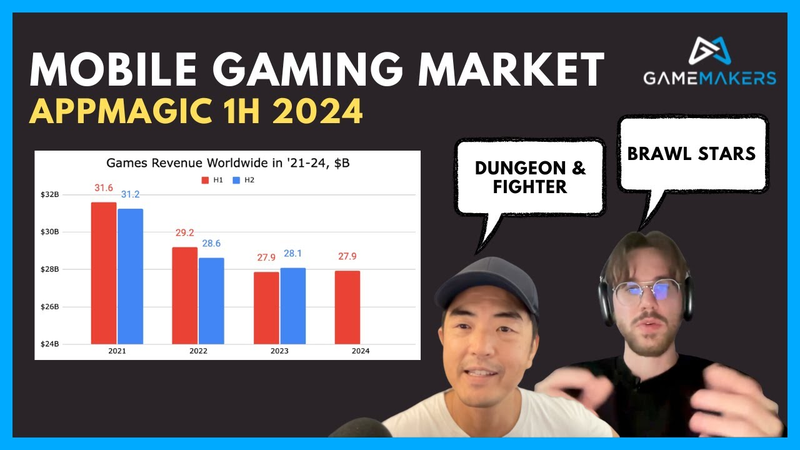
The mobile gaming market reached a state of stabilization during the first half of 2024, effectively concluding the post-pandemic decline.
- The mobile gaming market stabilized in 1H 2024, ending the post-pandemic decline with Tier 1 Western markets recording a 7% revenue increase despite modest global download growth of 1–2%.
- Major studios are shifting strategy from high-risk new title development to optimizing existing assets through sophisticated LiveOps and enhanced monetization frameworks.
- Success is increasingly driven by the 'casualization' of core mechanics, exemplified by Brawl Stars' revenue recovery and the integration of hyper-casual loops in 4X strategy titles like Last War: Survival and Whiteout Survival.

Game Monetisation Design: Strategies, Trends, and Best Practices with Oscar Clark
Sustainable game monetization centers on the principle that revenue should be a byproduct of player value rather than an end in itself.
- Prioritize player value over immediate revenue, as viewing money as the sole driver causes designers to miss the psychological factors that influence engagement and retention.
- Design monetization around 'shortcuts'—tools that allow players to play longer, perform better, or maximize rewards—while distinguishing between temporary consumables and permanent aspirational items.
- Understand the 'fan' economy by recognizing that a player's willingness to spend is not directly correlated to their disposable income; developers should value all fans regardless of their monthly spend level.

Is Zenless Zone Zero FLOP or NOT?
Zenless Zone Zero represents a significant shift in the trajectory of HoYoverse titles, failing to replicate the explosive financial success and player engagement levels established by predecessors like Genshin Impact and Honkai: Star Rail.
- Zenless Zone Zero is underperforming commercially compared to HoYoverse predecessors Genshin Impact and Honkai: Star Rail, failing to achieve similar levels of financial success and player engagement.
- The game suffers from a core gameplay loop that feels derivative in a saturated market, leading to diminishing returns despite high production values and fluid combat.
- Player retention is negatively impacted by tedious, mandatory puzzle-based mini-games that frequently interrupt the primary combat experience.

How To Make Millions From An Indie Game
The journey of developing the indie game Eastshade serves as a case study for transitioning from a stable career in AAA game development to independent production.
- Eastshade, an indie game developed by Danny Weinbaum, has generated over $3.5 million in revenue across all platforms since its 2019 release.
- To fund full-time development, the creator saved approximately $130,000 while working in the AAA industry at Sucker Punch, allowing for a multi-year runway.
- The development process spanned four years, during which the creator and his partner lived frugally and eventually moved in with family to extend their financial stability.

10+ billion installs x Azur Games Review live: Launching hypercasual with long ROAS
The hyper-casual gaming sector has undergone a significant transformation following the post-COVID market correction, characterized by heightened competition and declining eCPMs.
- The hyper-casual sector has shifted toward hybrid-casual models that prioritize long-term retention and sustainable profitability over short-term user acquisition metrics to counter declining eCPMs.
- Publishers are successfully scaling titles released as far back as 2019 by moving away from rigid industry benchmarks and focusing on long-term lifetime value.
- Monetization strategies now integrate in-app purchases alongside traditional ad-driven revenue to boost the lifetime value of players.

The Past, Present, & Future of KidTech
The kidtech sector has undergone a fundamental transformation over the past decade, evolving from an unregulated landscape into a highly complex environment defined by stringent global privacy laws and a strategic imperative for online safety.
- The kidtech sector has shifted from an unregulated environment to a highly complex landscape where regulatory compliance is now a core requirement for sustainable business models.
- Game studios are increasingly adopting specialized infrastructure, such as age-gating APIs and parental verification tools, to mitigate legal risks while maintaining immersive user experiences.
- The industry is transitioning toward universal, OS-level age verification systems that replace unreliable self-declaration with automated, dynamic content reconfiguration.

2.5 gamers x Live AM(F)A #4 - Ask Me Anything @ July 18 6 pm CET
Mobile game monetization currently relies on a sophisticated hybrid model that integrates both in-app purchases and advertising to maximize lifetime value.
- To optimize ad revenue, implement banner ads across all menus rather than limiting them to a single screen, and maintain a consistent ad unit across scene changes to avoid unnecessary auction reloads.
- When managing banner ad refresh rates in mediation platforms like LevelPlay or MAX, set them to 10 seconds to maximize impressions, though be aware that excessively low refresh rates can negatively impact user retention.
- Improve ad revenue by 8% to 10% by integrating Moloco’s ad network, which is currently supported on MAX and LevelPlay with upcoming support for AdMob.


Gaming Public Comp Sheet and Valuation Guide
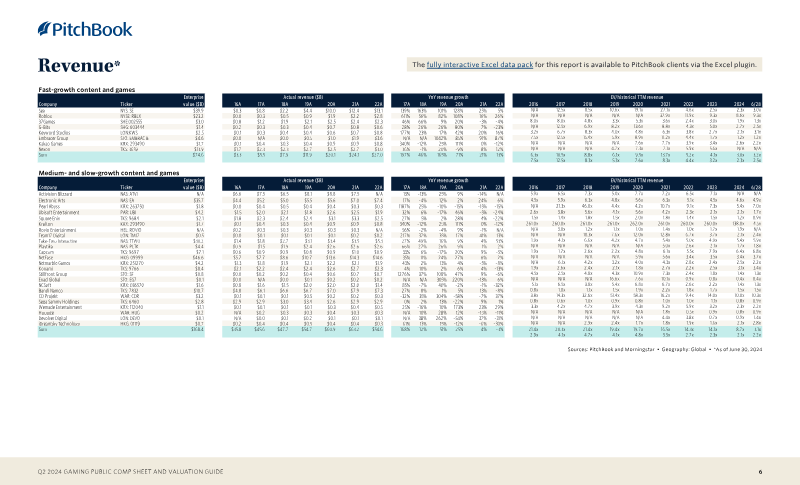
The analysis presents a snapshot of the U.S. public-equity environment for the gaming industry in the second quarter of 2024, contrasting overall technology strength with sector-specific performance.
- The gambling sub-sector significantly outperformed the broader gaming market in the first half of 2024, delivering a 29 percent year-to-date return.
- Broader gaming publishers failed to match the 14 percent surge seen in the S&P 500 Information Technology index during Q2 2024, resulting in only modest gains for the segment.
- Valuation metrics for niche gaming entities like Guild, Simplicity Esports, and EBET are frequently unavailable or unreliable, complicating standard benchmarking efforts.

AdQuantum’s Sergey Sukhov On Strengthening Ad Network Bonds for Better Performance
Smaller game studios can achieve significant scale by cultivating strategic partnerships with larger ad networks and growth agencies.
- Smaller studios can secure superior financial terms and specialized resources by positioning themselves as collaborative partners willing to experiment with new ad formats and strategies.
- Performance optimization must shift away from generic industry benchmarks toward granular, bespoke analysis using Mobile Measurement Partners and internal business intelligence tools.
- Lifetime value (LTV) and return on ad spend (ROAS) remain the foundational metrics for success in the current mobile gaming landscape.

The Next Era of Voice Games
Voice-controlled gaming is undergoing a fundamental shift, moving from primitive, high-friction interactions to sophisticated, AI-driven experiences that leverage the natural human instinct for speech.
- Advancements in large language models and native audio-to-audio processing have reduced latency to under half a second, transforming voice from a novelty into a high-fidelity primary input mechanism.
- The sector is successfully targeting casual demographics—specifically millennial parents, children, and seniors—to convert passive television-viewing time into active, social gaming engagement.
- Studios are utilizing subscription-based models that prioritize high user retention over aggressive monetization, with development cycles typically lasting between six and nine months.

Banana Special: Exploring the Potential, Mechanics & Popularity of the Banana Game with/ Joseph Kim
The viral success of the clicker game Banana on Steam, which achieved peak concurrent player counts approaching 900,000, serves as a definitive case study in the power of speculative digital economies.
- The clicker game 'Banana' reached nearly 900,000 peak concurrent players on Steam, demonstrating the massive market demand for speculative digital asset trading.
- The game's success proves that play-to-earn mechanics can achieve significant scale and profitability using the existing Steam Community Marketplace without requiring blockchain technology.
- A substantial portion of the game's engagement is driven by bot farms rather than organic gameplay, highlighting that the economic potential of virtual items often outweighs traditional design loops.
Vietnamese Mobile Gaming in 2024: Four Billion Downloads & Emerging Trends
Vietnam has emerged as a significant force in the global mobile gaming industry, characterized by rapid growth over the past four to five years.
- Vietnamese developers achieved four billion mobile game downloads in the past year, securing over 90 positions on global top-chart rankings.
- The industry is supported by a robust ecosystem of approximately 400 game companies and over 1,500 independent developers.
- Studios are shifting from hyper-casual titles to hybrid-casual models, incorporating deeper narratives and in-app purchases to improve lifetime value and offset rising acquisition costs.