Monetization reports and market data
Documents

Jonas Tyroller: Making Games Alone Again, Project Overload, Profitable Game Ideas | Ep. #043
Solo game development requires a disciplined approach to project management, where the limited number of major releases in a career necessitates rigorous commercial validation before long-term commitments.
- To achieve full-time indie success, developers must prioritize efficiency and validate ideas rigorously before committing years of development, as the ROI on long-term projects is often not guaranteed.
- Working with a team can be more cost-effective than working solo; sharing royalties is a secondary concern compared to the necessity of partnering with people who improve the project's quality and output.
- Game performance can be significantly optimized by using scripts to merge individual meshes into single objects at runtime, which reduces draw calls and improves frame rates.

⚠️ The Industry’s Dirty Little Secrets: Confessions from the UA Underground
The mobile gaming industry is currently characterized by a systemic reliance on unsustainable user acquisition strategies that prioritize short-term valuation over long-term profitability.
- Chinese game studios are outperforming Western competitors by utilizing massive creative teams, with some companies employing over 300 people specifically to iterate on ad assets and lower acquisition costs.
- Mobile user acquisition (UA) has become increasingly simplified since 2020, shifting the primary focus for many managers toward creative testing and bidding rather than deep algorithmic understanding.
- Internal UA reporting is frequently subject to 'window dressing,' where managers manipulate data or highlight specific metrics to secure bonuses and satisfy management, often misleading founders who lack a deep understanding of UA mechanics.

Mobile Gaming: Casual
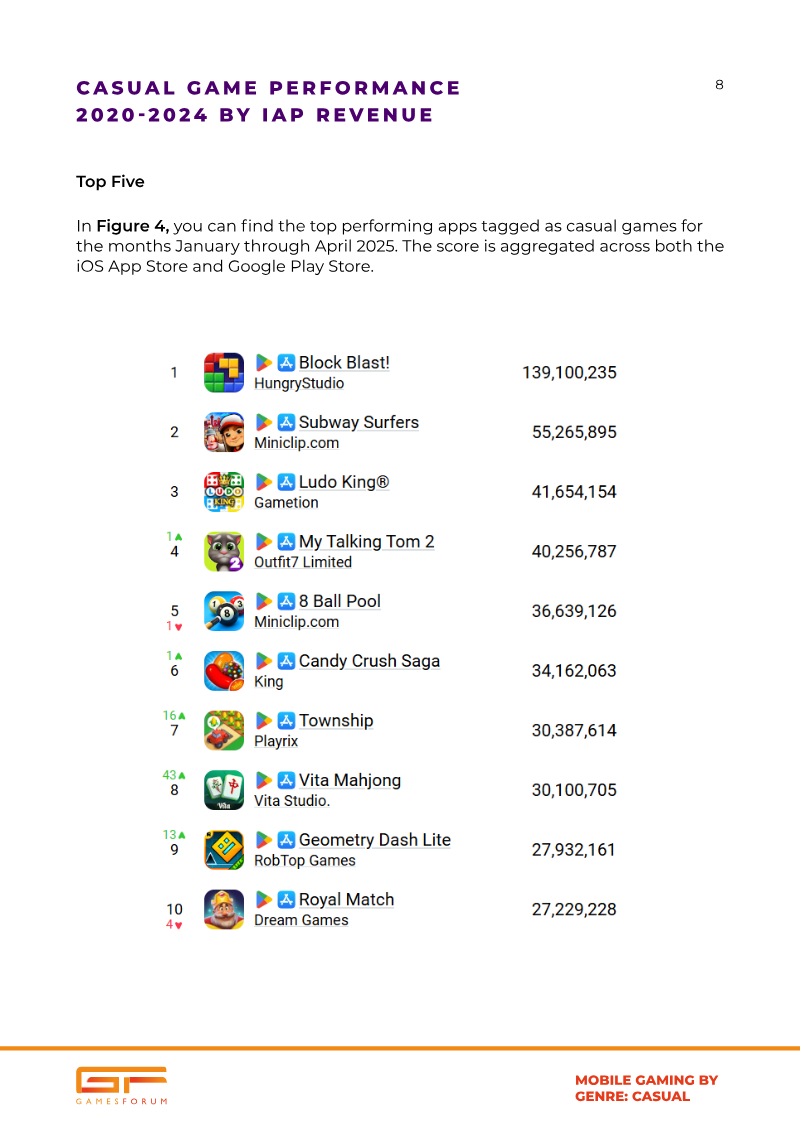
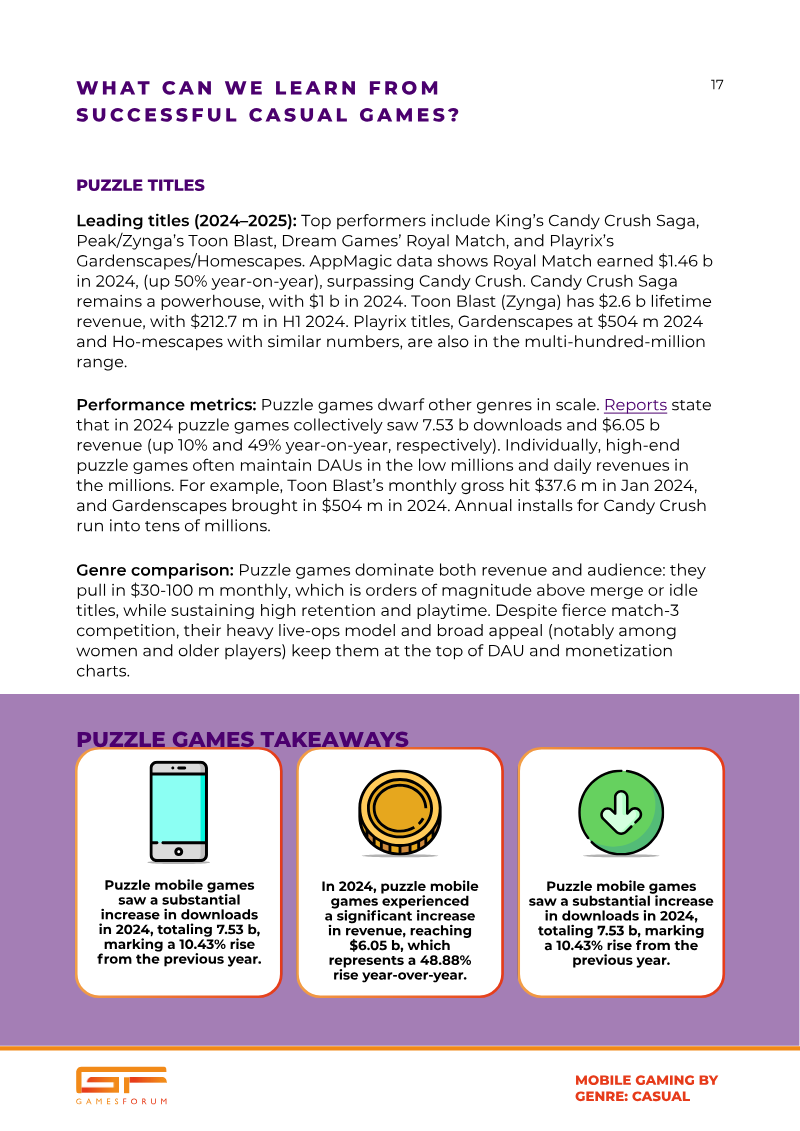
The analysis demonstrates that casual mobile gaming has entered a phase of mature monetization and strategic diversification.
- Casual mobile gaming is shifting toward higher revenue per user, with IAP revenue projected to grow from $16.8 billion to $22.9 billion by the end of 2025 despite a fluctuating download volume.
- Market leaders demonstrate divergent monetization strategies: Royal Match ($540M) and Monopoly Go! ($431M) rely exclusively on IAPs, while Candy Crush Saga ($421M) successfully integrates advertising.
- Playrix’s portfolio approach, utilizing a suite of titles like Township and Gardenscapes, generated a combined $554 million, proving the effectiveness of hybrid monetization and established franchise management.
If You Want To Make Games Alone... WATCH THIS
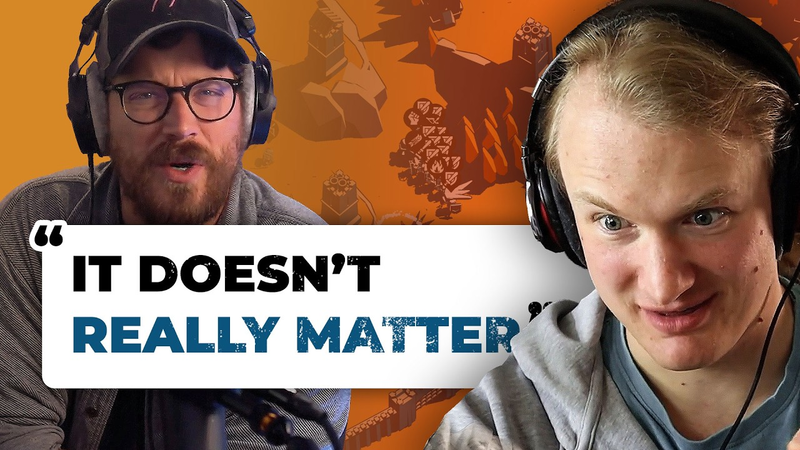
The decision to pursue solo game development versus team-based collaboration centers on the trade-off between creative autonomy and the increased probability of commercial success.
- The primary goal of team composition should be 'talent density,' where you only bring in partners who can perform specific tasks better than you to improve the overall quality of the final product.
- Revenue sharing with partners or publishers is largely irrelevant to financial viability because game success follows an exponential distribution, meaning you are either far above or far below your break-even point regardless of a 50% split.
- Partnering with others increases the likelihood of a project's success, often providing a greater net benefit than the cost of splitting royalties.

📊 Is 24-Month Payback the New Normal? Real ROAS Benchmarks Revealed!
The mobile gaming industry is currently navigating a period of significant financial strain characterized by a widening gap between user acquisition costs and monetization growth.
- Payback windows for mobile games are extending significantly, with many titles now requiring 12 to 24 months to achieve full return on ad spend (ROAS).
- M1 ROAS serves as the primary predictor for long-term success, where a 40% M1 ROAS typically correlates to a 6-month payback, while under 25% indicates a payback period exceeding 12 months.
- Hybrid monetization is becoming the industry standard, with traditionally IAP-heavy genres like 4X and strategy games increasingly incorporating rewarded ads, and ad-heavy games adopting IAP-focused VIP tiers.

The Evolving Future of User Acquisition with Mistplay's CCO Aaron Thandi
The mobile gaming loyalty sector is undergoing a strategic shift toward long-term engagement, moving away from traditional offer-wall mechanics in favor of AI-driven matchmaking.
- Mobile gaming acquisition is shifting from short-term retention metrics like D1-D7 to long-term lifetime value (LTV) and high-value user cultivation.
- Platforms are replacing traditional offer-wall mechanics with AI-driven matchmaking to provide personalized game recommendations that foster sustainable engagement.
- Strategic success is increasingly measured by time spent in-game rather than session frequency, as the former serves as a more reliable predictor of future player spending.

How I Went From a 3D Artist to GM of a Billion-Dollar Game - Justin MacFarlane
Professional advancement in the gaming industry is best achieved by prioritizing cross-functional mastery and the proactive identification of organizational needs over rigid adherence to specific job titles.
- Operational excellence in live service games requires integrating data-informed decision-making with rapid, iterative development cycles to respond to real-time player engagement metrics.
- Physical proximity of product, analytics, and development teams is a critical strategy for maintaining the high-speed collaboration necessary to manage complex, billion-dollar live service ecosystems.
- Career advancement in the gaming industry is best achieved by prioritizing cross-functional mastery and internal mobility over rigid adherence to specific job titles.

Epic Defeats the Big Bad Apple - Here's What it Means
The recent legal ruling in the Epic Games versus Apple case marks a significant shift in the mobile gaming landscape, as a federal judge determined that Apple violated a 2021 injunction by imposing a 27% commission on external purchases and restricting developers from directing users to alternative payment methods.
- A federal judge ruled that Apple willfully violated a 2021 injunction by imposing a 27% commission on external purchases and restricting developer communication regarding alternative payment methods.
- The court has prohibited Apple from collecting fees on external transactions and from limiting how developers direct users to third-party payment options, despite Apple's ongoing appeal.
- Epic Games is leveraging the ruling to relaunch Fortnite on the US iOS App Store, marking a significant shift in mobile distribution access.

Week in Mobile Games E52: Tim Sweeney's epic App Store win & Tripledot's $800m AppLovin deal
The mobile gaming landscape is undergoing a structural transformation driven by legal challenges to platform monopolies and significant consolidation among major publishers.
- A US court ruling now mandates that Apple must allow developers to link directly to external payment systems on the App Store, a move expected to significantly impact mobile ecosystem revenue tracking and user acquisition strategies.
- Tripledot has acquired AppLovin’s games business, adding 10 studios—including Lion Studios, Machine Zone, and PeopleFun—to its portfolio, creating a combined entity with 2,500 employees and an anticipated $2 billion in annual gross revenue.
- The Tripledot acquisition doubles the company's daily active users to 25 million and expands its footprint to 23 cities, with the firm maintaining a 20% stake in the new venture alongside AppLovin.

Behind Roblox’ Unhinged Growth
Roblox continues to demonstrate significant growth, characterized by a consistent upward trend in key performance indicators, including a 25% to 30% increase in daily active users (DAU) and a 22% rise in the US and Canada market.
- Roblox is approaching 100 million daily active users (DAU), driven by a 25% to 30% overall growth rate and a 22% increase in the US and Canada market.
- The platform is successfully expanding its demographic reach by retaining users as they age past 13 while maintaining a stable acquisition rate for younger players.
- Financial health is supported by strong free cash flow, bolstered by an economics team that uses algorithmic price personalization, regional adjustments, and dynamic price floors for avatar cosmetics.

TWIG #330 The App Store Endgame, Roblox’s Growth Playbook and GTA 6 Trailer Dissected
The gaming industry is currently undergoing a structural transition defined by a shift from high-burn, venture-backed marketing toward disciplined financial sustainability.
- Scopely’s Monopoly Go has surpassed $5 billion in lifetime gross revenue by utilizing direct payment integrations to bypass standard platform fees.
- The gaming industry is shifting from high-burn, venture-backed marketing models toward a focus on disciplined financial sustainability and high-ROI content strategies.
- Roblox is approaching 100 million daily active users by leveraging sophisticated economic modeling, dynamic pricing, and the acquisition of branded content studios to scale advertising.

Has Xbox’s Call of Duty Game Pass gamble paid off?
The gaming industry is currently navigating a period of structural transition defined by shifting distribution models and evolving consumer engagement strategies.
- Microsoft’s inclusion of Call of Duty: Black Ops 6 in Xbox Game Pass drove record subscriber growth, capturing 47% of the franchise’s console player base in late 2024.
- The initial surge in Game Pass subscribers following the Black Ops 6 launch has leveled off, forcing Microsoft to shift toward a multi-platform publishing strategy to sustain revenue.
- The console sector is currently experiencing stagnation, driven by the delay of major titles like Grand Theft Auto 6 and a reliance on legacy hardware that is underperforming compared to historical cycles.