Monetization reports and market data
Documents

UNCUT: Co-CEO Javier Ferreira and The Scopely Playbook Behind $5B Monopoly GO!
Scopely has evolved from a modest enterprise generating $12 million in annual revenue in 2014 to a global powerhouse exceeding $2.8 billion by 2023.
- Scopely scaled its annual revenue from $12 million in 2014 to over $2.8 billion by 2023, anchored by the $5 billion performance of Monopoly GO!.
- The company’s growth strategy centers on aligning high-quality intellectual property with product mechanics that specifically honor the established fantasies of existing fanbases.
- Scopely treats M&A as a daily operational function rather than a sporadic event, utilizing shared incentives and long-term alignment to mitigate the risks of scaling.

The Hard Conversation The Games Industry Keeps Avoiding—And Why People Are Talking Now
The gaming industry faces an urgent imperative to address systemic issues regarding toxic advertising, player safety, and ethical monetization.
- The gaming industry faces significant reputational and regulatory risk due to the proliferation of misogynistic and domestic abuse imagery in mobile game advertisements, often propagated by automated AI-driven networks.
- A fragmented ecosystem involving developers, publishers, and third-party ad networks currently lacks the unified oversight necessary to prevent the dissemination of harmful advertising content.
- Current regulatory frameworks, such as age-appropriate design codes, are criticized for placing disproportionate compliance burdens on small developers while failing to mitigate risks from user-generated content and external platforms.

The Real Reason Why Discord Replaced Their Beloved CEO
The departure of Discord CEO Jason Citron marks a strategic pivot for the platform, signaling a transition from a founder-led, community-focused entity to a profit-driven organization preparing for a potential initial public offering.
- Discord has replaced long-time CEO Jason Citron with Humam Sakhini, a former Activision Blizzard executive, to pivot the company toward profit-driven operations and a potential IPO.
- Despite reaching over 200 million active users and a $15 billion valuation, Discord has struggled to generate consistent revenue after raising nearly $1 billion in funding.
- The company is aggressively shifting its business model to include advertising and subscription-based monetization, strategies previously resisted by its founders.

Sorry Gamecraft, You Got It WRONG
The central debate concerns whether the mobile game industry’s genre stagnation is a result of platform-enforced distribution duopolies or inherent consumer preferences.
- The mobile game industry's genre stagnation is driven by a whale-centric economy where a tiny fraction of users generates the vast majority of revenue, rather than by platform-enforced distribution duopolies.
- Developers are economically incentivized to prioritize high-monetization genres like 4X, casino, puzzle, and RPG because these formats align with the spending habits of high-value players.
- The current market operates on a performance marketing model where user acquisition costs are bid up to match the lifetime value of whales, creating a cycle that discourages innovative content.

Mobile Game Publishing 101: How to Get Your Game Published
The mobile gaming landscape has reached a state of significant consolidation, rendering self-publishing an increasingly difficult path for independent studios.
- Publishers require specific retention benchmarks for partnership consideration: 35–40% Day 1, 20% Day 3, and 10% Day 7 retention rates.
- Success in the current mobile market is defined by unit economics where the lifetime value (LTV) of a user consistently exceeds the cost per install (CPI).
- Developers should implement hybrid monetization models that combine advertising and in-app purchases to ensure financial stability during the soft launch phase.

EMERGENCY EPISODE: Capitalize on The Epic vs. Apple Ruling
The recent legal ruling in the Epic versus Apple case marks a significant shift in the mobile gaming landscape, specifically regarding payment infrastructure in the United States.
- A federal judge ruled that Apple violated a 2021 injunction by restricting developers from informing users about alternative payment methods and imposing a 27% tax on external purchases.
- Developers are now permitted to include direct links to external payment systems within iOS applications, allowing them to bypass Apple’s proprietary payment gateway.
- Larger publishers can use these direct payment channels to optimize customer acquisition costs and increase lifetime value, enabling more aggressive bidding in user acquisition markets.

🚨 EMERGENCY EPISODE🚨 Game over, Apple? What you need to know & do NOW!
The April 30, 2025, United States court ruling marks a transformative shift in the mobile gaming industry by declaring Apple’s anti-steering policies anti-competitive and unenforceable.
- The April 30, 2025, U.S. court ruling declared Apple’s anti-steering policies anti-competitive, immediately allowing developers to bypass Apple’s payment systems and avoid the mandatory 30% commission.
- Developers can now link directly to web stores and promote off-platform pricing, with industry projections suggesting up to 50% of iOS revenue can be migrated to these web-based platforms.
- Studios are increasingly utilizing merchant-of-record services to handle the complexities of global payment processing, risk mitigation, and regulatory compliance associated with direct-to-consumer sales.

Cross-Border Publishing: Lessons From Netease’s Once Human
The global expansion of Chinese game development is exemplified by the strategic launch of the survival title Once Human.
- NetEase achieved a peak of over 200,000 concurrent users for 'Once Human' by prioritizing a PC-first launch before expanding into a cross-platform mobile version.
- The studio opted for global self-publishing to maintain direct control over player relationships, brand messaging, and the ability to iterate rapidly based on community feedback.
- Monetization for the Western market was intentionally restrained, focusing on cosmetic items and engagement-driven systems rather than the more aggressive models often seen in mobile-first markets.

Why You Can't Crowdfund Video Games | Design Club
Crowdfunding serves as an ineffective and unsustainable primary model for financing modern video game development.
- Crowdfunding is not a viable primary funding model for modern video game development because the actual costs of production—often millions of dollars for a two-year project—far exceed what can realistically be raised through public campaigns.
- Over a 16-year period, only about 60 video game projects have successfully raised more than $1 million on Kickstarter, highlighting how rare high-level crowdfunding success is for the industry.
- Successful crowdfunding campaigns often function as pre-order platforms rather than development funding, requiring developers to already possess a playable alpha or significant concept art to attract backers.

TWIG #329: Royal Match Goes All-In, Discord Shifts Gears, Call of Duty Meets Its Match
The mobile gaming industry is currently defined by a tension between aggressive, high-budget marketing strategies and the structural limitations of user acquisition economics.
- The mobile gaming industry is experiencing genre stagnation as developers prioritize high-LTV models like puzzle and 4X games to justify rising user acquisition costs.
- Aggressive, celebrity-led marketing campaigns, such as those for Royal Kingdom, are yielding diminishing returns by attracting low-value users rather than the high-spending 'whales' required for profitability.
- Major industry players are shifting toward operational efficiency, with Discord pivoting to advertising and monetization, and NetEase consolidating resources to reduce the costs of Western operations.
Digital Market Index: Q1 2025
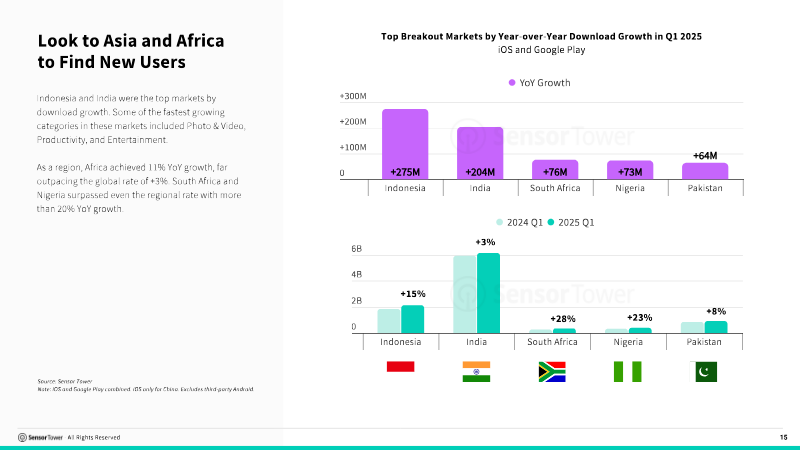
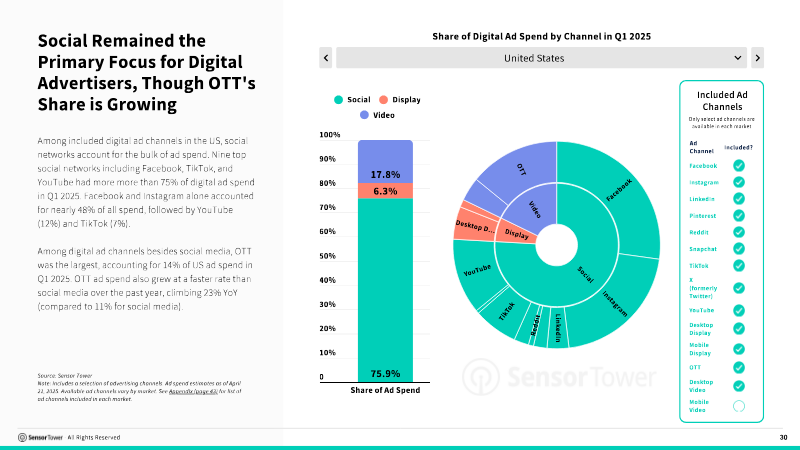
The global digital economy experienced a transformative first quarter in 2025, characterized by a shift in revenue dominance toward non-gaming applications and a strategic pivot in advertising priorities.
- Total in-app purchase revenue reached a record $40 billion in Q1 2025, marking an 11% year-over-year increase despite a 2.5% contraction in total game downloads.
- Financial services advertising surged by 43% in the U.S. market, driven by tax season activity and renewed interest in cryptocurrency.
- Retail media impressions grew by 31% year-over-year, with platforms like Walmart and Chewy establishing themselves as leaders in the space.


2025 GDC Trends Report: Connecting the World Through Games
The global game industry in 2025 is defined by a strategic pivot toward practical generative AI implementation and sustainable monetization models in response to market saturation and rising development costs.
- The mobile in-game advertising market reached $100 billion in 2024, officially surpassing revenue generated from in-app purchases.
- Financial instability has forced 56% of studios to rely on personal funding as the publishing landscape becomes increasingly selective.
- The industry is experiencing a 17% layoff rate, which has served as a primary catalyst for the formation of the United Videogame Workers union.