Transcript
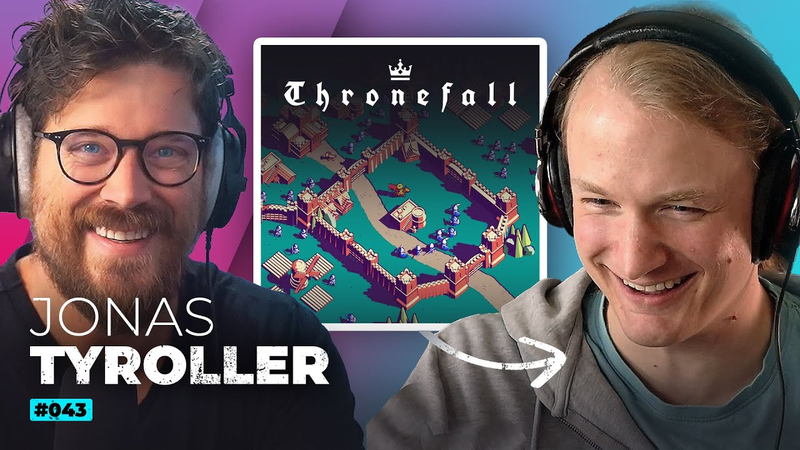
Should you make a game alone or should you work with a team? Jonas Tyroller, the co-creator of Thronefall, he's done both. And he told me something that definitely caught me off guard. He said that sharing your revenue with another developer really doesn't matter. That is, as long as you do one thing. If you do this one thing, sharing your revenue with a developer or even a publisher, it doesn't really matter. So, let's jump into this conversation, which by the way, it's from a bigger conversation for a fulllength podcast episode, and the link is below. So, let's talk about team development versus solo development and which one is right for you. And by the way, if you want an extra team member on your project with a significantly lower cost, consider Bezi, today's sponsor. They're the creators of this new and interesting tool for Unity that uses AI to write code and scripts and has a real-time deep context of your entire project. It has full context of the codebase, asset library, scene graph, and components, allowing it to provide tailored suggestions for your game. It
can also pinpoint scripts, components, and scene interactions, maybe causing issues, and propose custom fixes to help you identify performance bottlenecks. What's really unique is that it can also give a detailed technical explanation of your entire project, which could save a ton of digging around when collaborating with other team members on a larger project. Your project integrity and data privacy are of course completely secure, so your project stays 100% yours. Bezi is currently in active development and will have a ton of new updates coming soon, including the ability to preview and accept code changes directly within your scripts. That's pretty cool. They have just opened up early access for everyone. That includes you. So, you can download it right now to check it out for yourself by simply clicking the link in the description. I want to do solo dev this year. I probably want to do it for like two years. Um, I just want to be a hermit again. There's something romantic about it. You know what I mean? I'm curious. Is your solo dev life cyclical? Do you go solo dev, then work with a
team, then solo dev, then you work with a team? Because you're solo now, right? They they both scratch kind of different. It just if if you're solo, you have like all the freedom you want. You can do whatever you want. You don't need to justify any of your ideas. Mhm. You want to do something really stupid, there's nobody who's like, "Uh, that's always kind of stupid." You can just You can just do it. That's very That's very uh liberating. Mhm. At the same time, uh team projects with with a good team are just more likely to be successful. That's that's also the case. So I think for my commercial projects, I will try to go with a team whenever I can with with a good team. You know, a lot of these tech billionaires I've heard this uh advice given a couple of times. You don't need to like them, but they do give good advice sometimes. Is what actually you're talking about Elon Musk, aren't you?
Maybe, maybe not. Well, but what actually matters is not the size of your team, but the um talent density you have in your team. Much more important. So, if you bring somebody in who can do something much better than you. Mhm. And you just let that person do that one thing, then it's like an upgrade for the team because you basically improve the average skill of your team. But if you bring somebody into your team to just do something worse that you could al also do to maybe get it done faster. I guess doing something faster is another reason to sometimes bring somebody somebody in. But in general if you want to build something where the only goal is to make it as good as possible. Then obviously the conclusion from that is that you only bring people in who can do something better than you so that you get get a better end result. Okay. Have you ever paid somebody a full-time salary? Um, we have
a we have a community manager who I think can live off of what what he what we pay him. Okay. So, it's a it's a freelancing contract. So, well, you know, that's not really gamedev, though. It's like studio management, right? I guess the reason I ask is because or the reason I clarify that is because you've never when you say team, it's not a team of salaried positions or contract workers that are building your game. Instead, it's an it's a team effort, meaning you guys get a royalty share. Correct? Yeah. Okay. Um I think this is an interesting I wanted to ask you about this. I can't bring myself to do that because Why? Um because I like to be in charge. Mhm. Would you say leadership is forfeited when you do that? When you partner up like that? When you share responsibility
and revenue and everything because suddenly everyone's got a stake in it and therefore they feel like they have a valid they have a valid leadership position. They they have a say and so they can trump what you say. Yeah, of course. Yeah. Yeah, of course. And it also happens all the time. You have to be um willing to make compromises and you also often times obviously have have these discussions. It's a little bit of a give and take also where like okay, yeah, I guess you're right on that. And sometimes you have to walk your own opinion back a little bit to make room for for what the other person thinks. And and the very difficult thing about it is of course to not make it something personal because it can very easily become something personal where it's like no you blocked my idea so now I'm going to block yours and um you need to be very careful that you don't end up in that kind of team dynamic. Yeah. But as long as you're like reasonable and try very hard not to take anything personal, I think it's
extremely productive. And I also think that the incentive of people actually having ownership over the project does very much help to to make them give their best and also to you know they also feel more of that responsibility. So I think people are also more proactive like a lot of times like the employee mindset is kind of okay I'm just going to do what what you tell me. I I'll just turn my brain off. You're the brain. I'm just going to do whatever you say. The advantage of having somebody with shared ownership is that they actually proactively do things and proactively use their brain for you. So often times you you come back to the project and there's just there just there have just been a lot of good decisions been made on your behalf that you didn't have to take yourself. So it's it would have been like okay Paul works on something for a week all of a sudden there's like a new git commit and like the all of the UI looks way better now and I'm like oh
I I couldn't have done it better basically like oh man that's beautiful. So in a way in a way what what what's happened is for me I can't do it emotionally because I like to be in charge. I'm just being being as transparent as I can. I like to be in charge. Number two, you kind of forfeit getting a publisher because there's not much revenue share to split. You see what I mean? Like, let's say a publisher comes in and they're like, "Well, we want to give you guys $300,000 for 30% of the revenue." Well, you've already done a 50-50 split, so now you got to give 30% and now you got to split 70. And that sucks. I don't think it I don't think it matters that much to be honest. It's like for there are certain kinds of media
or success where where you know it's it's a exponential curve. The the amount of success you can have is sort of distributed like an exponential curve. There are a lot of people getting nothing and then all of a sudden there's like a very steep increase where the next guy gets like double what the last one got. And the and on an exponential having 50% more or 50% less is actually not that big of a difference on an exponential scale. So I don't think I don't think it surprisingly doesn't have that big of an impact on whether you're profitable or not. Is that what you're talking about? Can you see that? Exactly. That's what I mean. Okay. Now, is did I put throne fall in this in the correct spot? Yeah, I think so. Somewhere somewhere around there, maybe. Y. So, now let's try Okay, now that we've got your graph, I'm an idiot, dude. I'm trying to figure this out. Yeah. So, um you're like, "Yeah, sure." Uh
so, what you're saying is look, it doesn't matter. you're gonna make very little money or a lot of money. Is that what you're saying? I'm saying if you cut all of these bars that you just drew in half, the amount of them that are above a specific line doesn't actually change that much. Like at the moment, they're like maybe 10% above the line. If you cut them in half, it's it's not like only half of them are above the line. It's I know, but look, if let's let's say this is our I'm trying to figure what you're saying. If this is my revenue right here, let's say that's my game. If I partnered up with somebody, I just lost all of that revenue. Yeah. But can you see that you're still in the top 1% of everybody still? I know. But not really because I only got this. Yeah, but it doesn't at that point. I don't think it matters. Like it's still a lot of money is what you're saying. Yeah. Okay. Okay. So, what I'm saying is
like on but like hold on hold on let me let me finish my point. Okay, cuz I'm going to I'm devil's advocating you here. Okay, let's say that that bar right there that I just circled, that's $100,000. Okay, if I partnered up with a publisher and a partner, let's say I partnered up with you and we made a game and we got a publisher. Mhm. Now I only made 30K. Well, I mean, whatever the number is after the steam cut, you barely made anything. You made 20K. You can't live on that. You lose everything. You have to go get a job. Or if you do it alone, you make 100K. Exactly. So there there's a small narrow bend where the 50 minus 50% is going to make the difference for you. But I'm saying you have a certain break there is a certain break even point that you have and the odds of landing exactly on this break even point with your game is minuscule. You're either going to make way less
than you need to break even or you're going to make way more than you need to break even. So it's taking 50% away is not going to not going to change your odds that much actually. Okay. So royalty shares and revenue share doesn't really matter if you make a good game. Yeah. It's it's like um if you make the next hit indie game, if you make the next Undertale, doesn't really matter if you have another partner with you that takes 50% of what what you would have what you would have gotten. It's like, okay, sure thing. Um I guess I could have made double if I made this game alone, but I didn't. I can't make this game alone anyway. So what's also what's the point of of making the comparison in the first place? Okay. So in order to stay away from the midpoint or that where it's I think I know what you're saying. So in order to stay away from that bottom of the bell curve or not bell curve uh the bottom of that exponential
curve you should probably partner up. Is that what you're saying? You there there's a priority list. You should only partner up with people who who make your team better. Sure. If you can't if you can't do that, then you should work alone. And the worst thing you can do is to work with people who make your team worse. Okay. So, what you're saying is do everything we can to hit this spot, even if that means giving up royalty shares. Yeah. If you if you hit that spot, it it also doesn't matter. If you're like 50% lower, that's kind of fine. Yeah. And and and what I'm saying is it's very very difficult to get to that spot as a solo anyway. So might as well just partner up with people and work with people to get to that higher spot. Exactly. I think I think it's very much worth it. I think the the the cost benefit analysis maybe to simplify this whole thing a little bit is is just like you get way more benefit from partnering with somebody
than it cost you. That's like the if if I have to put it very simply in plain English, that's what it is. That's exactly what it is. Unless you're brilliant. Unless you're brilliant. That's that's ex also exactly what I said earlier. You should only team up with people who make your team better in some way because they can do certain things better than you can. I love that, dude. Your brain, it always thinks in terms of charts. It's like your brain is a TI83 calculator. every time we talk, you end up sending me a chart or something or giving me like, well, the X and the Y. But I I think that's great. You know, it helps me a lot. Um, it helps me a ton. Also, hey, don't forget to check out Bezi to accelerate and simplify your development workflow. Early access is now open for everybody. That includes you. So, you can try it out for yourself right now simply by clicking the link in the description.
Auto-generated captions from YouTube — names and numbers may be misheard.
Key insights
6 takeaways · ~2 min read- 01The primary goal of team composition should be 'talent density,' where you only bring in partners who can perform specific tasks better than you to improve the overall quality of the final product.
- 02Revenue sharing with partners or publishers is largely irrelevant to financial viability because game success follows an exponential distribution, meaning you are either far above or far below your break-even point regardless of a 50% split.
- 03Partnering with others increases the likelihood of a project's success, often providing a greater net benefit than the cost of splitting royalties.
- 04Shared ownership incentivizes team members to be proactive and contribute high-level decision-making, which often leads to better project outcomes than a traditional employee-employer dynamic.
- 05Solo development offers total creative freedom and eliminates the need for interpersonal compromise, but it significantly limits the scope and quality of the game compared to a high-talent team.
- 06When working with partners, it is critical to maintain a professional dynamic and avoid taking disagreements personally to prevent the team from becoming dysfunctional.
Ask AI about this video
Cite this video
Citation
Generating citation…





















Comments