Monetization reports and market data
Documents

Scientific Revenue's Ted Verani on increasing your IAP revenue via dynamic pricing
The mobile gaming industry has shifted decisively toward free-to-play models, rendering traditional premium pricing strategies largely obsolete for most developers.
- Developers should replace static pricing with dynamic models that use real-time data—such as device type, location, and engagement patterns—to align offers with individual player price sensitivities.
- Internationalizing pricing tiers for emerging markets can increase lifetime value (LTV) by more than 10 percent by capturing revenue from non-affluent but highly active player segments.
- Initial acquisition timing is a critical predictor of spending propensity, making immediate monetization efforts upon a user's first entry into the game essential for long-term revenue.
The Lottery - Why People Favor Worse Odds - Extra Credits
The Multi-State Lottery Commission’s 2015 decision to adjust the Powerball odds from 1 in 175 million to 1 in 292 million serves as a significant case study in human psychology and incentive design.
- The Multi-State Lottery Commission increased Powerball odds from 1 in 175 million to 1 in 292 million in 2015 to prevent frequent payouts and allow jackpots to accumulate.
- Player participation follows an exponential growth curve relative to the size of the jackpot, proving that the allure of a massive reward overrides rational statistical analysis.
- Human behavior in lottery systems contradicts the traditional game design assumption that players prioritize consistent, predictable rewards and steady progression.

2016 Global Esports Market Report: An Overview of the Esports Market & Its Valuable Audience
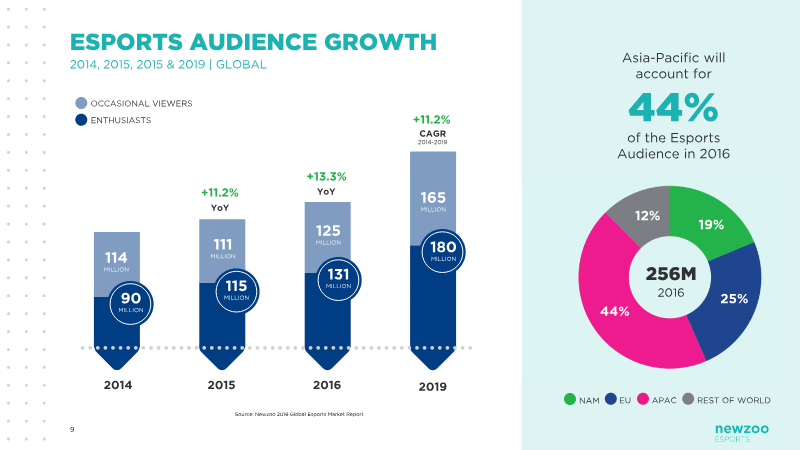
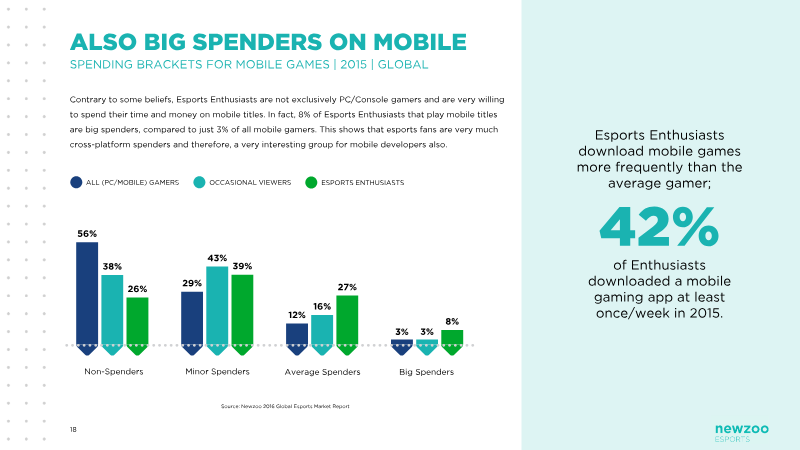
The 2016 Global Esports Market Report provides a comprehensive overview of the esports market, its growth trends, and the valuable audience it attracts.
- The global esports economy reached $325 million in 2015, with projections indicating continued rapid acceleration.
- The esports enthusiast audience grew by 13.3% year-over-year, signaling a shift in gaming from a personal activity to a spectator sport.
- Revenue per enthusiast is projected to rise from $2.20 in 2014 to $6.00 by 2019.

Monetizer: Path of War
Path of War, a mobile strategy game developed by Envision and published by Nexon M, attempts to differentiate itself within the crowded mobile strategy genre through specific gameplay mechanics and a focus on alliance-based social structures.
- Path of War, developed by Envision and published by Nexon M, utilizes a grid-based base-building system combined with lane-defense style combat mechanics.
- The game employs a traditional monetization model featuring a single construction queue bottleneck that incentivizes players to spend hard currency (diamonds) to accelerate progress.
- Combat is restricted by a command point system that limits unit deployment, requiring players to wait or pay currency to replenish forces.

Monetizer: Marvel Avengers Academy
Marvel Avengers Academy, a school-themed simulation game featuring teenage versions of Marvel superheroes, utilizes a highly aggressive monetization model that raises questions regarding its suitability for its target demographic.
- Marvel Avengers Academy employs an aggressive monetization model where unlocking specific high-profile characters can cost players more than $60.
- The game utilizes a dual-currency system consisting of gold and shards, which are required to purchase cosmetic items, upgrade buildings, and unlock characters.
- Core gameplay is structured as a time-gated metagame that relies on repetitive task management and waiting for timers, with in-app purchases offered to accelerate progress.

IAP Inspector: Marvel Avengers Academy
Marvel Avengers Academy functions as a management-style simulation game featuring iconic Marvel characters reimagined in a high school setting.
- Marvel Avengers Academy utilizes a management-style simulation loop centered on wait-timers, requiring frequent, short play sessions rather than extended engagement.
- The monetization model relies on aggressive hard currency (shard) consumption to bypass timers, with premium character unlocks costing upwards of twenty dollars.
- The game lacks secondary activities or mini-games to occupy players during wait periods, resulting in a stagnant experience that offers no gameplay options for non-paying users.

How Madden NFL Mobile drove EA Mobile's FY16 Q3 financials
EA Mobile’s financial performance for the third quarter of fiscal year 2016, covering October through December 2015, demonstrates a significant disparity between GAAP and non-GAAP accounting metrics.
- EA Mobile reported non-GAAP revenue of $162 million for FY16 Q3, marking a 43% quarterly increase driven by deferred revenue recognition in its free-to-play model.
- GAAP revenue for the same period was $126 million, reflecting a more modest 3% quarter-over-quarter and 5% year-over-year growth compared to non-GAAP figures.
- Madden NFL Mobile served as the primary growth engine for the quarter, leveraging a mid-August update to align with the NFL season and improve engagement levels.

Is there life for Glu Mobile after Kim Kardashian?
Glu Mobile’s 2015 financial performance highlights the volatility of the celebrity-driven mobile gaming model.
- Glu Mobile’s 2015 revenue stagnated at $250 million, a marginal 1% increase, highlighting the volatility of a business model heavily dependent on celebrity-driven titles.
- Revenue concentration remains a critical risk, with 'Kim Kardashian: Hollywood' and 'Racing Rivals' accounting for 47% of the company's total annual revenue.
- The commercial failure of 'Katy Perry Pop' and 'James Bond: World of Espionage' forced an organizational restructuring and a leadership change to address lapses in internal quality control.

IAP Inspector: Path of War
Path of War, a mobile strategy title developed by Envision Entertainment and published by Nexon M, attempts to differentiate itself within the crowded mobile strategy market through a unique base-movement mechanic and a column-based combat system.
- Path of War, developed by Envision Entertainment and published by Nexon M, features a restrictive monetization model that creates significant friction for both free-to-play and paying users.
- The game utilizes a dual-resource constraint system where energy is required for both map movement and combat, while command points limit the deployment of full unit rosters.
- Progression is bottlenecked by a building system that restricts concurrent upgrades to a single slot unless players purchase additional, expensive crane capacity.

Monetizer: Sandstorm: Pirate Wars
Sandstorm: Pirate Wars, a mobile title developed by Ubisoft, functions as a free-to-play combat game set in a post-apocalyptic, Mad Max-inspired universe.
- Ubisoft's Sandstorm: Pirate Wars utilizes a resource-heavy, grind-focused progression loop that prioritizes meta-game management over active, high-intensity combat.
- The game employs a standard free-to-play monetization model featuring a dual-currency system of soft 'bolts' and hard 'power cells' to gate progression through energy systems and repair timers.
- Core combat mechanics are modeled after drag-racing titles, requiring players to manage power distribution between shields and weapons within a fixed-camera environment.

FTUE: Sandstorm: Pirate Wars
Sandstorm: Pirate Wars functions as a free-to-play mobile title developed by Ubisoft, characterized by a post-apocalyptic, Mad Max-inspired aesthetic.
- Ubisoft’s Sandstorm: Pirate Wars is a free-to-play mobile title featuring a post-apocalyptic, Mad Max-inspired aesthetic and a core loop of tactical ship-to-ship combat.
- The game employs a restrictive energy-based resource system that forces players to balance energy consumption between offensive weapon systems and defensive shield boosts.
- Progression is driven by a cycle of combat, loot collection, and the acquisition of 'bolts' currency to upgrade ship equipment for increasingly difficult encounters.
Free to Play Laws - Can We Stop Predatory Practices? - Extra Credits
Current regulatory efforts regarding free-to-play (F2P) games, particularly those implemented within the European Union, focus disproportionately on protecting children.
- Current regulatory efforts, particularly in the EU, disproportionately focus on protecting children, which serves as a political mechanism that avoids impacting the core business models of F2P games.
- The primary targets of predatory monetization are vulnerable adults—such as those with compulsive spending habits or social isolation—rather than children, who lack independent access to credit.
- F2P companies actively identify and cultivate high-spending 'whales' through personalized incentives, leading to severe outcomes like financial ruin and significant psychological distress for these individuals.