Monetization reports and market data
Documents

🚨📢 BREAKING NEWS: Stillfront's CEO Steps Down + AdColony Sold for Under $5M + Meowdoku Hits 1.7M DAU
The mobile gaming industry is currently experiencing a period of rapid structural shifts, characterized by the decline of aggressive roll-up business models and the emergence of new, high-growth casual titles.
- Stillfront's CEO is stepping down following a period of declining revenue, downloads, and share price, signaling the risks of roll-up business models that rely on high valuations for acquisitions.
- The casual puzzle game Meowdoku scaled from 15,000 to 1.7 million DAU since mid-May by combining Sudoku mechanics with cat-themed aesthetics, generating estimated daily ad revenues of $70,000 to $120,000.
- Affle acquired the AdColony brand and technology assets from Digital Turbine for less than $5 million, gaining access to approximately 80,000 existing app integrations.

TWIG #390: Destiny Ends, Xbox's Biggest Layoff Ever, and Google Play's New Fee Chaos
The global video game industry is currently undergoing a painful period of structural realignment, characterized by the collapse of overly ambitious acquisition strategies and a pivot toward extreme fiscal conservatism.
- Sony’s $3.6 billion acquisition of Bungie has resulted in $766 million in impairment charges and the loss of over 600 jobs, highlighting the failure of the strategy to integrate independent studios into live-service operations.
- Microsoft is pivoting the Xbox division toward a 'fewer, bigger, better' strategy, prioritizing high-performing blockbuster franchises over niche titles to satisfy investor demands for immediate financial sustainability.
- The Xbox Series X has seen its pricing rise to $800, a move that effectively cedes competitive advantage to the PlayStation 5 as Microsoft shifts toward a digital-first, high-margin model.

eFootball vs EA FC, Apple Arcade stats, Stillfront, Queen, alt app stores, payments, more
The mobile games industry is currently experiencing significant shifts in monetization, platform accessibility, and regulatory oversight.
- Konami’s eFootball has achieved a highly effective monetization model in Japan, generating $915 million in lifetime revenue from 12 million downloads, resulting in a revenue-per-download figure exceeding $75.
- Regulatory pressure is mounting globally, with the UK’s Competition and Markets Authority expected to force Apple and Google to remove steering restrictions on payment systems by the end of the year.
- Apple Arcade functions primarily as a family-oriented platform, as data since its 2019 launch shows top-performing titles like Sneaky Sasquatch and Hello Kitty Island Adventure are non-hardcore, while titles targeting traditional gamers see minimal engagement.

NEW ** Panel: Payment Links vs. Web Stores: What Actually Drives Incremental DTC Revenue?
Direct-to-consumer (DTC) strategies have evolved into a critical component of the global mobile gaming market, which currently stands at $81.8 billion.
- Direct-to-consumer (DTC) revenue in the gaming industry has reached a $12 billion market size, with successful studios currently achieving between 15% and 30% of their total revenue through these channels.
- Industry leaders, including those at DECA, report that mature titles can reach up to 40% or more of their revenue through DTC, with expectations that large studios could reach 50% within a few years.
- DTC strategies should be viewed as a funnel where payment links are used for high-conversion in-game transactions, eventually transitioning players to web stores that offer better value and long-term loyalty.
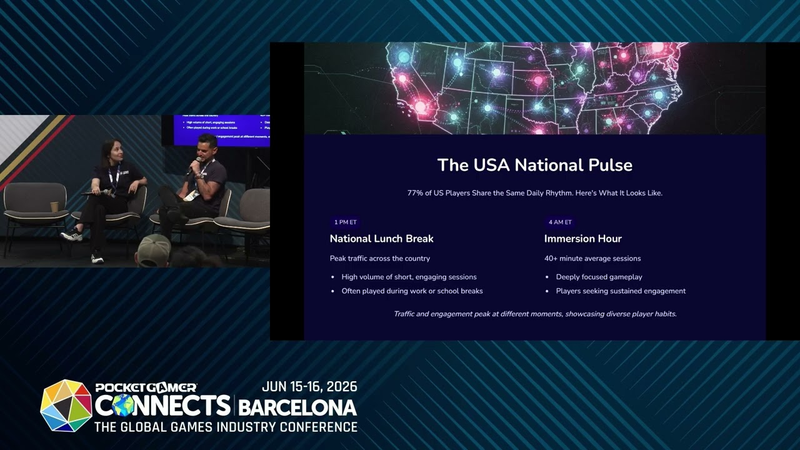
Session: How to Make a Successful Web Game in 2026: What Actually Works - R. Dincer & R. Morgan.
The web gaming industry is undergoing a significant evolution, characterized by increased accessibility and a shift toward higher-fidelity experiences.
- Web games are increasingly viable for developers, with platforms like Crazy Games managing over 5,000 partners and receiving approximately 2,500 game submissions per month.
- Browser-based gaming maintains a strong desktop presence, with desktop users accounting for 65% to 70% of the audience on platforms like Crazy Games.
- Game performance and accessibility are critical for retention, as large, unoptimized projects often lose half their potential audience before the game even starts.

🎮 Live Review Tetris Block Party: Block + Coin Looter into one liveops machine
Tetris Block Party represents a strategic evolution in mobile gaming by merging traditional block-puzzle mechanics with a coin-looter meta.
- Tetris Block Party increases player agency by replacing passive slot-based mechanics with a hybrid model that combines skill-oriented block puzzles with a coin-looter meta.
- The game utilizes template-based event builders that allow monetization managers to deploy complex features like reward wheels and segmented store configurations without requiring engineering support.
- Predictive data models enable automated, proactive interventions, such as granting boosters to players at high risk of churn, which has reduced churn rates by low double-digit percentages.

Panel: From Transactions to Relationships: How Studios Are Redefining Player Ownership.
Modern gaming studios are undergoing a fundamental strategic shift, moving away from short-term transactional metrics like install counts toward the cultivation of sustainable, long-term player relationships.
- Studios are shifting from transactional models to relationship-based engagement by integrating purpose-driven mechanics, such as environmental rewards, which have been shown to increase key performance indicators like first-time deposits and new paying users.
- Effective loyalty programs must move beyond simple 'what's in it for me' incentives—such as discounts—to avoid masking churn and instead foster genuine player investment.
- Personalization is a critical challenge for modern studios, requiring tailored pricing, game difficulty, and experiences that align with individual player profiles to maintain long-term retention.

Podcast: Quantifying the advertising value of cookies (with Garrett Johnson and Shunto Kobayashi)
The transition away from third-party cookies in digital advertising presents a substantial economic challenge for publishers, resulting in revenue declines ranging from 29% to 35%.
- Google’s Privacy Sandbox increases ad latency by 100%, with median ad rendering times rising from 1 second under status quo conditions to 2 seconds, leading to a 3% loss of total ad impressions due to users navigating away before ads load.
- Privacy-enhancing technologies (PETs) like the Privacy Sandbox currently fail to fully bridge the revenue gap caused by the removal of third-party cookies, with the effectiveness of these tools heavily dependent on widespread adoption by adtech firms.
- The revenue impact of privacy restrictions is more severe in markets with fewer alternative identifiers, such as the European Union, where the Privacy Sandbox performs better because it faces less competition from traditional header bidding channels.

Session: Beyond Ads: How Publishers Are Rewriting Mobile Gaming Monetization - J. Vause & A. Jones
The mobile gaming industry is currently undergoing a shift in monetization strategies, moving beyond traditional advertising and in-app purchases toward integrated, rewarded ecosystems.
- Mobile monetization is shifting from traditional ads and in-app purchases toward integrated, rewarded ecosystems to combat rising user acquisition costs and ad fatigue.
- The most effective monetization strategy is a hybrid model that uses AI and machine learning to deliver personalized rewarded offers—such as surveys, retail deals, and third-party installs—at optimal moments.
- While gaming-related offers currently generate the highest revenue, diversifying with non-gaming rewards is essential to maintain engagement across varied user segments.
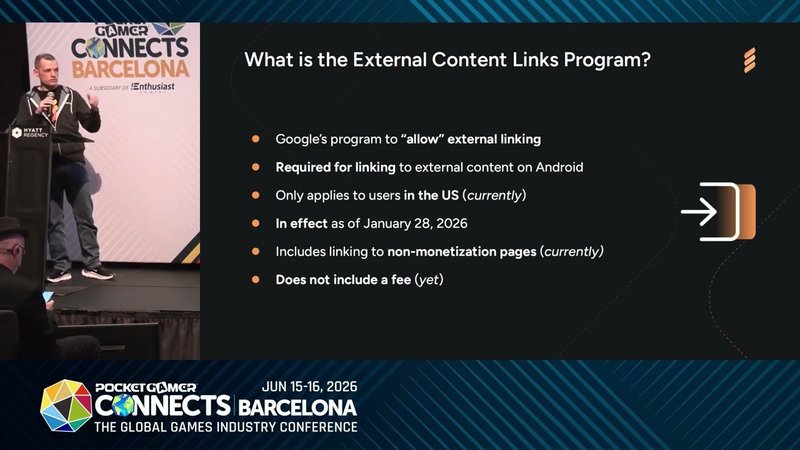
Session: D2C In 2026: Global Growth In Web Stores - Chip Thurston, FastSpring.
The direct-to-consumer (D2C) landscape for mobile gaming is undergoing a significant transformation driven by global regulatory shifts and evolving platform policies.
- Direct-to-consumer (D2C) revenue for mature gaming studios currently ranges between 27% and 44% of total earnings, highlighting a significant and successful shift toward web-based monetization.
- Publishers operating on Android in the United States must enroll in Google’s 'External Content Links' program to avoid app update rejections when linking to external web stores.
- The pending Epic vs. Google settlement proposes a new fee structure that splits the traditional 30% platform fee into a 5% billing fee and a 20-25% distribution fee, depending on the date of the app install.

Designing for the Rewarded Pathway: Why Product Teams are Critical to Ad Strategy
The integration of rewarded advertising into mobile game design has evolved into a critical component of long-term monetization strategy.
- Monetization through rewarded advertising must be integrated as a core pillar of game design during the initial development phase rather than treated as a peripheral business function.
- Product teams should shift focus from isolated early-stage metrics like day-seven ROAS to a holistic view that prioritizes long-term user engagement, retention, and progression.
- AI-driven hyper-segmentation and automation are required to manage complex player segments at scale and dynamically adjust live ops to prevent churn.

Puzzle Monthly #4: $60M Marketing, $65M Revenue, What Happened to Good Job Games?
Good Job Games represents a cautionary case study in the mobile puzzle market, illustrating the limitations of prioritizing rapid asset exits and visual polish over sustainable, player-centric design.
- Good Job Games' title Match Villains generated $65 million in lifetime revenue but likely operated at a loss, as marketing expenditures for the project reached $83 million.
- The studio's failure to compete with industry leaders like Royal Match stems from a reliance on aggressive, punishing level design that prevents the retention of high-value users.
- Match Villains suffered from flat revenue-per-download metrics and an over-reliance on lower-tier geographic markets, preventing the game from achieving necessary scale.