Monetization reports and market data
Documents

Direct-to-consumer banks $17 billion and Google rolls out fee changes | Week in Mobile Games podcast
Direct-to-consumer (DTC) platforms have emerged as a critical pillar of the mobile gaming economy, currently generating $17 billion in annual revenue and capturing 15% of the global market.
- Direct-to-consumer (DTC) platforms now generate $17 billion annually, accounting for 15% of the global mobile gaming market.
- While 92% of publishers expect DTC growth, only 25% of organizations currently possess the mature infrastructure required to scale these operations.
- The mobile gaming industry is experiencing a period of significant contraction, marked by recent layoffs at Electronic Arts, operational consolidation at Kabam, and anticipated restructuring at Xbox.

Grand Theft Absent, Steam Machine Caught in the RAM racket & Bungie’s Bad Day | Games For Breakfast
The gaming industry is currently navigating a period of significant volatility characterized by aggressive monetization strategies, widespread workforce instability, and hardware market challenges.
- Grand Theft Auto 6 will launch with a $79.99 standard edition price point and lacks physical media, a move that may set an industry precedent for other publishers to follow.
- The $55 billion acquisition of Kadokawa involves $20 billion in loan financing, highlighting the high levels of debt-based leverage currently used in major gaming industry mergers.
- Bungie is facing significant internal challenges, including layoffs and criticism regarding its monetization strategies, such as the implementation of multiple currencies and gated content in Destiny.

🚨📢 BREAKING NEWS: New Hoyoverse game, D2C stuff, layoffs and a WhatsApp game
The current state of the mobile gaming industry is defined by a significant shift toward direct-to-consumer (D2C) monetization, ongoing corporate restructuring, and the integration of artificial intelligence in operations.
- Mobile game direct-to-consumer (D2C) revenues are projected to reach $17 billion this year, driven by 53% of publishers planning to port titles to browser platforms to bypass traditional app store billing.
- AppsFlyer secured over $1 billion in funding at a $2.7 billion valuation, signaling continued investor confidence in mobile infrastructure despite broader industry volatility.
- Corporate restructuring persists as Electronic Arts continues workforce reductions during a $55 billion acquisition process, alongside notable layoffs at Netmarble subsidiary Kabam.

TWIG #389: GTA 6 Pricing, Tencent Pulls Back from Japan, and Steam Machine Flops at Launch
The gaming industry is currently undergoing a significant pricing recalibration, anchored by the decision to set the standard edition of Grand Theft Auto 6 at $80 and its deluxe version at $100.
- Grand Theft Auto 6 is setting a new industry standard with an $80 base price and a $100 deluxe version, signaling a move beyond the previous $70 price ceiling for premium software.
- Tencent is retreating from Japanese studio acquisitions, indicating a cooling global M&A market that is pushing startups to explore management buyouts for liquidity.
- Queen Digital Entertainment closed following a $50 million loss, highlighting a shift toward data-driven project management and a move away from pedigree-based venture capital investments.

💰 The $45M/Month Football Game Nobody Talks About: eFootball, EA FC & Dream League Breakdown
The mobile football gaming sector is defined by a high-revenue landscape dominated by three primary titles: eFootball, EA Sports FC Mobile, and Dream League Soccer.
- eFootball currently leads the mobile football sector with $45 million in monthly revenue, outperforming major competitors in the category.
- EA Sports FC Mobile generates approximately $900,000 in daily revenue, primarily driven by complex card collection systems and in-app purchases.
- Dream League Soccer utilizes a distinct monetization model where 68% of total revenue is derived from advertising rather than in-app purchases.
Google Play store fees, Kingshot's World Cup ads, AppsFlyer gets $1bn, Kabam layoffs, more
The mobile games industry is currently navigating significant shifts in platform policy, investment trends, and studio operations. A primary development is Google’s adjustment of Play Store fees, effective June 30.
- Starting June 30, Google Play is lowering store fees for most developers in Western markets, effectively reducing the standard 30% fee to approximately 25% for in-app purchases.
- AppsFlyer secured a $1 billion investment from Google, Meta, Unity, and Moloco, a move analysts suggest is intended to bolster the company's independence and measurement capabilities against AppLovin's market dominance.
- Queen Digital Entertainment, a startup founded by former King executives that raised up to $50 million in VC funding, has ceased operations after failing to scale its casual puzzle game portfolio.

2026 World Cup Effect on Games
The 2026 FIFA World Cup serves as a catalyst for significant shifts in the mobile football gaming landscape, highlighting a divergence between established market leaders and the governing body’s own interactive efforts.
- Konami’s eFootball has surpassed EA’s FC Mobile in cumulative revenue, reaching $1.9 billion compared to FC Mobile’s $1.6 billion.
- While eFootball leads in total revenue, FC Mobile maintains a larger daily active user (DAU) base, highlighting a divergence in monetization strategy versus user reach.
- Major football titles have abandoned traditional seasonal resets in favor of continuous progression and power inflation to reduce user churn.
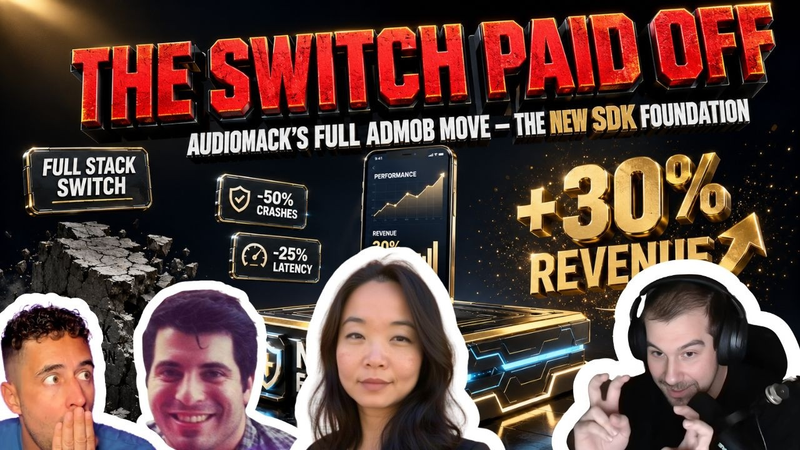
How Audiomack Boosted Revenue by 30% with Google’s New Next-Gen SDK
The migration of the music streaming platform Audiomack to Google’s Next-Gen GMA SDK 1.00 resulted in significant technical and financial improvements.
- Audiomack achieved a 30% increase in total revenue and a 16% rise in ad performance after migrating to Google’s Next-Gen GMA SDK 1.00.
- The SDK migration yielded significant technical improvements, including a 25% reduction in ad load latency and a 50% decrease in app crash rates.
- The 50% reduction in crash rates was particularly impactful for maintaining stability and user retention within emerging markets.

Why Everyone Wants A 'Live-Service' Game
The video game industry has increasingly pivoted toward live-service models as a strategic response to the rising costs and inherent volatility of AAA game development.
- The shift toward live-service models is primarily a strategy to mitigate the extreme financial risk of modern AAA development, where production costs have ballooned from $20–30 million to a $200–300 million floor.
- Live-service games provide recurring revenue streams that stabilize companies against the volatility of a hit-driven industry, preventing total reliance on the success of a single, infrequent release.
- The industry's pivot was heavily influenced by the massive success of Fortnite, which demonstrated the profitability of free-to-play models combined with ongoing monetization through skins, seasons, and content updates.

🎮 The 3-Minute playable that pre-qualifies your WHALES!
Mobile game advertising is currently defined by the widespread adoption of templated playable ads, particularly those featuring fashion, dress-up, or narrative-driven mechanics.
- Extended engagement within multi-level playable ads serves as a primary indicator for identifying high-value 'whale' players, making these demos a critical funnel for long-term monetization.
- Relying on templated playable ads that differ from core gameplay lowers cost-per-install metrics but significantly increases user churn due to the disconnect between the advertised experience and the actual product.
- Studios are maximizing ROI by iteratively refining high-performing playable builds through asset swaps, camera angle adjustments, and seasonal thematic updates rather than creating new assets from scratch.

PGC takeaways, the UK's social media ban and Fortnite vs Roblox | Week in Mobile Games podcast
The mobile gaming industry is currently navigating a complex landscape defined by shifting platform strategies, evolving regulatory pressures, and the pursuit of sustainable growth.
- The UK government is planning to implement a social media ban for under-16s by spring 2027, targeting platforms like TikTok, Instagram, and X while excluding messaging services like WhatsApp and Signal.
- Epic Games has paid over $1 billion to creators through the Unreal Editor for Fortnite since 2023, though the platform faces stiff competition from Roblox, which paid out $1.5 billion to creators in 2025 alone.
- The mobile title 'Where Winds Meet' generated $22.1 million in revenue outside of China during its first six months of release.

🚨📢 BREAKING NEWS: GTA 6 pre-sale, EU regulations looming, Layoffs and Pokemon Champions launch
The current landscape of the gaming industry is defined by high-profile product launches, significant regulatory challenges, and a pervasive trend of studio restructuring and layoffs.
- Take-Two’s stock valuation has risen in anticipation of the upcoming Grand Theft Auto 6 pre-sale.
- Epic Games has set a 2027 target for Unreal Engine 6, focusing on AI-assisted development and live service interoperability.
- Fortnite’s creator ecosystem has surpassed $1 billion in total payouts since 2023, with community-made content now accounting for nearly 50% of total playtime.