Mobile reports and market data
Documents

Curated Panel: Leveraging Player & AI-Powered Business Insights – Unlocking Value For Hybrid.......
Hybrid monetization strategies are increasingly centered on the integration of non-intrusive, native advertising formats that preserve player engagement while driving revenue.
- Hybrid monetization—combining in-app purchases (IAP) and advertising—is increasingly essential for developers to maximize revenue, as simply adding more ad placements often degrades player retention rather than increasing income.
- NOXGAMES successfully utilized AdInMo’s in-game advertising platform to cross-promote their high-value titles within their casual sports games, effectively leveraging shared themes to drive installs for harder-to-market games.
- Strategic ad placement requires rigorous A/B testing on new installs to ensure that monetization efforts do not negatively impact player retention or user experience.

Session: Embracing New Technologies – A Must-Have For Ad Monetisation And UA Managers - Dan Bowen.
The mobile gaming industry faces significant challenges in ad monetization and user acquisition (UA) following the widespread implementation of App Tracking Transparency (ATT) and the subsequent rise in user opt-out rates.
- Publishers can achieve a 20% to 30% increase in eCPM for opt-out users by leveraging first-party data to restore value to audiences previously obscured by ATT and privacy restrictions.
- Combining first-party data with machine learning and AI allows publishers to create actionable behavioral insights, such as churn prediction, conversion modeling, and real-time bid optimization.
- First-party data serves as the foundation for modern ad monetization, enabling publishers to group users into behavioral cohorts that increase the value of inventory for advertisers.

Curated Panel: How To Maximise Your ROAS & Retention Advertising On Rewarded Platforms.
Rewarded advertising platforms have emerged as a significant, reliable, and growing component of user acquisition strategies for mobile game developers.
- Rewarded platforms are a reliable scaling source for user acquisition, typically accounting for 10% to 15% of the total marketing spend for the participating companies.
- User retention metrics from rewarded platforms are often superior to traditional channels, making them a valuable data point when presenting performance to investors.
- To maximize return on ad spend (ROAS), advertisers should implement separate reporting and analysis for rewarded traffic, as user behavior differs significantly from organic or standard paid acquisition.

Session: AI Video Ads – Built 90% Faster & 80% Cheaper - Athar Zia, BLKbox
The integration of artificial intelligence into performance marketing is fundamentally shifting the creative landscape, enabling teams to produce video advertisements with significantly higher efficiency.
- AI-powered creative platforms can accelerate video ad production by 90% and reduce costs by 80% compared to traditional manual workflows.
- Modern UA strategy has shifted from a primary focus on bidding, budgeting, and targeting to a creative-first approach where identifying winning ad concepts is the key driver of profitability.
- The BLKbox platform utilizes five core pillars—analyze, ideate, create, test, and scale—to automate the generation of video ads by extracting the 'DNA' of successful competitor creative.

Session: From Players To Profits – Leveraging The Value Triangle For Enhanced ROI -Vishal Mahtani.
The value triangle framework serves as a strategic model for optimizing rewarded advertising by balancing the interests of three core stakeholders: the user, the advertiser, and the publisher.
- The 'Value Triangle' framework balances the interests of the user, the advertiser, and the publisher to move beyond purely transactional rewarded advertising toward higher user retention and engagement.
- Leveraging rich data from Mobile Measurement Partners (MMPs)—including in-app purchase data, recency, frequency, and time-on-platform—allows for more precise targeting and personalized user experiences.
- Machine learning and AI are essential for optimizing the 'Value Triangle,' enabling platforms to dynamically segment audiences into micro-groups and tailor rewards and timeframes to individual user habits.

Session: Bootstrapping Formula – Gamelight's Path To Success - Günay Azer, Gamelight
Gamelight, a rewarded mobile marketing platform, demonstrates the viability of a bootstrapping strategy in the competitive mobile gaming and ad-tech sectors.
- Gamelight maintains full autonomy and avoids equity dilution by bootstrapping, requiring a disciplined model where profitability cycles are restricted to 30–60 days to ensure liquidity.
- The company utilizes a lean startup methodology that prioritizes rapid MVP launches and real-time AI-driven optimization over founder intuition to minimize resource waste.
- Leadership enforces a strict 'no-calls' policy for founders, mandating written communication to maximize time spent on product development and scaling rather than administrative meetings.

Session: Why Focusing Only On New Users Is Holding Back Your Mobile Game – Vera Manhoso, RTB
Mobile game developers often prioritize user acquisition (UA) at the expense of retargeting, a strategy that limits long-term growth and profitability.
- Only 1.83% of mobile game users typically make in-app purchases, making the retention of these high-value players through retargeting essential for long-term profitability.
- Retargeting is more cost-effective than user acquisition (UA) because it leverages existing data on player value, whereas UA requires spending to identify the value of new, unknown users.
- Retargeting campaigns can be initiated with an audience as small as 2,000 to 3,000 high-value players, and they do not need to run year-round to be effective.

GOAT: Matej Lancaric on Mobile Gaming, UA, and Fun | Full Interview
This interview features mobile marketing consultant and podcast host Matej Lancaric, who provides an analytical perspective on the mobile gaming industry, user acquisition (UA) strategies, and the professional evolution of a solopreneur.
- Effective user acquisition requires deep product knowledge, as managers who do not actively play the games they market cannot develop accurate targeting or high-performing creative assets.
- The mobile gaming industry suffers from a systemic reliance on deceptive or misleading creative assets, which remain prevalent because platforms fail to regulate their short-term conversion efficacy.
- Long-term industry health depends on radical transparency and the sharing of real data, rather than the industry-standard practice of withholding actionable insights to protect competitive secrets.

Cracking the 4X Code: Billion Dollar Strategy (2.5gamers x @GameMakersDev crossover)
The 4X strategy genre has undergone a significant transformation, evolving from traditional, complex simulations into a highly efficient, data-driven ecosystem dominated by a new generation of titles.
- Modern 4X game success is driven by 'genre mashing,' where developers layer hyper-casual mechanics (like those in Frozen City or Legend of Mushroom) onto traditional 4X engines to lower high user acquisition (UA) costs.
- The 4X genre has shifted from simple reskins to complex multi-core gameplay, with titles like 'High Seas Hero' integrating three distinct gameplay layers to maximize engagement and retention.
- Aggressive UA strategies are now defined by massive creative volume, with top-performing studios like the developers of 'Dark War' managing up to 600 pages of ad creatives to optimize performance.

Panel: The Experts' Guide To Direct To Consumer Strategies.
The mobile gaming industry is undergoing a fundamental shift toward direct-to-consumer (DTC) strategies, driven by the necessity to mitigate rising user acquisition costs and circumvent the restrictive 30% margin pressures imposed by traditional app store monopolies.
- Mobile studios are adopting direct-to-consumer (DTC) web storefronts to bypass the 30% margin fees imposed by traditional app store monopolies.
- Transitioning to web-based platforms allows developers to reclaim ownership of customer data and implement personalized monetization strategies that are restricted within app store ecosystems.
- Successful DTC implementation requires integrating merchant-of-record services, advanced attribution analytics, and scalable communication tools to manage transactions and player engagement.
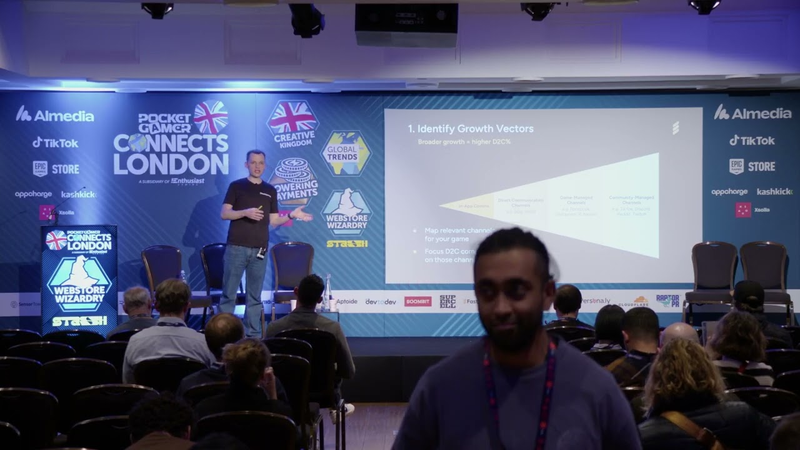
Session: Proven Insights On D2C Monetisation From The Frontlines Of Major Mobile Publishers.
Direct-to-consumer (D2C) monetization has become a standard, essential component of modern mobile gaming, with over 70% of games now utilizing web shops.
- Direct-to-consumer (D2C) web shops are now a standard industry practice, with over 70% of mobile games utilizing them and some major publishers generating nearly 30% of their total revenue through these channels.
- Successful D2C monetization requires a long-term multi-platform distribution strategy rather than a one-off project, as evidenced by consistent year-over-year revenue growth in direct channels.
- Publishers should focus migration efforts on high-value players by offering exclusive incentives such as unique currency, web-only subscriptions, or specialized items that are not available in mobile stores.

Session: From Data To Dollars – How To Crush Your Web Shop’s KPIs - Archie Stonehill, Stash.gg
Web stores for mobile games function best when treated as dedicated e-commerce products rather than simple extensions of in-game monetization.
- The primary KPI for web shops is channel share, which measures the percentage of total player spending occurring through first-party web channels rather than in-app stores.
- Increasing channel share by as little as 2.5% yields higher financial returns than equivalent percentage reductions in payment processing fees.
- Web stores should be treated as dedicated e-commerce products rather than simple extensions of in-game monetization to maximize revenue impact.
Writers
Games and companies
Games