Mobile reports and market data
Documents

Staying compliant in a changing legal landscape | Margarita Sovertokina from Usercentrics
The primary objective of this discussion is to address the increasing complexity of global data privacy regulations and their impact on the mobile gaming industry.
- Mobile game developers are increasingly required to implement Google-certified Consent Management Platforms (CMPs) to maintain monetization capabilities, shifting data privacy from a legal-only concern to a core operational responsibility for user acquisition managers.
- Usercentrics provides an SDK that enables game developers to automate compliance with evolving global data privacy regulations, allowing them to continue collecting data for personalized ads without manual legal oversight.
- The gaming industry has shifted from viewing compliance as an external legal issue to a critical business requirement, largely driven by strict data-gathering mandates from major platforms like Google AdMob and Apple.

Unlocking Gen Z: Strategies for Game Publishers and Developers
Generation Z has emerged as the most influential demographic in the mobile gaming sector, with 82% of this cohort utilizing smartphones as their primary platform.
- Gen Z gamers are highly social, with 34% citing social interaction as their primary motivation, necessitating a shift from single-player models to social live-ops and community-driven engagement.
- Influencer-led marketing is critical, as Gen Z is 58% more likely to engage with a title based on creator recommendations compared to traditional advertising methods.
- Developers should prioritize long-term partnerships with micro-creators over expensive, short-term campaigns with top-tier influencers to drive higher advocacy and community growth.

Week in Mobile Games E48 - Nintendo Switch 2 release date reaction & Tencent's bizarre Ubisoft deal
The Nintendo Switch 2 is positioned to redefine the console market upon its June 5th launch, carrying a base price of $450.
- The Nintendo Switch 2 is scheduled for a June 5th launch with a $450 base price, featuring 4K output, 120fps support, 256GB storage, magnetic Joy-Cons, and face-tracking cameras.
- Tencent has increased its strategic influence over Ubisoft through a $1.25 billion investment structure, reflecting a broader industry trend of consolidation.
- Market analysts project the Nintendo Switch 2 platform will generate $7 to $8 billion in total content potential.

TWIG #325 Ubisoft Bails Out, AppLovin Fights Back, Roblox Becomes an Ad Network
The global gaming industry is currently navigating a period of intense structural realignment, characterized by aggressive monetization shifts, strategic corporate restructuring, and evolving regulatory landscapes.
- Ubisoft has secured a $1.25 billion investment from Tencent, a defensive move designed to maintain founder control and bypass regulatory scrutiny through a subsidiary structure.
- Roblox is scaling its advertising business via programmatic partnerships with Google to monetize its Gen Alpha user base, though it continues to struggle with regional CPM disparities.
- Mobile developers are increasingly bypassing platform fees by pivoting to direct-to-consumer web stores and rewarded advertising to offset the impact of post-IDFA data limitations.

🎮 Kingshot's Insane Genre Mix Explained! How Century Games’ New 4X Hooks Players & Payers
Kingshot represents a strategic evolution in the mobile 4X landscape, functioning as a hybrid title that integrates idle survival mechanics, tower defense elements, and Archero-style combat into a traditional alliance-based meta-game.
- Century Games has adopted a standardized 'template' strategy for Kingshot, essentially re-skinning the successful survival-city-builder mechanics of Whiteout Survival and Frozen City by layering them onto a 4X strategy framework.
- The core gameplay loop of Kingshot combines idle survival mechanics, such as resource management and base building, with traditional 4X alliance warfare and hero-based gacha progression.
- Kingshot utilizes aggressive user acquisition tactics, including fake gameplay mini-games and AI-generated character assets, to mirror successful creative trends observed in other top-performing mobile titles.

Leadership, AI, and Mobile Growth – Insights from AppsFlyer’s CEO and co-Founder, Oren Kaniel
Organizational success stems from a deeply ingrained, customer-centric culture that prioritizes shared values over rigid documentation.
- Organizations must treat AI as a core strategic superpower rather than a simple efficiency tool to avoid obsolescence, as the technology represents a shift more significant than the mobile revolution.
- Successful organizational scaling requires a customer-centric culture that prioritizes shared values and employee empowerment over rigid documentation to prevent mediocrity.
- AppsFlyer is positioning itself for a potential IPO by focusing on enhancing market trust and building secure infrastructure that bridges the gap between privacy compliance and AI innovation.
Your ads are boring! 5 Inspiration Tricks to Ignite Your Creative Strategy by Matej Lancaric
Effective creative strategy in the mobile gaming industry centers on the ability to evoke strong emotions to drive user acquisition and lower cost-per-install (CPI) metrics.
- Creative strategy in mobile gaming has shifted from Forex-style ads to casual and puzzle-based mechanics, with a primary focus on driving user engagement through emotional triggers like near-death experiences or satisfying ASMR-style interactions.
- To identify high-performing creatives, monitor competitor spend using tools like Adscan.ai, Facebook Ad Library, TikTok Ad Library, and Google Ads Transparency Center, as the highest-spending creative is typically the best-performing one.
- Cross-pollinate creative concepts by looking outside your specific genre; for example, adapt hyper-casual mechanics (like gates or sorting) or e-commerce and app-space trends to fit your game's audience.
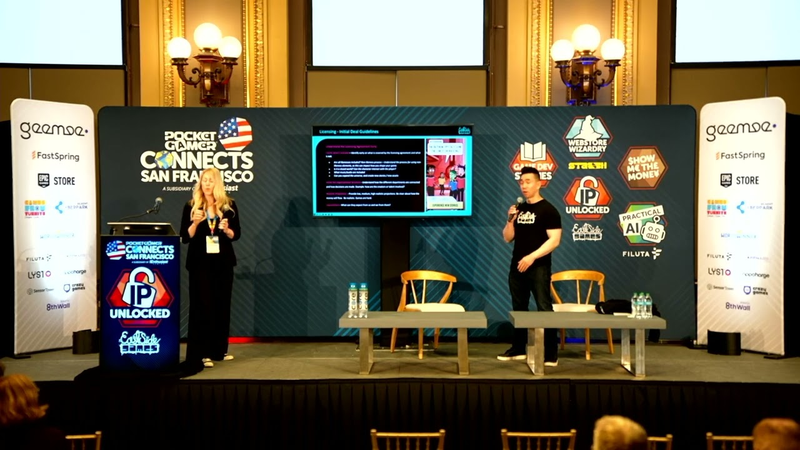
Session: Mastering IP Partnerships – A Guide To IP Brand Management -Elin Jonsson & Wally Nguyen.
Mastering intellectual property (IP) partnerships in the mobile gaming industry requires a strategic approach that balances creative authenticity with rigorous business management.
- IP licensing deals typically involve a royalty percentage ranging from 10% to 20%, though highly prominent brands like Star Wars or Pokémon may command significantly higher rates.
- The primary motivations for IP holders to enter mobile gaming are audience engagement and expansion, followed by revenue generation and marketing utility.
- Effective IP management requires deep brand immersion; developers should move beyond standard guidelines by consuming the source material to ensure the game acts as an authentic extension of the IP rather than a superficial brand application.
Session: Skills & Cash – How Real Money Mobile Games Are Shaping A Billion-Dollar Industry.
The real money mobile gaming industry, specifically the skill-based gaming sector, represents a significant and rapidly expanding segment of the broader gaming market.
- The U.S. skill-based mobile gaming market is valued at $9 billion, representing 14% of the total gaming market with an annual growth rate of 12%.
- There are currently 20 million active skill-based gamers in the U.S., but market research indicates that 46% of all mobile gamers are interested in playing for money, signaling significant untapped potential.
- The industry is targeting a broader ecosystem of 200 million real-money gamers, which currently includes participants in daily fantasy sports, social casinos, and sweepstakes.
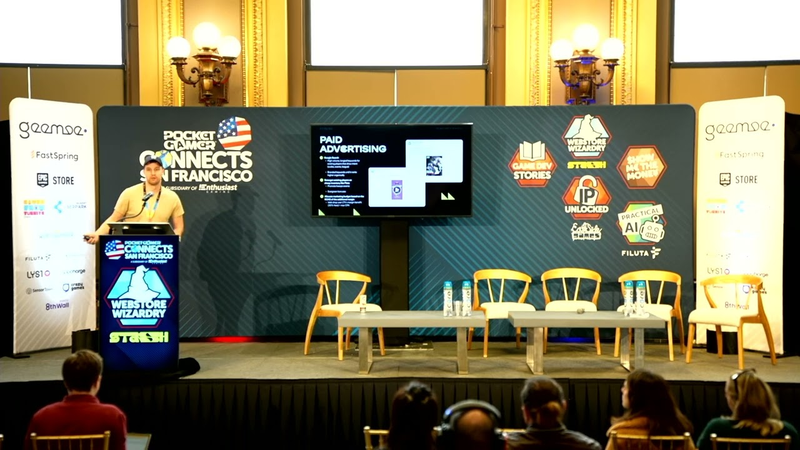
Session: How To Steer Players To Your Webshop (Without Breaking the Rules!) - Archie Stonehill.
The primary objective for mobile game developers is to successfully transition players from in-app environments to proprietary web shops, thereby bypassing traditional platform fees and increasing net revenue.
- Developers can leverage the 2021 Epic Games versus Apple and Google litigation outcomes to communicate alternative payment options and bypass traditional platform fees.
- Driving web shop adoption requires a multi-channel strategy that integrates non-commercial features like loyalty programs and daily rewards into the core game loop to incentivize migration.
- To maintain app store compliance, developers must avoid direct links to payment pages within the app and instead use pre-authenticated links to facilitate a seamless user experience.
Session: Revealing Winning Patterns From 500+ Top Game Creatives Of 2024 - Brijesh Bharadwaj.
The analysis of over 500 top-performing mobile game creatives from 2024 identifies specific, data-driven patterns that drive user acquisition across the puzzle, strategy, and simulation genres.
- Across both puzzle and strategy genres, 70% of top-performing creatives utilize a 'distress' theme, where a character is shown in a life-threatening or negative scenario that the player must resolve.
- Puzzle game ads frequently use 'IQ meters' to signal progression, with 55% of winning creatives incorporating these elements to challenge the viewer's intelligence.
- Strategy game ads perform best when using 'hold' or 'survival' mechanics as hooks, even if these mechanics are not core features of the actual game.
Session: Key Trends & Monetization Strategies In Mobile Gaming - Eden Liu, BIGO Ads.
The mobile gaming industry is currently undergoing a significant shift from hyper-casual titles toward casual games, driven by market saturation, rising user acquisition costs, and the impact of Apple’s privacy policies on traditional monetization models.
- The hyper-casual gaming sector is in decline, with global downloads dropping 12% quarter-over-quarter in 2024 and year-on-year declines of 18% in Western markets and 16% in Eastern tier-one markets.
- Developers are pivoting to casual subcategories like puzzles and match-three games, which achieve higher retention rates of 50% on day one and 15% on day seven.
- Casual games are shifting toward a hybrid monetization model that combines in-app purchases (IAP) with in-app advertising (IAA), specifically rewarded video ads preferred by 50% of users.