Mobile reports and market data
Documents

Mobile Gaming in 2025: 10 Trends That Matter
The global mobile gaming industry has entered a period of maturity characterized by stagnant download volumes and a shift toward long-term stability.
- The mobile gaming market has reached maturity with stagnant download volumes since 2020, forcing a strategic shift toward hybrid-casual models that combine accessible gameplay with deep meta-progression.
- New game launches are declining as developers extend soft launch periods to an average of 200 days to refine retention and overcome high market entry barriers.
- Revenue remains concentrated in established titles with deep content ecosystems, making intellectual property collaborations and market expansion—as seen with Monopoly Go—essential for new entrants.
What Players Do Outside Your Game Will Grow Your ROAS
Modern mobile game marketing requires a fundamental shift from siloed user acquisition toward a holistic, cross-app behavioral strategy.
- Tailoring advertisements to specific app categories and player personas can increase user engagement by up to three times.
- Studios must shift from siloed user acquisition to a holistic, cross-app behavioral strategy that maps player activity across e-commerce, fintech, and other gaming environments.
- Integrating acquisition and re-engagement campaigns into a continuous user journey is necessary to sustain lifetime value and improve overall profitability.

Review radar #8: From Stable Dinosaur to Revenue Rocket. Podcast curse broken!
The current mobile gaming landscape is defined by a shift away from volatile growth patterns toward long-term stability, where success is increasingly driven by aggressive user acquisition, disciplined creative strategies, and consistent live-ops.
- Long-term stability in mobile gaming is now driven by aggressive user acquisition, disciplined creative strategies, and consistent live-ops rather than radical feature innovation.
- Pokémon Sleep is currently on track to reach $1 billion in annual revenue within its first year, highlighting the significant market power of established intellectual property.
- Celebrity-led marketing campaigns have proven highly effective, as demonstrated by Royal Kingdom, which successfully doubled its revenue and download metrics.

MAU'25 Live Special: The Bold New Era of Rewarded Gaming & UA in 2025
The rewarded gaming landscape is undergoing a significant transformation as platforms transition from traditional Android-centric models to more complex, multi-platform ecosystems.
- Rewarded gaming strategy for 2025 is shifting from Android-centric models to iOS expansion, requiring a move away from last-touch attribution toward rigorous incrementality testing.
- Measurement frameworks now rely on a triangulation strategy that combines last-touch data with causal incrementality testing and self-reported user insights to validate growth.
- Successful geographic expansion, particularly in competitive markets like South Korea, now mandates deep culturalization through local staffing and region-specific reward structures.

Apple vs Epic Aftermath: A New Era for Game DTC
The gaming industry is undergoing a fundamental shift toward direct-to-consumer (DTC) monetization, catalyzed by recent legal rulings in the United States and the European Union that dismantle restrictive app store billing policies.
- Following the April 30, 2024, ruling, Apple now permits developers in the U.S. to freely link to external payment channels and advertise those channels within their apps without paying a 27% commission or displaying anti-steering 'scare screens.'
- Studios are increasingly adopting a hybrid monetization model where 'evergreen' impulse purchases remain in-app, while exclusive or high-value offers are routed through web-based stores to bypass platform fees.
- To drive traffic to web stores, developers are utilizing two primary strategies: offering direct discounts or providing 'extra value' through exclusive bundles, loyalty points, or cashback incentives that are unavailable in-game.

Why Most Games Deserve to Die — And How Voodoo Finds the Ones That Don’t
The modern mobile gaming landscape demands a rigorous, data-centric approach to publishing that prioritizes long-term engagement over subjective creative intuition.
- Voodoo maintains a rigorous testing pipeline of approximately 2,000 prototypes annually, discarding the vast majority early to focus resources exclusively on high-potential projects.
- Success is measured by long-term engagement metrics, specifically tracking retention rates at the one, three, seven, and thirty-day marks rather than initial release volume.
- Publishers are shifting from ad-only monetization to hybrid models that integrate in-app purchases with rewarded advertising to ensure profitability within a 120-day window.
Q2 2025 Gaming Ad Snapshot
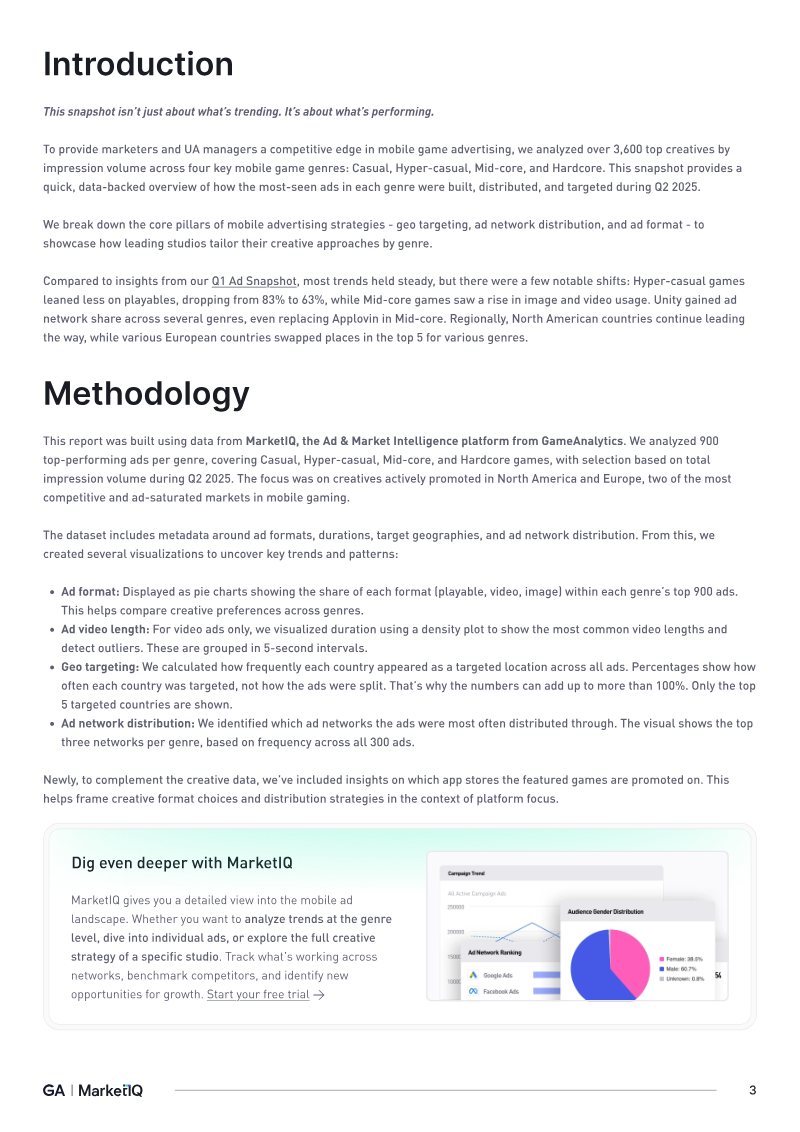
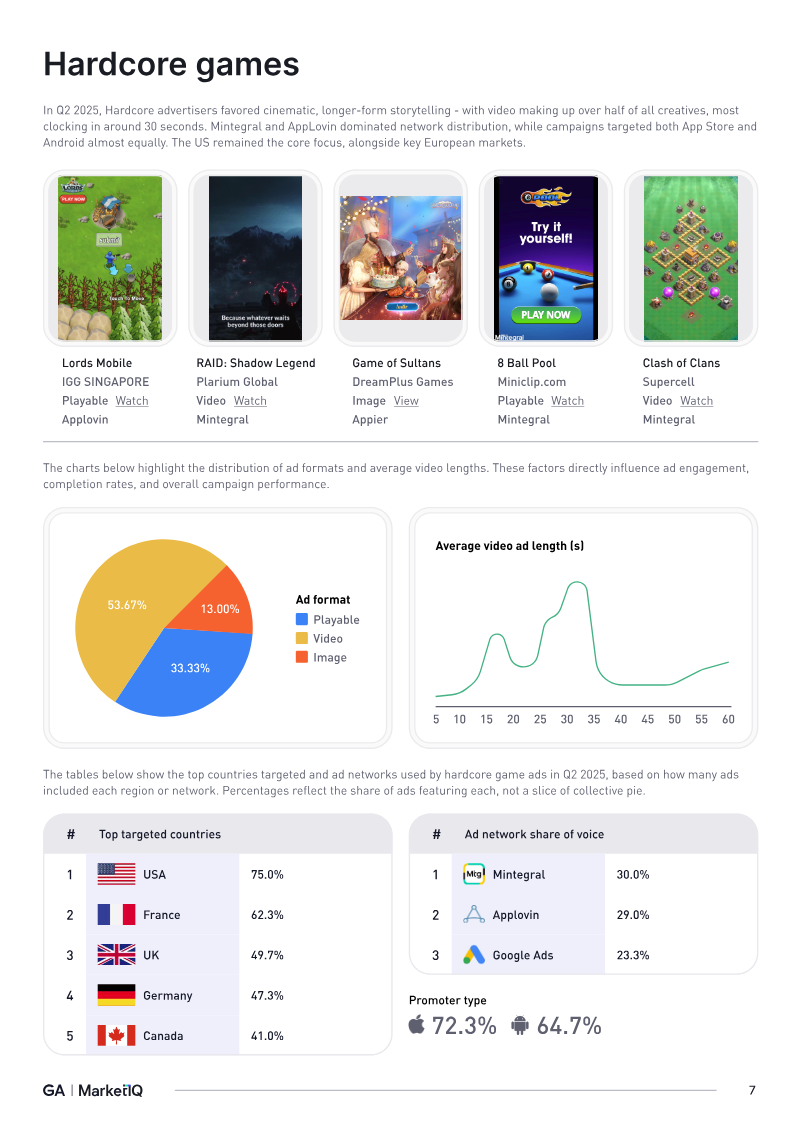
The Q2 2025 Gaming Ad Snapshot from GameAnalytics offers a data-backed look at how top-performing mobile game ads were built, distributed, and targeted across four genres: Casual, Hyper-casual, Mid-core, and Hardcore.
- Google Ads and Facebook Ads remain the dominant platforms for mobile gaming promotion in Q2 2025.
- The active mobile gaming audience is composed of 61% males, 38.5% females, and 0.8% unclassified users.
- High-performing mobile gaming ad assets demonstrate rapid scaling, with impressions growing from an average of 13 million to 47 million over their lifecycle.

The Xsolla Report: State of Play Q2 2025
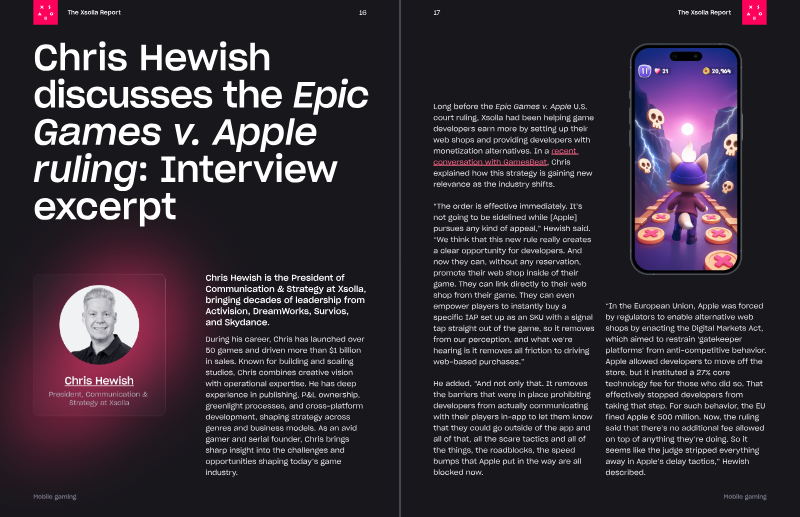
Xsolla's Q2 2025 State of Play positions mobile gaming as the industry's dominant segment and argues that a wave of legal and regulatory change is reshaping how developers monetize it.
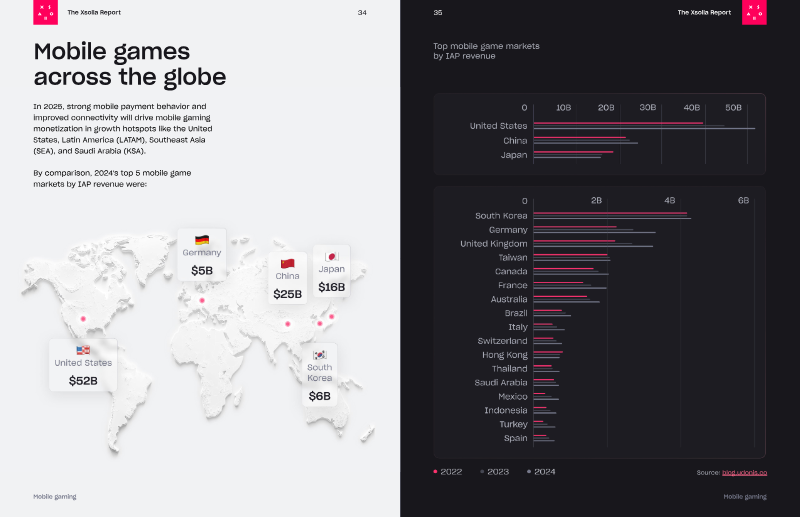
- Mobile gaming is the industry's primary revenue driver, projected to reach $126 billion in 2025 with a total segment forecast of $150 billion.
- Following the April 2025 Epic Games v. Apple court order, developers can now utilize direct-to-consumer web-shops to retain up to 95% of transaction value, with early adopters seeing millions in revenue recovery.
- Hybrid monetization models—combining in-app purchases, advertising, and subscriptions—are used by 72% of developers and account for approximately 75% of total mobile revenue.

Week in Mobile Games E55 - Apple faces further EU fines and Trump tariffs chaos continues
The mobile gaming industry is currently navigating a period of significant regulatory pressure and structural transformation.
- Mobile gaming monetization is shifting toward direct-to-consumer web shops and alternative payment systems to bypass traditional 30% platform fees and reclaim control over customer data.
- Despite a 7% decline in total U.S. mobile game downloads, average player spending has increased by 11% to $152 per install in 2024.
- Apple faces significant regulatory pressure from the European Commission, which has set strict deadlines for compliance with the Digital Markets Act regarding anti-steering practices under threat of substantial fines.

TWIG #333: Apple's Stand Up Comedy, Fortnite Mobile's Tea Leaves, and a Mystery Success
Generative AI is fundamentally reshaping game development, offering transformative potential for asset creation, trailer production, and the implementation of sophisticated conversational systems.
- Generative AI is currently being integrated into game development to enhance asset creation, trailer production, and the implementation of complex conversational systems.
- High-budget television advertising campaigns for mobile games continue to underperform in ROI compared to data-driven user acquisition strategies.
- Apple's development of a dedicated gaming hub is interpreted as a defensive legal strategy to protect its 30 percent commission structure rather than a user-centric innovation.

GOAT: Paul Bowen on Ad Network Wars & Future of UA
The mobile advertising landscape has transitioned from a fragmented, high-growth environment into a mature, consolidated market dominated by major entities such as Meta, Google, and AppLovin.
- The mobile advertising landscape has undergone significant consolidation, leaving AppLovin as a dominant force in the ad network space alongside the walled gardens of Google, Facebook, and TikTok.
- The incentivized offer market, popularized by Mistplay, has a low barrier to entry that has led to a surge of new, non-defensible business models relying on gift card rewards.
- Allegations of fraud regarding AppLovin's auto-downloading of apps are largely misunderstood, as iOS technical constraints make such actions impossible and the ecosystem remains a matter of buyer awareness and contract transparency.

🔥 The Art of Scaling Applovin UA & Admon: A Deep dive
AppLovin’s Axon 2 algorithm represents a fundamental shift in user acquisition, moving away from manual optimization toward a sophisticated, data-driven black box model.
- AppLovin’s Axon 2 algorithm functions as a black box that requires stable data inputs; changing ROAS goals every 2–3 days prevents the system from calibrating, as it forces the algorithm to constantly re-target different user segments.
- For IAP-based games, D28 ROAS campaigns are recommended over shorter windows because they yield higher-quality, higher-retention users, even if initial D0 metrics appear significantly lower.
- Campaigns require a minimum of 10–14 days to calibrate on a specific ROAS goal before any adjustments should be made to the target.