Market Analysis
Documents
State of the LATAM Games Industry 2026
Latin America has solidified its position as a formidable force in the global gaming landscape, transitioning from a peripheral source of cost-effective labor to a sophisticated hub of creative innovation and live service expertise. Driven by massive, mobile-first player populations in Brazil and Mexico, the region is increasingly defined by high levels of community engagement and a thriving esports culture. While economic challenges such as currency volatility and limited infrastructure persist, the industry is successfully pivoting toward sustainable, long-term business models that prioritize authentic, socially integrated experiences over traditional, short-term monetization strategies.
The regional ecosystem is characterized by a strategic shift toward self-publishing and advanced Live Ops, supported by a deep pool of engineering talent that is increasingly utilizing artificial intelligence to enhance production efficiency. Although major hubs like Brazil and Mexico anchor the market, smaller nations such as Argentina and Ecuador are gaining international visibility through indie innovation and strategic global partnerships. This evolution reflects a broader maturation of the industry, where developers are moving beyond simple localization to address the specific technological and cultural nuances of individual domestic markets.
Success within this territory requires a departure from standardized global frameworks in favor of localized strategies that account for unique payment preferences and regional economic constraints. Despite systemic hurdles regarding access to specialized venture capital and user acquisition, the region offers significant growth potential for developers who commit to long-term engagement. By fostering trust and prioritizing accessibility, the Latin American gaming sector is effectively countering the stagnation currently impacting global mobile markets, establishing itself as a vital, influential player in the international creative economy.
- Brazil and Mexico serve as the region's primary anchors, with Brazil driving engagement across all platforms and Mexico acting as a commercial gateway for global publishers.
- Mexico's gaming industry generated $1.27 billion in revenue in 2024, with mobile and tablet devices accounting for 72% of all gaming activity.
- Brazil hosts a robust ecosystem of over 1,000 developers, while indie game creation in Mexico grew by 30% year-over-year in 2023.
- Successful regional studios like Chile-based TinyBytes have achieved significant scale, with over 100 million downloads and $40 million in lifetime gross revenue from titles like Massive Warfare.
- Growth in the LATAM market is frequently driven by localized payment methods, such as PIX in Brazil and OXXO in Mexico, which are essential for reducing friction in price-sensitive, mobile-first economies.
CESA Game Industry Report 2025: Launch Seminar Report
The CESA Game Industry Report 2025 Launch Seminar, held in Tokyo on February 20, 2026, served as a platform to analyze the evolving landscape of the Japanese gaming sector. The event introduced the updated 2025 industry report, which features expanded data sets and enhanced international market research to better support the global expansion of Japanese firms. The seminar aimed to address industry needs for technical knowledge sharing, talent development, and cross-sector networking among corporate and academic stakeholders.
Key findings highlight a significant shift toward the integration of generative AI, with approximately half of domestic game companies now utilizing these tools within their development pipelines. While internal production workflows show high adoption rates, industry experts noted a more cautious approach regarding AI-generated content visible to end-users. Legal discussions emphasized the importance of navigating copyright frameworks, specifically distinguishing between AI learning and generation phases, while balancing innovation with intellectual property risks.
Government representatives from the Ministry of Economy, Trade and Industry and the Agency for Cultural Affairs outlined strategic support for the content industry, targeting 20 trillion yen in overseas sales by 2033. Policy initiatives focus on multi-year funding, tax incentives, and robust talent development programs to ensure long-term competitiveness. Furthermore, legal experts underscored the increasing complexity of global regulatory environments, noting that Japanese companies must proactively manage diverse international requirements regarding data privacy, monetization, and rating systems. By synthesizing perspectives from government, legal, and development sectors, the seminar emphasized that strategic investment and regulatory compliance are essential for the sustainable growth of Japan’s gaming industry in a globalized market.
- The Japanese government has set a strategic target to reach 20 trillion yen in overseas content industry sales by 2033.
- Approximately 50% of domestic game companies have integrated generative AI into their internal development pipelines.
- Industry adoption of generative AI remains bifurcated, with high usage in production workflows but a cautious, risk-averse approach toward AI-generated content delivered to end-users.
- Legal frameworks are currently prioritizing the distinction between AI learning and generation phases to mitigate intellectual property risks while fostering innovation.
- Government policy initiatives to support industry competitiveness include multi-year funding, tax incentives, and dedicated talent development programs.
Bilan du Marché Français: 2025
The French video game market demonstrated significant resilience in 2025, generating €5.856 billion in total revenue, a 2.9% increase over the previous year. This performance marks the second-highest in the industry’s history, solidifying its position as a cornerstone of the national cultural economy. Growth was primarily fueled by a rebound in console hardware sales and a record-breaking 11% surge in the mobile sector, which reached €1.792 billion. The market maintains a balanced ecosystem, with consoles commanding a 44% share, followed by mobile at 31% and PC gaming at 26%.
Software remains the primary revenue driver, accounting for over two-thirds of the total market. While physical game sales faced a double-digit decline, this was effectively mitigated by the expansion of digital content, including microtransactions and downloadable content. Electronic Arts emerged as the leading publisher across console and PC platforms, while the mobile landscape remains almost entirely dominated by free-to-play models, which now represent 94% of mobile revenue.
The industry’s reach expanded to 40.2 million players, characterized by a maturing demographic where adults comprise 88% of the base. High engagement levels persist, with 76% of players gaming on a weekly basis and a growing trend toward cross-platform usage. Alongside this growth, there is a heightened emphasis on responsible gaming. Parental involvement has reached new heights, with 67% of parents actively monitoring gaming habits through PEGI classifications and standardized parental control tools. This commitment to safety, supported by organizations like the SELL and events such as Paris Games Week, ensures that the industry continues to thrive as a mature, socially responsible, and culturally significant sector within France.
- The French video game market reached €5.856 billion in 2025, a 2.9% year-over-year increase and the second-highest revenue in the industry's history.
- Mobile gaming experienced an 11% surge to reach €1.792 billion, with free-to-play models accounting for 94% of that sector's total revenue.
- Market share is distributed across consoles (44%), mobile (31%), and PC (26%), with software sales—driven by digital content and microtransactions—comprising over two-thirds of total revenue.
- The player base has expanded to 40.2 million people, 88% of whom are adults, with 76% of all players engaging with games on a weekly basis.
- Physical game sales suffered a double-digit decline in 2025, necessitating a shift toward digital distribution and downloadable content strategies.

Corporate Responsibility Report 2013
Modern Times Group (MTG) maintains a comprehensive corporate responsibility strategy centered on media integrity, employee welfare, environmental stewardship, and ethical business governance. During the 2013 fiscal year, the organization prioritized digital development and the protection of young audiences, achieving recognition in the Dow Jones Sustainability Europe Index. With a workforce of 3,361 employees and net sales reaching 14,129 MSEK, the company leveraged its extensive media reach to contribute over 42 million TSEK in combined financial and media-time donations to charitable causes, most notably through the Reach for Change social entrepreneurship foundation.
Operational performance in 2013 reflected a mix of progress and systemic challenges. Environmental efforts yielded a strong score of 88 out of 100 in the CDP report, supported by energy-efficient infrastructure and carbon disclosure initiatives, despite a 7% rise in total carbon emissions linked to corporate expansion. Internally, the company implemented rigorous anti-bribery policies and updated editorial standards. However, workforce metrics revealed persistent disparities, including a gender pay gap where female remuneration averaged 70% of male earnings, alongside a decline in return-to-work rates following parental leave.
The reporting process, conducted in accordance with GRI G4 Core standards and independently assured by Ethos International, identified customer data integrity and child protection as the most material issues for the business. While the company successfully established a new Corporate Responsibility Advisory Group to oversee governance, auditors noted significant limitations in existing data collection systems. Future strategic objectives focus on harmonizing human resources data, improving supply chain management, and refining internal reporting mechanisms to better track labor and training metrics across the company’s global operations.
- MTG achieved 14,129 MSEK in net sales while contributing 42 million TSEK in financial and media-time donations, primarily through the Reach for Change foundation.
- The company reported a significant gender pay gap in 2013, with female remuneration averaging only 70% of male earnings.
- MTG earned a score of 88 out of 100 in the CDP environmental report, though total carbon emissions increased by 7% due to corporate expansion.
- Materiality assessments identified customer data integrity and child protection as the primary strategic risks for the business.
- The organization maintained a workforce of 3,361 employees while experiencing a decline in return-to-work rates following parental leave.
Modern Responsibility Report 2010
MTG’s 2010 Modern Responsibility initiative establishes a comprehensive framework for integrating economic, environmental, and social accountability across its global media operations. Spanning 33 countries, the company’s strategy centers on four pillars: responsible business conduct, broadcasting integrity, employee relations, and community engagement. By adopting the Global Reporting Initiative framework and conducting a formal materiality analysis, the organization has aligned its internal governance with stakeholder priorities, specifically emphasizing anti-corruption, regulatory compliance, and fair employment practices.
Operational performance in 2010 reflects a dual focus on professional development and social impact. The company invested heavily in human capital through the MTG Academy, which emphasizes leadership and sales training, while simultaneously promoting diversity and female representation in management. Beyond internal operations, the company leveraged its media influence to drive social change, donating 111 million SEK in airtime to charitable causes and launching foundations such as MTG United for Peace and Playing for Change. These efforts underscore a commitment to using broadcasting platforms to support disaster relief, cancer research, and youth development.
Environmental stewardship remains a critical, albeit challenging, area of focus. Total climate impact reached approximately 15,000 tons of CO2e in 2010, driven largely by business travel and facility energy consumption. Despite a 36 percent increase in travel-related emissions, the company has implemented rigorous mitigation strategies, including the adoption of ISO 14001 standards and a mandate to reduce CO2 emissions per employee by 5 percent by early 2012. Through the integration of green training for 59 percent of its staff and the expansion of video conferencing, the organization seeks to balance its international growth with a measurable reduction in its corporate carbon footprint.
- MTG established a 2010 corporate responsibility framework across 33 countries, utilizing the Global Reporting Initiative to prioritize anti-corruption, regulatory compliance, and fair employment.
- The company donated 111 million SEK in airtime to charitable causes in 2010, supporting initiatives like MTG United for Peace and Playing for Change.
- MTG’s total climate impact reached approximately 15,000 tons of CO2e in 2010, with business travel-related emissions increasing by 36 percent.
- To mitigate environmental impact, the company mandated a 5 percent reduction in CO2 emissions per employee by early 2012 and provided green training to 59 percent of its staff.
- Human capital investment in 2010 focused on leadership and sales training through the MTG Academy, alongside efforts to increase female representation in management.
Modern Responsibility Report 2009
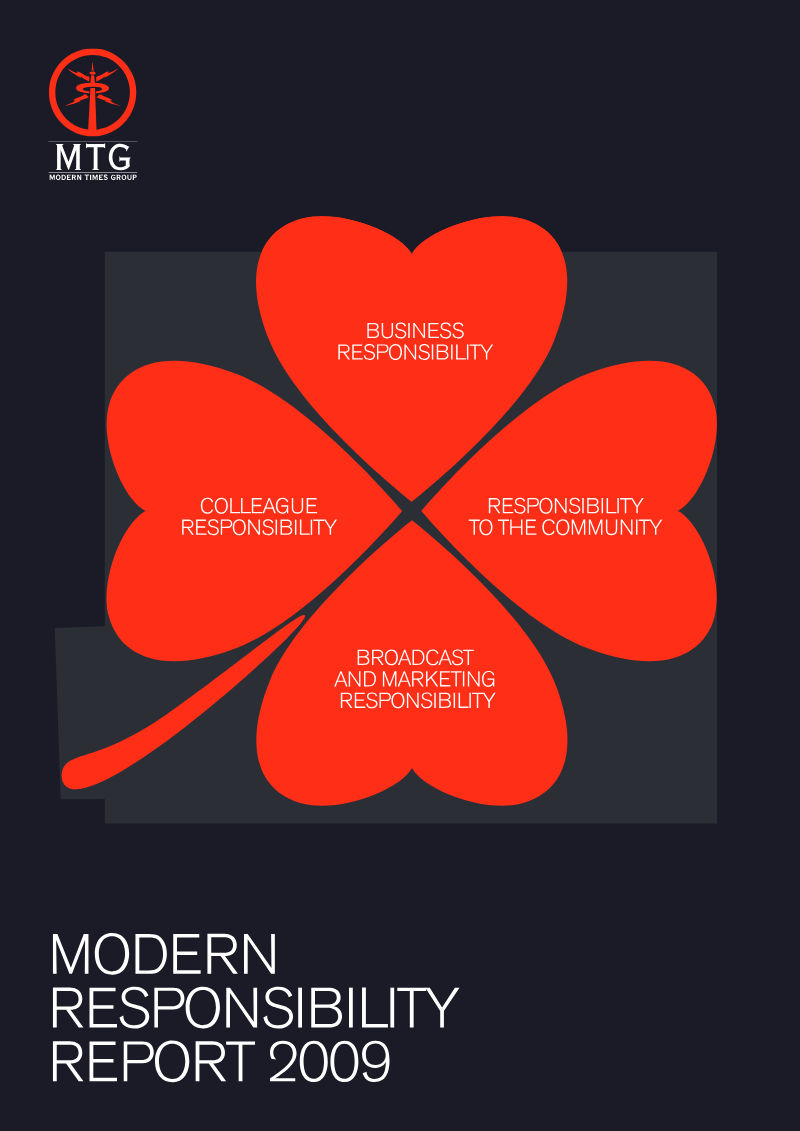
Modern Times Group (MTG) maintains a comprehensive commitment to integrating corporate responsibility into its broadcasting and entertainment operations across 31 countries. The primary objective of its 2009 strategic framework is to ensure sustainable business growth through rigorous governance, ethical conduct, and social accountability. By formalizing environmental policies and establishing a structured oversight committee, the company seeks to balance its commercial objectives with its impact on society and the environment, even amidst the challenging economic climate of the late 2000s.
Operational performance is anchored by a robust governance model that emphasizes transparency, fair competition, and strict adherence to a global code of conduct. Key initiatives include the implementation of a whistleblower policy, mandatory compliance training, and the protection of minors through regulated content and parental controls. The company’s focus on human capital is evidenced by the MTG Academy, which provided training to 81 percent of permanent staff, and a diverse workforce spanning 38 nationalities. These efforts are supported by internal audits and key performance indicators designed to enhance the measurability of ethical and social initiatives.
Environmental stewardship remains a central pillar of the company’s strategy, with carbon footprint audits now covering operations in 19 countries. In 2009, the organization recorded a total climate impact of approximately 13,000 tons of CO2e, prompting investments in energy-efficient infrastructure and reduced travel requirements. Beyond internal reductions, the company leverages its media platforms to drive social change, notably through the "Playing for Change" initiative and the donation of airtime to support environmental and social causes. By aligning its broadcasting reach with philanthropic goals, the company reinforces its position as a responsible stakeholder in the global media landscape.
- MTG established a formal corporate responsibility framework in 2009 to integrate governance, ethical conduct, and social accountability across its broadcasting operations in 31 countries.
- The company recorded a total climate impact of approximately 13,000 tons of CO2e in 2009, leading to the implementation of carbon footprint audits across 19 countries and investments in energy-efficient infrastructure.
- Human capital development was prioritized through the MTG Academy, which provided training to 81 percent of the company's permanent staff.
- MTG maintains a diverse workforce representing 38 nationalities, supported by a governance model that includes mandatory compliance training and a formal whistleblower policy.
- The company utilizes its media reach for philanthropic purposes, specifically through the 'Playing for Change' initiative and the donation of airtime to support social and environmental causes.
Annual Report 2024: Savvy Games Group
Savvy Games Group has established itself as a premier global force in interactive entertainment, currently ranking eighth worldwide by net revenue. The organization serves as the primary vehicle for Saudi Arabia’s National Gaming and Esports Strategy, which seeks to generate $13.3 billion in GDP contribution and create 39,000 jobs by 2030. By integrating publishing, development, and esports community building, the group effectively navigates the challenges of a saturated global market, positioning the Kingdom as a central hub for the international gaming industry.
The company’s operational success is underpinned by a robust capital deployment strategy, with over $12 billion invested across nine major acquisitions since 2021. Under the leadership of CEO Brian Ward, the group has scaled to nearly 4,000 employees across 22 countries, supported by a governance structure that includes specialized committees for investment, risk, and executive oversight. This organizational framework ensures that the group maintains strategic alignment while pursuing aggressive growth in both domestic and international markets.
Key business units, specifically Scopely and the ESL FACEIT Group, have delivered record-breaking financial results and solidified the company’s market dominance. The ESL FACEIT Group currently commands a 40% share of the global esports market, engaging over 225 million users through high-profile events like the inaugural Esports World Cup. Simultaneously, internal development efforts through Steer Studios and strategic partnerships with firms like Niantic and Xsolla continue to diversify the portfolio. These collective efforts demonstrate a commitment to scaling interactive entertainment through high-engagement competitive platforms and localized talent development, ensuring long-term sustainability within the global gaming ecosystem.
- Savvy Games Group ranks as the eighth-largest global gaming company by net revenue and serves as the primary vehicle for Saudi Arabia’s goal to contribute $13.3 billion to GDP and create 39,000 jobs by 2030.
- The organization has deployed over $12 billion in capital across nine major acquisitions since 2021 to scale its operations to nearly 4,000 employees across 22 countries.
- The ESL FACEIT Group holds a 40% share of the global esports market and engages more than 225 million users through platforms like the Esports World Cup.
- Business units Scopely and ESL FACEIT Group are the primary drivers of the company's record-breaking financial performance and current market dominance.
- The group is diversifying its portfolio through internal development at Steer Studios and strategic partnerships with firms including Niantic and Xsolla.
Videogiocatori in Italia
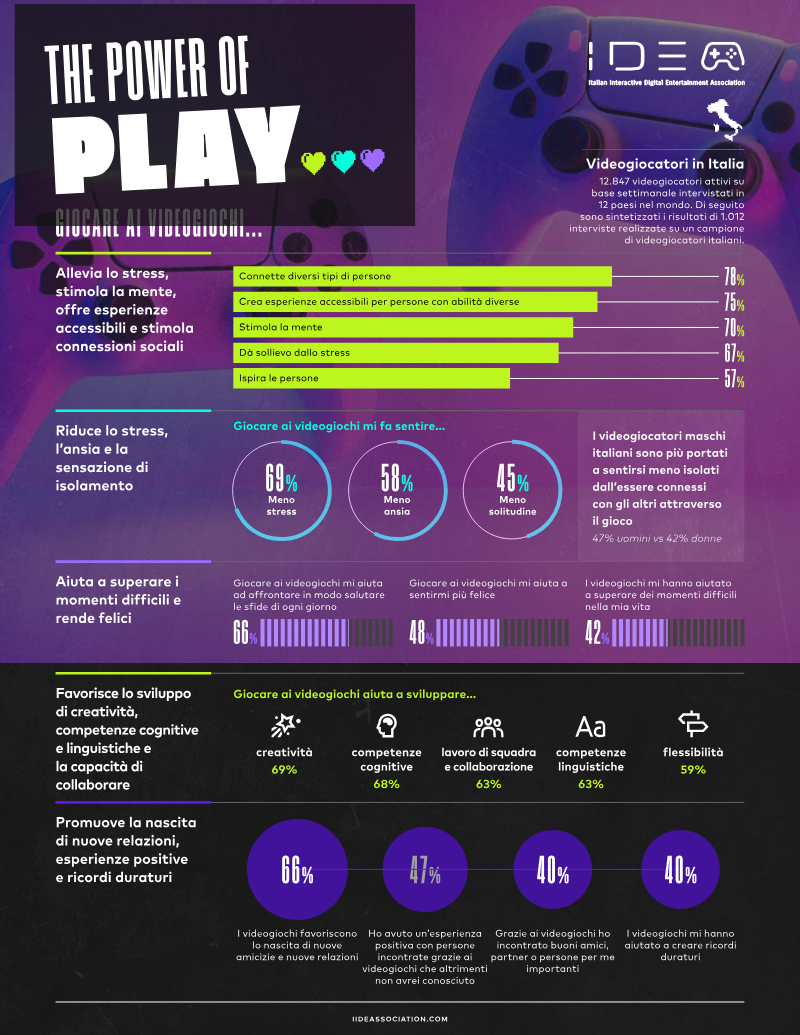
The Italian gaming landscape is characterized by a strong emphasis on the psychological and social benefits of interactive entertainment. Based on a survey of 1,012 Italian gamers, which forms part of a broader 12-country study involving 12,847 active weekly players, the research highlights that gaming serves as a vital tool for stress relief, cognitive stimulation, and social connection. A significant majority of respondents report that gaming alleviates stress and anxiety, fosters creativity, and enhances problem-solving skills, with 69% of participants noting that the medium stimulates the mind and improves teamwork capabilities.
Social interaction remains a cornerstone of the Italian gaming experience. While solitary play is common on a daily basis, approximately half of the respondents prefer engaging with others through online platforms on a weekly basis. This social dimension is particularly prevalent among male gamers, who show a higher propensity for online multiplayer interaction. Furthermore, the data indicates that gaming acts as a bridge for building new relationships, with many users reporting that they have formed lasting friendships or met significant partners through in-game experiences.
The demographic reach of gaming in Italy is broad, though usage patterns vary by age and gender. Engagement is most concentrated within the 19-34 age bracket, and there is a notable adoption of in-game communication tools, particularly among male players. Ultimately, the findings suggest that gaming is perceived not merely as a pastime, but as a constructive activity that supports mental well-being, facilitates personal development, and provides a reliable framework for community building in an increasingly digital society.
- 69% of Italian gamers report that interactive entertainment stimulates the mind and improves teamwork capabilities.
- Gaming is primarily utilized as a tool for stress relief, anxiety reduction, and the enhancement of cognitive skills like creativity and problem-solving.
- Approximately 50% of Italian gamers engage in online multiplayer sessions on a weekly basis, highlighting the medium's role as a social platform.
- The 19-34 age demographic represents the most concentrated segment of gaming engagement in Italy.
- In-game environments serve as significant social hubs, with many users reporting the formation of lasting friendships and romantic partnerships through digital play.
Video Games as a Tool for Mental Resilience: Italy
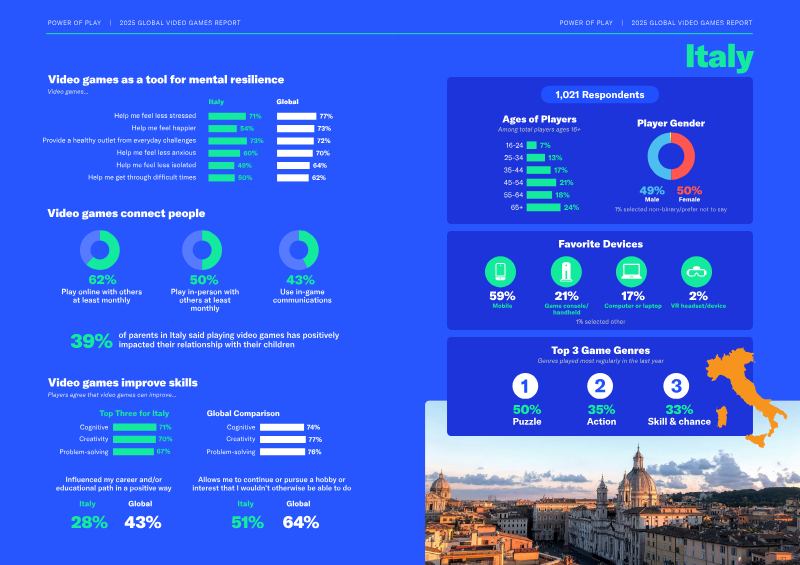
Video games serve as a significant mechanism for mental resilience and emotional regulation among the Italian population. A survey of 1,021 respondents aged 16 and older reveals that a substantial majority of Italian players utilize gaming to mitigate negative psychological states. Specifically, 71% of participants report that gaming helps reduce stress, while 60% use it to manage anxiety and 49% rely on it to combat feelings of isolation. These figures demonstrate that gaming functions as a vital outlet for navigating everyday challenges and difficult life transitions, with 50% of respondents explicitly noting that the medium helps them endure personal hardships.
The demographic profile of the Italian gaming community is broad, with the largest segment of players falling into the 45-54 age bracket at 21%, followed closely by those aged 65 and older at 24%. Mobile devices remain the primary platform for 59% of users, significantly outpacing consoles and computers. Social connectivity is a core component of the experience, as 62% of players engage in online multiplayer sessions at least monthly. Beyond emotional support, gaming is perceived as a tool for cognitive development, with 71% of players reporting improvements in cognitive function, 70% in creativity, and 67% in problem-solving skills.
The impact of gaming extends into familial and professional spheres, fostering positive interpersonal dynamics and skill acquisition. Approximately 39% of parents in Italy report that shared gaming experiences have strengthened their relationships with their children. While the influence on career paths remains lower in Italy at 28% compared to the global average of 43%, the medium continues to provide a unique space for pursuing hobbies and educational interests. Puzzle, action, and skill-based games represent the most popular genres, underscoring a preference for interactive experiences that challenge the mind while providing a structured environment for relaxation.
- Gaming is a primary tool for mental health in Italy, with 71% of players using it to reduce stress, 60% to manage anxiety, and 49% to combat isolation.
- The Italian gaming demographic is older than often assumed, with the 65+ age group representing 24% of players and the 45-54 bracket accounting for 21%.
- Mobile devices are the dominant gaming platform in Italy, utilized by 59% of the population compared to consoles and computers.
- Beyond emotional regulation, 71% of Italian players report improvements in cognitive function, 70% in creativity, and 67% in problem-solving skills.
- Social connectivity is a key driver of engagement, with 62% of players participating in online multiplayer sessions at least once a month.
Gamer Motivation Profile: Empirical Research and Data Insights
The Gamer Motivation Profile provides a comprehensive empirical framework for understanding player behavior through a psychometric model that categorizes gaming preferences into twelve distinct motivational drivers. These drivers—organized into six primary clusters including Action, Social, Mastery, Achievement, Immersion, and Creativity—allow developers and marketers to quantify why specific audiences engage with particular game titles. By linking psychometric data with demographic variables and specific game franchises, the model offers a data-driven approach to audience segmentation and product positioning.
The research is built upon a robust dataset derived from over 1.75 million global participants who have completed the Gamer Motivation Profile survey. This large-scale, ongoing collection of data enables real-time analysis of player demographics, such as age, gender, and play frequency, alongside their psychological motivations. The methodology utilizes factor analysis to identify how various gaming preferences cluster together, providing a statistically sound basis for comparing individual titles against broader genre norms.
The primary utility of this research lies in its ability to generate actionable insights for game development and player acquisition. Through a dynamic dashboard, users can perform side-by-side comparisons of different franchises, identify "game neighborhoods" based on shared motivational profiles, and filter titles by specific criteria to uncover underserved market segments. By mapping how individual games deviate from genre benchmarks, the model helps stakeholders prioritize development features, refine marketing messaging, and identify potential competitors even across disparate genres. This analytical toolset is designed to assist industry professionals in making evidence-based decisions regarding portfolio management and the strategic targeting of core and mid-core gaming audiences.
- The Gamer Motivation Profile utilizes a dataset of over 1.75 million global participants to categorize player behavior into twelve distinct motivational drivers across six primary clusters.
- The psychometric model employs factor analysis to link player demographics, such as age and gender, with specific gaming preferences to enable precise audience segmentation.
- Developers can use the framework to compare individual game franchises against broader genre benchmarks to identify how specific titles deviate from industry norms.
- The research enables the identification of 'game neighborhoods' based on shared motivational profiles, allowing stakeholders to uncover underserved market segments across different genres.
- The analytical toolset supports evidence-based decision-making for portfolio management, feature prioritization, and the strategic targeting of core and mid-core gaming audiences.
Gamer Motivation Profile: Empirical Research Methodology
The Gamer Motivation Profile provides an empirical framework for understanding player behavior by categorizing gaming preferences into twelve distinct motivational factors. Developed through psychometric techniques and factor analysis, the model identifies how specific gaming desires—such as competition, immersion, or mastery—cluster together to drive player engagement. The primary thesis posits that gaming motivations exist on a spectrum, where both high and low scores serve as critical indicators of a player’s preferences, allowing for a nuanced analysis of why individuals gravitate toward specific titles or genres.
The research is underpinned by a robust dataset of over 1.25 million unique gamers worldwide, with a demographic composition of 74% male, 22% female, and 3% non-binary, and a median age of 23. The geographic scope is global, with the largest concentrations of participants in North America (33%) and Western Europe (14%). Data collection relied on a five-minute online survey, which achieved high internal and test-retest reliability. By mapping these motivations against a 50th-percentile industry norm, the model allows analysts to visualize which factors are disproportionately important for specific game audiences, effectively linking demographic data with franchise-specific engagement.
The twelve motivations are grouped into six thematic clusters: Action-Social (Destruction, Excitement, Community, Competition), Mastery-Achievement (Challenge, Strategy, Completion, Power), and Immersion-Creativity (Fantasy, Story, Discovery, Design). Each factor is defined by its behavioral anchors, providing a clear distinction between high-intensity, goal-oriented play and more relaxed, expressive, or exploratory experiences. By utilizing this standardized methodology, the research offers an actionable tool for developers and industry analysts to decode player behavior, predict engagement patterns, and better align game design with the psychological needs of diverse gaming audiences.
- The Gamer Motivation Profile categorizes player behavior into twelve distinct factors grouped into six thematic clusters: Action-Social, Mastery-Achievement, and Immersion-Creativity.
- The model is built on a global dataset of over 1.25 million unique gamers, providing a statistically significant foundation for analyzing player engagement.
- The participant demographic is 74% male, 22% female, and 3% non-binary, with a median age of 23 and a primary geographic concentration in North America (33%) and Western Europe (14%).
- Gaming motivations exist on a spectrum where both high and low scores serve as critical indicators, allowing analysts to map specific player preferences against a 50th-percentile industry norm.
- The framework uses psychometric techniques and factor analysis to link demographic data with franchise-specific engagement, enabling developers to predict player behavior and align design with psychological needs.
Global Gaming Report Q1 2026
LOS ANGELES | SAN FRANCISCO | NEW YORK | LONDON | PARIS | MUNICH | BERLIN | DUBAI PROVEN TRACK RECORD IN GAMING M&A AND GROWTH FINANCING ADVISORY PROVEN TRACK RECORD IN GAMING M&A AND GROWTH FINANCING ADVISORY MICHAEL METZGER JULIAN RIEDLBAUER Linkedin - Free social media icons MOHIT PAREEK Linkedin - Free social media icons MICHAEL METZGER JULIAN RIEDLBAUER ...
- Q1 2026 saw 106 private placement deals totaling $785 million, a significant decrease from Q1 2025's $5.0 billion across 149 deals, indicating a cooling investment landscape.
- Project financing is now the primary funding path for studios due to headwinds in studio equity, with dedicated User Acquisition (UA) funds emerging as a new lifeline for mid-stage mobile studios.
- Key strategics to watch include PIF/Scopely, KRAFTON, NCSoft, Tencent, MTG, Take-Two, Netflix, everplay, and Keywords Studios, while Private Equity is expected to drive take-private transactions of publicly listed gaming firms.
- AI, User-Generated Content (UGC), and tech platforms remain top investment areas, with a projected surge in Augmented Reality (AR) activity, exemplified by RayNeo's eSIM-enabled AR glasses and 24% AR glasses market share in Q3 2025.
- Notable M&A activity includes NCSOFT acquiring a 70% stake in JustPlay for $202 million, Nazara Technologies acquiring a 50% controlling stake in Bluetile Games for $100.3 million, and Mattel taking full ownership of Mattel163 for $159 million.