Updated Apr 30, 2026 by Modern Times Group
Report
Published by Modern Times Group
MTG’s 2010 Modern Responsibility initiative establishes a comprehensive framework for integrating economic, environmental, and social accountability across its global media operations. Spanning 33 countries, the company’s strategy centers on four pillars: responsible business conduct, broadcasting integrity, employee relations, and community engagement. By adopting the Global Reporting Initiative framework and conducting a formal materiality analysis, the organization has aligned its internal governance with stakeholder priorities, specifically emphasizing anti-corruption, regulatory compliance, and fair employment practices. Operational performance in 2010 reflects a dual focus on professional development and social impact. The company invested heavily in human capital through the MTG Academy, which emphasizes leadership and sales training, while simultaneously promoting diversity and female representation in management. Beyond internal operations, the company leveraged its media influence to drive social change, donating 111 million SEK in airtime to charitable causes and launching foundations such as MTG United for Peace and Playing for Change. These efforts underscore a commitment to using broadcasting platforms to support disaster relief, cancer research, and youth development. Environmental stewardship remains a critical, albeit challenging, area of focus. Total climate impact reached approximately 15,000 tons of CO2e in 2010, driven largely by business travel and facility energy consumption. Despite a 36 percent increase in travel-related emissions, the company has implemented rigorous mitigation strategies, including the adoption of ISO 14001 standards and a mandate to reduce CO2 emissions per employee by 5 percent by early 2012. Through the integration of green training for 59 percent of its staff and the expansion of video conferencing, the organization seeks to balance its international growth with a measurable reduction in its corporate carbon footprint.
report this About Let us introduce MTG’s third Modern Responsibility report. This is our first report that summarises our corporate responsibility progress world wide following the Global Reporting Initiative. This is our first corporate responsi- the 50% acquisition was finalised in February Highlights 2010 bility report that follows the Global 2010 and the figures would therefore not co- Reporting Initiative (GRI) fram- ver the whole year. TV broadcasting network We produced our first GRI report and ework, although this is actually our CTC Media and the Finnish radio station set concrete targets for our CR work third annual Modern Responsibility Radio Nova are excluded as MTG doesn’t report. Our previous report was published on exercise exclusive control over these entities. We started our own foundation MTG 12 May 2010 and is available on mtg.se. The boundary has changed from the United for Peace This report summarises our corporate previous report – the CDON Group has been We completed a Modern Responsibility responsibility progress and developments on excluded from the environmental reporting tour to engage with all local MTG a calendar year basis, from 1 January until for Q4, as they were demerged from MTG in companies 31 December 2010. We have used the GRI Q4.
een We completed a Modern Responsibility responsibility progress and developments on excluded from the environmental reporting tour to engage with all local MTG a calendar year basis, from 1 January until for Q4, as they were demerged from MTG in companies 31 December 2010. We have used the GRI Q4. The emission factors for MTG’s environboundary protocol and completeness princi- mental impact have changed slightly from the We conducted a materiality analysis ple to define the report boundary, to reflect previous report and the due to improved data and stakeholder survey to further MTG’s significant economic, environmental collection processes the 2010 environmental engage with our stakeholders and social impacts. We have addressed and data is more accurate than in 2009 – more We started supporting Playing for included the full value chain from customers information is available on p.43-44. Change’s work with underprivileged to suppliers in our dialogues to help us This report focuses on corporate respon- children define boundary and ensure completeness. sibility issues that were defined as relevant Included in the reporting scope are by stakeholder engagement in 2010 (see We established a Crisis Support Team operations over which we have full con- p.14). We have also included information on to be able to act fast in case of an trol, as well as all subsidiaries and leased smaller scale social and environmental initia- emergency facilities unless stated otherwise. Also tives that we have done locally in the various We submitted our first public response included are GES Media Holding in the countries of operation.
se of an trol, as well as all subsidiaries and leased smaller scale social and environmental initia- emergency facilities unless stated otherwise. Also tives that we have done locally in the various We submitted our first public response included are GES Media Holding in the countries of operation. The GRI index of this to the Carbon Disclosure Project Czech Republic where MTG owns 50% of report can be found on p. 46. MTG has self- “I’VE the company and Viastrong in Ukraine with declared that this report meets the criteria Our Green Ambassadors trained 56% NEVER an 85% ownership. for reporting level C of GRI’s G3 Guidelines. of all permanent employees in environ- STOPPED TV Countries where we only operate pay- The report compliments the Annual mental issues channels on other providers’ platforms Report and the Modern Responsibility pages ” have been excluded from the reporting, on www.mtg.se, where you can follow our MTG Radio completed their environ- DREAMING because we don’t have employees or facilities progress and recent activities. mental ISO 14001 certification in these countries, and thus they don’t have We really want to hear your thoughts, ALICE KINGSLEY (MIA WASIKOWSKA) significant impact on MTG’s sustainable be it regarding this report or our work with ALICE IN WONDERLAND, 2010 development. The Russian digital satellite TV Modern Responsibility. Let us know what you WALT DISNEY STUDIOS MOTION PICTURES. platform Raduga is also excluded because think at [email protected].
impact on MTG’s sustainable be it regarding this report or our work with ALICE IN WONDERLAND, 2010 development. The Russian digital satellite TV Modern Responsibility. Let us know what you WALT DISNEY STUDIOS MOTION PICTURES. platform Raduga is also excluded because think at [email protected]. ON TV1000 SPRING 2011* ALICE IN WONDERLAND, 2010
responsibility It is said that with great power, comes great responsibility. As one MTG United for Peace was a first step in what we hope will be a About this report p.2 Let us entertain you p.28 of Europe’s leading broadcasters, we recognise and respect the long history of charitable work that our stakeholders would like to fact that we wield a significant amount of influence. During 2010 we see us pursue. MTG United for Peace brings together disadvan- • Compliance with regulations have tried to assess how we can best utilise this influence for the taged children from all backgrounds through the universal language Words from our CEO p.5 • Protecting minors benefit of all of our stakeholders and the world around us, and which of football, to teach them about peace, tolerance and respect. We • Online safety specific areas we should be concentrating on in the future. believe that children both do and will need to be well equipped in All about us Our numerous stakeholder groups represent a diverse number of these areas, to face the challenges of the future. Because of this, we p.6 • Accessibility industries, businesses, organisations and individuals. In 2010 we also support Playing for Change; to help children play their way to a • Changes 2010 • Positive programming have, both through ongoing dialogue and through our Stakeholder better tomorrow. • MTG countries In the spotlight Survey, taken the views of all our stakeholders into account as part of As an integrated free-TV and pay-TV operator, we benefit from a mix • Operational structure p.35 our continued work.
e, both through ongoing dialogue and through our Stakeholder better tomorrow. • MTG countries In the spotlight Survey, taken the views of all our stakeholders into account as part of As an integrated free-TV and pay-TV operator, we benefit from a mix • Operational structure p.35 our continued work. This dialogue, and other assessments, which in- of advertising and subscription revenues, as well as the synergies, • Corporate giving clude a materiality analysis and benchmarking, have strengthened our which arise from our competitive business model. Broadcasting is We are here… conviction that the focus of our Modern Responsibility work, which our core business and therefore our core responsibility. During 2010 p.10 • More than kicking a ball is based on the four pillars of Business, Broadcasting & Marketing, we have continued our work on areas like anti-corruption, compliance • Governance • Playful help for children Colleague and Community Responsibilities, should be focused on and equality, and we have also set short, middle and long-term goals fair employment terms, equality, anti-corruption and charity. for what we aim to achieve in these areas. These goals have, and will • Mission statement Making the world a As we continue our expansion into Emerging Markets, we are continue to be, assigned to their respective departments. By doing • Key responsibility areas responsive to the risks involved, and will work actively to combat cor- so, we hope to increase measurability and accountability of their • Engaging with our stakeholders greener place ruption, human and labour rights abuse, as well as pollution.
This research examines the professional landscape of the global gaming industry, drawing on a survey of over 160 professionals conducted during Gamescom 2025. The sample represents a diverse geographic spread, with significant participation from Europe and North America, alongside emerging representation from Latin America, Asia-Pacific, and Africa. Demographically, the industry remains male-dominated (65%), though women (30%) and non-binary individuals (6%) constitute a notable portion of the workforce. The data highlights a mid-career-heavy industry, where nearly half of the respondents possess six to ten years of experience, while newcomers are increasingly rare due to slowed recruitment and a preference for senior talent. The central thesis identifies a stark paradox: while 76% of professionals report high job satisfaction driven by a deep passion for creative expression, trust in the industry as a sustainable career path has collapsed, evidenced by a Net Promoter Score (NPS) of -40. This disillusionment is most pronounced among veterans aged 45 and older. While the "spark of passion" remains the primary motivator for joining and staying in the field, it is increasingly undermined by systemic issues. Key deterrents include low compensation (54%), unstable employment (43%), and burnout (30%). The findings conclude that the industry is at a critical juncture. Professionals envision a future defined by player-centric design, cross-platform development, and increased diversity. However, they warn that the current model—characterized by "suits" maximizing short-term profits and frequent layoffs—is unsustainable. The research suggests that a "Golden Age" of gaming can only be achieved by shifting from profit-driven exploitation of passion toward structural stability, fair compensation, and genuine collaboration. Without these changes, the industry risks a continuous drain of the talent required to sustain its creative output.
The research surveyed more than 24,000 active gamers from 21 nations on six continents, representing a broad cross‑section of the global gaming population (average age 41, 48 % female). Its central thesis is that video games function as a powerful catalyst for cognitive, social, educational, and mental‑health benefits, extending far beyond entertainment. Across all regions, a majority of players report gaming primarily for fun (56 %), stress relief (55 %) and mental stimulation (46 %). Mobile devices dominate usage (55 % of respondents), followed by PCs/laptops and consoles, while 73 % say gaming reduces feelings of isolation and 81 % view it as mentally stimulating. Perceived skill development is strong: 77 % associate gaming with enhanced creativity, 74 % with problem‑solving, and substantial portions note improvements in teamwork, resilience and social interaction. The survey highlights a professional impact, with 43 % globally—reaching 76 % in Nigeria and 70 % in India—believing gaming positively shaped their education or career. Mental‑health outcomes are equally pronounced; 70‑90 % report reduced stress, increased happiness and a healthier outlet for daily challenges, with the highest well‑being scores in India, Nigeria and Mexico. Online multiplayer is identified as the primary social connector, cited by up to 96 % of respondents. Complementary academic research corroborates these findings, showing that digital games boost learning engagement, reading skills and decision‑making, while immersive technologies such as AR/VR enhance performance in high‑stress professional settings, including medical surgery and aerospace training. Collectively, the evidence positions video games as a validated tool for skill development, education, and mental‑health recovery across diverse global markets.
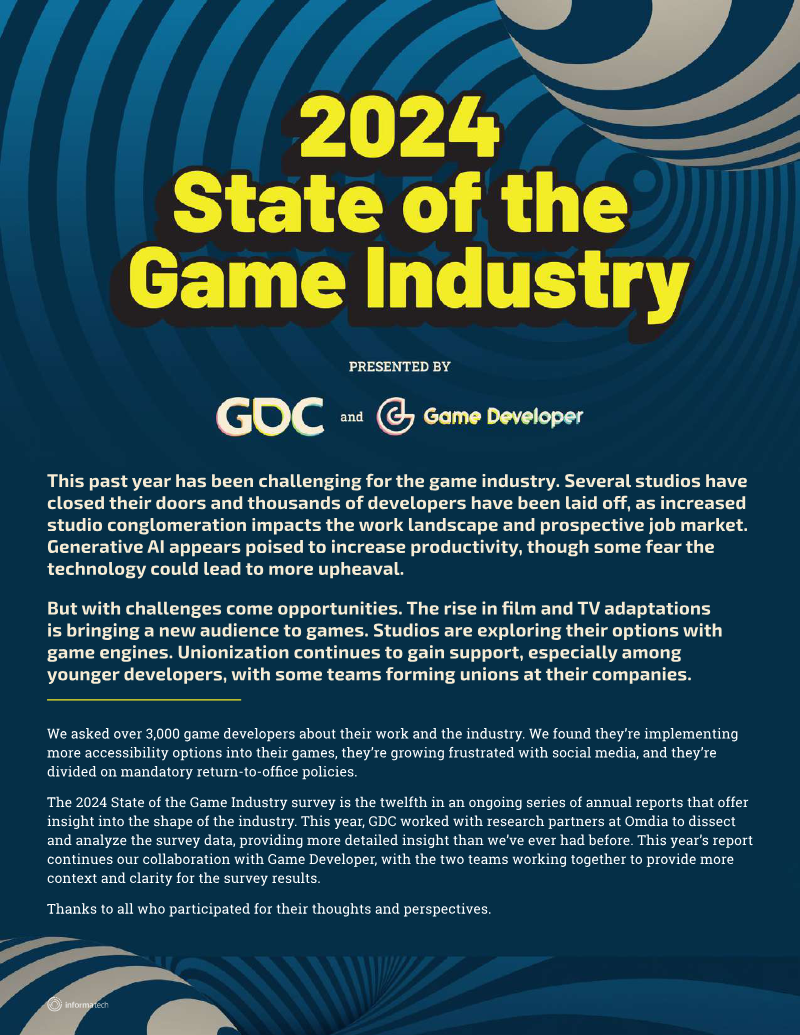
The global game industry entered 2024 in a state of profound volatility, defined by a painful market correction following post-pandemic overexpansion. This period of instability is marked by widespread layoffs affecting one-third of the workforce and a surge in studio closures linked to rapid corporate conglomeration. While North America remains the primary hub for development and PC continues to be the dominant platform, the workforce is increasingly preoccupied with job security and the ethical implications of emerging technologies. Generative AI has seen rapid adoption, with nearly half of developers utilizing these tools, yet 84% express deep concern regarding copyright infringement and the potential for further job displacement. Labor dynamics are shifting as developers react to economic pressures and perceived corporate mismanagement. Support for unionization has climbed to 57%, with particularly high enthusiasm among younger professionals aged 18 to 24 who are grappling with inflation and precarious employment. This desire for collective bargaining coincides with a growing rejection of mandatory return-to-office policies and a decline in confidence regarding corporate diversity and sustainability initiatives. Furthermore, the technical landscape is fracturing; significant dissatisfaction with Unity’s recent policy changes has led one-third of developers to consider switching engines, often favoring open-source alternatives like Godot. Business models remain centered on digital premium downloads, favored by 51% of the industry, even as marketing strategies face disruption due to overwhelming negative sentiment toward major social media platforms like Twitter/X. Despite the internal turmoil, there is a measurable increase in the implementation of accessibility features, which now appear in nearly half of all projects. However, the industry’s demographic makeup remains largely stagnant, continuing to be predominantly White and male. Ultimately, the current landscape reflects a workforce caught between the necessity of financial stability through consolidation and a growing demand for systemic reform to address ethical, technical, and labor-related grievances.
Thunderful Group’s 2024 Annual Report documents a decisive pivot toward a pure gaming focus, achieved through divestment of non‑gaming assets and a 20 % workforce reduction. The restructuring tightened the balance sheet, halving interest‑bearing net debt and leaving a modest cash position of SEK 29.6 million, yet it also produced a sharp decline in operating performance: net revenue fell 23.8 % to SEK 292.8 million and adjusted EBITA swung to a loss of SEK 383.9 million, largely due to cost‑cutting and the transition to higher‑margin publishing and co‑development activities. The global gaming market grew modestly in 2024, reaching USD 187.7 billion with a 5 % rise in the player base to 1.5 billion, projected to reach 1.67 billion by 2027. Thunderful’s strategy targets a 3.1 % CAGR in the PC segment, high‑quality titles priced USD 10–30, and external project investments capped at EUR 2 million. The company has reorganised into Publishing and Co‑development & Services segments to optimise resource allocation, lower fixed costs through third‑party publishing, and balance riskier internal IP development with predictable service revenue. Governance remains robust: a board‑led risk framework, annual review of a Zero‑tolerance Code of Conduct, and an anonymous whistleblowing function reinforce ethical standards. Executive remuneration is tightly linked to long‑term value, with fixed salaries capped at 30 % variable pay and share‑based incentives that could dilute equity by up to 4.65 % if fully exercised. Despite a net loss of SEK 887.5 million in 2024, the Group’s operating profit rose 57 % to SEK 292.8 million, signalling a turnaround post‑restructuring. Financially, the Group’s liquidity is constrained; total assets fell from SEK 3.15 billion to SEK 772.9 million, and net cash turned negative. Impairments of over SEK 444 million on goodwill and other intangibles, coupled with significant restructuring costs, underpin the negative operating margin of –46.9 %. The company’s exposure to foreign‑exchange, interest‑rate and liquidity risks remains moderate but requires ongoing monitoring. Overall, the report presents a company in transition, balancing aggressive cost discipline and strategic realignment against a challenging financial backdrop.