Updated Apr 30, 2026 by Quantic Foundry
Whitepaper
Published by Quantic Foundry
The Gamer Motivation Profile provides a comprehensive empirical framework for understanding player behavior through a psychometric model that categorizes gaming preferences into twelve distinct motivational drivers. These drivers—organized into six primary clusters including Action, Social, Mastery, Achievement, Immersion, and Creativity—allow developers and marketers to quantify why specific audiences engage with particular game titles. By linking psychometric data with demographic variables and specific game franchises, the model offers a data-driven approach to audience segmentation and product positioning. The research is built upon a robust dataset derived from over 1.75 million global participants who have completed the Gamer Motivation Profile survey. This large-scale, ongoing collection of data enables real-time analysis of player demographics, such as age, gender, and play frequency, alongside their psychological motivations. The methodology utilizes factor analysis to identify how various gaming preferences cluster together, providing a statistically sound basis for comparing individual titles against broader genre norms. The primary utility of this research lies in its ability to generate actionable insights for game development and player acquisition. Through a dynamic dashboard, users can perform side-by-side comparisons of different franchises, identify "game neighborhoods" based on shared motivational profiles, and filter titles by specific criteria to uncover underserved market segments. By mapping how individual games deviate from genre benchmarks, the model helps stakeholders prioritize development features, refine marketing messaging, and identify potential competitors even across disparate genres. This analytical toolset is designed to assist industry professionals in making evidence-based decisions regarding portfolio management and the strategic targeting of core and mid-core gaming audiences.
An Empirical Model A Unique Data Set Actionable Insights Our motivation model (next slide) Over 1.75M gamers worldwide Our data links game titles/franchises was developed via established have participated in our Gamer with demographic and motivation psychometric techniques, such as Motivation Profile, providing data variables, allowing us to analyze the factor analysis—a statistical on their motivations, demographics, motivations of game audiences to method that identifies how variables and their favorite games. produce data-driven insights. cluster together. Our Expertise in Gamer Motivation Research For over two decades, Nick Yee and Nic Ducheneaut have been studying the motivations and behavior of gamers. They have over 40 peerreviewed papers on gaming and virtual worlds. Nick Yee’s paper on the motivations of online gamers has been cited over 7,500 times.
Action Social Mastery Achievement Immersion Creativity “Boom!” “Let’s Play Together” “Let Me Think” “I Want More” “Once Upon a Time” “What If?” Destruction Competition Challenge Completion Fantasy Design Guns. Explosives. Duels. Matches. Practice. High Get All Collectibles. Being someone else, Expression. Chaos. Mayhem. High on Ranking. Difficulty. Challenges. Complete All Missions. somewhere else. Customization. Excitement Community Strategy Power Story Discovery Fast-Paced. Action. Being on Team. Thinking Ahead. Powerful Character. Elaborate plots. Explore. Tinker. Surprises. Thrills. Chatting. Interacting. Making Decisions. Powerful Equipment. Interesting characters. Experiment.
> **[Chart page]** This page contains visual data — view in PDF for the best experience. 8 8 8 8 8 8 8 8 8 8 8 8 8 8 8 The dashboard provides real-time online 8 8 8 access to our full data set. 8 8 8 When gamers fill out the profile survey, we also ask then to list specific game titles they enjoy. The dashboard 8 8 8 provides a way to pivot between gamer motivations, demographics, and specific game titles/franchises. 8 8 8 8 8 8
Easy and Quick Title Searches Help civiliza Profile Not sure of the exact name of a game or its Sid Meier's Civiliza tion V (sample size: 15,779) spelling? Just type in a word fragment, and the dashboard will show you what’s available. Sid Meier'sCiviliza tion VI (sample size: 14,363) Civiliza tion (series) (sample size: 10,030) Live Access Sid Meier's Civiliza tion IV (sample size: 3,049) The dashboard is connected to the live Sid Meier'sCiviliza tion II (sample size: 850) database. As soon as a gamer fills out the profile survey, their data is accessible to the Sid Meier's Civiliza tion III (sample size: 672) dashboard. Sid Meier's Civiliza tion: Beyond Earth (sample size: 491)
Demographics MEAN AGE Slightly older than average [median age: 25] Range: 11 to 76 Standard Deviation: 7.9 13% Female Quick Demographics 85% Male See the overall demographic profile and how 2% Other it compares to gamers in our full dataset. Is GENDER Slightly lower proportion of female gamers this audience less active than gamers in [average: 19% female] general? 9% Casual Gamer 5% 0-1 day A Chart of What This Game 73% Core / Mid-Core Gamer 18% 2-3 days Audience Cares About 18% Hardcore Gamer 25% 4-5 days GAMER CATEGORY Gamer type distribution close to the average DAYS PLAYED / 52% 6-7 days The chart shows how this audience compares [average: 21% hardcore] Slightly more days per week than average WEEK (> 30 MINS) [average: 49% 6-7 days] with the average gamer—the 50ᵗʰ %-tile Motivations represents the average. Quickly get a sense of what’s most and least Community important for this game audience. Use that 51% information to prioritize development, Competition 46% allocate resources, and tailor marketing Excitement 39% messaging. Destruction 46% Completion 42% Power 47% Strategy 63%
Motivations Community Genre Norms Competition We reference IGDB to dynamically generate 4 comparative norms for themes (e.g., horror) Excitement F and genre (e.g., strategy) based on recently- Destruction released titles that fit the criteria. Completion I A box-and-whiskers plot shows the min/max, median, and interquartile range of the genre Power norms. Strategy Quick Comparative Insights Challenge The overlay allows you to quickly identify Fantasy 1 how a specific title fits in the broader genre, Story and how it might be an outlier. Discovery Design 30 35 40 45 50 55 60 65 70 75 Overlay Norms IGDB: Genres × | v Value Strategy × | v Titles in Norm Baldur's Gate 3 + Loop Hero + Planet Zoo + Squad + Legends of Runeterra + Magic: The Gathering Arena + Crusader Kings III + Factorio + Teamfight Tactics + Anno 1800 Sample Size 32,092
Gaming has become the dominant entertainment medium for younger generations, with 80 % of under‑18s actively gaming and Gen Z allocating up to 22 % of free time to play. The study, combining first‑party data from SuperAwesome and Anzu with social listening, qualitative research, quantitative surveys, syndicated data, brand lift studies and parent‑tracking panels, covers the UK, France, Germany, the United States and global markets from 2023‑24. A sample of 30 000 children, teens and young adults (ages 4‑24) plus parent responses informs the analysis. Key findings show that gaming captures more attention than social media for Gen Z, with 55 % of under‑18s reporting a strong affinity for branded in‑game experiences. Younger gamers are highly receptive to ads, with 75 % of Gen Z players in the UK and US saying in‑game ads improve their experience, compared to 34 % of older adults. In‑game advertising drives higher brand recall (+7 pts) and purchase intent (+9 pts) for audiences under 34, and generates a “halo effect” that boosts brand affinity by up to 86 % among under‑18s. Parents report that children influence household spending, with 86 % saying their child’s opinions matter in purchases and 82 % prioritising items for children. The report recommends a multi‑platform, contextual approach that respects emerging data‑protection regulations and Age Appropriate Design Codes. It emphasizes early engagement before brand loyalties lock at age 16, contextual targeting over behavioural profiling, and rigorous creative vetting to avoid manipulative design. The analysis underscores gaming’s strategic importance for reaching Gen Alpha and Gen Z, offering measurable lift across awareness, consideration and purchase stages.
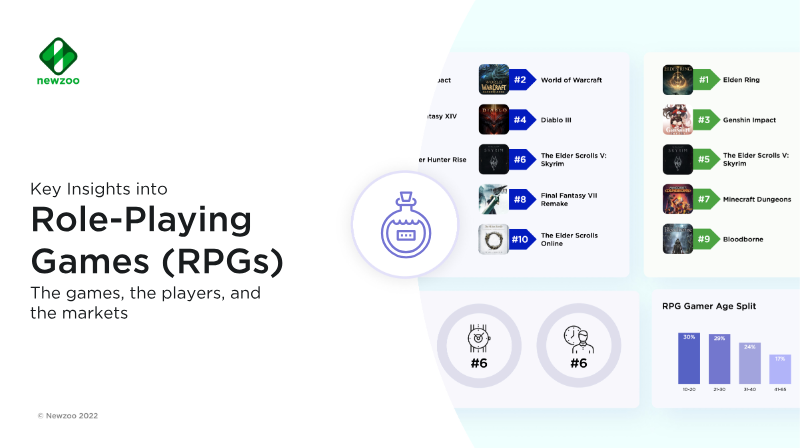
Role-Playing Games (RPGs) represent the highest-revenue genre in the global gaming market as of 2022. The genre is characterized by deep character development, party-based mechanics, and progression systems centered on quests and combat. While RPGs are played across all platforms, they maintain a strong presence on PC and console, where they consistently rank among the top genres for monthly active users. The demographic profile of the RPG audience is predominantly male, accounting for 58% of players, and skews toward younger age groups, with 59% of the player base falling between the ages of 10 and 30. Engagement patterns reveal that RPG players are highly active, averaging 18.8 sessions per month. The genre also demonstrates significant cross-genre appeal, with high player overlap in the adventure, shooter, and battle royale categories. High magical fantasy remains the most popular thematic element, utilized by 63% of the player base, while skill and talent trees serve as the most prevalent gameplay mechanic. Monetization within the RPG space is dominated by pay-to-play models, which reach 97% of the player base, followed closely by in-app purchases at 90%. Geographically, the United States and Japan lead in monthly active users on PC and console. The genre also maintains a robust live-streaming presence, generating 205 million hours watched across platforms like Twitch and Facebook Gaming in June 2022. These insights are derived from data covering 37 markets, excluding China and India, and utilize proprietary gamer segmentation to analyze player motivations, viewing habits, and engagement metrics across the broader gaming ecosystem.
Across more than twenty national markets, the majority of gamers report that playing video games reduces stress and enhances happiness, with 70‑90 % indicating lower stress levels and 57‑91 % feeling happier. Respondents also cite diminished anxiety and isolation, while parents observe a positive shift in relationships with their children, ranging from roughly one‑third in Sweden to nearly four‑fifths in Nigeria. Mobile devices dominate the landscape, accounting for 60‑96 % of play sessions, and online multiplayer emerges as the most prevalent social mode. In the United Arab Emirates, United Kingdom and United States, surveys of roughly three thousand gamers reveal consistent benefits: about 70‑80 % experience reduced stress and increased well‑being, and roughly two‑thirds of parents note improved parent‑child interaction. Genre preferences diverge, with UAE players favoring teamwork, collaboration and creativity, whereas UK and US gamers gravitate toward problem‑solving, critical‑thinking and cognitive‑skill development. Approximately half to sixty percent of participants perceive gaming as supportive of career‑related or hobby pursuits, and a similar share report enhancements in professional competencies. Research spanning multiple sectors demonstrates that video‑game‑based training yields measurable gains in cognition, decision‑making speed and technical performance. Gamers outperform non‑gamers in robotic‑surgery simulations, emergency‑response drills and retail‑seasonal‑sales scenarios, with meta‑analyses confirming statistically significant improvements in perception, attentional control and procedural accuracy. These outcomes translate into higher job performance, reduced error rates and stronger return on investment, prompting organizations such as NASA, the U.S. Air Force and elite sports teams to integrate game‑based platforms into their training pipelines.
Global PC and console revenues are expected to grow modestly through 2027, with consoles driving the majority of expansion at an estimated +13 % CAGR while PC revenue rises only in single digits. 2024 saw a plateau for PCs, dominated by free‑to‑play and in‑game monetisation, whereas console sales are set to rebound from 2025 thanks to strong releases such as GTA VI and the launch of Nintendo Switch 2. Player growth remains incremental, with PC players increasing at +2.3 % annually and console players at +3.5 %, driven largely by established franchises rather than breakthrough innovation. Playtime data confirm that 2024 experienced a 6 % YoY increase, with Pay‑to‑Play titles (e.g., Call of Duty) and free‑to‑play hits (Fortnite, Roblox) accounting for most of the lift. New releases captured only about 9 % of total playtime, underscoring that long‑running series dominate the market. Console audiences remain heavily slate‑dependent: 67 % of new‑release hours come from annual franchises, while PC players show a higher share of non‑annual titles. In the US and Western Europe, non‑annual franchise games contribute a smaller slice of console revenue (≈8–22 %) compared to annual franchises, which drive the bulk of earnings. Engagement patterns reveal a sharp decline in title diversity on PC and Xbox, with the average number of titles played per player falling 27 % on Steam in the US and up to 34 % in Russia and Brazil. PlayStation, by contrast, shows modest growth in title engagement. Genre preferences are shifting away from Battle Royale toward Adventure and Role‑Playing, reflecting a broader industry trend toward narrative‑rich, long‑form gameplay. Nostalgia and free‑to‑play models continue to sustain short‑term spikes, but long‑term retention hinges on continuous content updates and robust live‑service strategies. New IPs must prioritize originality, polished gameplay loops, and community‑first discovery to overcome the legacy brand advantage and achieve lasting commercial success.