Updated Apr 30, 2026 by SELL – Syndicat des Éditeurs de Logiciels de Loisirs
Report
Published by SELL – Syndicat des Éditeurs de Logiciels de Loisirs
The French video game market demonstrated significant resilience in 2025, generating €5.856 billion in total revenue, a 2.9% increase over the previous year. This performance marks the second-highest in the industry’s history, solidifying its position as a cornerstone of the national cultural economy. Growth was primarily fueled by a rebound in console hardware sales and a record-breaking 11% surge in the mobile sector, which reached €1.792 billion. The market maintains a balanced ecosystem, with consoles commanding a 44% share, followed by mobile at 31% and PC gaming at 26%. Software remains the primary revenue driver, accounting for over two-thirds of the total market. While physical game sales faced a double-digit decline, this was effectively mitigated by the expansion of digital content, including microtransactions and downloadable content. Electronic Arts emerged as the leading publisher across console and PC platforms, while the mobile landscape remains almost entirely dominated by free-to-play models, which now represent 94% of mobile revenue. The industry’s reach expanded to 40.2 million players, characterized by a maturing demographic where adults comprise 88% of the base. High engagement levels persist, with 76% of players gaming on a weekly basis and a growing trend toward cross-platform usage. Alongside this growth, there is a heightened emphasis on responsible gaming. Parental involvement has reached new heights, with 67% of parents actively monitoring gaming habits through PEGI classifications and standardized parental control tools. This commitment to safety, supported by organizations like the SELL and events such as Paris Games Week, ensures that the industry continues to thrive as a mature, socially responsible, and culturally significant sector within France.

Chiffres-clés 2025 Chiffres-clés 2025 Les Français et le jeu vidéo Le marché 40 Parmi les joueurs 1 PT 76 % 44 % 31 % VS 2024 millions Écosystème Écosystème de joueurs* 2,5 console** mobile*** jouent au moins mds d’euros 1,8 md d’euros *Au moins 1 fois dans l’année une fois par semaine = 0 % 11 % VS 2024 VS 2024 5 8 Adultes (18 ans et +) , 40 ANS 88 % 4 PTS VS 2024 Âge moyen 35,4 millions d’individus milliards d’euros d’un joueur 2,9 % en France VS 2024 Enfants (10-17 ans) 12 % 4,8 millions d’individus 26 % Écosystème = 0 % PC gaming** VS 2024 Temps moyen hebdomadaire 6 H 25 1,5 md d’euros de l'ensemble des joueurs Le total peut différer de 100 % (ici 101 %) en raison des arrondis. Sources: étude SELL/Médiamétrie «Les Français et le jeu vidéo», réalisée sur Internet du 19 juin au 13 juillet 2025 auprès d’un échantillon de 4001 individus Sources: données SELL, à partir des panels GSD/GameTrack/Sensor Tower/IDC à fin2025. *Écosystèmes console (hardware, accessoires, software 15 dématérialisé
Les adhérents AR SYSTEM DON'TNOD WORKS EA innelec Lil vilcroso ndcon Nintendo MICROIDS PLAION 7IL Plug in PUJLUP QUANTIC DIGITAL DREAM Chapitre 1 Le marché français du jeu vidéo ....................................... 10 Chapitre 2 Les Français et le jeu vidéo en 2025 ............................... 50 Chapitre 3 Une industrie responsable ................................................. 58 Chapitre 4 Le Syndicat des Éditeurs de Logiciels de Loisirs ............ 70 RDRLOX CEFA «L’Essentiel du jeu vidéo» est produit par le Syndicat des Éditeurs de Logiciels de Loisirs «SELL». Il est le reflet de l’industrie française du jeu vidéo sur les aspects marché, consommation et usages.
LE JEU VIDÉO EN FRANCE L’écosystème console, avec croissance continue du mobile rester attentifs aux défis ren- AFFIRME SA SOLIDITÉ 44% de part de marché et et la montée en puissance des contrés par le secteur : IA, ET RENOUE AVEC LA 2,552 milliards d’euros de contenus additionnels et des concentration du secteur, CROISSANCE EN 2025 chiffre d’affaires, conserve sa microtransactions, traduisant nouveaux comportements de Le jeu vidéo en France position de leader et retrouve un engagement accru des jeux, tensions sur l’emploi, ces confirme en 2025 sa robus- une dynamique positive, porté joueurs dans la durée. défis ne manquent pas. tesse, en enregistrant une principalement par le rebond progression de 2,9% par rap- du hardware. Les écosys- Au-delà des performances L’année 2025 apparaît ainsi port à 2024. Avec un chiffre tèmes mobiles et PC gaming économiques, ces résultats comme une année de consolid’affaires de 5,856 milliards poursuivent quant à eux leur confirment les fondamentaux dation et de relance, qui ouvre d’euros, le marché atteint trajectoire solide : le mobile de notre industrie : une capa- des perspectives encouraainsi son deuxième plus haut atteint un nouveau record cité d’innovation constante, geantes pour 2026. La force du niveau historique, consoli- historique à 1,792 milliard une richesse de contenus marché de consommation frandant plus que jamais sa place d’euros (+11%), tandis que le toujours renouvelée et une çais, la perspective d’un line-up de première industrie cultu- PC gaming se maintient à un demande soutenue de la part ambitieux, ainsi que l’annonce relle et créative du pays. niveau élevé à 1,512 milliard des consommateurs.
jamais sa place d’euros (+11%), tandis que le toujours renouvelée et une çais, la perspective d’un line-up de première industrie cultu- PC gaming se maintient à un demande soutenue de la part ambitieux, ainsi que l’annonce relle et créative du pays. niveau élevé à 1,512 milliard des consommateurs. Ils s’ins- d’innovations technologiques, Dans un contexte écono- d’euros, confirmant son rôle crivent dans un environne- notamment sur le segment mique et géopolitique toujours structurant dans l’industrie. ment qui demeure exigeant, hardware, permettent à l’induscontraint, marqué notamment James Rebours, Le segment software présente tant sur le plan économique trie du jeu vidéo d’envisager par des tensions persistantes segment hardware. Cette Président du SELL des évolutions contrastées, que social, et appellent à l’année 2026 avec confiance. sur le pouvoir d’achat des reprise correspond à l’arrivée Président du SELL révélatrices des transforma- que social, et appellent a l'année 2026 avec confiance. ménages, cette performance d’une nouvelle console de tions profondes du marché. témoigne de la solidité struc- génération 9. Si les ventes physiques sont Après une année 2024 turelle de notre industrie et génération 9. en recul, à l’image des autres marquée par un ajustement de l’attachement durable des La force du marché repose, marchés européens, la France Français au jeu vidéo. une nouvelle fois, sur la com- se distingue toujours par le post-covid exceptionnel, Français au jeu vidéo.
industrie et génération 9. en recul, à l’image des autres marquée par un ajustement de l’attachement durable des La force du marché repose, marchés européens, la France Français au jeu vidéo. une nouvelle fois, sur la com- se distingue toujours par le post-covid exceptionnel, Français au jeu vidéo. plémentarité des trois grands dynamisme de son réseau Après une année 2024 mar- écosystèmes – console, de distribution et l’attache- le marché retrouve une quée par un ajustement PC gaming et mobile – qui ment de ses joueurs au forpost-Covid exceptionnel, le confirment leur capacité à mat physique. Les ventes dynamique de croissance marché retrouve une dyna- répondre à des usages variés dématérialisées continuent mique de croissance por- et à des niveaux d’engage- toutefois de progresser, portée par le segment hardware. tée en grande partie par le ment très variés. portées notamment par la et à des niveaux d'engage- toutefois de progresser,
Panels et méthodologie Les estimations des chiffres du marché 2025 sont le résultat de la collaboration entre quatre organismes fournissant leurs données au SELL et permettant de dresser une analyse précise de l’activité du secteur. à -face tous les trois ans dans chaque marché GSD pour le marché physique GSD et GameTrack pour le marché digital À propos de GameTrack auprès d’un échantillon de 1000 individus â gés Sensor Tower et GameTrackpour le marché mobile IDC pour le hardware et les écrans PC gaming de 14 ans et plus (selon le marché), évaluant GameTrack est géré par Ipsos pour le compte le comportement personnel de jeu vidéo, ainsi GSD À propos de GSD Afin de garantir une base de données de produits de Video Games EU. Les résultats fournissent que les habitudes de jeu des mineurs âgés de 6 (Game Sales Data) fiable et uniforme, les informations relatives aux une analyse des profils démographiques des à 17 ans, telles que rapportées par les parents joueurs de jeux vidéo européens, ainsi que de ou tuteurs. Ces résultats sont analysés chez les Démarré en 2013, le projet GSD catalogues sont directement fournies par les édi- leurs comportements de jeu et d’achat sur toutes adultes â gés de 18 à 75 ans et servent à pondérer est le résultat d’une démarche teurs. En parallèle, les éditeurs et les distributeurs les plateformes et formats, offrant une vue com- et contextualiser les conclusions d’une enquête européenne menée par VGE transmettent des données permettant d’affiner les plète de leurs habitudes de jeu.
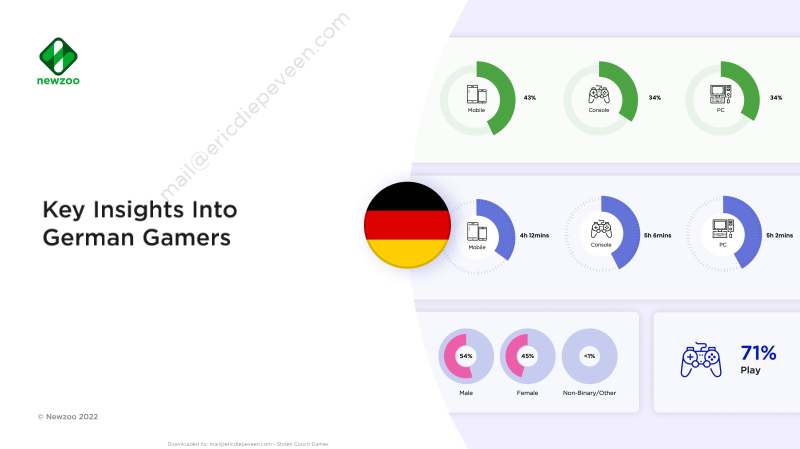
The Consumer Insights: Games and Esports 2022 report provides a comprehensive analysis of global gaming behaviors, motivations, and market engagement. The primary purpose of the research is to equip game developers, publishers, and industry stakeholders with actionable data to benchmark titles, understand player demographics, and identify growth opportunities across 36 diverse international markets. By examining over 100 key performance indicators, the analysis offers a granular view of how players interact with PC, console, and mobile platforms. The research is underpinned by a robust methodology, drawing on survey data from over 75,000 consumers worldwide. The findings highlight distinct engagement patterns, such as the prevalence of specific gaming personas—notably Time Fillers and Mainstream Gamers—and the interplay between playing and viewing habits. For instance, data from the German market indicates that while playing remains the dominant activity, a significant portion of the population also engages with gaming video content and esports. Furthermore, the report identifies key drivers for consumer spending, noting that price sensitivity, the desire for exclusive content, and social connectivity are primary motivators for financial investment in games. Covering a broad geographic scope that includes North America, Europe, Latin America, the Middle East, and the Asia-Pacific region, the report serves as a strategic tool for navigating the complex global gaming landscape. By synthesizing metrics such as monthly active users, daily active users, and lifetime player value, the analysis facilitates a deeper understanding of the motivations driving player behavior. Ultimately, the findings emphasize that a nuanced approach to audience segmentation and platform-specific engagement is essential for companies seeking to reach and retain diverse gaming populations in an increasingly competitive entertainment market.
In 2025, roughly 14.2 million Italians—about a third of the population aged six to seventy‑five—engage in video gaming, with a pronounced male bias and a concentration of players under 35. The industry’s total revenue remains steady at €2.4 billion, of which game sales account for 77 percent (€1.8 bn). Gaming time has risen to nearly eight hours per week, driven primarily by smart‑device play (22 percent reach, €929 m revenue) and console gaming (13 percent reach, €643 m). App‑based games now represent more than half of the market, dominated by freemium monetisation; only one percent of app revenue comes from upfront purchases. Revenue distribution varies by platform. Smart‑device earnings are almost entirely from in‑app purchases (ARPU €84), while console sales lean heavily on digital downloads—65 percent of new game revenue comes from full‑game downloads (€502 m) and 21 percent from DLC (ARPU €99). PC revenue is largely driven by DLC (43 percent) and full‑game downloads (98 percent of console sales). Subscription services are pivotal: console ecosystem subscriptions contribute 59 percent of total gaming‑subscription revenue (€153 m), with mobile and single‑game franchises accounting for 6 percent and 35 percent respectively. Player demographics reveal that smart devices attract a younger, male‑skewed audience (31 percent of 6–17‑year-olds), whereas console and PC gaming remain niche but heavily male‑skewed, concentrated among teens. Casual and sports titles dominate sales across all platforms, with subscription services such as PlayStation Plus and Xbox Game Pass driving a significant share of paid play. Engagement patterns show males spending the most hours on consoles (average seven hours per week), while PC gaming remains steady across age groups. Approximately one‑quarter of players follow gaming news on YouTube or vlogs, and 20 percent rely on social media or family discussions for information. The data derive from a nationally representative online survey of 3,000 respondents, weighted against an offline omnibus sample and calibrated to industry sales figures.
The global games market is entering a period of moderate maturation, with total revenue projected to reach $188.8 billion in 2025, a 3.4% increase over the previous year. The industry now serves 3.6 billion players, reflecting a 4.4% year-over-year expansion. While mobile gaming maintains its dominance, accounting for $103.0 billion or 55% of total revenue, console gaming is poised for the strongest growth at 5.5%, reaching $45.9 billion. PC gaming remains a stable pillar with $39.9 billion in revenue. Despite the growth in player counts, average spend per payer is experiencing a slight decline, signaling a strategic pivot toward maximizing engagement and retention within saturated markets rather than relying solely on aggressive monetization. Strategic success in this environment increasingly depends on long-tail engagement and the effective management of post-launch content. Data indicates that releasing single-player titles during the second quarter yields 34% higher engagement compared to the saturated holiday season. Furthermore, simultaneous multi-platform launches significantly outperform staggered releases, and titles exiting Early Access after a six-month window demonstrate superior acquisition results. Developers are also increasingly leveraging remakes and remasters to mitigate rising development costs, while user-generated content platforms like Roblox continue to expand as foundational ecosystems for daily active users. Geographically, the market continues to diversify, with Latin America emerging as a notable growth region projected to reach $8.3 billion, driven primarily by mobile adoption. The industry’s analytical framework, which focuses on consumer spending on software and services, highlights that player attrition typically stabilizes after 12 weeks. Consequently, long-term commercial viability is now inextricably linked to aligning content updates and discounting strategies with this post-launch retention curve, ensuring that community support remains as critical as initial sales performance.
The French video game market has reached a historic peak in engagement, with 40.2 million individuals—representing 66% of the national population—identifying as players. The demographic profile of the average gamer has stabilized at 40 years old, characterized by near gender parity. Notably, women now constitute a 55% majority within the 16-30 age bracket, while the senior segment has expanded to 5.4 million participants. This broad adoption is accompanied by an increase in weekly playtime to nearly eight hours, driven largely by a preference for social and multiplayer experiences. Approximately 86% of players utilize multiplayer modes, and 60% report forming direct friendships through gaming, illustrating the medium's role as a primary driver of social cohesion across generations. Professional interest in the sector is also rising, particularly among young adults, over a third of whom have considered industry careers. This cultural integration is supported by a robust regulatory and educational framework. Parental involvement is high, with 67% of parents actively monitoring their children’s gaming habits and 95% expressing awareness of parental control systems. The PEGI classification system remains the cornerstone of consumer protection, utilizing independent verification bodies to ensure content appropriateness across more than 35,000 titles. This system facilitates informed purchasing decisions and maintains safety standards for the nation's "digital native" demographics. The industry’s operational landscape is anchored by the Syndicat des Éditeurs de Logiciels de Loisirs (SELL), which represents major publishers and manages significant cultural milestones such as Paris Games Week. Beyond market intelligence and event organization, the sector emphasizes social responsibility through initiatives like PédagoJeux and various inclusion-focused partnerships. These efforts ensure that the French gaming ecosystem remains both economically vibrant and socially responsible, balancing rapid growth with a commitment to player safety and diversity.