Updated Apr 30, 2026 by IIDEA – Italian Interactive Digital Entertainment Association
Report
Published by IIDEA – Italian Interactive Digital Entertainment Association
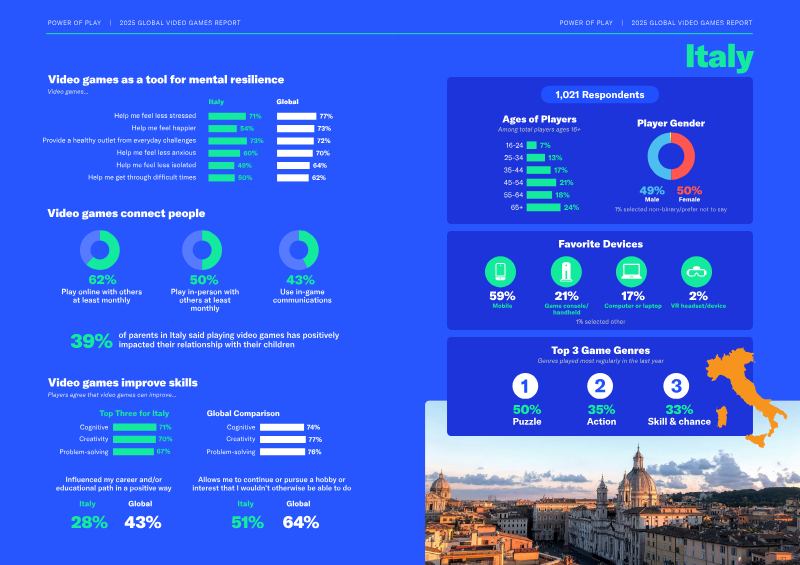
Video games serve as a significant mechanism for mental resilience and emotional regulation among the Italian population. A survey of 1,021 respondents aged 16 and older reveals that a substantial majority of Italian players utilize gaming to mitigate negative psychological states. Specifically, 71% of participants report that gaming helps reduce stress, while 60% use it to manage anxiety and 49% rely on it to combat feelings of isolation. These figures demonstrate that gaming functions as a vital outlet for navigating everyday challenges and difficult life transitions, with 50% of respondents explicitly noting that the medium helps them endure personal hardships. The demographic profile of the Italian gaming community is broad, with the largest segment of players falling into the 45-54 age bracket at 21%, followed closely by those aged 65 and older at 24%. Mobile devices remain the primary platform for 59% of users, significantly outpacing consoles and computers. Social connectivity is a core component of the experience, as 62% of players engage in online multiplayer sessions at least monthly. Beyond emotional support, gaming is perceived as a tool for cognitive development, with 71% of players reporting improvements in cognitive function, 70% in creativity, and 67% in problem-solving skills. The impact of gaming extends into familial and professional spheres, fostering positive interpersonal dynamics and skill acquisition. Approximately 39% of parents in Italy report that shared gaming experiences have strengthened their relationships with their children. While the influence on career paths remains lower in Italy at 28% compared to the global average of 43%, the medium continues to provide a unique space for pursuing hobbies and educational interests. Puzzle, action, and skill-based games represent the most popular genres, underscoring a preference for interactive experiences that challenge the mind while providing a structured environment for relaxation.
Video games as a tool for mental resilience Italy Video games... Italy Global 1,021 Respondents Help me feel less stressed 71% 77% Ages of Players Player Gender Help me feel happier 54% 73% Among total players ages 16+ Provide a healthy outlet from everyday challenges 73% 72% 16-24 7% Help me feel less anxious 60% 70% 25-34 13% Help Help me feel less isolated 49% 64% 35-44 17% me get through difficult times 50% 62% 45-54 21% 49% 50% 55-64 18% Male Female Video games connect people 65+ 24% 1% selected non-binary/prefer not to say Favorite Devices Play 62% 50% 43% online with others Play in-person with Use in-game 59% 21% 17% 2% at least monthly others at least communications Mobile Game console/ Computer or laptop VR headset/device monthly handheld 1% selected other 39% of parents in Italy said playing video games has positively impacted their relationship with their children Top 3 Game Genres Genres played most regularly in the last year Video games improve skills 1 2 3 Players agree that video games can improve... Top Three for Italy Global Comparison 50% 35% 33% Cognitive 71% Cognitive 74% Puzzle Action Skill & chance Action Skill Creativity 70% Creativity 77% Puzzle & chance Problem-solving 67% Problem-solving 76% Influenced my career and/or Allows me to continue or pursue a hobby or educational path in a positive way interest that I wouldn’t otherwise be able to do Italy Global Italy Global 28% 43% 51% 64%
Gaming has become the dominant entertainment medium for younger generations, with 80 % of under‑18s actively gaming and Gen Z allocating up to 22 % of free time to play. The study, combining first‑party data from SuperAwesome and Anzu with social listening, qualitative research, quantitative surveys, syndicated data, brand lift studies and parent‑tracking panels, covers the UK, France, Germany, the United States and global markets from 2023‑24. A sample of 30 000 children, teens and young adults (ages 4‑24) plus parent responses informs the analysis. Key findings show that gaming captures more attention than social media for Gen Z, with 55 % of under‑18s reporting a strong affinity for branded in‑game experiences. Younger gamers are highly receptive to ads, with 75 % of Gen Z players in the UK and US saying in‑game ads improve their experience, compared to 34 % of older adults. In‑game advertising drives higher brand recall (+7 pts) and purchase intent (+9 pts) for audiences under 34, and generates a “halo effect” that boosts brand affinity by up to 86 % among under‑18s. Parents report that children influence household spending, with 86 % saying their child’s opinions matter in purchases and 82 % prioritising items for children. The report recommends a multi‑platform, contextual approach that respects emerging data‑protection regulations and Age Appropriate Design Codes. It emphasizes early engagement before brand loyalties lock at age 16, contextual targeting over behavioural profiling, and rigorous creative vetting to avoid manipulative design. The analysis underscores gaming’s strategic importance for reaching Gen Alpha and Gen Z, offering measurable lift across awareness, consideration and purchase stages.
The Southeast Asia Gaming Consumer Economy report, produced jointly by Telekom Malaysia and twimbit in Q2 2022, examines the region’s rapidly expanding gaming market. Six key economies—Indonesia, Malaysia, the Philippines, Singapore, Thailand and Vietnam—account for 85 % of SEA’s gamer population, which is projected to reach 367.8 million by 2025, representing more than half of the region’s total population. Mobile gaming dominates, with 70 % of in‑game revenue and a 13.7 % CAGR in consumer spend from 2018 to 2021, totaling US$5.57 billion. Urbanisation and a youthful demographic drive high willingness to spend, with 64 % of gamers willing to pay; average annual spend varies from US$9 in Indonesia to US$189 in Singapore. Genre preferences skew toward action, strategy and casual titles; 86 % of players engage in the top five genres. Gender parity is notable, especially on mobile where female gamers constitute 47 % of the market and are highly spend‑active. eSports viewership is nascent but growing, with SEA tournaments ranking among the world’s most‑watched events; mobile eSports is expected to lead future growth as 5G and cloud gaming mature. Monetisation remains dominated by free‑to‑play with in‑app purchases (86 % of revenue), supplemented by hybrid and subscription models. Methodologically, the study synthesises industry interviews, published data, annual reports, and platform analytics. The report recommends that developers adopt edge computing for low‑latency play, deliver cross‑device flexibility, and build scalable cloud architectures to meet the region’s dynamic demand.
The report examines the esports market across Southeast Asia (SEA) for 2024, drawing on a summer‑2024 consumer survey of 14,250 respondents representing the region’s online population aged 16–65. The study focuses on audience reach, engagement maturity, demographic composition, consumption habits, and monetisation challenges. SEA emerges as the world’s most extensive esports market, with a 75 % overall reach but only 32 % of viewers engaging regularly; about half of those regular viewers watch more than seven hours per week. Mobile gaming dominates, accounting for roughly 55 % of esports consumption and driving the shift toward digital-first viewing platforms such as YouTube Gaming, Facebook Gaming, and local streaming services. Gender distribution shows 43 % female viewership, slightly higher than in traditional sports, while the audience is markedly younger—81 % of viewers are Millennials or Gen Z. Compared to traditional sports, esports has a comparable male share but a younger demographic profile and higher urban concentration. Country‑level snapshots reveal Vietnam, Malaysia, and the Philippines as leaders in regular viewership (over 70 % of aware audiences), whereas Singapore lags behind. The report highlights a significant drop‑off from sporadic to regular viewership, underscoring the need for brands and tournament organisers to build stronger brand equity and leverage influencers. Engagement data indicate that esports audiences are highly willing to pay for free‑time activities, yet they also maintain many hobbies, presenting both opportunity and competition for attention. Overall, the findings suggest that SEA’s esports ecosystem is maturing into a mainstream entertainment sector, offering substantial growth potential for advertisers, publishers, and league operators willing to invest in mobile‑centric, data‑driven engagement strategies.
The French video game market has reached a historic peak in engagement, with 40.2 million individuals—representing 66% of the national population—identifying as players. The demographic profile of the average gamer has stabilized at 40 years old, characterized by near gender parity. Notably, women now constitute a 55% majority within the 16-30 age bracket, while the senior segment has expanded to 5.4 million participants. This broad adoption is accompanied by an increase in weekly playtime to nearly eight hours, driven largely by a preference for social and multiplayer experiences. Approximately 86% of players utilize multiplayer modes, and 60% report forming direct friendships through gaming, illustrating the medium's role as a primary driver of social cohesion across generations. Professional interest in the sector is also rising, particularly among young adults, over a third of whom have considered industry careers. This cultural integration is supported by a robust regulatory and educational framework. Parental involvement is high, with 67% of parents actively monitoring their children’s gaming habits and 95% expressing awareness of parental control systems. The PEGI classification system remains the cornerstone of consumer protection, utilizing independent verification bodies to ensure content appropriateness across more than 35,000 titles. This system facilitates informed purchasing decisions and maintains safety standards for the nation's "digital native" demographics. The industry’s operational landscape is anchored by the Syndicat des Éditeurs de Logiciels de Loisirs (SELL), which represents major publishers and manages significant cultural milestones such as Paris Games Week. Beyond market intelligence and event organization, the sector emphasizes social responsibility through initiatives like PédagoJeux and various inclusion-focused partnerships. These efforts ensure that the French gaming ecosystem remains both economically vibrant and socially responsible, balancing rapid growth with a commitment to player safety and diversity.