Updated Apr 30, 2026 by IIDEA
Report
Published by IIDEA
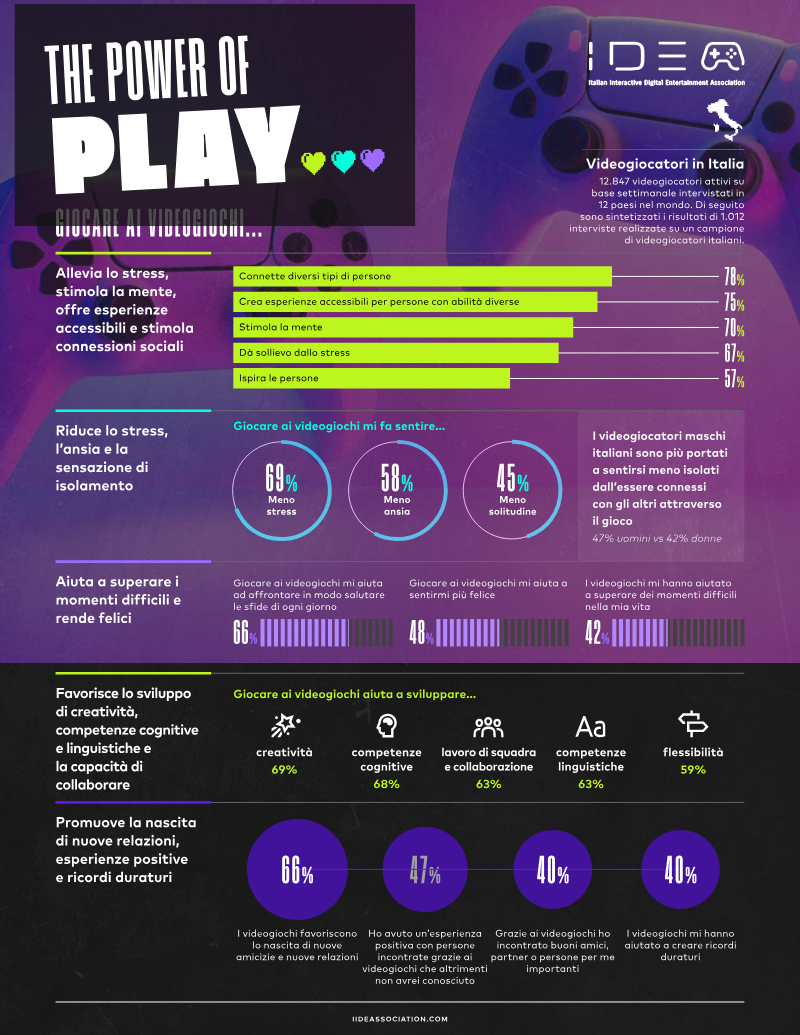
The Italian gaming landscape is characterized by a strong emphasis on the psychological and social benefits of interactive entertainment. Based on a survey of 1,012 Italian gamers, which forms part of a broader 12-country study involving 12,847 active weekly players, the research highlights that gaming serves as a vital tool for stress relief, cognitive stimulation, and social connection. A significant majority of respondents report that gaming alleviates stress and anxiety, fosters creativity, and enhances problem-solving skills, with 69% of participants noting that the medium stimulates the mind and improves teamwork capabilities. Social interaction remains a cornerstone of the Italian gaming experience. While solitary play is common on a daily basis, approximately half of the respondents prefer engaging with others through online platforms on a weekly basis. This social dimension is particularly prevalent among male gamers, who show a higher propensity for online multiplayer interaction. Furthermore, the data indicates that gaming acts as a bridge for building new relationships, with many users reporting that they have formed lasting friendships or met significant partners through in-game experiences. The demographic reach of gaming in Italy is broad, though usage patterns vary by age and gender. Engagement is most concentrated within the 19-34 age bracket, and there is a notable adoption of in-game communication tools, particularly among male players. Ultimately, the findings suggest that gaming is perceived not merely as a pastime, but as a constructive activity that supports mental well-being, facilitates personal development, and provides a reliable framework for community building in an increasingly digital society.
France Germany Italy PLAY Videogiocatori in Italia 12.847 videogiocatori attivi su Videogiocatori ~~in Italia~~ Poland 12.847 videogiocatori attivi su South Korea Spain Italy base settimanale intervistati in GIOCARE AI VIDEOGIOCHI... 12 paesi nel mondo. Di seguito sono sintetizzati i risultati di 1.012 interviste realizzate su un campione di videogiocatori italiani. Allevia lo stress, 78% stimola la mente, Connette diversi tipi di persone 78% offre esperienze Crea esperienze accessibili per persone con abilità diverse 75% accessibili e stimola Stimola la mente 70% connessioni sociali Dà sollievo dallo stress 67% Ispira le persone 57% Riduce lo stress, Giocare ai videogiochi mi fa sentire… I videogiocatori maschi l’ansia e la italiani sono più portati sensazione di 6 9 % 5 8 % 4 5 % a sentirsi meno isolati isolamento Meno Meno Meno dall’essere connessi stress ansia solitudine con gli altri attraverso il gioco 47% uomini vs 42% donne Aiuta a superare i Giocare ai videogiochi mi aiuta Giocare ai videogiochi mi aiuta a I videogiochi mi hanno aiutato momenti difficili e ad affrontare in modo salutare sentirmi più felice a superare dei momenti difficili rende felici le sfide di ogni giorno sentirmi più felice nella mia vita 66 48 nella mia vita rende felici % % 42%
giochi mi aiuta Giocare ai videogiochi mi aiuta a I videogiochi mi hanno aiutato momenti difficili e ad affrontare in modo salutare sentirmi più felice a superare dei momenti difficili rende felici le sfide di ogni giorno sentirmi più felice nella mia vita 66 48 nella mia vita rende felici % % 42% Favorisce lo sviluppo Giocare ai videogiochi aiuta a sviluppare… di creatività, Giocare ai videogiochi aiuta a sviluppare.. competenze cognitive D e linguistiche e creatività competenze lavoro ~~di squadra ~~ ~~competenze ~~ ~~flessibilità~~ la capacità di 69% cognitive e collaborazione linguistiche 59% collaborare 69% 68% 63% 63% 59% collaborare 68% 63% 63% Promuove la nascita di nuove relazioni, esperienze positive 6 ~~6~~ % ~~47~~ % ~~4 0~~ % ~~4 ~~ 0 % e ricordi duraturi 47% 40% 40% esperienze positive 66% e ricordi duraturi I videogiochi favoriscono Ho avuto un’esperienza Grazie ai videogiochi ho I videogiochi mi hanno lo nascita di nuove positiva con persone incontrato buoni amici, aiutato a creare ricordi amicizie e nuove relazioni incontrate grazie ai partner o persone per me duraturi videogiochi che altrimenti importanti I videogiochi mi hanno lo nascita di nuove non avrei conosciuto incontrato buoni amici, aiutato a creare ricordi
il il il videogioca per passare il videogioca per divertirsi pensa esista un videogioco tempo per tutti I videogiochi sono un efficacie strumento per Videogiocare da soli è più frequente su base quotidiana, I videogiochi sono un efficacie strumento per Videogiocare da soli è più frequente su base quotidiana, ridurre lo stress a tutti i livelli ma su base settimanale circa la metà dei videogiocatori italiani predilige giocare con altre persone online In solitaria Con altre Con altre persone, Con altre Con altre persone, In solitaria persone online in presenza 50% 54% 51% 55% 54% 49% Ogni 50% 54% 47% 51% 55% 47% 48% 54% 49% Ogni 47% 38% 47% 48% giorno ~~64~~ % ~~25~~ % ~~13~~ % 38% Ogni 89% 48% 38% settimana DonneUomini 16-18 19-2425-34 35-44 45-54 55-64 65+ Totale Italia I videogiocatori maschi sono più propensi a videogiocare con altre persone online 71% Donne 44% Uomini 52% Donne 37% Uomini 40% valuta positivamente la propria esperienza Videogioco con altre persone online Videogioco con altre persone in presenza di gioco online Videogioco con altre persone online Videogioco con altre persone in presenza di gioco online 45% L’utilizzo è maggiormente diffuso tra i 28% videogiocatori maschi e nella fascia d’età 19-34 Ogni tanto videogiocatori maschi e nella fascia d'eta 19-34 Ogni tanto 209 75% 60% Frequenza 49% 53% 75% 53% di utilizzo 13 dei videogiocatori 41% 60% 42% 37% Frequenza Spesso % utilizza gli 49% 53% 53% 28% di utilizzo Spesso 1 % strumenti di 41% 42% 37% 28%
atori maschi e nella fascia d’età 19-34 Ogni tanto videogiocatori maschi e nella fascia d'eta 19-34 Ogni tanto 209 75% 60% Frequenza 49% 53% 75% 53% di utilizzo 13 dei videogiocatori 41% 60% 42% 37% Frequenza Spesso % utilizza gli 49% 53% 53% 28% di utilizzo Spesso 1 % strumenti di 41% 42% 37% 28% Sempre 4% comunicazione in-game DonneUomini 16-18 19-2425-3435-44 45-54 55-64 65+ comunicazione
Gaming has become the dominant entertainment medium for younger generations, with 80 % of under‑18s actively gaming and Gen Z allocating up to 22 % of free time to play. The study, combining first‑party data from SuperAwesome and Anzu with social listening, qualitative research, quantitative surveys, syndicated data, brand lift studies and parent‑tracking panels, covers the UK, France, Germany, the United States and global markets from 2023‑24. A sample of 30 000 children, teens and young adults (ages 4‑24) plus parent responses informs the analysis. Key findings show that gaming captures more attention than social media for Gen Z, with 55 % of under‑18s reporting a strong affinity for branded in‑game experiences. Younger gamers are highly receptive to ads, with 75 % of Gen Z players in the UK and US saying in‑game ads improve their experience, compared to 34 % of older adults. In‑game advertising drives higher brand recall (+7 pts) and purchase intent (+9 pts) for audiences under 34, and generates a “halo effect” that boosts brand affinity by up to 86 % among under‑18s. Parents report that children influence household spending, with 86 % saying their child’s opinions matter in purchases and 82 % prioritising items for children. The report recommends a multi‑platform, contextual approach that respects emerging data‑protection regulations and Age Appropriate Design Codes. It emphasizes early engagement before brand loyalties lock at age 16, contextual targeting over behavioural profiling, and rigorous creative vetting to avoid manipulative design. The analysis underscores gaming’s strategic importance for reaching Gen Alpha and Gen Z, offering measurable lift across awareness, consideration and purchase stages.
The Southeast Asia Gaming Consumer Economy report, produced jointly by Telekom Malaysia and twimbit in Q2 2022, examines the region’s rapidly expanding gaming market. Six key economies—Indonesia, Malaysia, the Philippines, Singapore, Thailand and Vietnam—account for 85 % of SEA’s gamer population, which is projected to reach 367.8 million by 2025, representing more than half of the region’s total population. Mobile gaming dominates, with 70 % of in‑game revenue and a 13.7 % CAGR in consumer spend from 2018 to 2021, totaling US$5.57 billion. Urbanisation and a youthful demographic drive high willingness to spend, with 64 % of gamers willing to pay; average annual spend varies from US$9 in Indonesia to US$189 in Singapore. Genre preferences skew toward action, strategy and casual titles; 86 % of players engage in the top five genres. Gender parity is notable, especially on mobile where female gamers constitute 47 % of the market and are highly spend‑active. eSports viewership is nascent but growing, with SEA tournaments ranking among the world’s most‑watched events; mobile eSports is expected to lead future growth as 5G and cloud gaming mature. Monetisation remains dominated by free‑to‑play with in‑app purchases (86 % of revenue), supplemented by hybrid and subscription models. Methodologically, the study synthesises industry interviews, published data, annual reports, and platform analytics. The report recommends that developers adopt edge computing for low‑latency play, deliver cross‑device flexibility, and build scalable cloud architectures to meet the region’s dynamic demand.
The report examines the esports market across Southeast Asia (SEA) for 2024, drawing on a summer‑2024 consumer survey of 14,250 respondents representing the region’s online population aged 16–65. The study focuses on audience reach, engagement maturity, demographic composition, consumption habits, and monetisation challenges. SEA emerges as the world’s most extensive esports market, with a 75 % overall reach but only 32 % of viewers engaging regularly; about half of those regular viewers watch more than seven hours per week. Mobile gaming dominates, accounting for roughly 55 % of esports consumption and driving the shift toward digital-first viewing platforms such as YouTube Gaming, Facebook Gaming, and local streaming services. Gender distribution shows 43 % female viewership, slightly higher than in traditional sports, while the audience is markedly younger—81 % of viewers are Millennials or Gen Z. Compared to traditional sports, esports has a comparable male share but a younger demographic profile and higher urban concentration. Country‑level snapshots reveal Vietnam, Malaysia, and the Philippines as leaders in regular viewership (over 70 % of aware audiences), whereas Singapore lags behind. The report highlights a significant drop‑off from sporadic to regular viewership, underscoring the need for brands and tournament organisers to build stronger brand equity and leverage influencers. Engagement data indicate that esports audiences are highly willing to pay for free‑time activities, yet they also maintain many hobbies, presenting both opportunity and competition for attention. Overall, the findings suggest that SEA’s esports ecosystem is maturing into a mainstream entertainment sector, offering substantial growth potential for advertisers, publishers, and league operators willing to invest in mobile‑centric, data‑driven engagement strategies.
The French video game market has reached a historic peak in engagement, with 40.2 million individuals—representing 66% of the national population—identifying as players. The demographic profile of the average gamer has stabilized at 40 years old, characterized by near gender parity. Notably, women now constitute a 55% majority within the 16-30 age bracket, while the senior segment has expanded to 5.4 million participants. This broad adoption is accompanied by an increase in weekly playtime to nearly eight hours, driven largely by a preference for social and multiplayer experiences. Approximately 86% of players utilize multiplayer modes, and 60% report forming direct friendships through gaming, illustrating the medium's role as a primary driver of social cohesion across generations. Professional interest in the sector is also rising, particularly among young adults, over a third of whom have considered industry careers. This cultural integration is supported by a robust regulatory and educational framework. Parental involvement is high, with 67% of parents actively monitoring their children’s gaming habits and 95% expressing awareness of parental control systems. The PEGI classification system remains the cornerstone of consumer protection, utilizing independent verification bodies to ensure content appropriateness across more than 35,000 titles. This system facilitates informed purchasing decisions and maintains safety standards for the nation's "digital native" demographics. The industry’s operational landscape is anchored by the Syndicat des Éditeurs de Logiciels de Loisirs (SELL), which represents major publishers and manages significant cultural milestones such as Paris Games Week. Beyond market intelligence and event organization, the sector emphasizes social responsibility through initiatives like PédagoJeux and various inclusion-focused partnerships. These efforts ensure that the French gaming ecosystem remains both economically vibrant and socially responsible, balancing rapid growth with a commitment to player safety and diversity.