Investment reports and market data
Documents


State of Play: Spring Edition
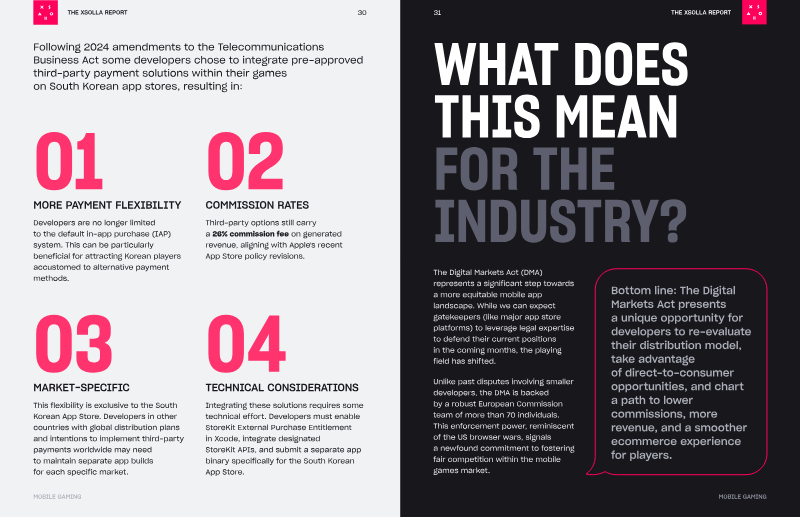
Mobile gaming has solidified its position as the industry’s primary driver, currently engaging 1.9 billion players and tracking toward $118 billion in annual revenue by 2027.
- Mobile gaming is the industry's primary growth engine, with 1.9 billion players and projected annual revenue of $118 billion by 2027.
- Regulatory changes like the EU's Digital Markets Act are dismantling app store walled gardens, enabling developers to bypass standard commission fees through alternative billing and direct-to-consumer commerce.
- Cross-platform play is now a standard expectation, with 87% of multiplayer gamers participating and developers increasingly integrating 5G and mobile wallets to facilitate unified 'cross-pay' ecosystems.

Learnings from Building & Exiting Three Companies with Paul Gouge, Founder of Fourth Star
The pursuit of excellence in the mobile gaming industry requires a departure from the common "family" corporate culture in favor of a high-performance "sports team" model.
- Adopt a 'sports team' organizational model that prioritizes elite talent and radical transparency over a 'family' culture to maintain high performance in saturated markets.
- Implement the AIM framework—Audience, Ingredients, and Mix—to filter out low-quality game concepts early and prevent the waste of development resources.
- Replace the 'fail fast' mentality with a disciplined, high-quality development process that emphasizes rigorous prototyping and granular, measurable roadmaps.
2023 Game Development Report: Griffin Gaming Partners
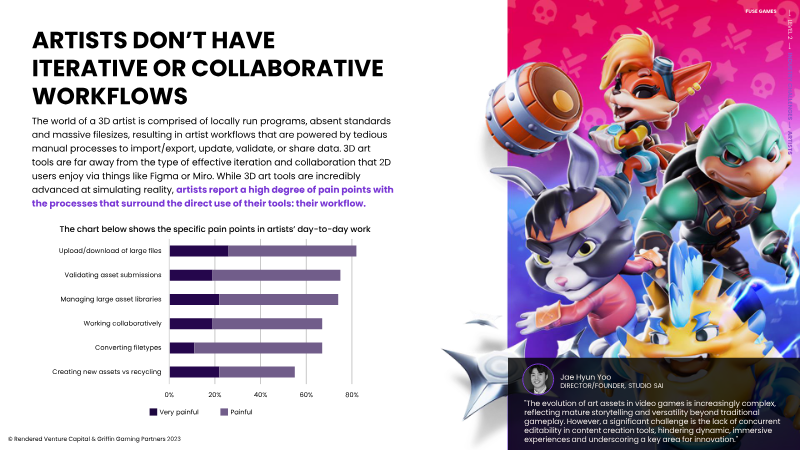
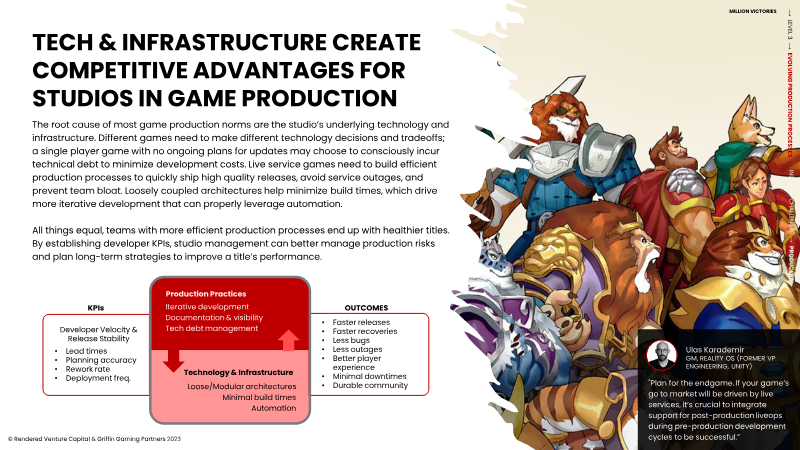
The modern game development landscape is defined by a critical tension between escalating production costs and the rigorous demands of the live-service model.
- Approximately 65% of development teams are shifting from proprietary, custom-built solutions to off-the-shelf backend infrastructure and third-party tools to reduce time-to-market and technical debt.
- 65% of developers are actively planning to support cloud streaming, prioritizing scalable, modular architectures to enhance audience reach and deployment speed.
- The industry is moving away from traditional waterfall methodologies toward iterative, data-driven development cycles to improve developer velocity and long-term stability.

Midnight, the AA Web 3 Games Consolidator
Midnight operates as a strategic consolidator within the Web3 gaming sector, focusing on the acquisition and development of AA-tier PC and console titles.
- Midnight is a strategic consolidator acquiring and developing AA-tier PC and console titles, specifically targeting studios with proven engagement metrics that have struggled with traditional funding.
- The company aims to release approximately 13 titles annually with individual budgets ranging from $500,000 to $5 million to ensure a broad, niche-focused ecosystem.
- The operational core is 'Evergreen,' a deconstructed MMO companion app that functions as a social hub for cross-game item trading and crafting while abstracting blockchain complexity for Web2 users.

Decoding Success: From Operator to Venture Capitalist
The gaming industry is defined by constant platform shifts, where long-term success depends on a leader’s ability to recognize emerging trends and maintain operational resilience during periods of market uncertainty.
- Long-term industry success is driven by prioritizing deep audience research and cultural nuance over standardized, global distribution models.
- Modern venture capital strategy focuses on the demographic expansion of Gen Z and Gen Alpha as gaming culture continues to mainstream.
- Investors prioritize founders who build scalable platforms rather than isolated products, leveraging subject matter expertise to achieve top-decile performance.
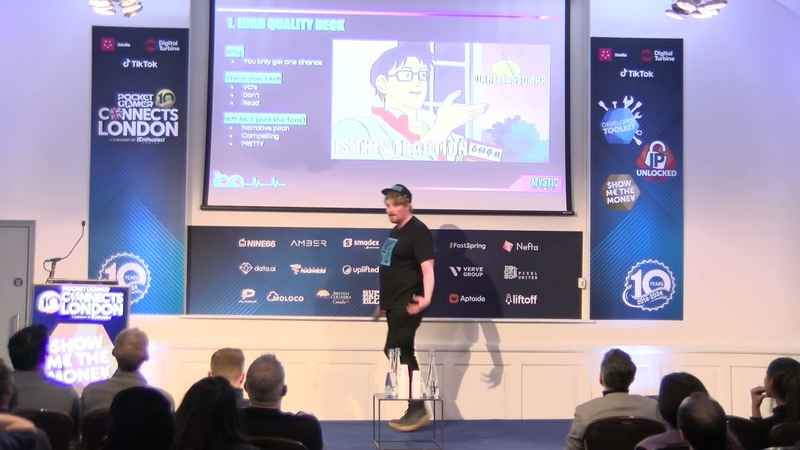
Beat the Bear: Raising Funds in a Challenging Landscape - Matthew Buxton, MYSTiC Games.
Raising venture capital in the current gaming industry landscape requires a strategic, disciplined approach that acknowledges the inherent risks and power dynamics of the investor-founder relationship.
- Fundraising is governed by power laws rather than pure meritocracy, with investors heavily favoring teams that possess proven track records or affiliations with major entities like Riot Games.
- Approximately 90% of startups fail, leading venture capitalists to act as risk-averse portfolio managers who prioritize social proof and peer validation to mitigate their exposure.
- Founders should employ a tiered pitch strategy, starting with lower-priority investors to refine their narrative and gather feedback before approaching top-tier targets.
Gaming Report: VC Trends and Emerging Opportunities Q4 2023
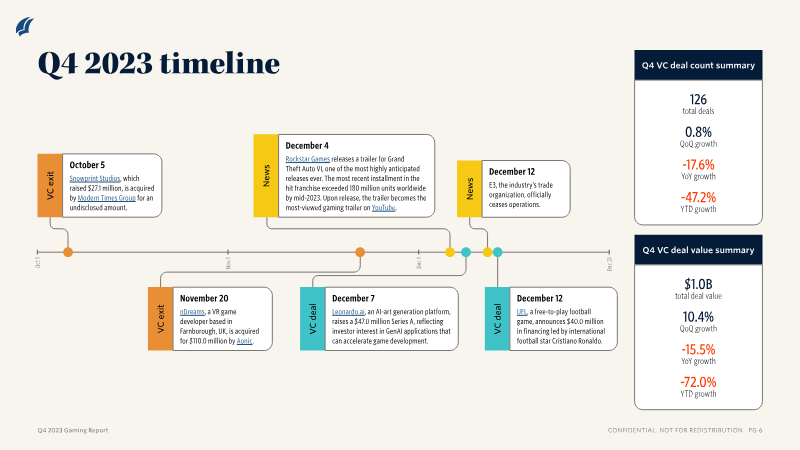
The analysis tracks global venture-capital activity in the gaming sector for the fourth quarter of 2023, highlighting a modest rebound in deal volume and capital while underscoring a broader contraction relative to the pandemic-driven peak years.
- Total 2023 gaming investment reached $4.1 billion, representing a 72% decline in value and a 47.2% drop in deal count compared to 2022.
- Q4 2023 showed a modest recovery with $1.0 billion raised across 126 deals, marking a 10.4% increase in value and a 0.8% increase in deal count over Q3.
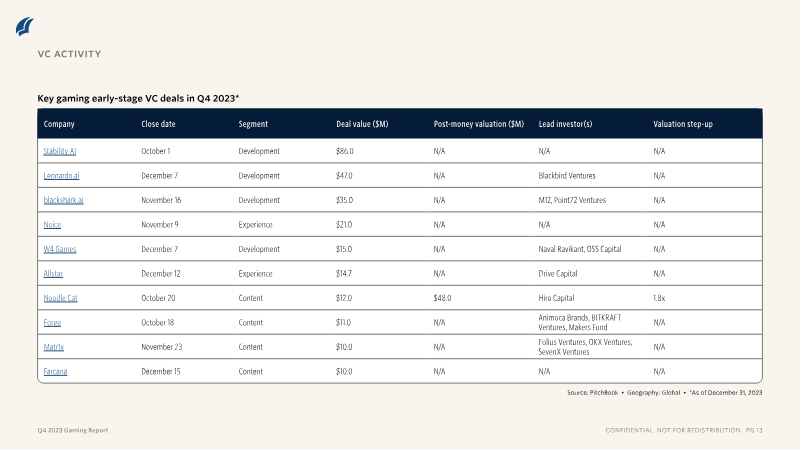
- Content-focused startups secured the largest share of funding in Q4 with $438.4 million across 71 deals, followed by development firms at $288.7 million.

Disney x Fortnite / Heroes of Mavia Launch / WB Live Service Stumbles
The gaming industry is currently undergoing a structural transformation characterized by a move away from traditional standalone development toward interconnected digital ecosystems and community-driven engagement.
- Disney is investing $1.5 billion into Epic Games to integrate its intellectual property into Fortnite, shifting away from internal development to leverage an existing, persistent cross-platform ecosystem.
- The gaming industry is moving toward interconnected digital ecosystems, prioritizing organic player retention and high-quality gameplay over aggressive, top-down monetization strategies.
- Forced live-service mechanics are alienating core audiences, as evidenced by the poor reception of Warner Bros. titles like Suicide Squad: Kill the Justice League and Mortal Kombat 1.

Panel: Surviving & Thriving: Why Being Part of the Right Ecosystems Matters.
The game development industry thrives when studios operate within integrated ecosystems that prioritize talent mobility, cross-sector collaboration, and predictable government support.
- A robust game development ecosystem requires a high density of competitors to facilitate the cross-pollination of talent and provide a support network during industry downturns.
- Government-backed tax incentives, such as British Columbia’s 17% digital media tax credit, provide essential stability for studios, provided these programs have a long-term, non-partisan track record.
- Successful game studios often leverage real-time engine expertise to diversify into adjacent sectors like theme park attractions, film, and VR, which helps mitigate risks during gaps in gaming project cycles.

Parallel, the $500 Million Web3 TCG
Parallel represents a significant evolution in the trading card game genre, securing a $500 million valuation through a $50 million funding round.
- Parallel achieved a $500 million valuation following a $50 million funding round, positioning it as a major player in the Web3 trading card game market.
- The game differentiates its mechanics through a unique banking system where cards function as energy, a design choice that has attracted professional players from established titles like Hearthstone.
- The studio employs a hybrid revenue model that combines traditional card pack sales and cosmetic microtransactions with a 10% royalty fee on all secondary market NFT transactions.

Between the Lines: Eastern Europe’s Gaming Market
The Eastern European gaming market represents a significant global force, projected to reach $3 billion in revenue by 2024.
- The Eastern European gaming market is projected to reach $3 billion in revenue by 2024, with Poland serving as a primary hub that accounts for 15% of the top 200 games on Steam wishlists.
- Geopolitical instability has forced a massive migration of studios to hubs including Cyprus, Poland, Portugal, and the UAE to maintain access to essential banking services and venture capital.
- The region’s success is driven by a highly skilled talent pool that produces both casual mobile games and high-fidelity titles, frequently utilizing unique cultural lore to create globally successful franchises like The Witcher and S.T.A.L.K.E.R.

Immutable’s Web3 Roadmap for 2024
Immutable has established itself as a dominant force in the Web3 gaming sector, currently commanding a 70 to 75 percent market share by providing specialized infrastructure designed to solve long-standing industry hurdles.
- Immutable currently holds a 70% to 75% market share in the Web3 gaming sector and is valued at approximately 2.5 billion dollars.
- The platform is supporting a pipeline of over 110 committed games, with more than 100 high-quality titles expected to launch throughout 2024.
- Immutable is shifting the industry from infrastructure development to a content-driven era by utilizing tools like the Immutable zkEVM, a global order book, and the Immutable Passport wallet to abstract technical complexities.