In-Game Advertising reports and market data
Documents

Gaming Spotlight 2023 Review
The global gaming market in 2023 was defined by a complex interplay between mobile contraction and steady growth in the PC and console sectors.
- The global mobile gaming market contracted by 2% to $108 billion in 2023, driven by macroeconomic instability and privacy-related shifts like Apple’s App Tracking Transparency.
- PC and home console markets grew by 4% and 3% respectively, largely supported by the increasing adoption of subscription-based models.
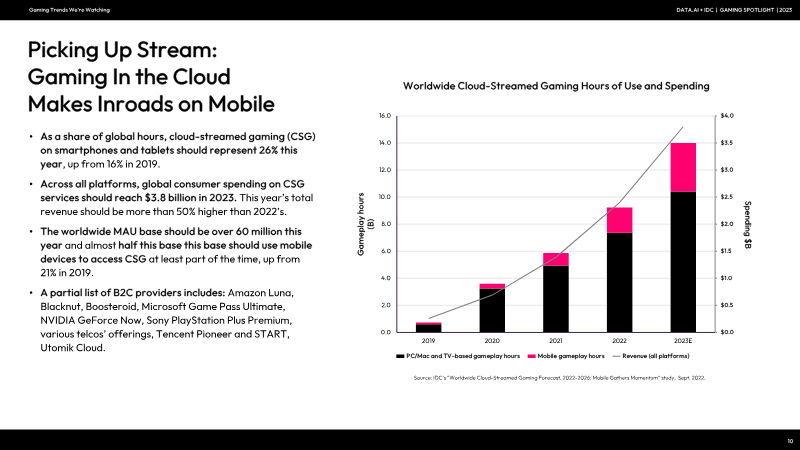
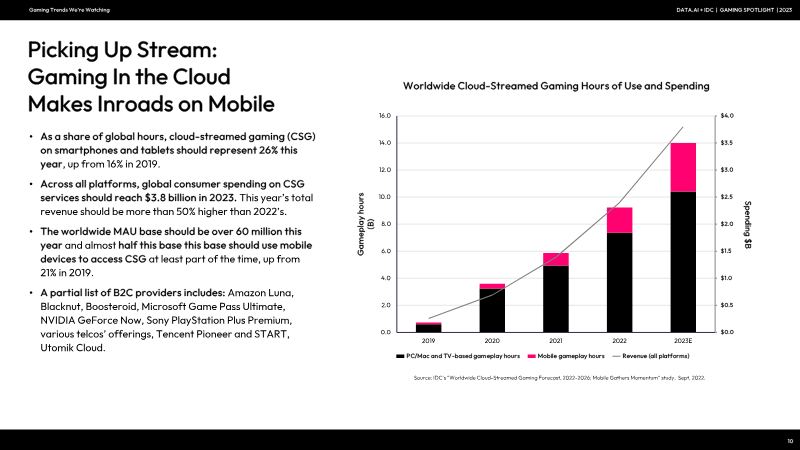
- Cloud-streamed gaming is a growing revenue stream projected to reach $3.8 billion, with mobile devices accounting for over 25% of total streaming hours.

In-Game Advertising Report 2023
This analysis examines the efficacy of intrinsic in-game advertising as a high-engagement medium compared to traditional digital channels.
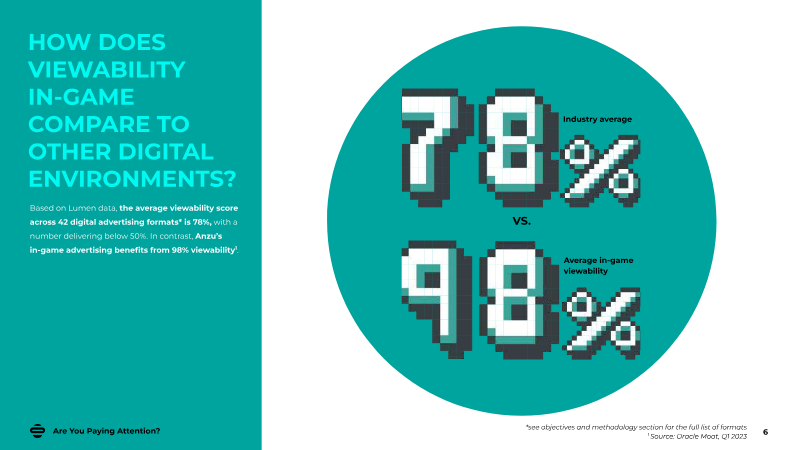
- In-game advertising achieves a 98% viewability rate, significantly outperforming the 78% average observed across standard digital advertising formats.
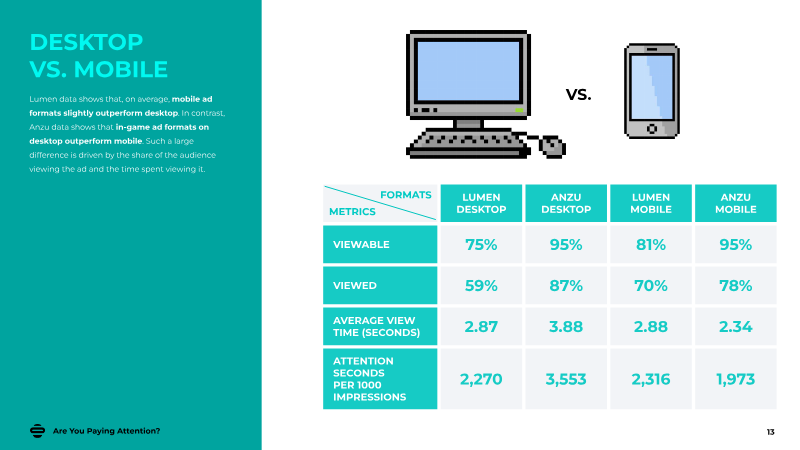
- Gaming environments generate 2,795 attentive seconds per 1,000 impressions, representing a 22% higher attention level than the average for other digital media.
- 85% of in-game ad impressions are actively viewed by players, compared to a 65% norm for traditional digital channels.

Q1 2023 Insights into Global Mobile Game Marketing Trends
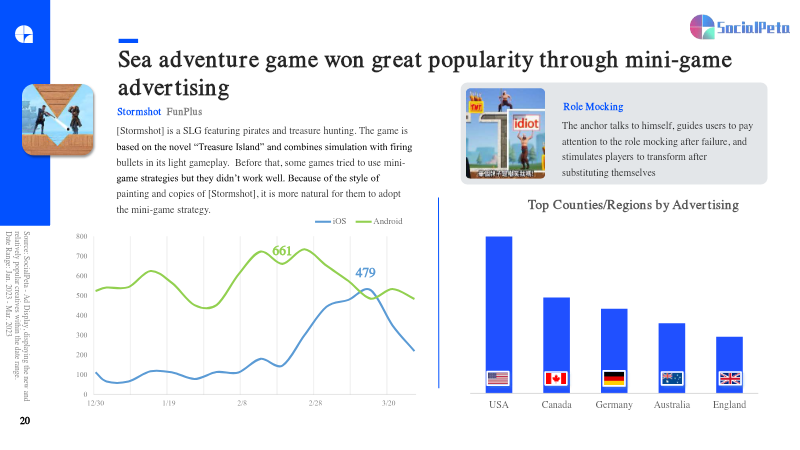
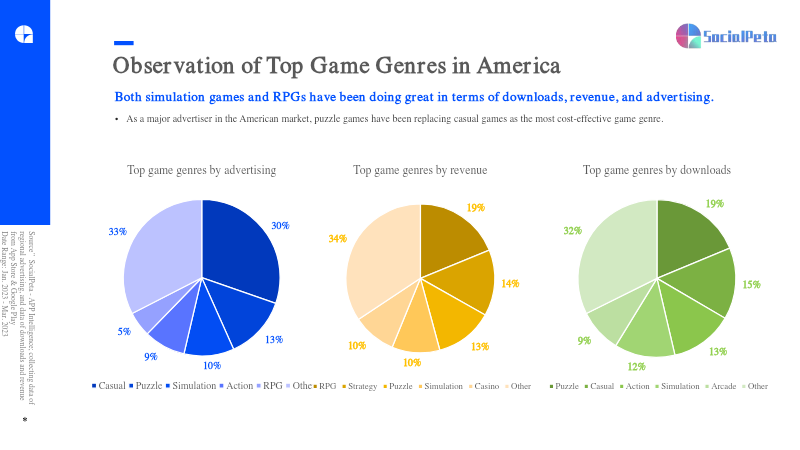
The global mobile game marketing landscape in early 2023 is characterized by a strategic pivot toward high-quality video content and localized engagement strategies.
- Mobile game advertisers are shifting from quantity to quality, evidenced by a 15% increase in active advertisers to over 160,000 alongside a 16% decline in new creative asset volume.
- Video content now dominates the advertising landscape, accounting for over 80% of all ad creatives and frequently utilizing playable mechanics or 'deliberate failure' tropes to improve engagement.
- Android remains the dominant advertising platform, capturing nearly 70% of total global ad volume.

Misleading (Non-Core) Gameplay Ads Research 2023
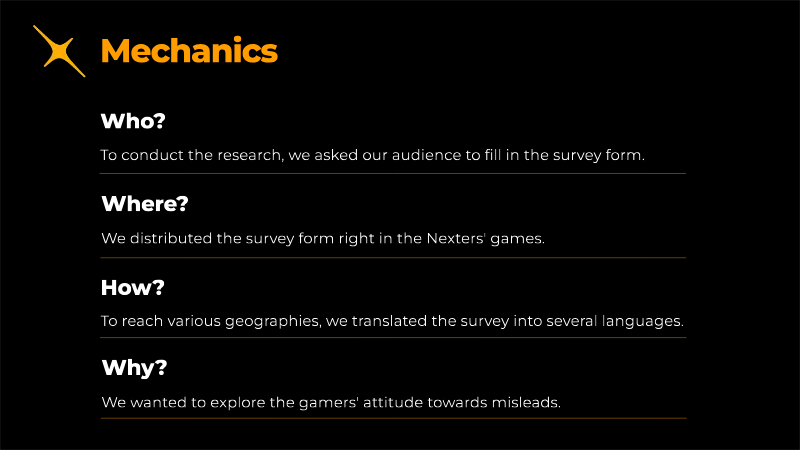
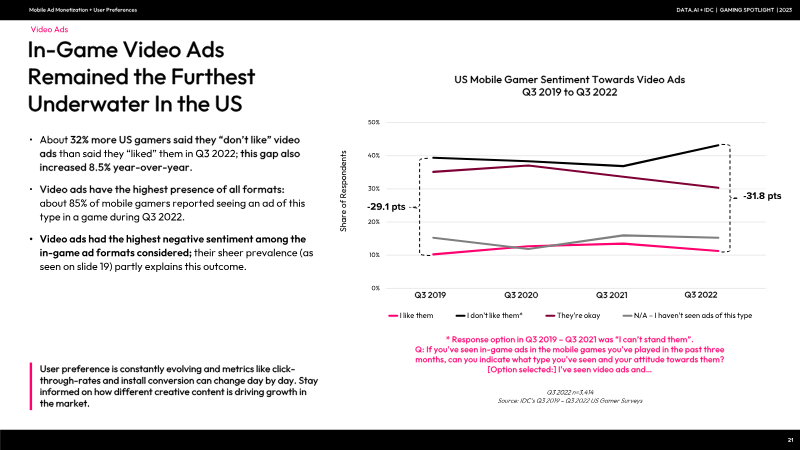
The prevalence of non-core gameplay advertising—often labeled as misleading—has become a standard industry practice, shifting from deceptive marketing to a strategy of incorporating secondary mini-games within larger titles.
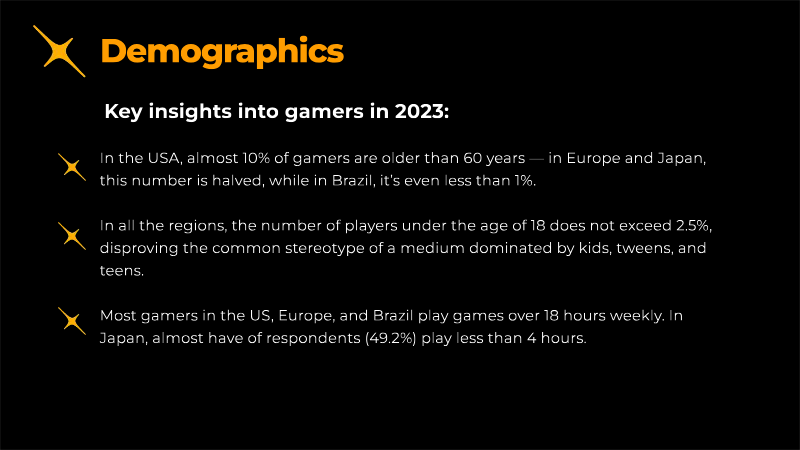
- Approximately 75% of Western players and 70% of Japanese and Brazilian players find the mechanics shown in misleading ads more engaging than the actual core gameplay of the advertised titles.
- Between 35% and 46% of gamers continue playing a title despite recognizing that the advertisement does not accurately represent the core gameplay experience.
- Ad recognition is widespread, with 91% of U.S. respondents and 71% to 77% of respondents in other surveyed regions reporting exposure to non-core gameplay advertisements.

Gaming Spotlight 2023: The Year in Review
The 2023 Gaming Spotlight provides a comprehensive analysis of the global gaming landscape, focusing on market shifts across mobile, PC, and console platforms during the first half of 2023.
- Mobile gaming consumer spend is projected to decline 2% year-over-year to $108 billion in 2023, driven by macroeconomic instability, Apple’s App Tracking Transparency, and Chinese regulatory constraints.
- Home console and PC/Mac gaming spending are bucking the mobile trend with projected growth of 3% and 4% respectively, fueled by improved hardware availability and subscription-based revenue models.
- User acquisition is becoming more difficult and costly, forcing publishers to shift toward playable ads for action genres and diversify revenue through battle passes and subscriptions.
How does SKAdNetwork 4.0 work? Q&A with Tenjin’s product manager
SKAdNetwork 4.0 represents a significant evolution in Apple’s privacy-centric mobile attribution framework, introducing several structural changes designed to provide advertisers with more granular data while maintaining user anonymity.
- SKAdNetwork 4.0 introduces three distinct postback windows at two, seven, and 35 days post-install to enable measurement of long-term user engagement.
- The framework utilizes a hierarchical crowd anonymity system with four tiers that determine the level of data granularity provided based on install volume.
- Advertisers now receive both fine-grained and coarse-grained conversion values, with the latter providing low, medium, or high signals for campaigns with lower install volumes.
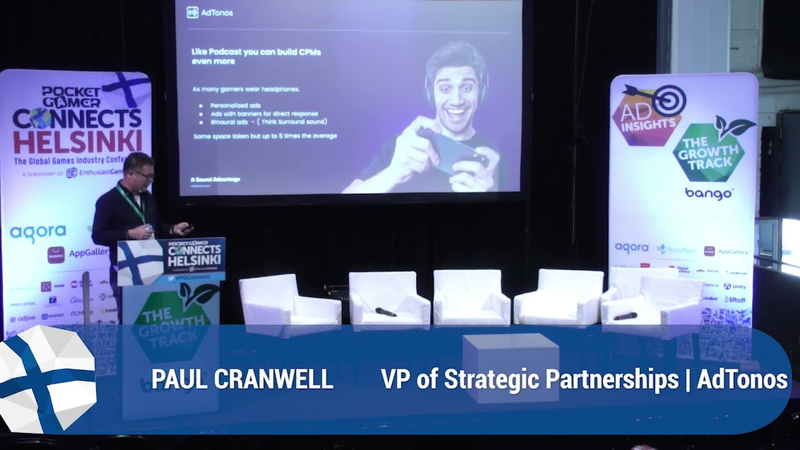
How Can Publishers & Developers Maximise Audio Ad Revenues - PAUL CRANWELL
Audio advertising represents a significant, underutilized revenue stream for mobile game developers and publishers, offering a non-intrusive alternative to traditional video and display formats.
- Audio ads offer a non-intrusive monetization alternative that improves retention, with research showing gamers have 36% to 39% higher memory recall for audio compared to video ads.
- Approximately 61% of mobile gamers listen to music while playing, creating a natural, high-engagement environment for audio-based advertising.
- Developers can increase CPM rates by shifting from internal reward-based ad loops to high-quality, third-party brand integrations.
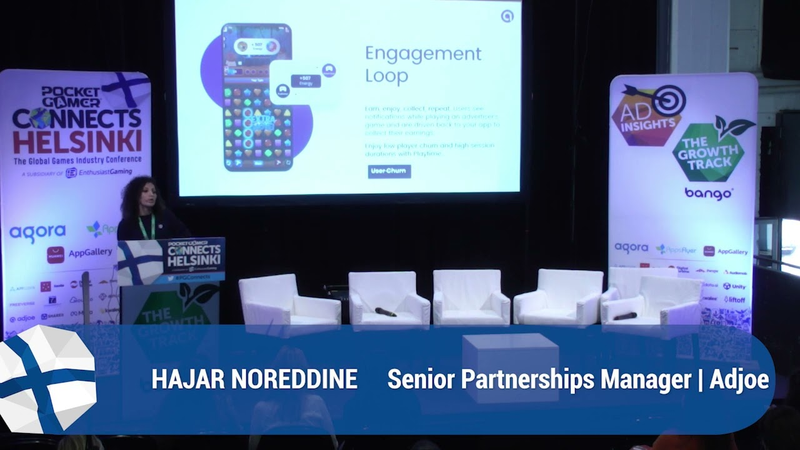
Recharging Your App Revenue with HAJAR NOREDDINE, adjoe
The mobile advertising landscape faces significant challenges, including revenue cannibalization, user churn, and inconsistent eCPMs.
- Implementing the Playtime time-based rewarded ad unit can generate a 20% increase in incremental ad revenue and a 20% boost in average revenue per daily engaged user, according to data from Gameloft.
- The platform utilizes an Android-based SDK to track gameplay duration in real time, allowing for immediate user rewards that scale as engagement time increases.
- An integrated engagement loop uses push notifications to drive user re-engagement with the original application up to 20 times per week.
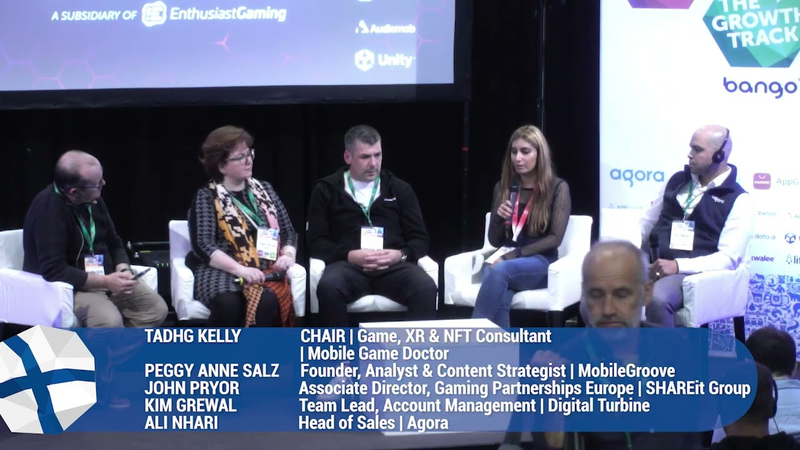
Panel: Know Your Audience How To Choose Between Subscription or Ad Models -
The mobile gaming industry is shifting away from binary monetization strategies, moving toward sophisticated hybrid models that integrate subscriptions, advertising, and virtual goods to maximize revenue and user retention.
- Mobile game monetization is shifting from binary strategies to hybrid models that integrate subscriptions, advertising, and virtual goods to maximize both revenue and retention.
- Monetization frameworks must be embedded into the early stages of game design rather than treated as secondary features to ensure long-term sustainability.
- Developers should abandon one-size-fits-all approaches in favor of data-driven, personalized experiences that align with specific game genres and player behaviors.

Panel: Turning Ads Into Success Stories
Successful in-game advertising requires a delicate equilibrium between maximizing revenue and preserving player retention.
- Developers are shifting from intrusive ad models to native, non-clickable brand placements and rewarded videos to protect player retention while maximizing lifetime value.
- Post-ATT user acquisition strategies now rely on continuous creative testing and the use of early proxy signals to forecast long-term player retention.
- Monetization management has transitioned from manual waterfall processes to product-centric, automated bidding systems that utilize granular analytics for better user segmentation.
Ads, IAP & Beyond Supercharge Your Game Growth - ANTONIO MANUEL RIBEIRO, Meta Audience Network
This analysis examines the current state of mobile game monetization and growth strategies, drawing on a survey of over 500 gaming business decision-makers across 17 countries.
- Hybrid monetization is the industry standard, with 93% of publishers now integrating in-app advertising (IAA) alongside in-app purchases (IAP) to maximize revenue and retention.
- Rewarded video is the most effective ad format for 47% of publishers, and 39% of those surveyed reported that its implementation actually increased IAP revenue rather than cannibalizing it.
- 67% of publishers now align monetization and user acquisition strategies to segment audiences and tailor revenue models based on regional IAP penetration.
Audio is the New Video - MUNIB TAHIR, AudioMob
Audio advertising is emerging as a non-intrusive, user-centric alternative to traditional video interstitials in mobile gaming.
- Audio advertising serves as a non-intrusive revenue stream that allows mobile gamers to continue playing while ads run in the background.
- 61% of players aged 18 to 24 listen to external audio while gaming, providing a significant target demographic for this format.
- Rewarded audio, which offers in-game benefits for listening, consistently generates the highest listen-through rates and user engagement.