Global reports and market data
Documents
Computer Games / Cinema / Interfaces
King and Krzywinska's "Computer Games / Cinema / Interfaces" examines the formal and industrial relationship between video games and film, arguing that cinematic concepts provide useful analytical tools for some games but that the two media should be compared on their distinct qualities rather than reduced one to the other.
- The authors argue that cinematic concepts are useful analytical tools for some games, but that games and film should be compared on their distinct qualities rather than one being reduced to the other.
- Cinema has shaped games far more than the reverse, since games rarely lend themselves to cinematic adaptation and their narrative and character development remain less developed than film's.
- Games demand more active engagement than film viewing, and the authors propose Aarseth's term "ergotic" as a more precise alternative to "interactive."
Towards Communicative, Collaborative and Constructive Multi-Player Games
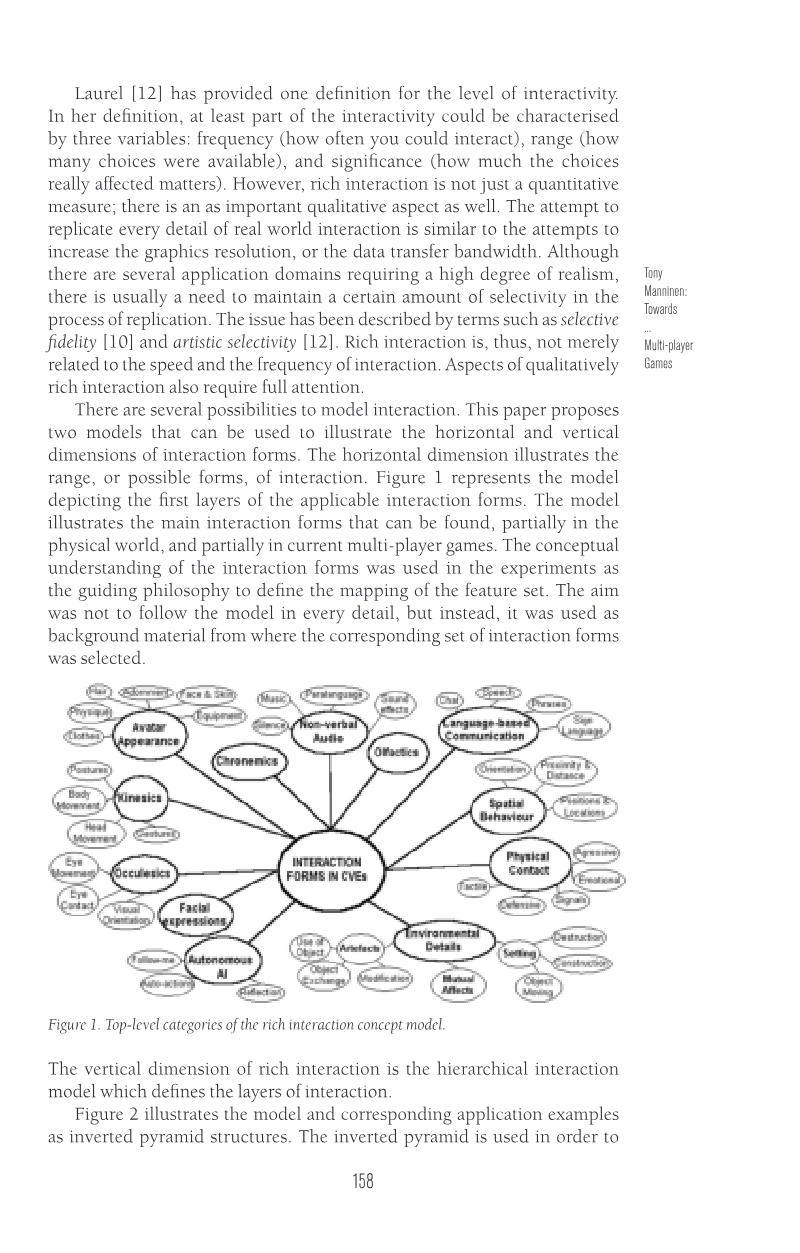
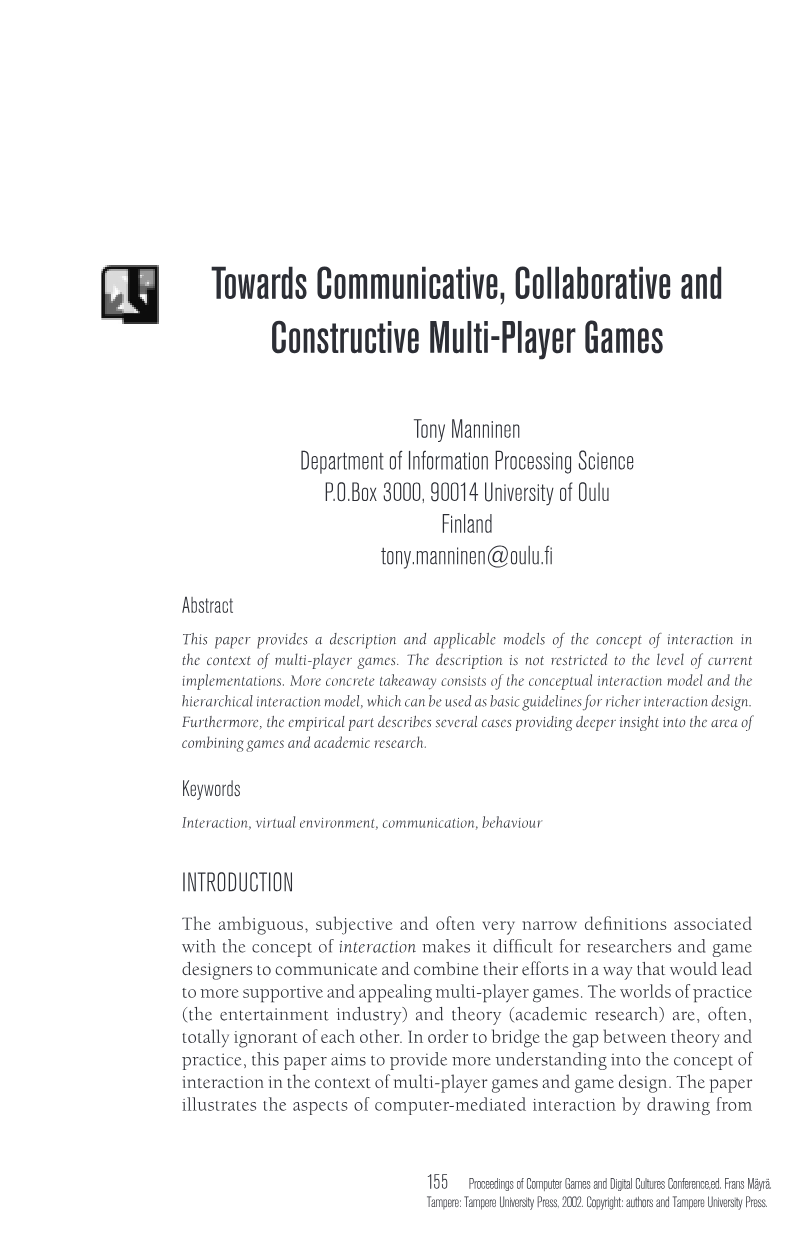
This paper proposes a refined understanding of "interaction" within multi-player games, offering conceptual and hierarchical models to inform the design of richer, more meaningful player experiences.
- The central finding is that participants communicate effectively in virtual environments when systems offer multiple communication channels in a "memorable, yet invisible" manner, with non-verbal communication identified as a key design priority.
- The author proposes two models of "rich interaction": a horizontal concept model describing forms of interaction and a vertical hierarchical model structuring them, aimed at making multiplayer games more communicative, collaborative and constructive.
- The work argues that multiplayer games are often mechanically shallow and that academic theory and industry practice remain poorly connected, partly because commercial secrecy limits researchers' access to industry data.
Gran Stylissimo: The Audiovisual Elements and Styles in Computer and Video Games
The document, "Gran Stylissimo: The Audiovisual Elements and Styles in Computer and Video Games," aims to establish a comprehensive framework for understanding and categorizing the diverse aesthetic forms of computer and video games.
- Järvinen's framework classifies game audiovisual style into three categories (photorealism, caricaturism, and abstractionism) and defines its elements as dimensionality, point of perception, visual outlook, and soundscape, arguing these matter more for understanding games than conventional genre labels alone.
- Games differ from film because players manipulate and simulate environments, which gives sound a functional role: diegetic sound grounds the player in the space and gives feedback on actions, while nondiegetic sound can be anchored to locations to build mood.
- Game aesthetics circulate constantly with film, as shown by Max Payne borrowing the 'bullet time' effect from The Matrix, so game styles cannot be analysed in isolation.
The Study of Computer Games as a Second-Order Cybernetic System
Kücklich's paper argues that the dominant literary and narratological approaches to computer games rest on a problematic two-level model of code and interface, inherited from Aristotelian and structuralist traditions.
- The paper argues that narratology should not be the governing discipline for game studies; games should instead be situated within ludic, representational, and media traditions.
- It proposes a constructivist, second-order cybernetic framework in which game and player form an interdependent whole, shifting focus from the underlying code to the player's experience of play.
- Interactivity and narrativity are treated as synergetic effects of semiosis rather than fixed properties of the software.
Computer Game Criticism: A Method for Computer Game Analysis
The document proposes a comprehensive, bottom-up method for analyzing computer games, specifically designed for computer game criticism rather than adapted from other fields.
- Konzack proposes a seven-layer method for analysing computer games (hardware, program code, functionality, gameplay, meaning, referentiality, and socio-culture), arguing that all layers should be considered together so that technical, aesthetic, and socio-cultural perspectives are integrated.
- The method takes a bottom-up approach, beginning with a general description of the game that separates its virtual space from the surrounding playground to preserve a sense of the whole.
- The paper argues that games must be analysed on their own terms rather than by transferring frameworks from other disciplines, while still drawing on existing analytical traditions.
Gameplay Rhetoric: A Study of the Construction of Satirical and Associational Meaning in Short Computer Games for the WWW
"Gameplay Rhetoric" investigates how short computer games distributed via the World Wide Web function as a medium for non-narrative rhetorical meaning, specifically satire and association.
- The study argues that short web-based games communicate satirical and allegorical meaning through rhetorical devices rather than through story or simulation, so meaning persists even when gameplay is rudimentary.
- Satirical effect in these games is produced mainly by incongruity, pretense via parody and low burlesque, surprise, superiority, exaggeration, and violence, drawing on Feinberg's taxonomy of satirical technique.
- Allegorical meaning relies on conceptual mappings such as "life is a journey" and on metonymic relations, which the author's pilot game Vanitas Game uses to express mortality.
The Gameplay Gestalt, Narrative, and Interactive Storytelling
The document, "The Gameplay Gestalt, Narrative, and Interactive Storytelling," posits that a fundamental conflict exists between repetitive gameplay patterns, termed "gameplay gestalts," and the achievement of deep narrative immersion in computer games.
- Craig Lindley argues that gameplay in computer games is best understood as a "gameplay gestalt", a learned, repeatable pattern of perceptual, cognitive, and motor interaction, and that this repetitive structure undermines deep narrative immersion.
- In many action-oriented titles, the three-act story is delivered through non-interactive cut scenes while player interactivity is confined to low-level tasks with little bearing on the plot.
- Lindley proposes that gameplay gestalts be studied as measurable across perception, cognition, and motor demands, and notes that strategy games often compete with narrative for players' limited cognitive resources while offering thematically shallow experiences.
The Pleasure of the Playable Text: Towards an Aesthetic Theory of Computer Games
The document proposes an aesthetic theory of computer games, arguing that the prevailing focus on game poetics (form and structure) should be supplemented by an analysis of aesthetics, specifically how players engage with games and the pleasures derived from them.
- Georg Lauteren argues that the dominant poetics-based study of computer games should be supplemented by an aesthetic theory centred on pleasure: how players use games, what they enjoy, and what gratifications they experience.
- The paper frames computer games as "playable texts", combining their status as mediated sign systems that gain meaning through intertextual culture with their structure as rule-based, competitive activities in Johan Huizinga's sense.
- Lauteren proposes three analytical levels of pleasure: psychoanalytical, social, and physical, drawing on Laura Mulvey, John Fiske, and Roland Barthes.
Albert Goes Narrative Contracting
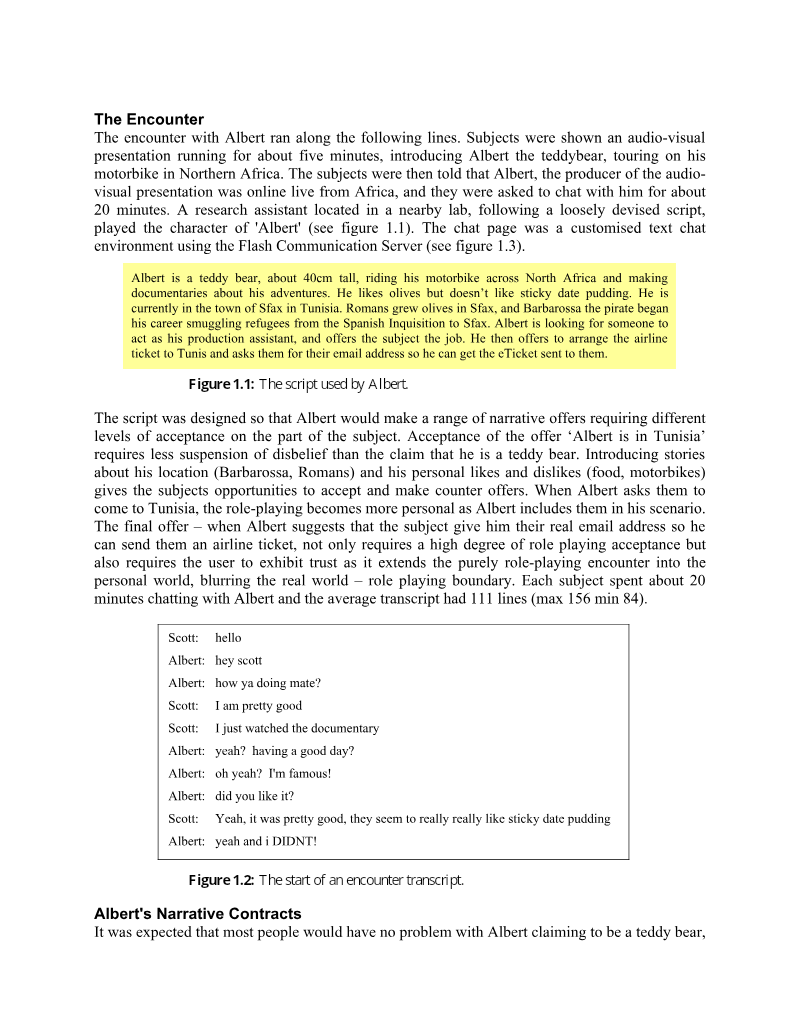
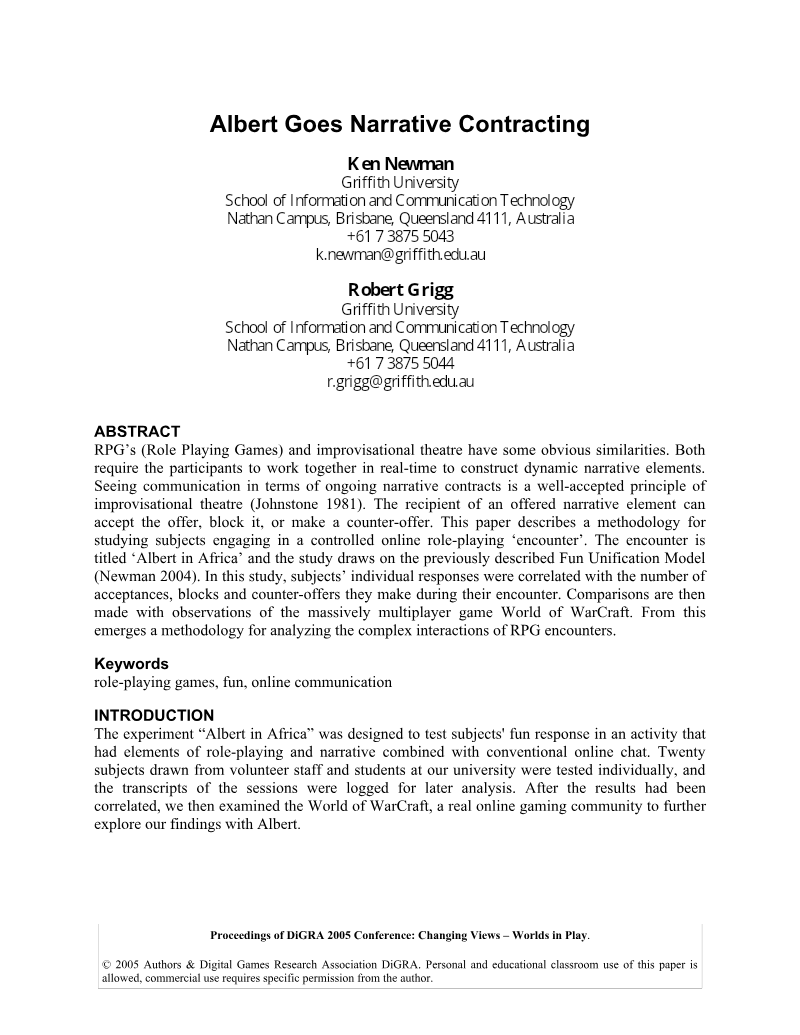
This study investigates the relationship between narrative contracting behavior and player enjoyment and engagement in role-playing games, drawing parallels between improvisational theatre principles and online gaming interactions.
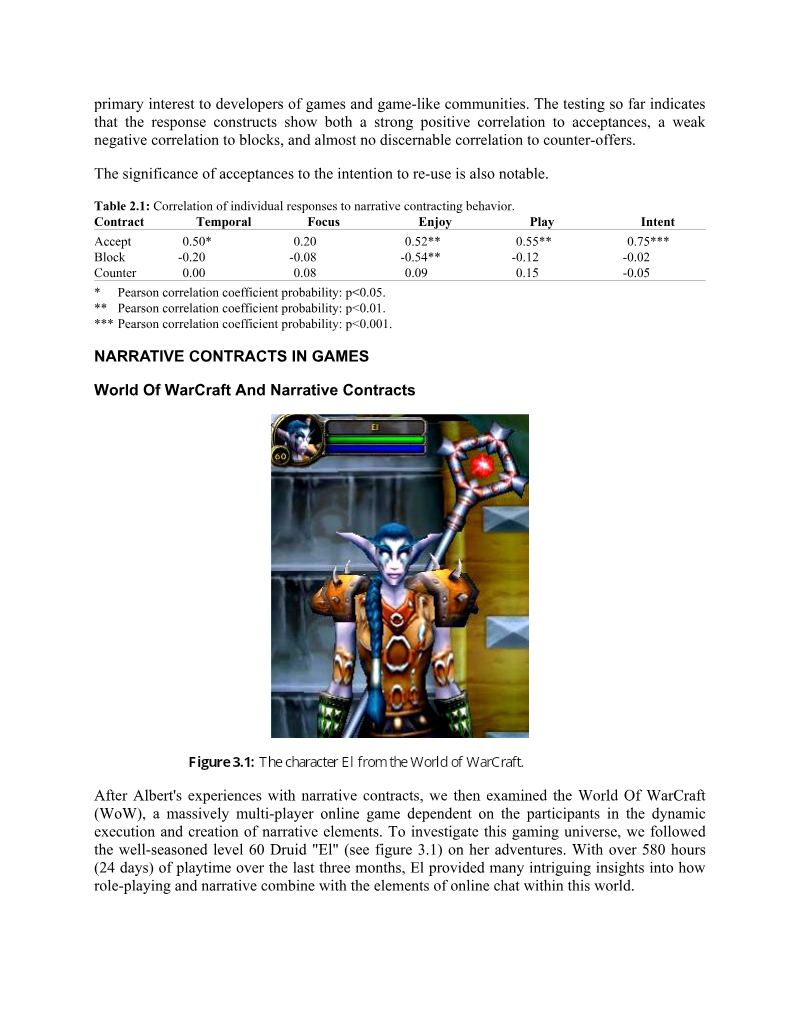
- Acceptance of a player's narrative offer shows the strongest association with enjoyment, playfulness, and intent to return, with the largest correlation to intent to revisit (r = 0.75, p<0.001).
- Blocks show only a weak negative correlation with enjoyment and little relationship to other fun measures, while counter-offers show almost no discernible correlation with any response.
- The authors frame conversational moves in role-playing as narrative offers that can be accepted, blocked, or countered, a concept borrowed from improvisational theatre.
The EverQuest Speech Community
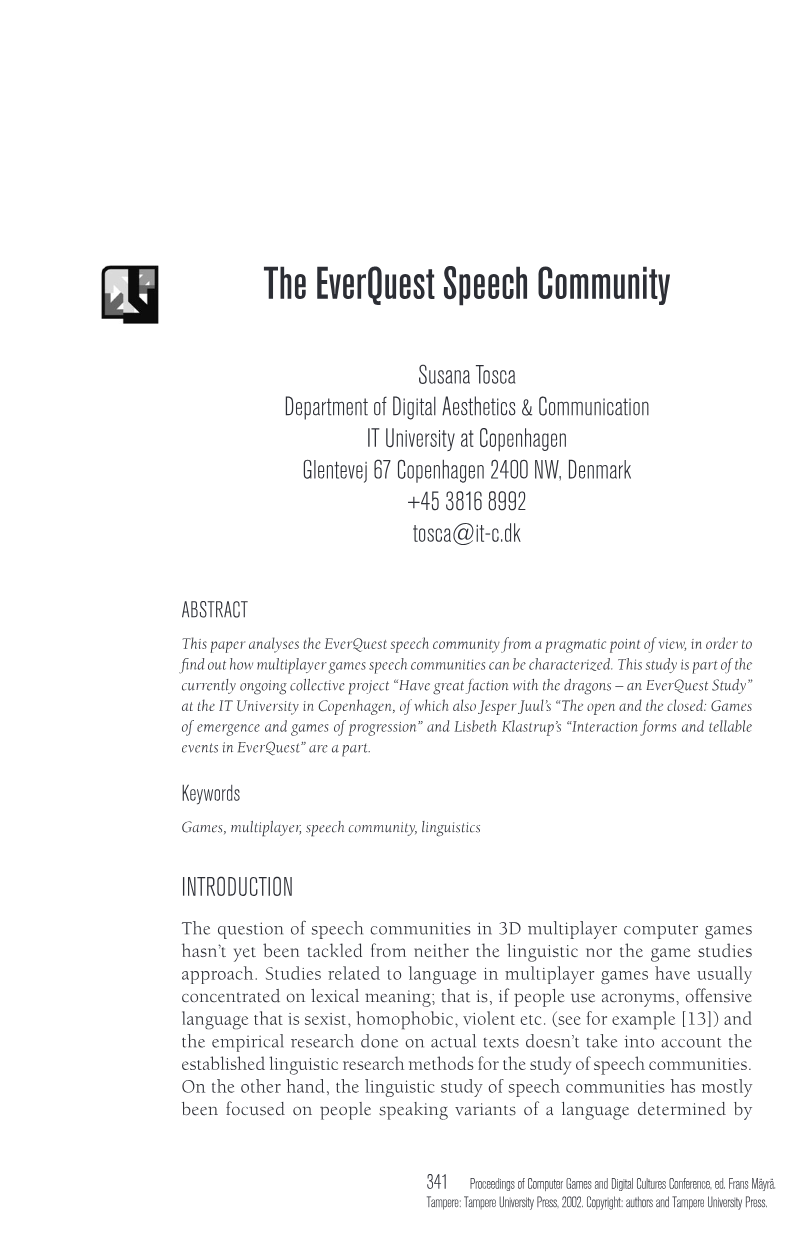
The EverQuest Speech Community paper investigates the nature of linguistic interaction within the multiplayer online game EverQuest, aiming to define the characteristics of speech communities in such virtual environments.
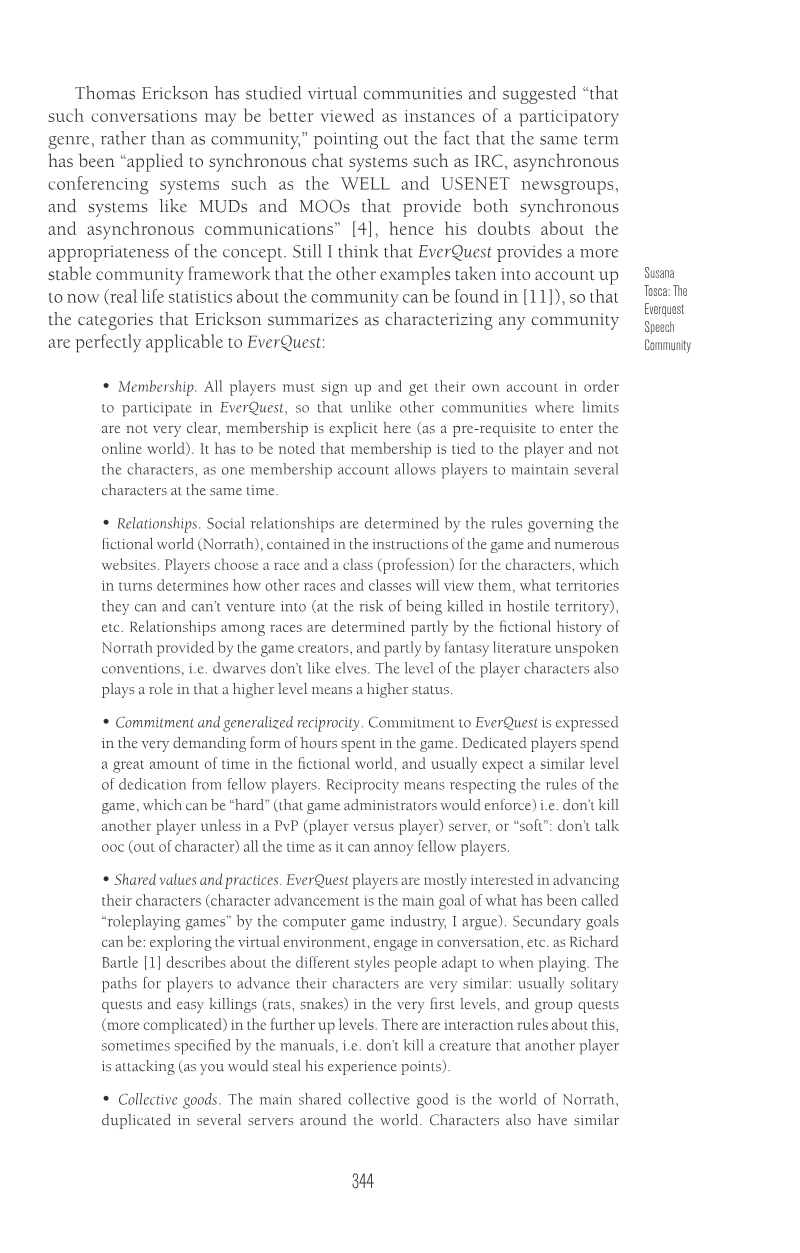
- Susana Tosca argues EverQuest's player base is a genuine speech community, applying Erickson's six criteria (membership, relationships, commitment, shared values, collective goods, duration) and Hymes's SPEAKING framework to text-based in-game interaction.
- The game studied had roughly 98,000 peak concurrent users and about 400,000 players, and was treated as a stable, context-bound community whose linguistic norms are shaped by its fictional gameworld.
- Field research found most players were "powerplayers" focused on character advancement rather than roleplay, so the performative speech the framework anticipated largely failed to materialize.
The Open and the Closed: Games of Emergence and Games of Progression
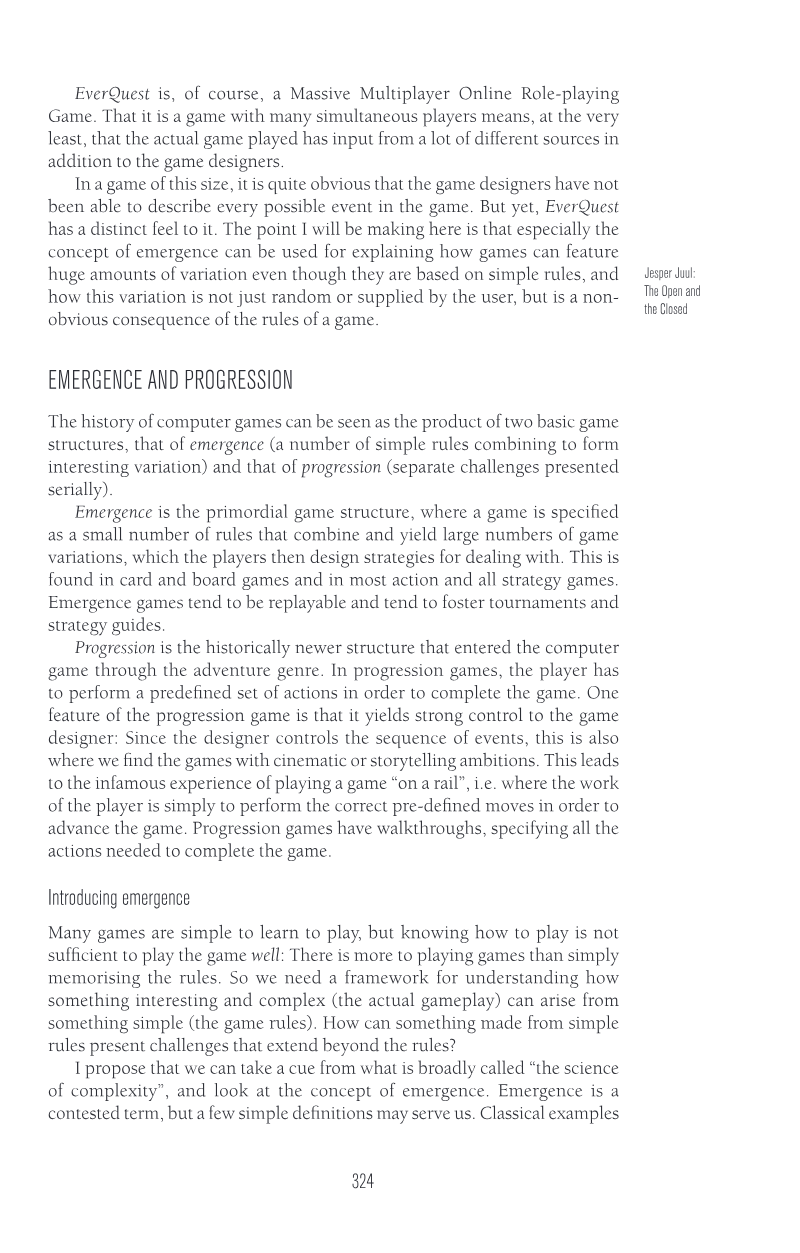
The document proposes a conceptual framework for analyzing computer game structures, differentiating between "emergence" and "progression" as fundamental design principles.
- Juul distinguishes two structures for presenting challenge: emergence, where a small set of simple rules combines to produce large variation, and progression, where challenges are introduced serially and their solutions are explicitly specified by the designer.
- Most computer games blend emergent and progression structures, and the variation found in complex games is a systematic, non-obvious consequence of their rules rather than mere randomness or player input.
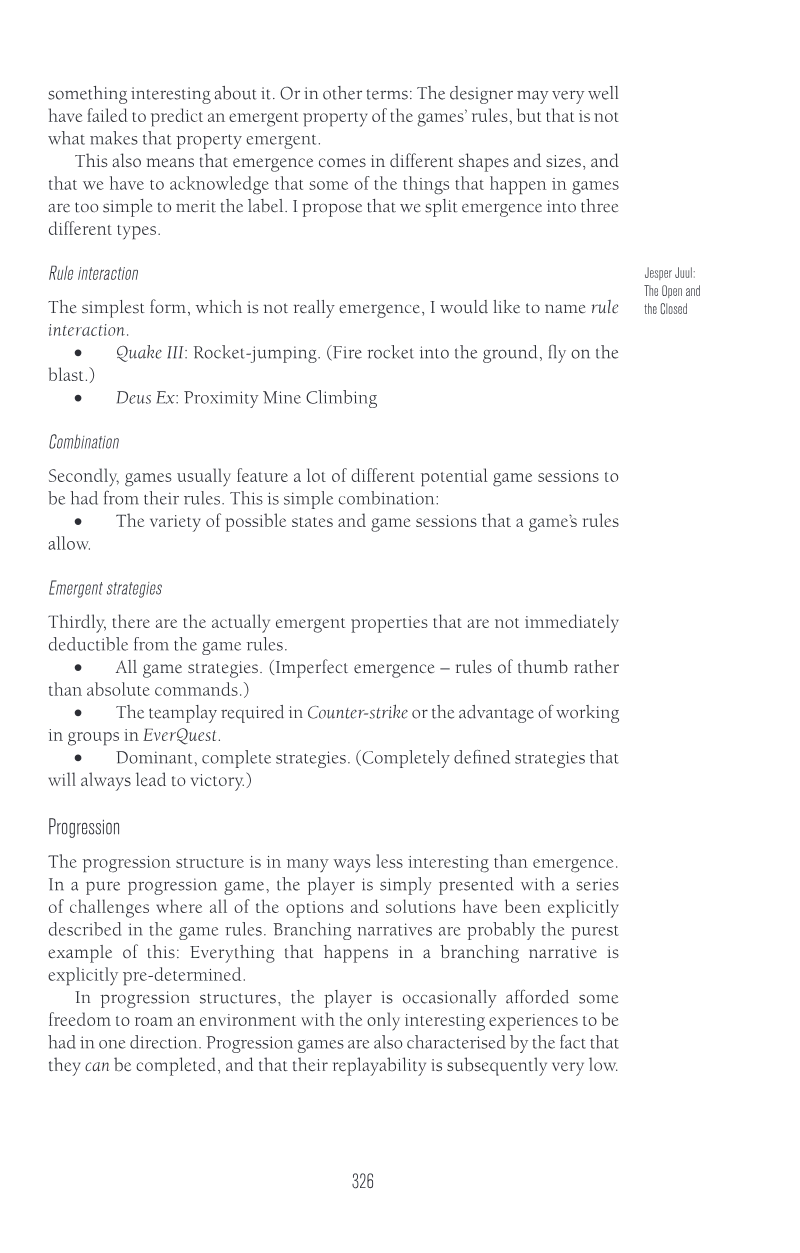
- Emergence is split into three types: rule interaction (e.g., rocket-jumping in Quake III, proximity mine climbing in Deus Ex), combination (the space of possible states a rule set permits), and emergent strategies (not immediately deducible from the rules, including rules of thumb and dominant strategies).
Interaction Forms, Agents and Tellable Events in EverQuest
This paper proposes a framework for analyzing interaction forms and agents in virtual worlds, specifically using EverQuest as a case study.
- The paper proposes an analytical framework for virtual worlds built on four basic agents (players; NPCs and informative objects; manipulable objects; world rules) and four basic interaction forms (navigation, manipulation, social interaction, information retrieval).
- The framework is presented as a work in progress: its in-depth empirical analysis of EverQuest (released 1999) is reserved for later publication.
- The author argues that existing definitions of interactivity are too vague to be analytically useful, and situates the framework within Jensen's three paradigms of interactivity and the ludology-narrative debate, claiming virtual worlds contain elements of all of them at once.