1 free read left. Create a free account for unlimited reading + AI research.
Create free accountWhitepaper DiGRA
1 free read left. Create a free account for unlimited reading + AI research.
Create free accountWhitepaperDiGRA
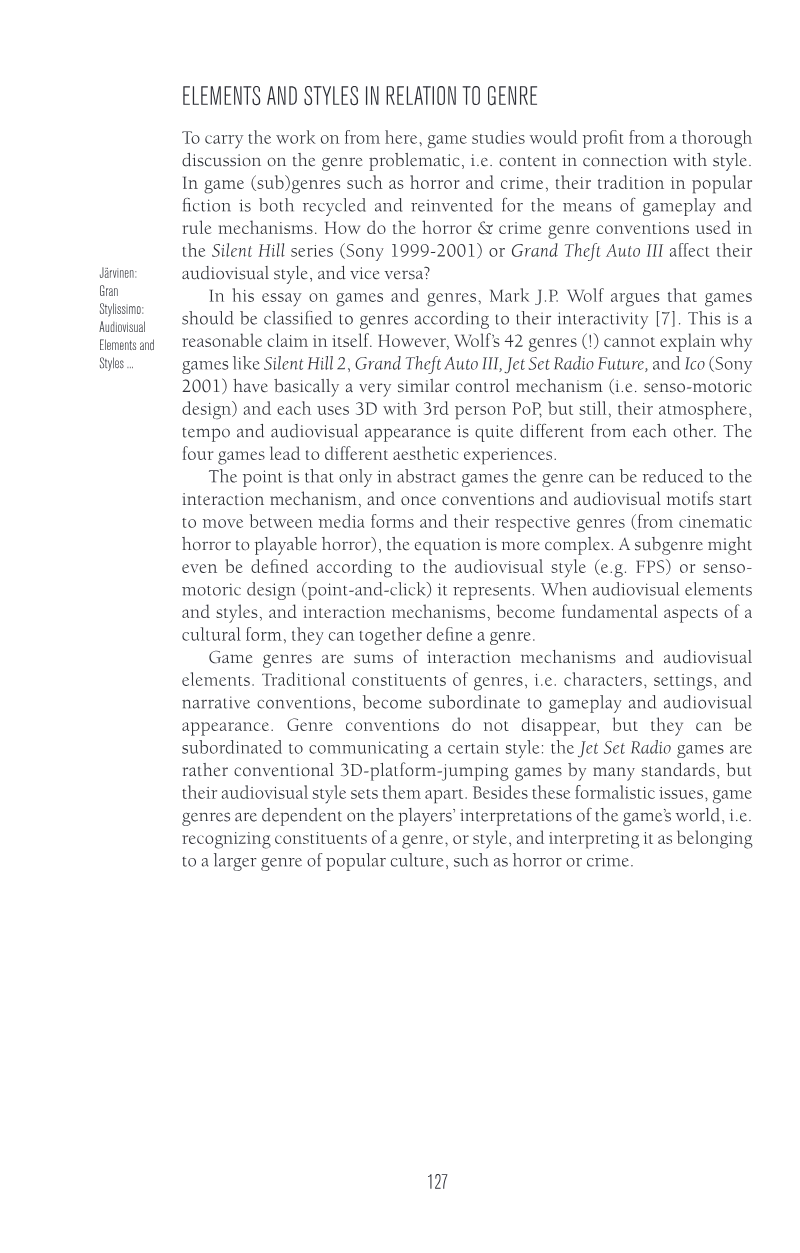
Järvinen proposes three style categories: photorealism, caricaturism, and abstractionism. The study argues these matter more than conventional genre labels alone for understanding how games present themselves.
Aki Järvinen's "Gran Stylissimo" offers a framework for analyzing the audiovisual appearance of computer and video games, proposing that their styles can be classified into three categories: photorealism, caricaturism, and abstractionism. The study defines the constituent elements of audiovisual style as dimensionality, point of perception, visual outlook, and soundscape, and argues that these elements, rather than conventional genre labels alone, are central to understanding how games present themselves to players. Its central claim is that game aesthetics cannot be treated in isolation, since audiovisual motifs circulate constantly between games and film, as when Max Payne borrowed its "bullet time" effect from The Matrix.
The analysis rests on a distinctive account of how games differ from film. Because players manipulate and simulate environments rather than only interpreting represented ones, sound takes on a functional as well as atmospheric role: diegetic sound grounds the player in the simulated space and supplies feedback for actions, while nondiegetic sound can be anchored to locations to build mood. Järvinen further observes that stylistic choices shape target audiences, and that gameplay environments and narrative cut-scenes within a single title may follow different stylistic principles, a point that underscores the fluidity of the proposed categories.
Historically, the study traces a progression from the abstract designs of the 1970s, exemplified by Pong and Space Invaders, through a long dominance of caricaturism that ended around 1993, when photorealism took over. Photorealism reached saturation by roughly 2000 to 2002 and in turn spawned non-photorealistic substyles such as cel shading. Abstractionism remains comparatively rare, the author argues, because narrative framing and fiction-derived contexts tend to pull games toward concrete, recognizable representation, though titles such as Tetris, Tempest, and Rez show what the style can achieve. The study concludes that genres are best understood as combinations of interaction mechanisms and audiovisual style, with conventional genre markers increasingly subordinate to gameplay and aesthetic presentation.
DiGRA · 2016



DiGRA · 2016
Game Developers Conference · 2020