1 free read left. Create a free account for unlimited reading + AI research.
Create free accountWhitepaper DiGRA
1 free read left. Create a free account for unlimited reading + AI research.
Create free accountWhitepaperDiGRA
He still draws on existing analytical traditions.
Lars Konzack's paper proposes a seven-layer method for analysing computer games, arguing that games must be examined on their own terms rather than by transferring frameworks from other disciplines, while still drawing on existing analytical traditions. The seven layers are hardware, program code, functionality, gameplay, meaning, referentiality, and socio-culture. Each can be examined individually, but a complete analysis requires considering all of them together so that technical, aesthetic, and socio-cultural perspectives are integrated. The method adopts a bottom-up approach and recommends first producing a general description of the game, separating its virtual space from the surrounding playground, to preserve a sense of the whole.
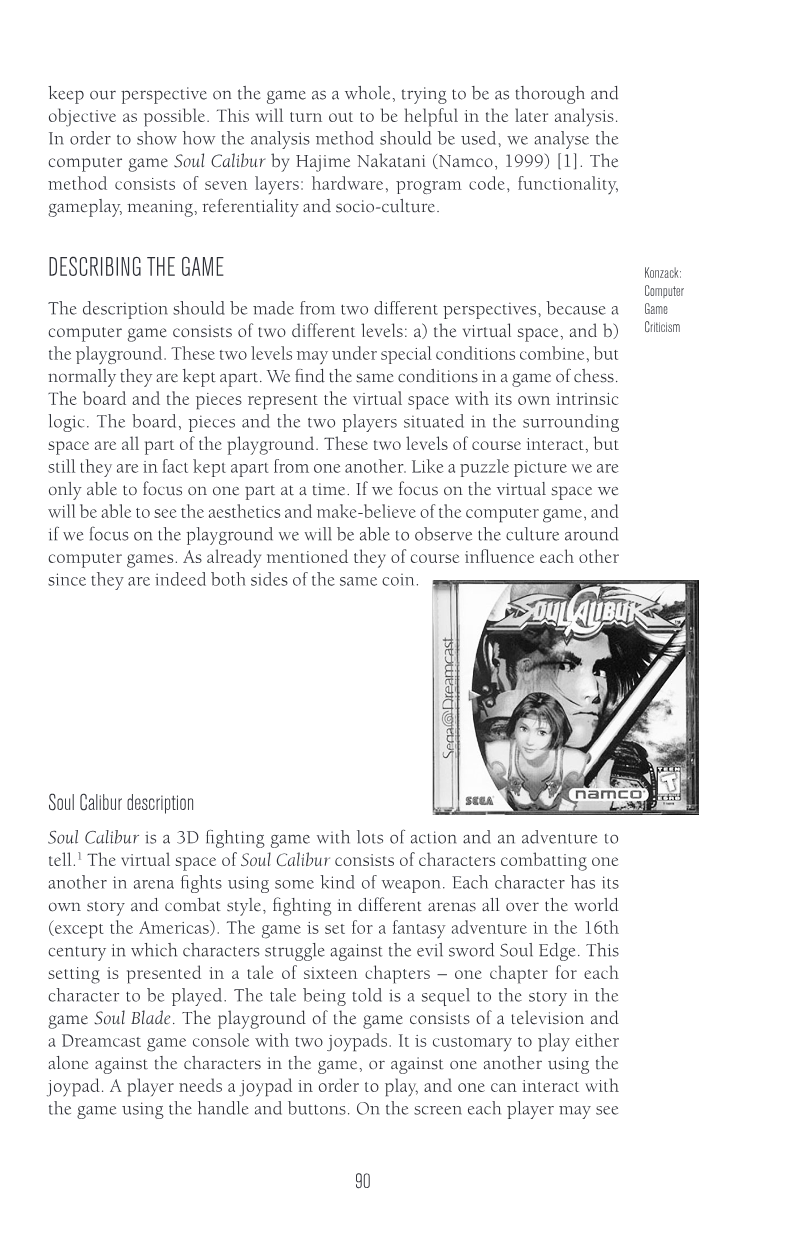
To demonstrate the method, the author applies it to Soul Calibur (Namco, 1999) on the Sega Dreamcast. The functionality layer draws on Espen Aarseth's categories of dynamics, determinability, transiency, perspective, access, linking, and user function, and finds the game to be textonic, intransient, personal, and conditionally linked. The gameplay layer uses ludological factors such as goals, obstacles, rewards, and knowledge, while the meaning layer applies semiotics and concludes that the game's ludic structure is primary and its narrative is largely ornamental. The referentiality layer places the game within fighting-game lineage, including Soul Blade and Tekken, and within Roger Caillois's categories of play, while the socio-cultural layer draws on Huizinga's view of play as the origin of culture and frames the game as one of social, symbolic power among friends.
The paper's scope is a theoretical and illustrative case study rather than an empirical one. It offers no survey data, sample sizes, or quantitative findings, and its conclusions rest on the author's analytical reading and personal experience. Its stated aim is to help understanding of how games work and, potentially, to inform better game design, while countering both narrative-centred criticism and purely functionalist or ludological accounts by placing these perspectives within a single layered framework.
Each row is a game or company this document names, each column a document, oldest first. A mark means that document names it. Select a row to see those documents.



DiGRA · 2023

DiGRA · 2023



DiGRA · 2023

DiGRA · 2023



DiGRA · 2023



DiGRA · 2023



DiGRA · 2023



DiGRA · 2023



DiGRA · 2023



DiGRA · 2023



DiGRA · 2023

DiGRA · 2023