Global reports and market data
Documents
Games, Montage, and the First Person Point of View
This document explores the concept of "interactive montage" in video games, specifically focusing on its application within a first-person point of view (POV).
- Montage in video games differs from film because the player initiates each cut, and cuts succeed when they reinforce the player's spatial positioning and control within the virtual environment.
- Player-triggered cuts remain comprehensible when spatial continuity is preserved, even when they break conventions such as the axis of action.
- Siren's 'sight-jacking' feature is presented as a counterexample: complex, changing visualizations weaken player positioning, making the game harder to read and play.

Towards an Ontological Language for Game Analysis
The "Towards an Ontological Language for Game Analysis" document introduces the Game Ontology Project (GOP), an initiative to develop a hierarchical framework for the systematic analysis of games.
- The Game Ontology Project (GOP) is a hierarchical framework that aims to give game studies and design a shared analytical vocabulary, built inductively from many specific games using prototype theory and grounded theory.
- Rather than classifying games by genre or cataloguing design patterns, the framework takes a black-box, player-perceived perspective that deliberately sets aside representational features such as setting and theme.
- At the top level, games are described through five elements: interface, rules, goals, entities, and entity manipulation, which are then elaborated into finer distinctions such as gameplay, gameworld, and rule-synergy rules.

Place Space & Monkey Brains: Cognitive Mapping in Games & Other Media
The document explores the relationship between architectural design, game space, and cognitive mapping, proposing that embodied interaction in three-dimensional games enhances sequential spatial memory more effectively than traditional non-ergodic media like film or literature.
- Erik Champion's paper is a conceptual, hypothesis-driven proposal rather than a completed empirical study, arguing that interactive 3D games engage spatial cognition differently from film and literature.
- The core hypothesis is that the embodied, ergodic experience of games produces a sequential spatial memory that passive episodic media like film and non-interactive books do not.
- Support for the hypothesis is anecdotal: a virtual heritage project on Mayan sites found task performance depended on which building cluster participants navigated and whether they could gain an overview of the site, and psychology students reported improved spatial memory after playing first-person shooters.
B.Sc. Computer Game Development: Why Not?
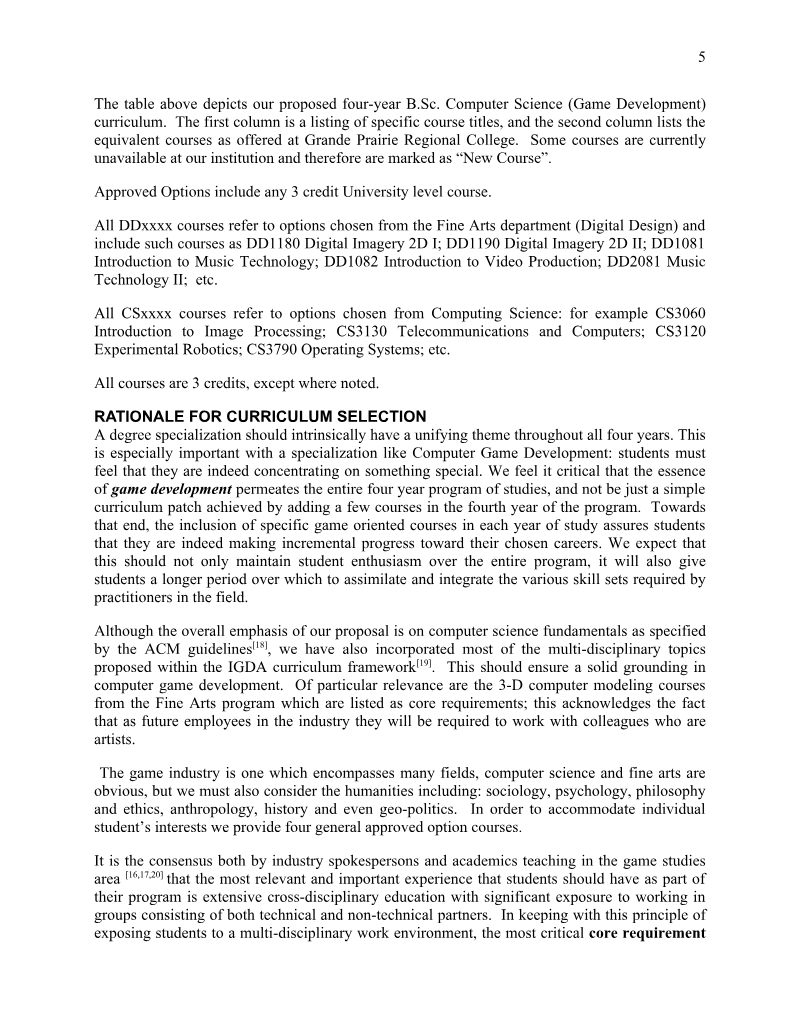
This document proposes a Bachelor of Science in Computer Science with a specialization in Game Development, driven by declining enrollments in traditional computing science programs and the significant, yet underserved, market niche of the computer game industry.
- The paper proposes a four-year B.Sc. in Computer Science with a Game Development specialization at Grande Prairie Regional College in Alberta, Canada, motivated by declining computing science enrolments in North America since around 2000.
- The authors argue the computer game industry, with global sales exceeding $30 billion, offers strong economic growth and largely unmet demand for qualified graduates.
- The central thesis is that a game development program can meet industry needs while preserving the integrity of a standard computing science education by blending ACM computing curriculum guidelines with the International Game Developers Association's curriculum framework.
Machinima: Digital Performance and Emergent Authorship
The document explores machinima as an emergent online dramatic form, analyzing its production process, dramatic conventions, and relationship to traditional video production techniques and gameplay.
- Machinima repurposes video game engines and off-the-shelf software such as Halo and The Sims 2 to produce dramatic works, which the authors, John Carroll and David Cameron of Charles Sturt University, argue is an emergent form of digital performance and authorship.
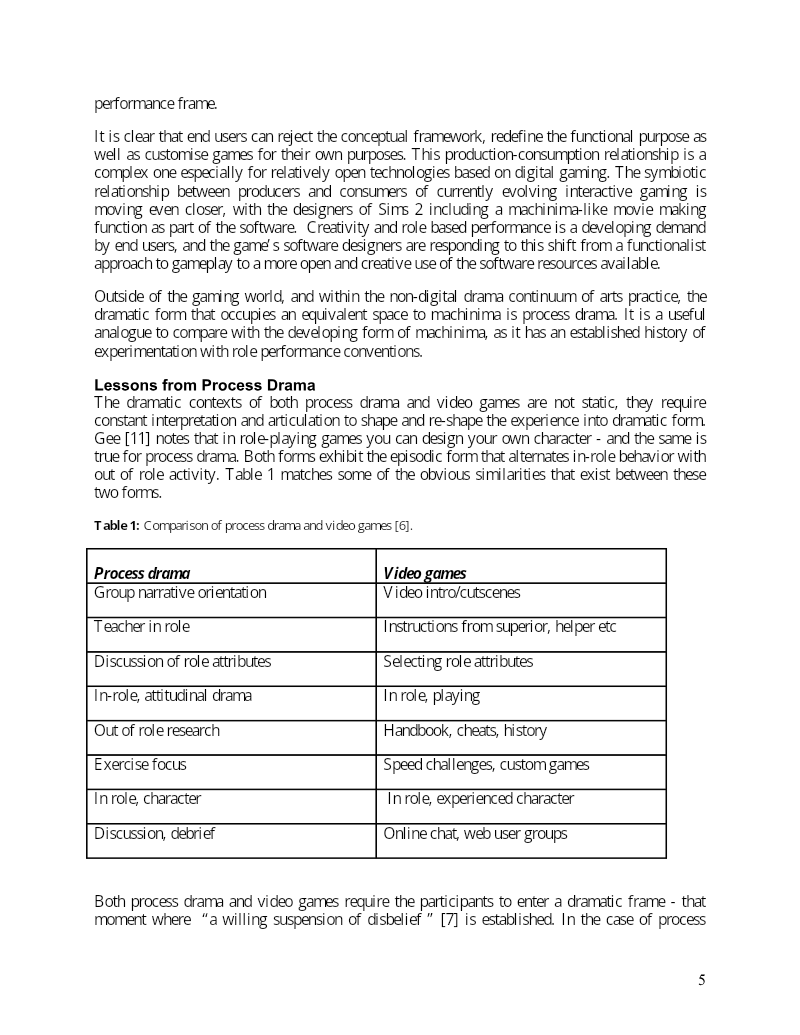
- The authors frame machinima through process drama conventions, particularly role distance and role protection, as a way to understand player agency in game-based performance.
- The history of machinima is traced to recording modes introduced in id Software's DOOM in 1994, which let players capture and share gameplay and later evolved into scripted parodies and episodic productions.

Sex in Games: Representing and Desiring the Virtual
"Sex in Games: Representing and Desiring the Virtual" examines the evolving landscape of sexual content within video games, tracing its progression from early, technologically limited insinuations to the current era of interactive, photorealistic 3D representations.
- The paper traces how sexual content in games moved from the margins to mainstream titles, citing early comedic adult games such as Leisure Suit Larry and Golgo 13 and later community-made nude patches for The Sims and celebrity-based adult skins.
- The author argues that virtual characters, celebrity culture, and pornography increasingly blur together, citing the topless Karen Walker cut-scene in Siberia and fan-made nude Lara Croft content as examples.
- Drawing on Baudrillard, Gaines, and Lacan, the paper contends that digital pornographic forms create a 'hyperreal' blend of looking and touching that intensifies voyeuristic desire.
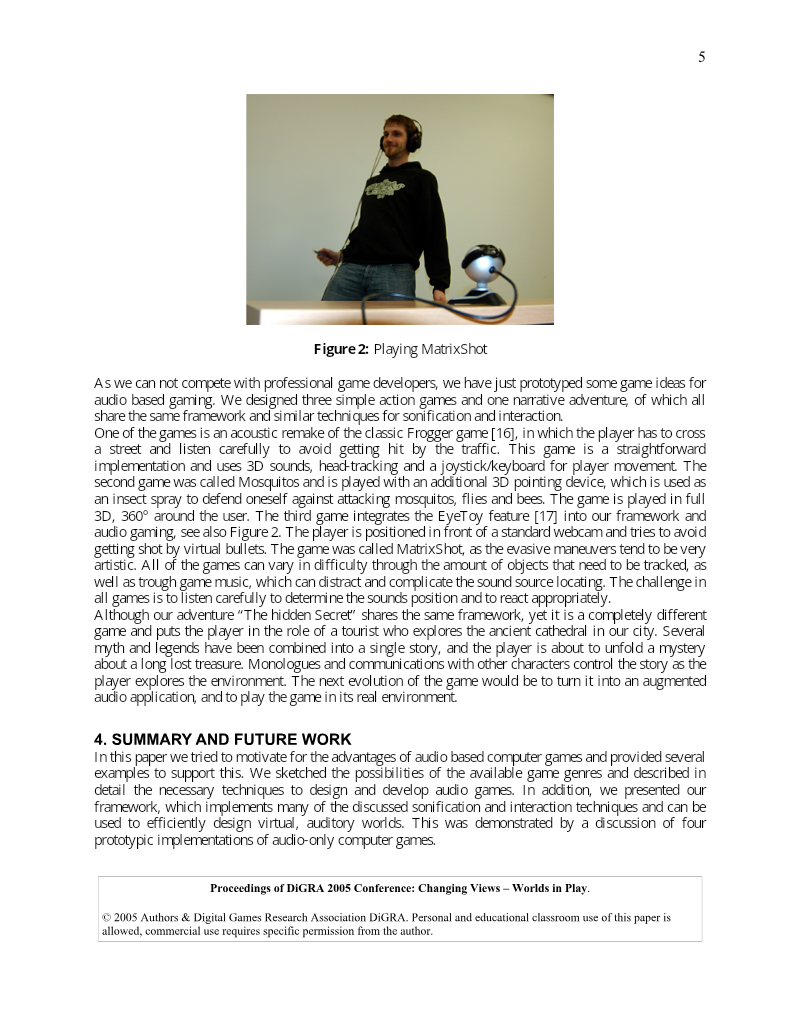
Playing Audio-Only Games: A Compendium of Interacting with Virtual, Auditory Worlds
This paper presents an overview of audio-only computer games, games played and perceived entirely through sound and acoustics.
- Audio-only games were originally developed by and for visually impaired players, but the authors argue they offer advantages for gameplay experimentation, mobile gaming, and immersive storytelling that also appeal to hearing players.
- The central design challenge is balancing functional information for orientation and navigation against artistic aesthetics, avoiding both cluttered auditory displays and silent stretches that disorient players.
- Designers can tune difficulty through narration, monologues, the number of sound objects, and background music, which the paper presents as tools for managing this functionality-aesthetics balance.
History of Digital Games in Turkey
This study provides a historical overview and current status of digital games and the game industry in Turkey, covering the period from the late 1980s to 2005.
- Turkish players' habits and play durations parallel global averages, but domestic game development has been extremely limited and poorly documented.
- Digital games reached Turkey in the early 1980s via arcade-style "Atari Salonu" halls, which prompted a 1985 regulatory response requiring local permits.
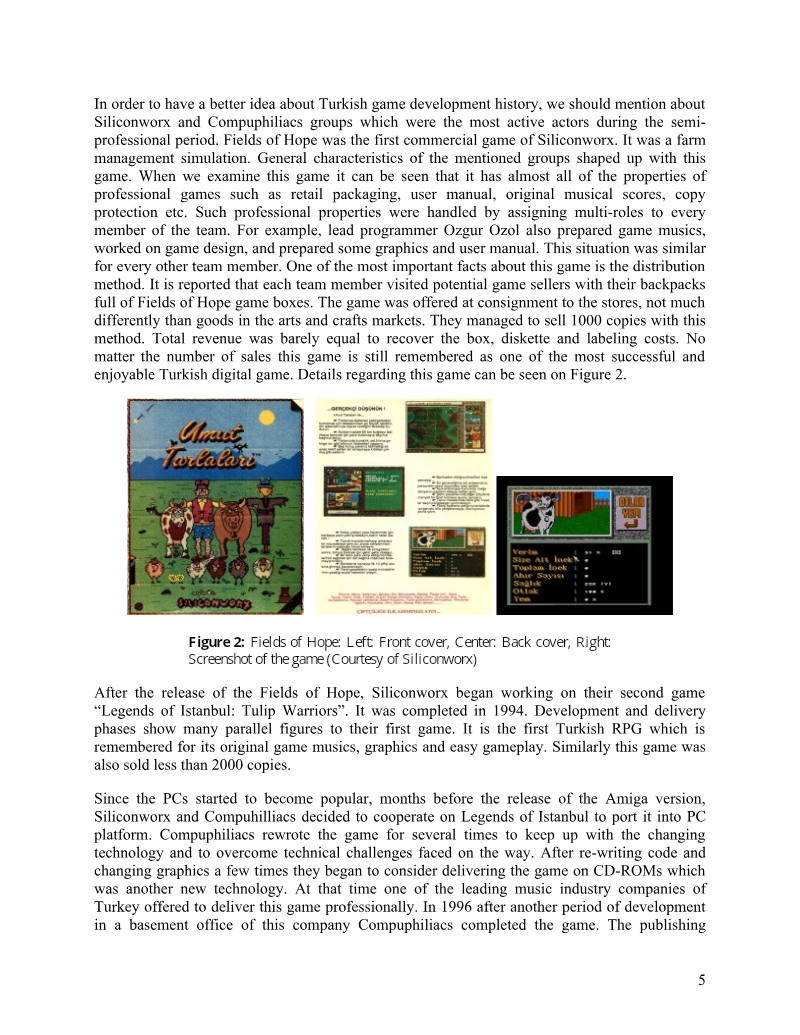
- Turkish home game development passed through three phases: an amateur 1980s period built on the Commodore 64 and magazine-published source code, a semi-professional 1990s period centered on Amiga and PC groups like Siliconworx and Compuphiliacs, and a professional stage from 2000 onward.
The Play's the Thing: Practicing Play as Community Foundation and Design Technique
Tracy Fullerton's paper describes the USC Game Design Community, an extracurricular, cross-departmental initiative at the University of Southern California's School of Cinema-Television and Annenberg Center for Communication.
- Tracy Fullerton's paper argues that shared play experiences can give students and researchers from different disciplines a common vocabulary, social bonds, and collaboratively generated design concepts, complementing formal curricula that leave cross-disciplinary teamwork to chance.
- The USC Game Design Community is an extracurricular, cross-departmental initiative run through the School of Cinema-Television and the Annenberg Center for Communication at the University of Southern California.
- The Cooperative Game Play Experiment, drawing on the 1970s New Games Movement and led by Bernie DeKoven, was judged the community's most successful event, with its outdoor, technology-free format and the motto "play hard, play fair, nobody hurt" credited with sustaining discussion.
A Sociotechnical Conjecture About the Context and Development of Multiplayer Online Game Experiences
The document posits a sociotechnical framework for understanding multiplayer online games, asserting that their "development" is an ongoing process of "context engineering" that extends beyond initial design into active gameplay.
- Multiplayer online game experiences are framed as sociotechnical constructions whose meaning is continuously co-produced by designers and players rather than fixed at launch.
- The central thesis is that 'playing is authoring': designers inscribe rules, roles, and arenas, while players reinterpret and rewrite these conditions through their actions.
- Game design sets up conditions for emergent experience rather than predetermining outcomes, making social interaction the principal driver of what unfolds in a match or community.
Socially Adaptable Games
The document introduces "Social Adaptability" as a crucial design characteristic for pervasive games, defining it as a game's ability to adjust to changes in its social environment to minimize negative effects on gameplay or overlapping activities.
- Social Adaptability is defined as a game's ability to adjust, actively through sensing or passively through design, to changes in its social environment so that negative effects on gameplay and bystanders are minimized.
- The authors argue that pervasive and mobile games, which are played over long periods, in changing locations, and often in public, cannot reach their potential unless they can coexist with complex social contexts.
- Traditional board and card games achieve only partial social adaptability, because their pause-based solutions force all players to adapt to one player's interruption.
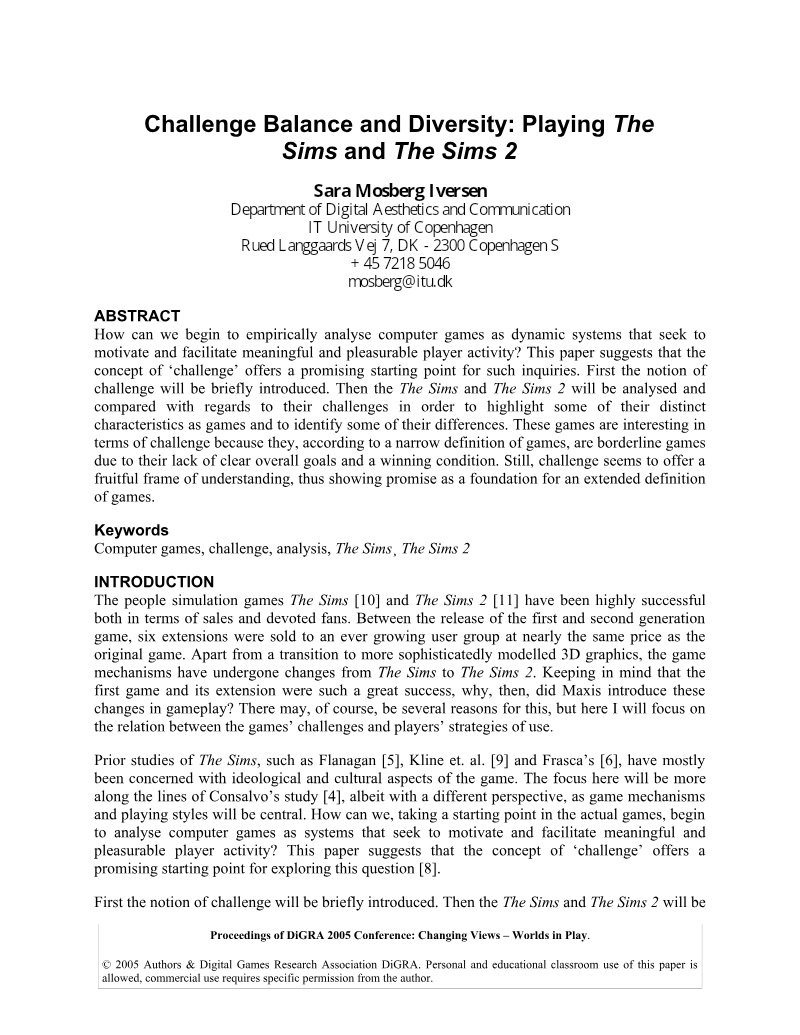
Challenge Balance and Diversity: Playing The Sims and The Sims 2
This analysis examines "The Sims" and "The Sims 2" through the lens of "challenge" to understand their appeal and differences, particularly given their status as "borderline games" lacking clear winning conditions.
- The paper treats The Sims (2000) and The Sims 2 (2004) as dynamic systems that motivate player activity through challenge, rather than as ideological or cultural artifacts as much prior scholarship has done.
- The author classes these people-simulation games as 'borderline' games under a classical definition because they lack clear overall goals or winning conditions, yet argues challenge is a productive framework for understanding them and could support a broader definition of games.
- Challenge is defined experientially as a situation of resistance that calls for transformative action and requires non-trivial effort or has an uncertain outcome.