1 free read left. Create a free account for unlimited reading + AI research.
Create free accountWhitepaper DiGRA
1 free read left. Create a free account for unlimited reading + AI research.
Create free accountWhitepaperDiGRA

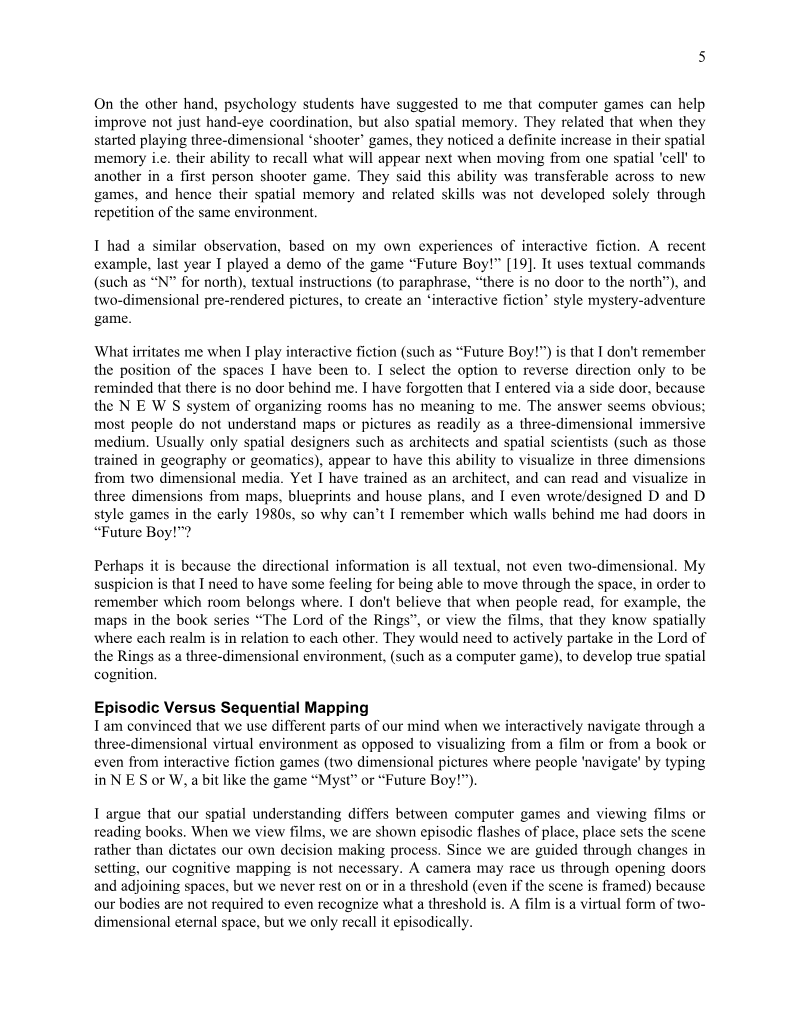
The paper argues that the embodied, ergodic experience of games produces a sequential spatial memory that passive media do not.
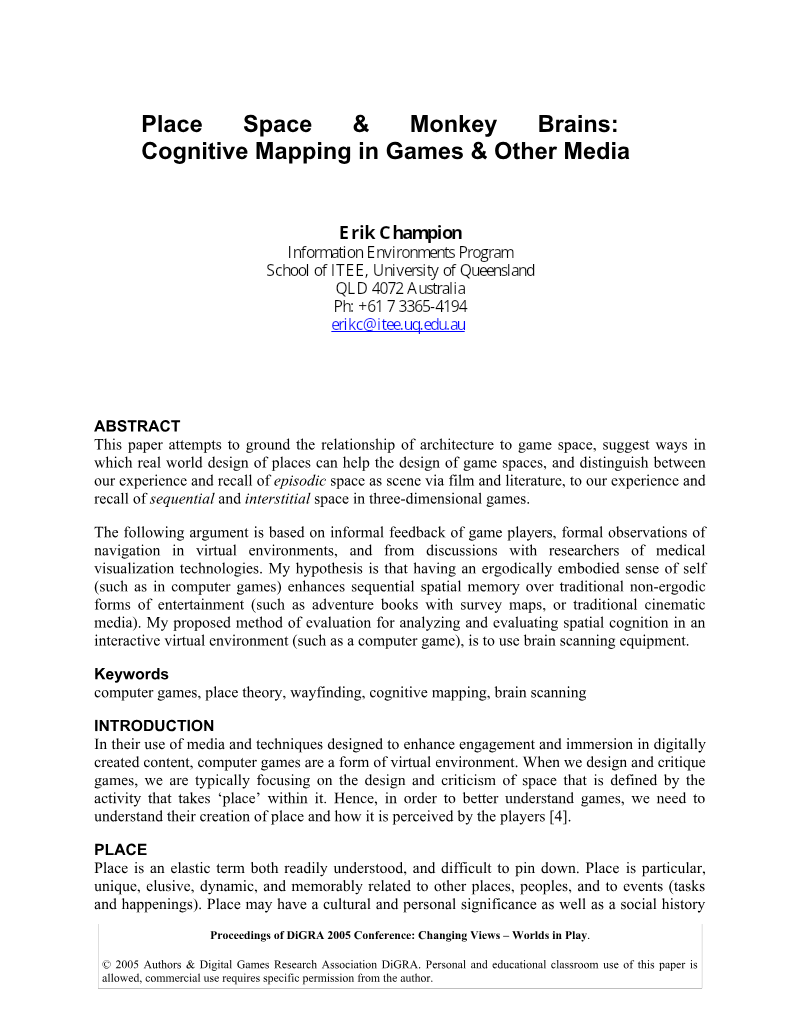
Erik Champion's paper examines how architecture and game design relate to the perception and memory of space, and proposes a research program to test whether interactive three-dimensional games engage spatial cognition differently from film and literature. Drawing on architectural history (such as the allegorical design of the Karnak temple), theories of navigation and wayfinding, and informal observations from players and researchers, the author argues that the embodied, ergodic experience of games produces a form of sequential spatial memory that passive episodic media like film and non-interactive books do not. The paper is framed as a hypothesis-driven proposal rather than a completed empirical study, and it situates games within broader debates about "narrative architecture" and place-making.
The author supports the hypothesis with anecdotal evidence. A virtual heritage project on Mayan sites revealed that participants' task performance and understanding depended heavily on which cluster of buildings they navigated and on whether they could gain an overview of the site, while psychology students reported improved spatial memory after playing first-person shooters. The author's own difficulty remembering room layouts in the text-based interactive fiction game "Future Boy!" is contrasted with the ease of spatial recall in three-dimensional environments. The paper also reviews the literature on cognitive maps, noting a debate over whether they are stored structures or on-demand products of retrieval, and cites monkey neurophysiology suggesting that spatial memory is organized around behavioral salience rather than objective geometry.
For empirical testing, the paper proposes using neuroimaging such as fMRI, steady-state visually evoked potentials, or EEG to compare brain activity across three groups: readers of an interactive book, players of a three-dimensional game version, and viewers of a film. The author acknowledges significant methodological challenges, including difficulty matching media for narrative content and duration, and the limitations of the proposed techniques. The paper's scope is therefore conceptual and exploratory, offering a research agenda and theoretical framing for spatial design in games, with its potential implications extending to architecture education, virtual heritage, and the design of spatial presence in digital environments.



DiGRA · 2018

DiGRA · 2018



DiGRA · 2018



DiGRA · 2018

DiGRA · 2018

DiGRA · 2018



DiGRA · 2018



DiGRA · 2018



DiGRA · 2018



DiGRA · 2018

DiGRA · 2018



DiGRA · 2018











Comments