1 free read left. Create a free account for unlimited reading + AI research.
Create free accountWhitepaper DiGRA
1 free read left. Create a free account for unlimited reading + AI research.
Create free accountWhitepaperDiGRA
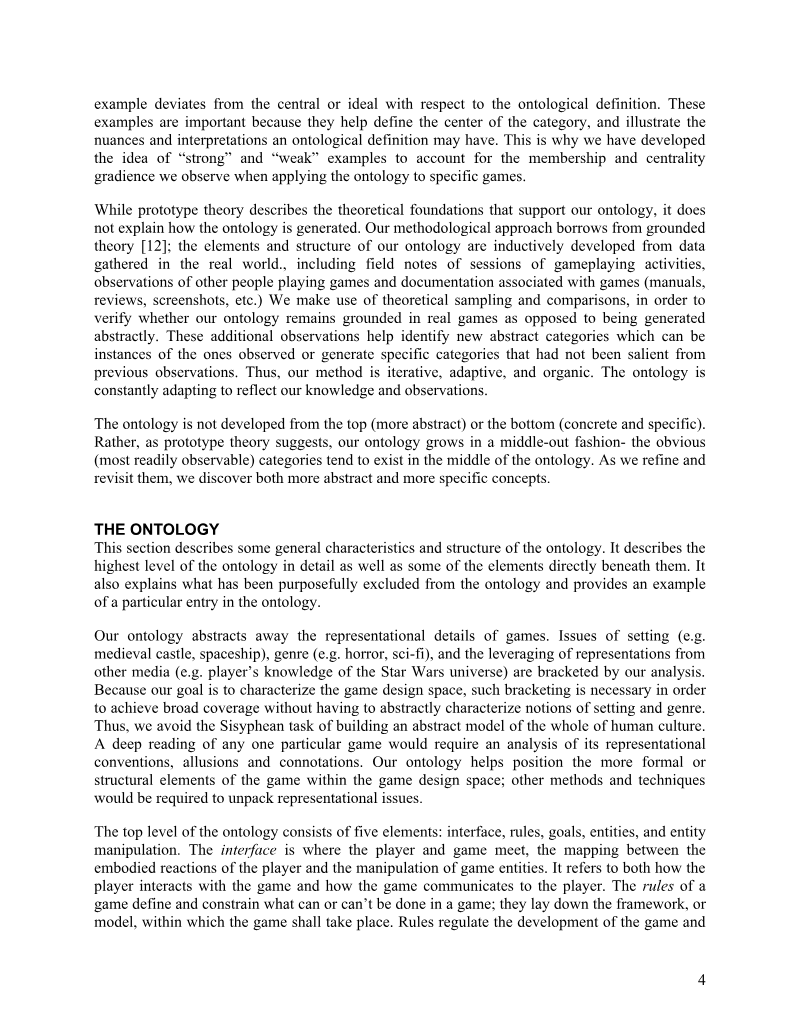
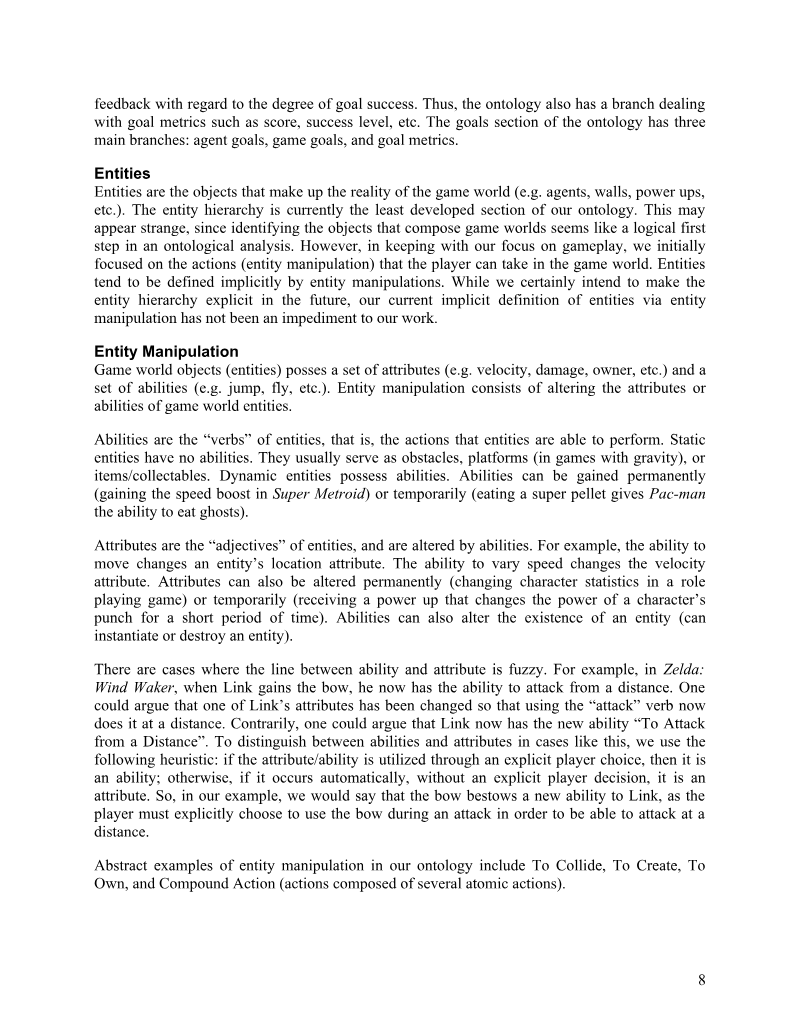
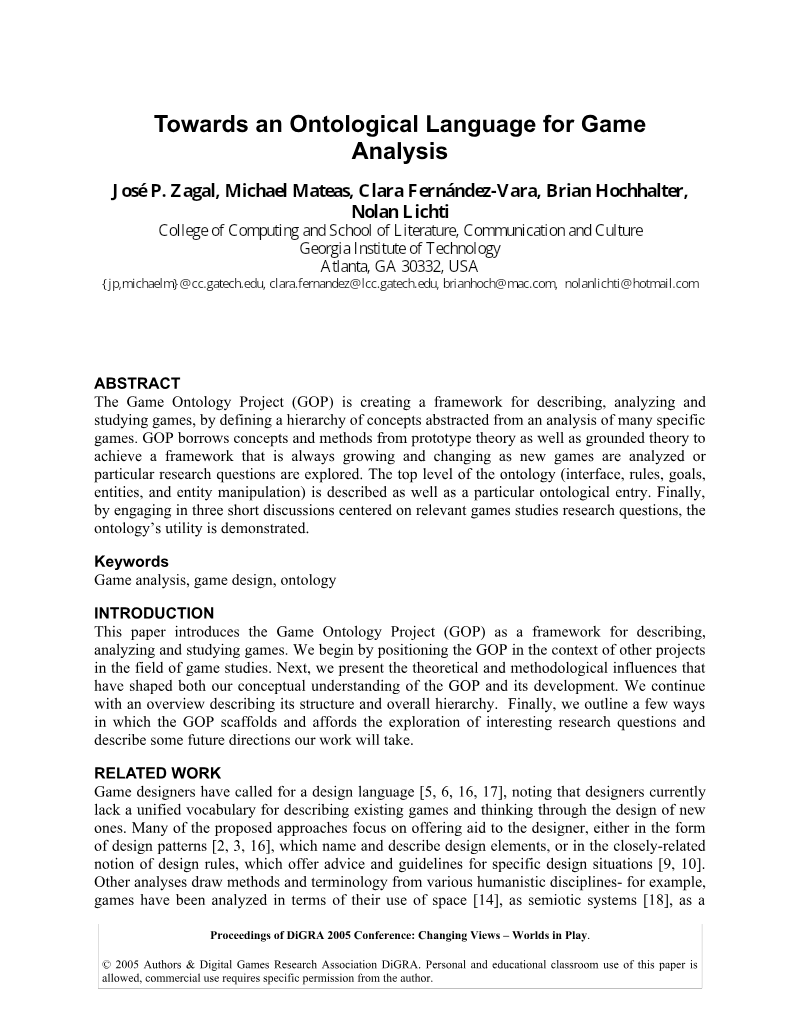
The Game Ontology Project aims to give game studies and design a shared vocabulary for analysis. It is built inductively from many specific games.
"Towards an Ontological Language for Game Analysis" presents the Game Ontology Project (GOP), a hierarchical framework for describing and analyzing games in terms of their structural elements. Its central aim is to provide a shared analytical vocabulary for game studies and design, built inductively from many specific games using prototype theory and grounded theory. Rather than classifying games by genre or cataloguing design patterns, the approach adopts a black-box, player-perceived perspective that deliberately sets aside representational features such as setting and theme. At the top level, games are described through five elements: interface, rules, goals, entities, and entity manipulation.
The ontology elaborates these elements into finer distinctions. Rules are divided into gameplay, gameworld, and rule synergies, while input devices and input methods are treated as separate layers so that they can vary independently. Several illustrative arguments underpin this structure: interactivity is understood as arising from the relationship between device and method, spatiality must be analyzed at the levels of representation, gameworld, and gameplay, and the segmentation of play into levels, waves, checkpoints, and puzzles forms a recognizable hierarchy. These discussions are presented as demonstrations of the approach rather than as validated empirical findings or quantitative results.
By the final section, the ontology had grown to more than 150 elements and was still evolving as the authors investigated specific gameplay issues. The authors conclude that its primary value lies in guiding game analysis and mapping the design space, with future development to be organized around concrete research questions. The work draws on game design and game studies literature largely from the early to mid-2000s, reflecting the period in which it was conceived.



DiGRA · 2018

DiGRA · 2018



DiGRA · 2018



DiGRA · 2018

DiGRA · 2018

DiGRA · 2018



DiGRA · 2018



DiGRA · 2018



DiGRA · 2018



DiGRA · 2018

DiGRA · 2018



DiGRA · 2018












Comments