Global reports and market data
Documents
Beyond P-1: Who Plays Online?
This study examines who plays online games and how their preferences cluster, aiming to move beyond earlier qualitative typologies toward a quantitative, empirically grounded framework.
- Exploration and themes/plot (88.5% each), good characters (86.2%), and graphics (79.3%) were the most important game features to surveyed online gamers, while military themes (31.9%) and realism (41.3%) ranked lowest.
- Based on a survey of 1,178 online gamers recruited via websites and bulletin boards, the sample is self-selected, heavily engaged, and skewed toward dedicated and Western players, limiting generalizability.
- Gender preferences diverged: males rated weapons, technology, and competition more highly, while females were more often indifferent to these features.

Making Right(s) Decision: Artificial Life and Rights Reconsidered
This paper, a DiGRA 2005 conference contribution by Juyun Kim, examines whether artificial life (A-life) and artificial intelligent robots raise genuine questions about rights and moral standing, using the popular simulation game The Sims as its primary case study.
- The paper argues that as machines become more socially interactive and emotionally expressive, the boundary between human and machine becomes less fixed, calling for a reconsideration of what rights mean for artificial life.
- The author's central evidence is qualitative analysis of public forums about The Sims and the robotic pet AIBO, where players described deliberately cruel treatment of their Sims (such as drowning or confining them) while also expressing guilt and reluctance to harm characters resembling family or friends.
- Research on AIBO users cited in the paper found people were attached to robotic pets yet seldom attributed moral standing to them, showing a gap between emotional attachment and moral consideration.

Mise-en-scène Applied to Level Design: Adapting a Holistic Approach to Level Design
This paper argues that mise-en-scène, the film concept of deliberately arranging everything visible within a frame to convey meaning, can be adapted to level design to deepen emotional engagement and communicate narrative and psychological subtext to players.
- Mise-en-scène, the film concept of deliberately arranging everything visible within a frame to convey meaning, is proposed as a framework for level design to deepen emotional engagement and communicate narrative and psychological subtext.
- The paper maps Robert Kolker's mise-en-scène elements (spatial arrangement, props, camera relationship, color, lighting, and framing) onto level designers' responsibilities such as set dressing, lighting, texturing, and object placement, noting that cinematography and costuming typically fall to other team members.
- Close readings of Kubrick's The Shining show how scale, the Overlook Hotel's labyrinthine architecture, shifting color temperatures from warm amber to cold blue, atmospheric effects like snow and haze, and repurposed props reinforce themes of isolation, decay, and supernatural dominance.
Video Games: A Significant Cognitive Artifact of Contemporary Youth Culture
This paper argues that recreational video games carry informal educational value, examining whether playing a commercial role-playing game can engage the thinking skills and strategies that formal classrooms prize.
- A study of five 13-year-old players of Final Fantasy IX recorded 600 instances of thinking skills during play, most often predicting, evaluating, and justifying, plus 155 instances of strategy use led by exploration and trial-and-error.
- All five participants engaged in higher-order reasoning while playing, supporting the authors' claim that recreational games can be a legitimate site of cognitive activity.
- Informal cognitive performance during play often diverged from teachers' ability ratings, as one student rated average outperformed a peer rated very high, which the authors use to question conventional academic assessment.


Interactive Audio on the Web: Review and Recommendations
The web audio landscape in 2002 is defined by extreme fragmentation, characterized by a reliance on incompatible, vendor-specific technologies that hinder the development of consistent interactive experiences.
- The 2002 web audio landscape is defined by extreme fragmentation, forcing developers to rely on incompatible proprietary technologies like Macromedia Flash, QuickTime, RealOne, and Java.
- Macromedia Flash is currently the most viable and ubiquitous tool for interactive web audio, despite its lack of native digital signal processing and advanced sequencing capabilities.
- Advanced platforms like Java Sound and Beatnik offer superior synthesis and real-time manipulation but are marginalized by high barriers to entry and inconsistent browser integration.
Issues and Approaches in Artificial Intelligence Middleware Development for Digital Games and Entertainment Products
This paper examines the design and development of artificial intelligence middleware for digital games and entertainment products.
- AI has shifted from a secondary concern to a priority in game development, yet developers still rely on a narrow set of techniques and lack flexible, reusable tooling.
- Dedicated AI middleware, a software layer that supplies agent behavior and decision-making services to game engines, is presented as the likely next step for improving game AI and freeing developers for creative work.
- Dominant practice relies on finite state machines, hierarchical and fuzzy state machines, A pathfinding, steering behaviors, decision trees, and rule-based systems, each trading off speed, expressiveness, and predictability.
Characters in Computer Games: Toward Understanding Interpretation and Design
Characters in Computer Games: Toward Understanding Interpretation and Design argues that protagonists in games are shaped jointly by their designers and by players, since player freedom is always bounded by rules and goals.
- Game characters are often perceived as flat because of weak design rather than any inherent limitation of the medium, and a consistent personality can be built deliberately.
- Personality is conveyed through predefined elements such as cut-scenes, dialogue, and animation, together with the goals assigned to a character and the actions enabled or restricted within the game.
- The authors argue that a protagonist's nature can be encoded into mechanics, meaning which actions are possible or impossible, rather than conveyed only through narrative exposition, and that this generates the conflict and goals that drive player behavior.

Expressive AI: Games and Artificial Intelligence
Michael Mateas's paper argues that as graphical gains yield diminishing returns, game development is shifting its attention toward artificial intelligence, and that AI-driven art and entertainment forms a new interdisciplinary agenda linking games studies, design practice, and technical research, which he names "expressive AI."
- Mateas argues that as graphical gains yield diminishing returns, game development is shifting attention toward artificial intelligence, and proposes "expressive AI" as an interdisciplinary agenda linking games studies, design practice, and technical research.
- Game AI is defined as the production of behavior that players read as intentional, distinguishing it from game physics: Asteroids' asteroids and water simulations generate behavior without inviting psychological interpretation, whereas enemies like Pac-Man's ghosts invite readings of goals, desires, and moods.
- The paper positions game AI as a "white box" vocabulary for analyzing and designing games, complementing the "black box" vocabularies of design patterns and humanistic game studies that deliberately ignore implementation.
Stepping Back: Players as Active Participators
"Stepping Back: Players as Active Participators" argues that single-player third-person games can position players flexibly among multiple characters, rather than binding them to a single fixed role, and that this variable positioning offers dramatic and narrative advantages that game design has yet to fully explore.
- The paper argues that single-player third-person games can position players flexibly among multiple characters rather than binding them to one fixed role, and that this variable positioning offers dramatic and narrative advantages design has yet to fully explore.
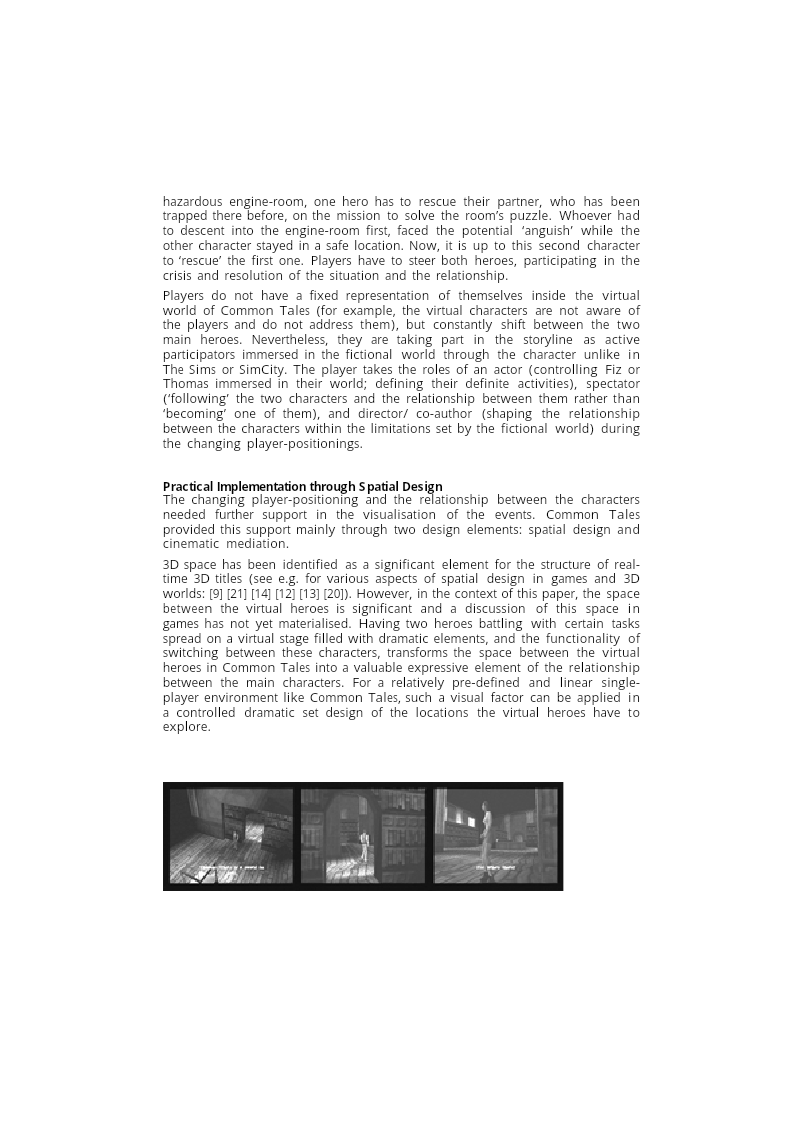
- The central case study is Common Tales, a 1999–2000 prototype by Sony and Cambridge researchers in which players alternate control between two heroes, Thomas and Fiz.
- Common Tales structures the hero relationship through three interaction types (teamwork, anguish, and rescue), along with spatial and cinematic design.

Technology Tells a Tale: Digital Games and Narrative
Kevin Schut's "Technology Tells a Tale: Digital Games and Narrative" contends that digital games are not narratives in themselves, but that the digital medium is reshaping how culture understands what a story is.
- Digital games are not narratives in themselves; the digital medium is reshaping how culture understands what a story is.
- The paper frames the long-running debate between narratologists (applying literary and film theory to games) and ludologists such as Aarseth, Frasca, and Eskelinen (prioritizing play and interactivity).
- The author identifies five recurring characteristics of computing as the basis for how games produce meaning: procedurality, participation, quantifiability, modularity, and finiteness.

Problem Solving: The Essence of Player Action in Computer Games
"Problem Solving: The Essence of Player Action in Computer Games" argues that player agency in computer games consists of intentional actions that advance play by solving problems.
- Player agency in computer games is framed as intentional actions that advance play by solving problems, built on Espen Aarseth's concepts of aporia (an obstacle) and epiphany (its resolution).
- The paper proposes a three-phase model of problem solving: comprehending the aporia, developing a strategy, and executing intentional action, with flawed approaches requiring a return to earlier stages.
- Baldur's Gate II conceals its overarching goal and presents a fixed, staircase-like chain of linked aporia-epiphany pairs with a role-play emphasis.
Space, Agency, Meaning and Drama in Navigable Real-Time Virtual Environments
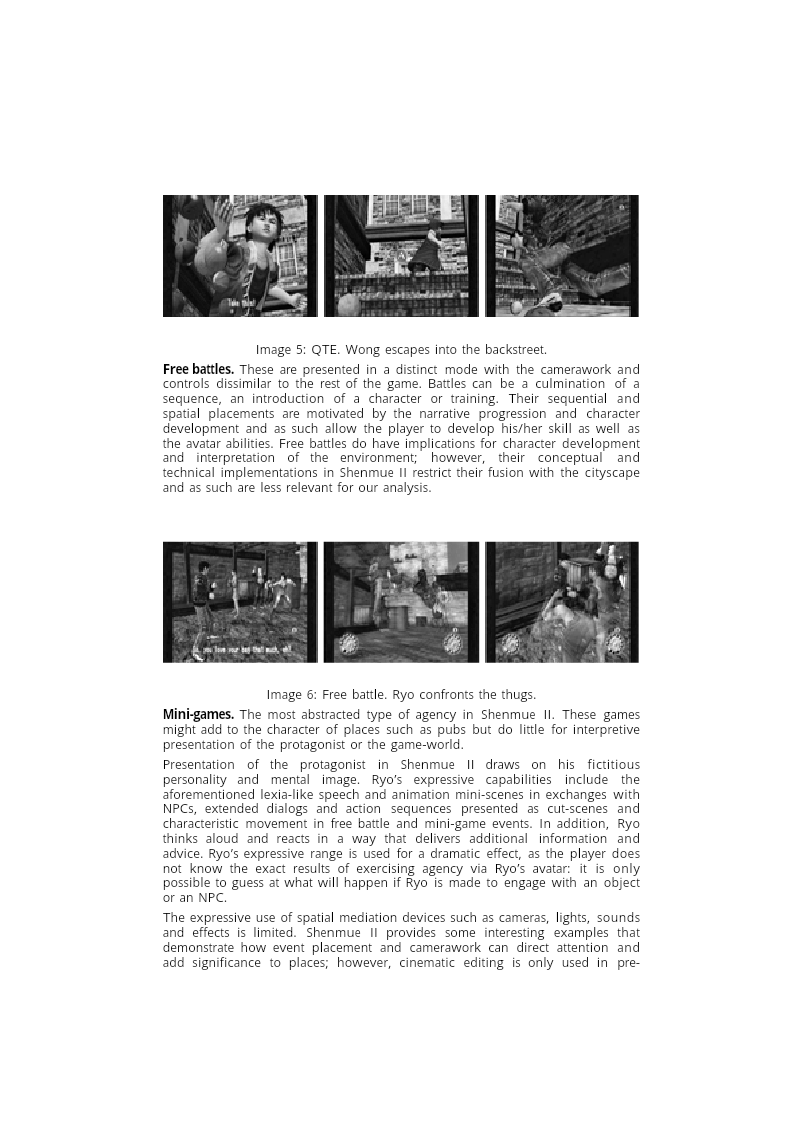
Navigable real-time virtual environments, examined through the action-adventure role-playing game Shenmue II, derive their meaning and dramatic force from a hybrid structure that combines rule-based, systematic organization with situational knowledge drawn from real-world experience.
- Navigable real-time virtual environments derive meaning and dramatic force from a hybrid of rule-based systematic organization and situational knowledge drawn from real-world experience.
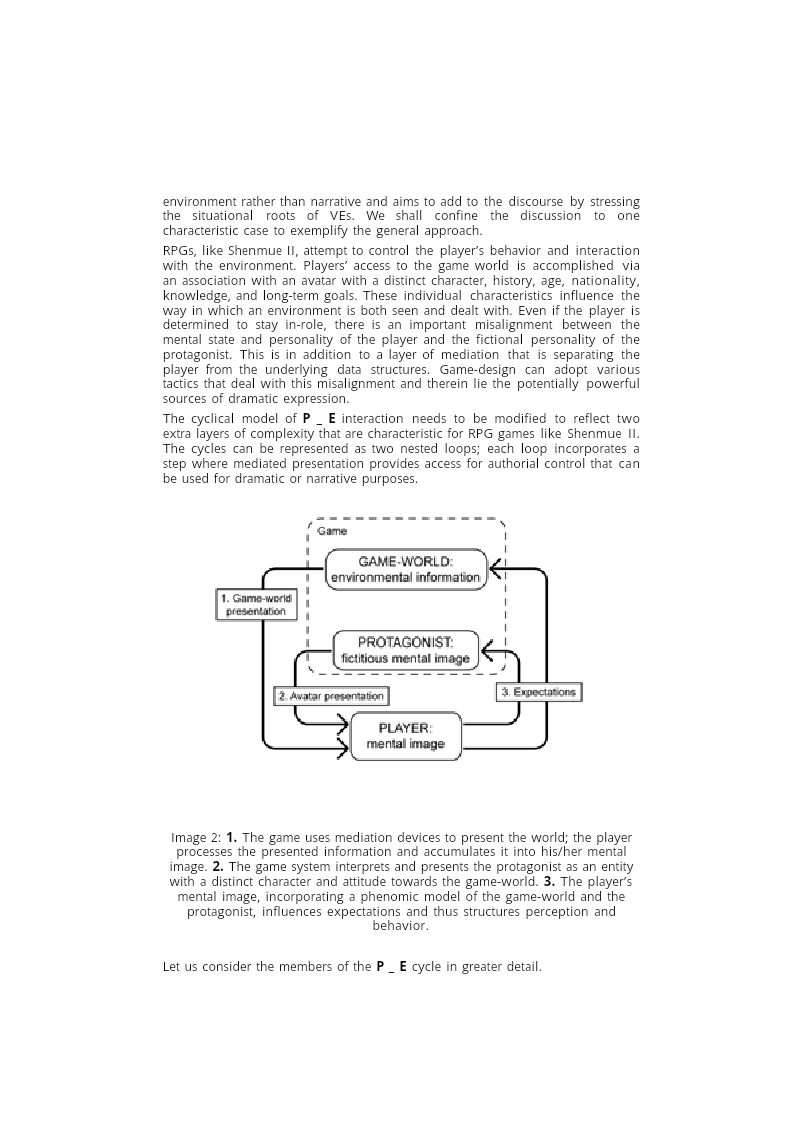
- Grounded in environmental psychology, the authors frame person-environment interaction as a cyclical, bi-directional process in which perception is continually shaped by prior experience, a cycle virtual environments replicate with an added layer of authorial mediation.
- The authors conclude that interactivity and culturally situated associations are the principal sources of engagement, and designers who neglect links to the external world risk producing confusion rather than immersion.