Global reports and market data
Documents
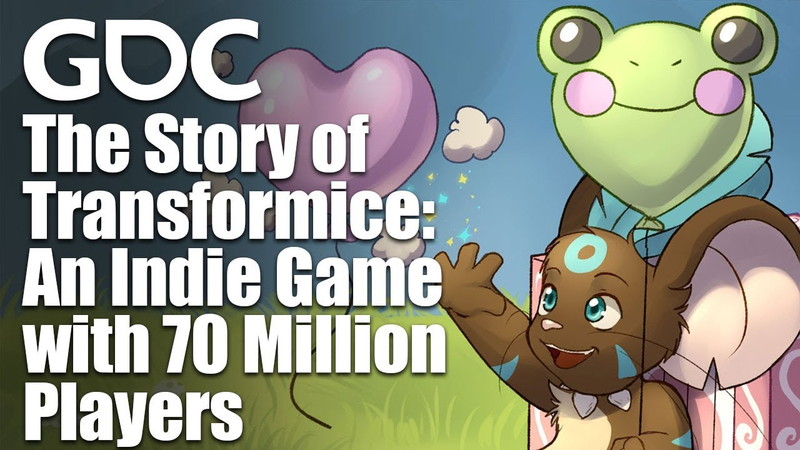
The Story of Transformice: An Indie Game with 70 Million Players
Transformice emerged from a brief three-week prototype to become a global phenomenon, ultimately attracting 70 million players through viral growth, extensive localization, and consistent seasonal engagement.
- Transformice grew from a three-week prototype to a global title with 70 million players, primarily through viral growth and extensive localization.
- A sudden Google AdSense ban forced a pivot to a free-to-play, cosmetic-focused monetization model, which generated over $1 million in microtransactions within six months.
- The studio remains a 'one-game studio' with 99% of its total revenue derived from Transformice, as subsequent releases have failed to replicate its initial success.
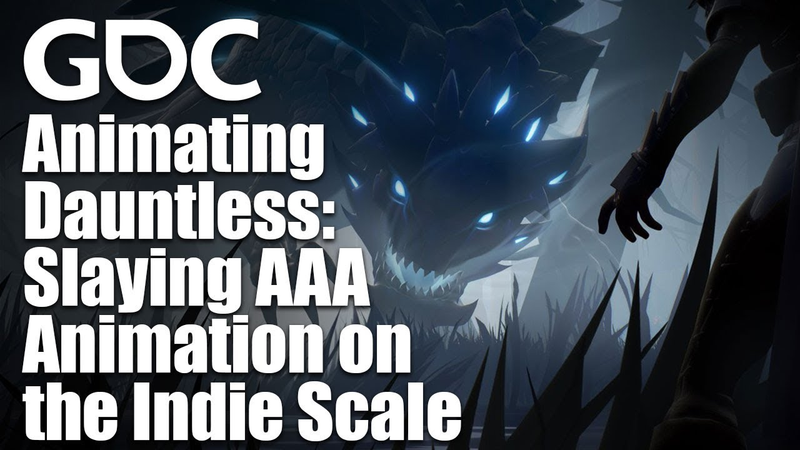
Animating Dauntless: Slaying AAA Animation on the Indie Scale
Achieving AAA-quality animation within an independent studio environment requires a strategic shift toward modularity and agile production workflows.
- Small teams can achieve AAA-quality animation by adopting a modular, genus-based classification system that allows skeletal rigs and geometry to be reused across different creature types.
- Utilizing automated Python-based rigging toolkits and dynamic simulation for secondary motion significantly reduces the need for manual keyframing.
- Integrating portable motion capture technology, such as OptiTrack, enables teams to reduce iteration cycles from days to hours, facilitating rapid gameplay prototyping.
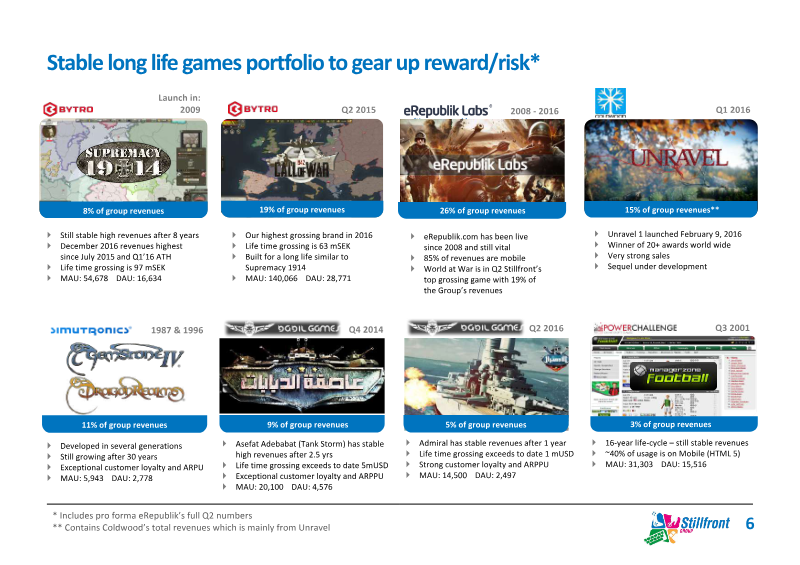
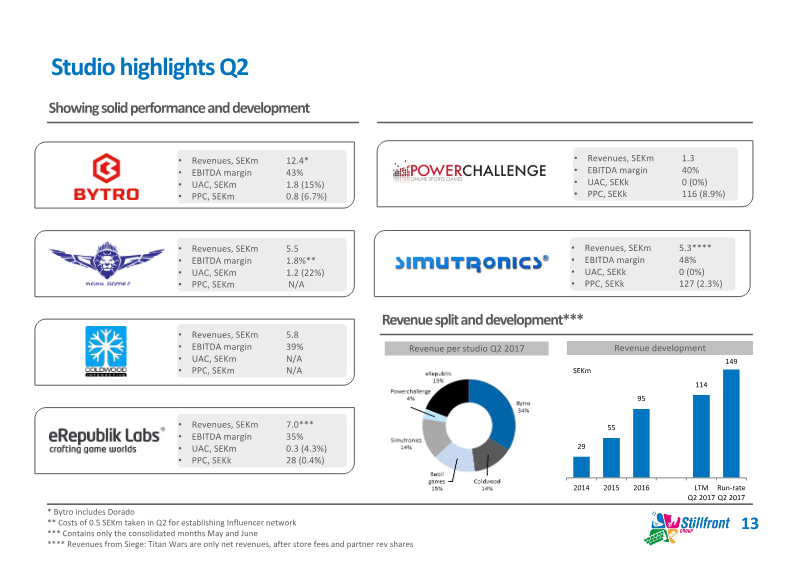
Stillfront Group Q2 2017 Presentation
Stillfront Group's Q2 2017 presentation outlines its strategy to become a leading group of independent game studios by focusing on long-lifecycle, free-to-play strategy games and a diversified portfolio.
- Stillfront Group achieved 37.3 million SEK in net revenue for Q2 2017, marking a 24% increase over the previous quarter.
- The company maintains a rolling 12-month EBITDA of 31 million SEK, with operational profitability consistently between 25% and 35%.
- Mobile platforms now account for 46% of run-rate revenues, contributing to a 53% CAGR recorded between 2012 and 2016.
The 2017 Game Animation Microtalks
The game animation industry has undergone a significant transformation, evolving from a fragmented field into a robust, collaborative network defined by the democratization of knowledge.
- The game animation industry has transitioned from a fragmented field into a collaborative network driven by the democratization of knowledge through online platforms and bootcamps.
- Professional communities now serve as essential support systems for animators to navigate industry volatility, including frequent layoffs and high rates of professional burnout.
- Developers are increasingly integrating political and social themes into their work to normalize diverse identities and reach broader, more inclusive audiences.
Surviving the Jump from AAA to Indie
Transitioning from AAA game development to independent production requires a fundamental shift in mindset, moving from a specialized, corporate-supported role to a multifaceted entrepreneurial existence.
- Transitioning to indie development requires shifting from a specialized role to an entrepreneurial model where the developer assumes full responsibility for production, marketing, and financial management.
- Financial sustainability depends on treating the project as a business by accounting for overhead costs like taxes, healthcare, and professional services that are typically covered by large studios.
- Developers should prioritize a lean, project-based workforce of specialized contractors over hiring a large, full-time staff to mitigate financial risk.

Our Games Are Not Linear, So Why Are Our Careers?
The traditional concept of a linear career ladder is fundamentally incompatible with the volatile, fast-paced nature of the modern games industry.
- Abandon the traditional vertical career ladder in favor of a 'career lattice' model that prioritizes lateral moves and the accumulation of diverse, transferable experiences.
- Prioritize the development of soft skills such as ego management, decision-making, and influence over purely technical mastery to ensure long-term professional viability.
- Treat your career as a collection of experiences rather than a rigid hierarchy to maintain agility and self-reliance amidst rapid technological shifts and market volatility.
Will Wright's Design Plunder
Game design functions most effectively when developers look beyond traditional software boundaries, drawing inspiration from architecture, urban planning, and industrial design.
- Designers should adopt a bottom-up approach by using physical prototypes and mock-ups to align technical development with the user's mental model.
- Game longevity is best achieved by engineering nested feedback cycles where short-term, minute-to-minute engagement serves as the foundation for long-term strategic depth.
- Designers can foster emergent gameplay and player exploration by incorporating biological concepts like fitness landscapes to model behavioral goals and manage difficulty.
The Art of Pre-Production
Effective pre-production serves as the critical foundation for game development, shifting the focus from static conceptualization to functional gameplay simulation.
- Shift the focus of pre-production from static conceptualization to functional gameplay simulation to identify technical bottlenecks early.
- Prioritize technical problem-solving, pipeline definition, and core design rules over traditional art bibles or mood boards to mitigate feature creep and mid-production pivots.
- Utilize a dedicated, isolated core team to build functional prototypes that serve as a testing ground for procedural systems and lighting.

DOOM: Behind the Music
Innovation in game audio requires a fundamental departure from established creative templates, favoring instead a culture of experimentation and the acceptance of potential failure.
- To achieve unique creative results, composers must abandon standard templates and established workflows, as repeating the same process inevitably leads to the same output.
- Creating an environment where failure is acceptable is essential for innovation, as the fear of rejection often prevents experimentation and the pushing of creative boundaries.
- The DOOM soundtrack utilized complex signal chains involving vintage distortion pedals, bit crushers, and tape echoes to process simple sine waves into aggressive, unique textures.
Tooth and Tail: Building Community Within Open Game Development
Pocketwatch Games successfully navigated the resource constraints inherent in small-scale game production by pioneering a model of community-integrated development.
- Pocketwatch Games utilized community-integrated development to offload critical operational tasks like quality assurance, balance testing, and tournament organization to their player base.
- The studio transformed development into a collaborative ecosystem by treating dedicated users as an extension of the internal team, allowing for faster iteration cycles.
- Access to early development builds was restricted to active participants, ensuring that testers were genuinely invested in the project’s long-term success.
A Q&A Session For New Game Writers
Game writing requires a specialized approach that prioritizes systemic integration and mechanical alignment over traditional prose.
- Game writing must prioritize systemic integration and mechanical alignment over traditional linear prose to ensure narrative elements support core gameplay.
- Writers should be involved in the development cycle from the initial stages to prevent the disjointed experience caused by retroactively applying story to finished products.
- Portfolios for aspiring writers should focus on interactive formats like branching narratives and dialogue mechanics rather than linear storytelling samples.
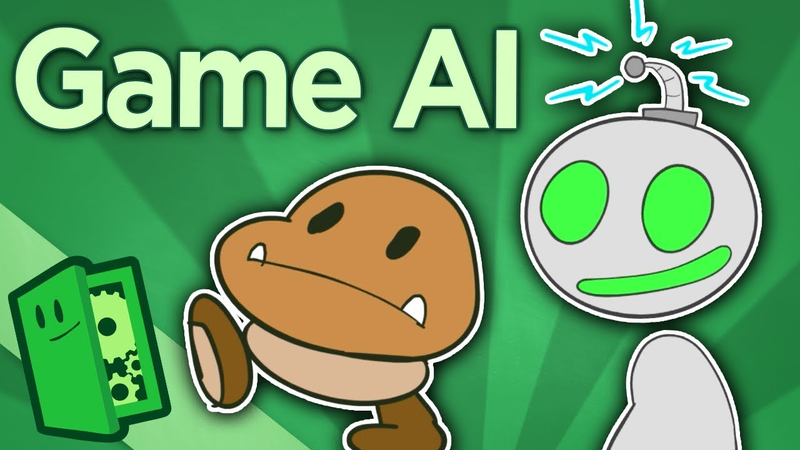
Game AI - Funtelligence - Extra Credits
Effective game artificial intelligence is defined not by technical complexity, but by its ability to foster player engagement through predictable or intuitive NPC behaviors.
- Effective game AI is defined by its ability to foster player engagement through predictable and intuitive behaviors rather than technical complexity.
- Developers should prioritize three core vectors: ensuring behaviors are learnable or intuitable, creating meaningful decision-making opportunities for the player, and maintaining resource efficiency.
- Simple, consistent scripts—such as those used in Super Mario Brothers—are superior to complex simulations because they allow players to master mechanics and refine strategies over time.
Writers
Games and companies
Games