Global reports and market data
Documents

How Saying 'No' Can Help You Make a Better Game
Achieving high-quality game development requires a disciplined adherence to a core design vision, balancing the inherent constraints of budget, schedule, and scope.
- Protect project integrity by establishing a concise mission statement and actionable design pillars early to serve as objective filters against feature creep.
- Prioritize iterative design and early prototyping over rigid documentation to ensure resources are allocated to essential mechanics rather than distracting concepts.
- Evaluate all new feature proposals against data-driven metrics, such as player engagement, retention, and psychological satisfaction, to determine their necessity.

Creating Social Experiences in VR
The primary objective of social virtual reality development is to transition the medium from a niche gaming platform into an accessible, everyday communication tool.
- Social utility, rather than high graphical fidelity, is the primary driver for mass adoption of virtual reality as an everyday communication tool.
- Developers should prioritize the concept of 'presence' through intuitive interactions and shared activities that mirror real-world social networks.
- Six-degrees-of-freedom tracking is essential for avatars to convey authentic body language, eye contact, and nuanced gestures.
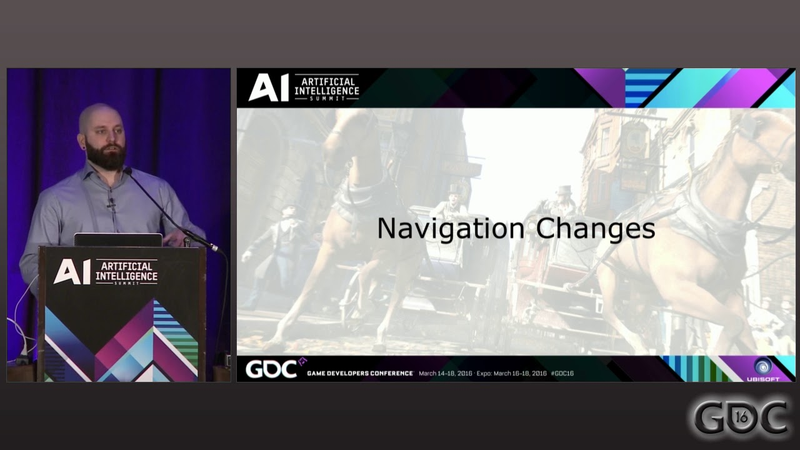
What Are You Driving At? Vehicle AI in Assassin's Creed Syndicate
The implementation of vehicle artificial intelligence in Assassin’s Creed Syndicate was driven by the need to integrate dynamic, physics-based carriages into a world defined by parkour, stealth, and historical accuracy.
- To integrate carriages into Assassin's Creed Syndicate, developers implemented 'navmesh patching,' which dynamically alters the navigation mesh by punching holes in it based on the vehicle's rigid body size to allow NPCs to interact with moving vehicles.
- Due to the high computational cost of navmesh patching, the system was limited to updating only one vehicle per frame and prioritized patching based on the vehicle's proximity to the player.
- The team utilized 'virtual vehicles'—fake entities existing in virtual space—to group NPCs by faction, allowing multiple NPCs to spawn with a single vehicle request rather than spawning individual vehicles for every enemy.

Possible Worlds in Video Games: From Classic Narrative to Meaningful Actions
"Possible Worlds in Video Games: From Classic Narrative to Meaningful Actions" by Antonio José Planells de la Maza presents a comprehensive theoretical framework for analyzing video games as complex cultural objects.
- Video games outperform film and music in revenue yet have been systematically neglected by academic study, a gap Planells de la Maza's book seeks to address with a new theoretical framework.
- The book conceptualizes video games as "ludofictional worlds" and analyzes them along three dimensions: a macrostructural static dimension (the game as a closed formal system of linked possible worlds), a microstructural dynamic dimension (evolving character identities and relationships), and a metaleptic dimension linking fictional worlds to the player.
- Its central conclusion is that video game worlds are structured around what can happen rather than what is, making the "possible" foundational to game design.
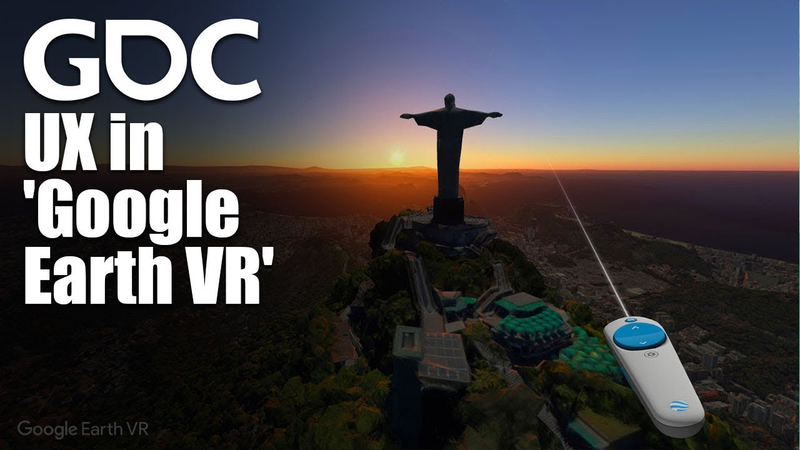
UX in Google Earth VR
Google Earth VR prioritizes user comfort and intuitive navigation as the primary pillars of its design philosophy.
- Google Earth VR mitigates motion sickness and spatial disorientation by using a tunnel vision technique that provides a stable horizon reference via a high-contrast grid.
- Navigation is optimized through non-linear power curves and altitude-based blending to replace jarring constant speeds with smooth, responsive movement transitions.
- The platform incorporates tactile feedback through low-pass filtering on controller rays and physics-based spring models to simulate weight and resistance in the virtual environment.
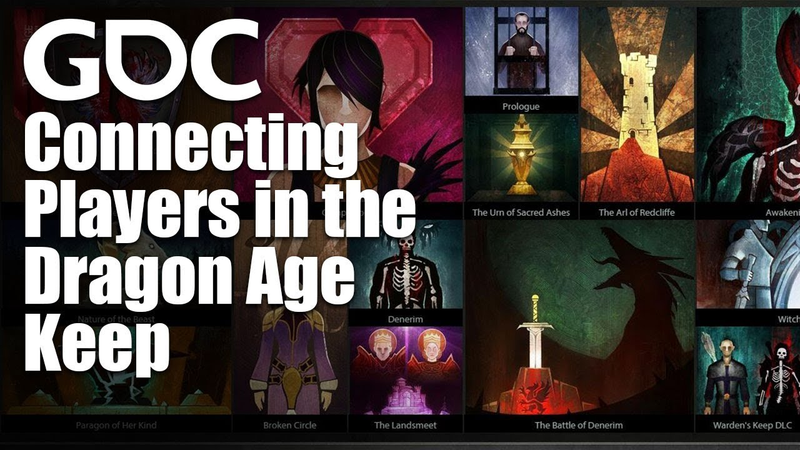
Connecting Players and Franchise Across Console Generations in the Dragon Age Keep
The Dragon Age Keep serves as a strategic solution to the technical limitations inherent in traditional save-game imports, effectively decoupling narrative logic from specific game clients.
- BioWare developed the Dragon Age Keep as a web-based 'World Vault' to solve the technical failures of traditional save-game imports, which were prone to errors and difficult to patch across console generations.
- The system uses a centralized web service called 'Orbit' to abstract plot logic and player choices from the game client, allowing developers to update story states and fix bugs without requiring client-side patches.
- By moving the world state management to the web, the team enabled players to maintain continuity and emotional investment across multiple games, novels, and comics within the franchise ecosystem.

Hearts and Minds
Games function as a unique bridge between rational, systematic thought and intuitive, emotional experience, serving as a microscope that renders the internal mechanics of human cognition visible.
- Games function as a unique bridge between rational, systematic thought and intuitive, emotional experience, allowing players to observe their own transition from deliberate rule-based learning to unconscious mastery.
- Designers should treat game design with the same intellectual seriousness as film or literature to elevate the medium into a significant art form.
- Players engage in a form of rigorous, personal scientific inquiry—such as theory-crafting and experimentation—to uncover the underlying logic of virtual worlds.
The 2017 Indie Soapbox
Independent game development thrives when creators prioritize authentic personal expression over market trends.
- Indie developers should prioritize authentic personal expression and creative integrity over chasing market trends to foster deeper audience connections.
- Sustainable production requires realistic task estimation and the rejection of crunch culture to treat game development as a long-term craft rather than a sprint.
- To prevent feature creep, developers should implement formal conceptualization and requirement-freezing while utilizing hybrid processes to optimize limited resources.

Everything's on Fire and No One Knows What to Do (In Game Writing)
Modern game narrative design functions as a highly collaborative, iterative process that demands a departure from solitary creative work.
- Modern narrative design requires shifting from solitary creative work to a collaborative, iterative process integrated directly into the broader game production pipeline.
- Writers should employ modular design strategies, such as floating NPCs and narrative choke points, to ensure story elements remain resilient during frequent project rescoping.
- Effective narrative management relies on data-driven communication, where writers quantify the impact of requested changes to help producers balance creative vision with technical constraints.

A Eulogy for Quintet - Melancholy and Wonder - Extra Credits
The developer Quintet, active during the Super Nintendo era, is remembered for a unique ability to weave profound melancholy and philosophical inquiry into the medium of video games.
- The developer Quintet created a cohesive four-game saga during the Super Nintendo era consisting of ActRaiser, Soul Blazer, ActRaiser 2, and Terranigma.
- Quintet’s games are defined by their philosophical exploration of the duality between light and darkness, moving beyond traditional hero narratives to focus on the human condition and the inevitability of tragedy.
- The studio’s narrative arc consistently examined the tension between divine intervention and human autonomy, culminating in the belief that true growth requires individuals to integrate their internal darkness.
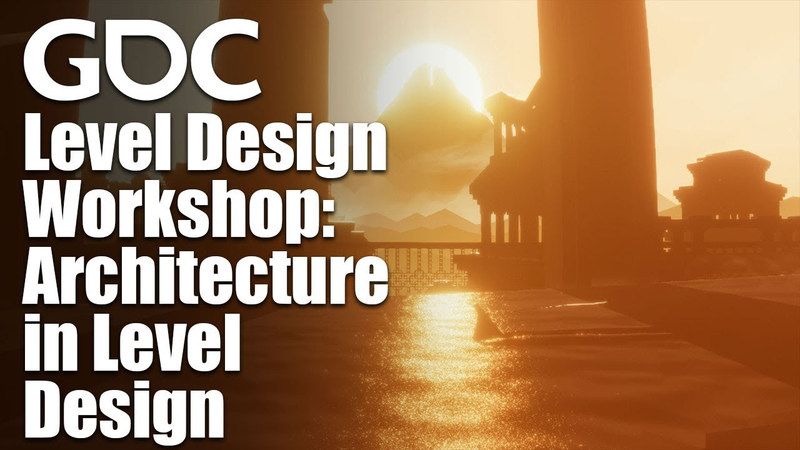
Level Design Workshop: Architecture in Level Design
The application of architectural principles to level design serves as a powerful tool for establishing mood, guiding player behavior, and creating cohesive game environments.
- Architectural consistency in structural layout, materials, and massing is more critical for player immersion than achieving photorealism.
- Designers should establish a 'party'—a fundamental organizational logic—to ensure that circulation, massing, and materials create a unified atmosphere.
- Spatial geometry should be used to intuitively guide player behavior and navigation, reducing the need for explicit signposting or decorative detail.
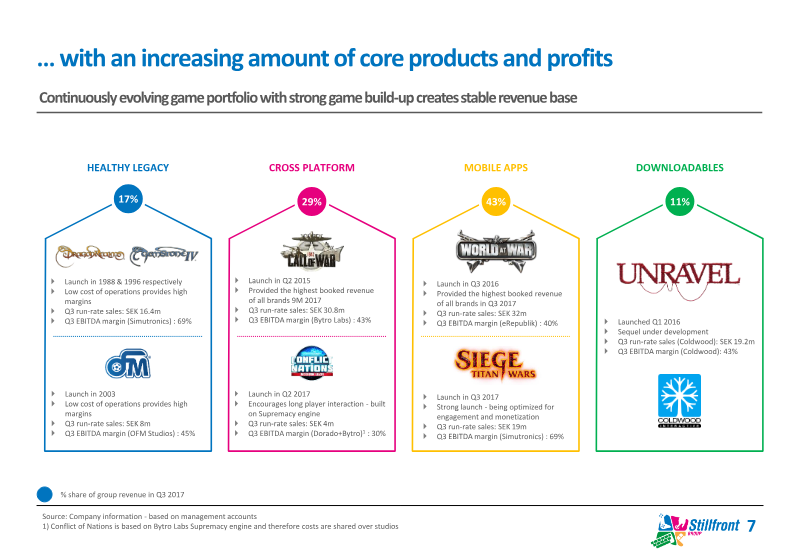


Stillfront Group Q3 Report: 2017
Stillfront Group's Q3 2017 report outlines its strategy to become a leading group of independent game studios, emphasizing a low-risk segment of the gaming industry through diversification and strategic acquisitions.
- Stillfront Group achieved 45.4 million SEK in net revenue for Q3 2017, maintaining a consistent 22–24% quarter-over-quarter growth rate for three consecutive quarters.
- The company reported a rolling 12-month revenue of 137.3 million SEK and an EBITDA of 43.7 million SEK.
- The portfolio of core products grew by 275% over the 16-month period preceding Q3 2017, driven by the acquisitions of eRepublik Labs and OFM.
Writers
Games and companies
Games